




TriStar Gold's 1.4Moz Gold Asset Trading at 80-90% Discount as Brazil Permit Ruling Nears


TriStar Gold's Castelo de Sonhos trades at an 80% peer discount despite a US$603M NPV, as a federal court ruling nears on its permit.
- TriStar Gold's Castelo de Sonhos project holds 1.4 million ounces of probable reserves and generates a $603 million post-tax net present value at a 40% IRR, using the PFS base case of $2,200 gold, against a market capitalisation of just C$63.6 million.
- The company trades at roughly $10 per ounce of resource and 0.02x price-to-net-asset-value, compared with peer medians of approximately $94/oz and 0.3x.
- TriStar's Licença Prévia environmental permit remains valid and unsuspended, having survived every injunction request filed against it, with the underlying civil action now in an evidentiary phase awaiting a federal judge's ruling.
- CEO Nick Appleyard has set a target of reaching a negotiated resolution before the end of 2026, alongside a new drill programme around the high-grade Esperança South zone expected to mobilise around October.
- TriStar maintains an active data room with roughly half a dozen regional candidates and international parties, though management has said it will not consider an offer carrying only a 20-25% premium to the current share price.
Brazil has quietly become one of the more active gold development jurisdictions in the Americas, with G Mining Ventures' Tocantinzinho, Hochschild's Mara Rosa, Ero Copper's Tucumã and Aura Minerals' Almas and Borborema all reaching commercial production over the past two years. TriStar Gold (TSXV:TSG)'s Castelo de Sonhos project, in the same Pará State region, has the reserve base and project economics to join that list, but a two-year legal dispute over indigenous consultation has left the stock trading at what CEO Nick Appleyard describes as one of the steepest discounts in the sector.
Project Overview and Economics
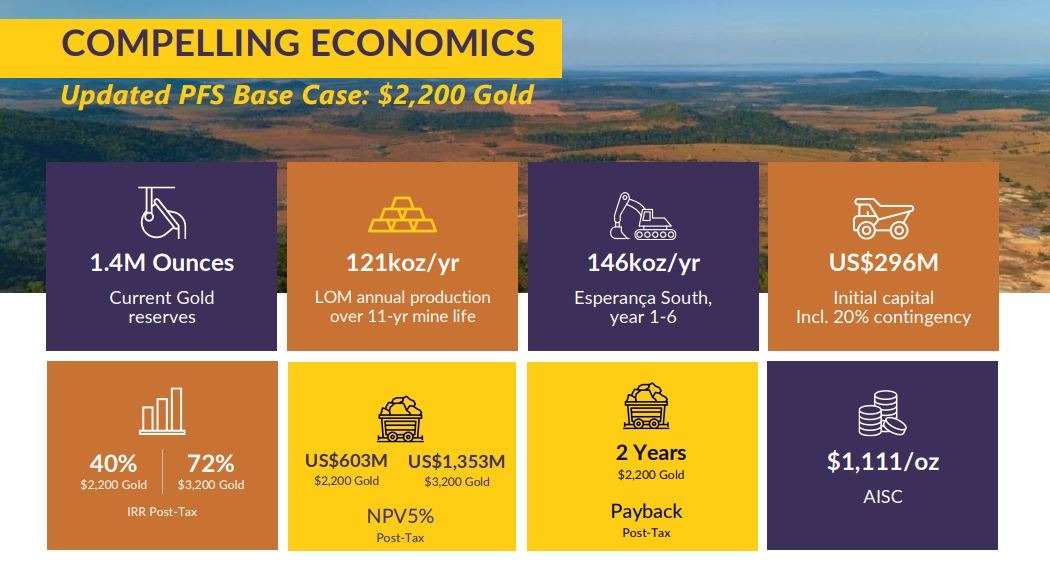
Castelo de Sonhos is a 100%-owned, gold-only paleoplacer deposit spanning roughly 19km of mineralised conglomerate reef across three zones: Esperança South, East and Center. The May 2025 pre-feasibility study (PFS) update outlines 1.4 million ounces of probable reserves (38.7Mt at 1.1 g/t gold), with a further 1.8 million ounces indicated and 0.7 million ounces inferred inclusive of reserves. At the study's $2,200/oz base case, the project delivers a post-tax internal rate of return (IRR) of 40% and a post-tax net present value (NPV5%) of $603 million, against initial capital of roughly $296 million. Payback is estimated at two years, with all-in sustaining costs of $1,111/oz and average annual production of 121,000 ounces over an 11-year mine life rising to 146,000 ounces a year across the higher-grade first six years at Esperança South. At $3,200/oz gold, post-tax NPV5% climbs to $1,353 million and IRR to 72%.
The Regulatory Overhang
TriStar received its main environmental permit - the Licença Prévia (LP) - from Pará State regulator SEMAS after a roughly two-year permitting process. Within weeks, federal prosecutors (the MPF) and Brazil's National Foundation of Indigenous Peoples (FUNAI) challenged the state-level approval, arguing the project should have undergone federal-level permitting that includes an Indigenous Component Study and formal consultation with the Kayapó communities of the Baú and Menkragnoti territories. That dispute escalated last year into a civil action naming both the State of Pará and TriStar as co-defendants.
Appleyard's position is that Castelo de Sonhos never triggered the thresholds that would move a project from state to federal jurisdiction, and that the indigenous territories in question sit well outside any plausible impact zone. The company has said it is willing to conduct the disputed indigenous studies voluntarily - and complete them before production begins - provided its existing permit stands. The LP itself has not been suspended: courts have rejected every injunction request against it to date, and the case is now in an evidentiary phase, with all parties having filed their submissions to the court and a ruling from the judge pending.
A Peer Valuation Gap
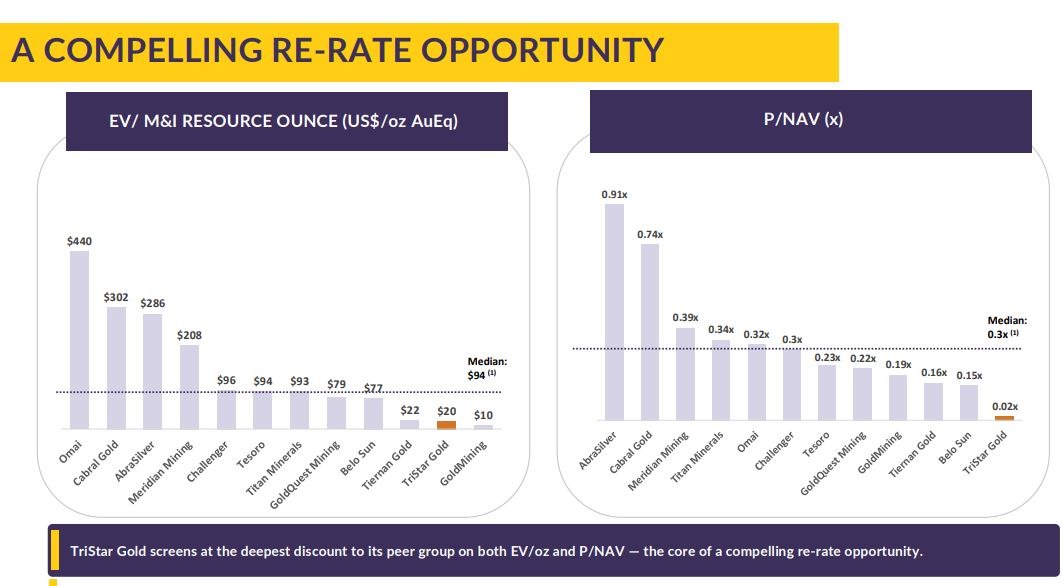
The scale of the discount is the crux of the investment case. Company disclosure comparing TriStar against a group of Brazil- and Americas-focused development peers shows TriStar trading at roughly $20 per ounce of measured-and-indicated resource against a peer median of $94/oz, and at 0.02x price-to-net-asset-value against a peer median of 0.3x - the steepest discount on both metrics in the comparison set. Market capitalisation stood at C$63.6 million as of end-July 2026, against a post-tax NPV5% of US$603 million at the PFS base case.
Appleyard attributes the gap almost entirely to the legal overhang rather than the underlying project economics. He also pointed to an unusually quiet newsflow period, roughly two years spent in permitting followed immediately by the lawsuit, as compounding the market's inattention to the story.
Path to Resolution and Near-Term Catalysts
Appleyard's stated target is a negotiated resolution before year-end 2026: a settlement in which TriStar retains its existing permit while committing to complete indigenous studies ahead of construction. He expects the market to take three to six months to fully reflect any resolution once it lands, contingent on the company demonstrating renewed activity - starting with a drill programme aimed at extending the high-grade zones around Esperança South, expected to mobilise around October, ahead of a feasibility study. The company has also increased its marketing budget and the CEO's own time allocation to investor outreach for the second half of 2026 and first half of 2027.
Interview with Nick Appleyard, CEO, TriStar Gold
Funding and M&A Optionality
TriStar holds approximately $10 million in cash against 397.5 million shares issued (475.1 million fully diluted). Appleyard argues that a re-rate would materially ease financing for the roughly $20-30 million feasibility study still required:
"It will easily allow us to raise money to complete a feasibility study that is still required. If our market cap can go from the current $50 million to $150-200 million, raising $30 million is easy."
Beyond self-funding, TriStar maintains an active data room with several Brazil-based candidates the CEO expects would be interested in the asset once the legal cloud clears, alongside international parties. Appleyard was explicit that a modest premium would not clear the board's bar: any offer at a 20-25% premium to the current share price won't even get considered. He has previously pointed to G Mining Ventures' trajectory with Tocantinzinho from a comparable development stage to commercial gold production in 2024 as one possible template for Castelo de Sonhos.
The Investment Thesis for TriStar Gold
- Castelo de Sonhos carries 1.4Moz of probable reserves and a post-tax NPV5% of $603 million at $2,200 gold - several multiples of TriStar's C$63.6 million market capitalisation.
- The company trades at 80-90% discount to peer median on EV/oz ($20 vs $94) and P/NAV (0.02x vs 0.3x), a gap management attributes almost entirely to the legal dispute rather than project quality.
- The Licença Prévia environmental permit remains valid and unsuspended; courts have rejected every injunction request against it to date.
- The case is in an evidentiary phase awaiting a federal judge's ruling, with management targeting a negotiated resolution before the end of 2026.
- A planned drill programme around Esperança South, mobilising around October 2026, is intended to support an eventual feasibility study and renewed newsflow.
- An active data room with regional and international parties provides M&A optionality once the legal overhang clears; management has signalled it will not entertain a modest premium offer.
- Key watch-items: the court's ruling on the evidentiary request, drill results from the Esperança South programme, and any update on financing for the feasibility study.
Macro Thematic Analysis: Brazil's Gold Development Pipeline
TriStar's story sits inside a broader Brazilian gold development wave. G Mining Ventures' Tocantinzinho, Hochschild's Mara Rosa, Ero Copper's Tucumã and Aura Minerals' Almas and Borborema have all reached commercial production in Pará, Goiás, Tocantins and Rio Grande do Norte since 2023 - evidence that Brazil's permitting environment, while capable of producing exactly the kind of dispute TriStar now faces, has repeatedly proven navigable for gold developers with the right jurisdictional and community relationships.
Gold's move above $4,000/oz through 2026 has sharpened the incentive for both developers and acquirers to bring new supply into production, and Brazil's combination of infrastructure, grade and relatively low operating costs has made it a magnet for that capital. For a project the scale of Castelo de Sonhos, a resolved permitting picture would likely draw interest from precisely the peer group TriStar is currently discounted against - a dynamic Appleyard is explicitly counting on. "I think people will then start to get the confidence and go, 'Okay, well, let's think of where G Mining were with TZ four or five years ago and look at TriStar now,'" he said, framing the company's own re-rate case around a template the market has already priced correctly once in the same jurisdiction.
TL;DR
TriStar Gold's Castelo de Sonhos project in Brazil holds 1.4Moz of gold reserves and a $603M post-tax NPV, but trades at 80-90% discount to peers because of a federal court dispute over indigenous consultation. The company's permit remains valid and courts have rejected every injunction request. CEO Nick Appleyard is targeting a negotiated resolution before year-end 2026, alongside a new drill programme around Esperança South. An active M&A data room with regional and international parties adds optionality once the legal cloud clears, though financing the roughly $296M build remains the larger longer-term question.
FAQs (AI Generated)
Analyst's Notes





Subscribe to Our Channel


.jpg)


.jpg)


Stay Informed






















