Uranium’s $9 Term Premium Signals a Deficit: Multi-Year Shift or Temporary Squeeze?



Uranium’s $9 term premium signals tighter long-term supply as reactor growth, permitting delays, and production constraints test a multi-year deficit.
- TradeTech's long-term uranium price indicator sits near $97 per pound against spot near $88 per pound as of August 2026, leaving multi-year contract pricing roughly $9 above spot.
- Kazatomprom held 2026 production guidance near 27,500 to 29,000 tonnes despite Q2 output running 4% to 5% above internal expectations, while a July sulfuric acid outage suspended Cigar Lake mining in Canada.
- A 20-year federal license renewal at Dewey Burdock and DISA testing that cut Tony M leach time from more than 20 hours to 2 hours show US supply projects advancing, but new pounds still require permitting and development.
- Atomic Eagle's March 25, 2026 corporate presentation showed A$3.12 per pound of Measured and Indicated resource versus A$6.56 for Deep Yellow and A$4.80 for Bannerman, despite Atomic Eagle's higher 359 ppm uranium oxide grade.
- China's eight approved reactors and India's target of five new reactors within six to seven years add long-term uranium demand, while a pending US-Saudi civil nuclear agreement could add another consuming market before new mines can be permitted and built.
$9 Term Premium & Thin Spot Trading Strengthen Uranium Mine Economics
TradeTech recorded only one 100,000-pound spot trade in the week of August 11 to 18, 2026, and the transaction lifted its weekly spot price indicator by $1 per pound to roughly $87.75.
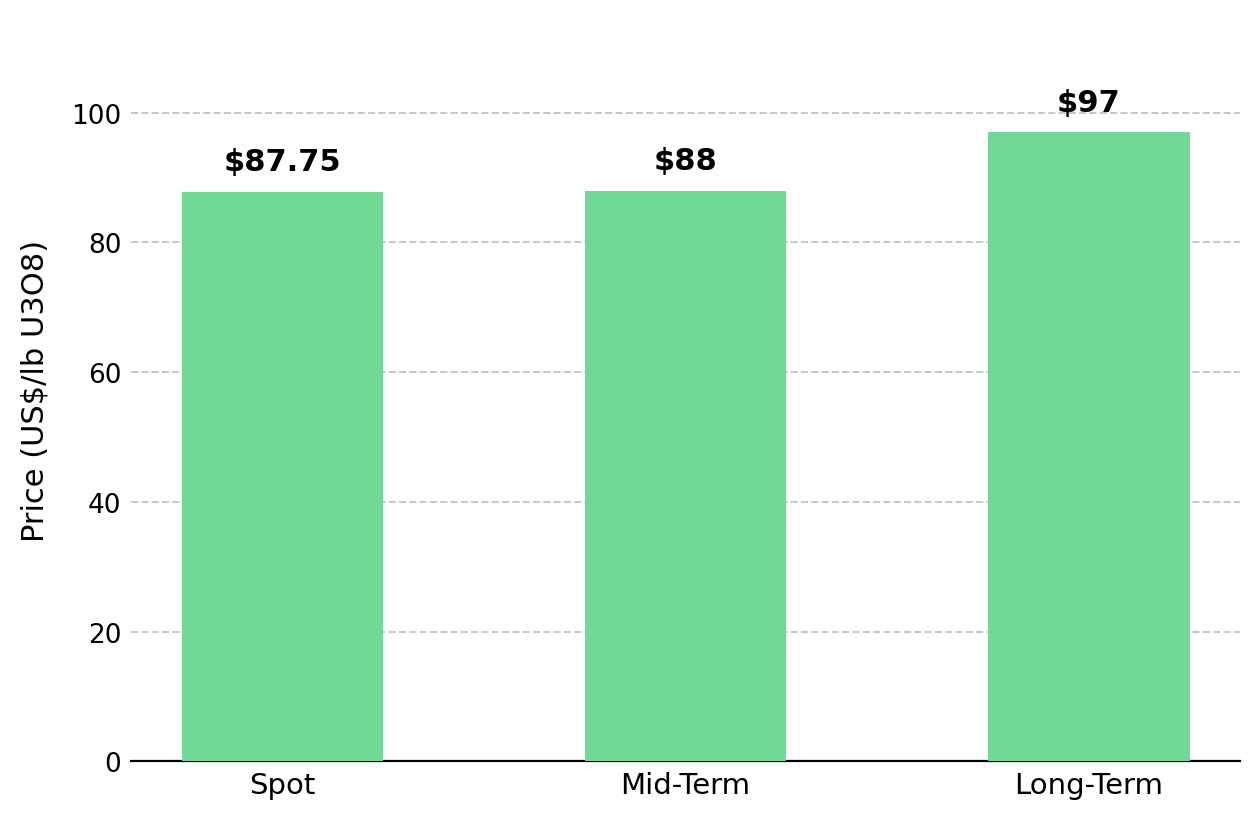
TradeTech's August 2026 mid-term price indicator stood at $88 per pound and its long-term indicator at $97 per pound, leaving the long-term price roughly $9 above spot. Term contracts lock utility deliveries 5 to 10 years out, while the spot market primarily serves shorter-term demand. Because multi-year contract pricing feeds into realized producer prices and project economics, the roughly $9 long-term premium carries more weight for mine economics than a single weak spot print.
From 2011 to 2016, uranium term prices remained above spot while both declined, showing that a term premium alone does not guarantee higher spot prices when secondary supply covers near-term demand. The current roughly $9 premium therefore supports a tighter long-term contracting market, but does not by itself imply that spot prices will rise.
Delayed Utility Contracting & Higher Term Prices Support 2030 Uranium Projects
Utilities can temporarily meet reactor demand through secondary inventories and delayed long-term contracts, but below-replacement contracting pushes unmet purchases into future years. Cameco’s August 5, 2026 earnings release showed annual deliveries above 28 million pounds over five years and 2026 realized-price guidance of $91 to $96 per pound, roughly $3 to $8 above spot. That premium supports stronger contract economics and can improve offtake and financing prospects for developers targeting production around 2030.
Phil Hoskins, Chief Executive Officer of Atomic Eagle, a development-stage company advancing its Muntanga uranium project in Zambia, describes what he expects utilities and strategic financiers to be competing for once the project reaches production:
"If you've got credible near-term pounds in a very stable jurisdiction like Zambia, and you're able to bring it on in that circa 2030, 2031 time frame, when we come to have offtake and financing discussions with the same set of strategic investors, we think it will be a very tight market to do so."
Supply Constraints & Permitting Delays Keep Uranium Output Slow to Respond
Kazatomprom's production discipline and Cigar Lake's sulfuric acid constraint show how operating decisions and processing inputs can limit primary uranium supply.
Sulfuric Acid Constraints Cap Uranium Output Despite Available Ore
Kazatomprom maintained 2026 production guidance of roughly 27,500 to 29,000 tonnes of uranium despite second-quarter output running about 4% to 5% above its internal plan, limiting how much stronger near-term production translates into higher full-year supply. In Canada, Cameco temporarily suspended mining at Cigar Lake in July 2026 after a sulfuric acid plant outage at Orano's McClean Lake mill disrupted processing of Cigar Lake ore. Because sulfuric acid is a key reagent in uranium processing, an outage affecting its supply can interrupt production even when the underlying ore remains available. The Cigar Lake suspension shows that processing-input disruptions can remove uranium supply independently of mine geology or spot prices.
US Permitting Delays Keep Uranium Supply Behind Higher Term Prices
enCore Energy secured a 20-year renewal of its Nuclear Regulatory Commission Source Materials License for the Dewey Burdock in-situ recovery project in South Dakota, completing federal permitting under the FAST-41 infrastructure review process. State-level permitting in South Dakota remains outstanding, with no disclosed completion date. With state permits still outstanding after federal approval, Dewey Burdock shows that higher uranium prices cannot translate immediately into new US mine supply.
Low-Cost US Uranium Margins Fund Expansion Beyond Core Production
Energy Fuels reported a weighted-average production cost of approximately $23 per pound from its Pinyon Plain production run, leaving a roughly $65 to $74 per pound spread against the current $88 to $97 spot-to-term uranium price range. Alongside those uranium margins, Energy Fuels is pursuing a $104 million Phase 1B expansion at the White Mesa Mill and a proposed $1.9 billion acquisition of Vacuumschmelze to expand its rare earth and magnet businesses. The roughly $65 to $74 per pound spread between reported production cost and current uranium pricing strengthens Energy Fuels’ operating economics as it commits capital to businesses outside uranium.
Mark Chalmers, Chief Executive Officer of Energy Fuels, frames the uranium segment as the funding engine behind that broader platform:
"Uranium is now. We'll give guidance up to two and a half million pounds, and that's greater than anybody else in the United States. Really good cost structures, and prices are firming."
Higher Term Prices & Company Fundamentals Shape Uranium Equity Repricing
Production-stage companies can convert current uranium prices into realized revenue, while earlier-stage companies depend on equity-market repricing before higher term prices are reflected in their valuations. For development and exploration-stage companies, balance-sheet runway determines whether they can wait for that repricing or must raise equity at a weak share price, increasing dilution risk.
24-Month Exploration Runway & Weak Uranium Equities Reduce Dilution Risk
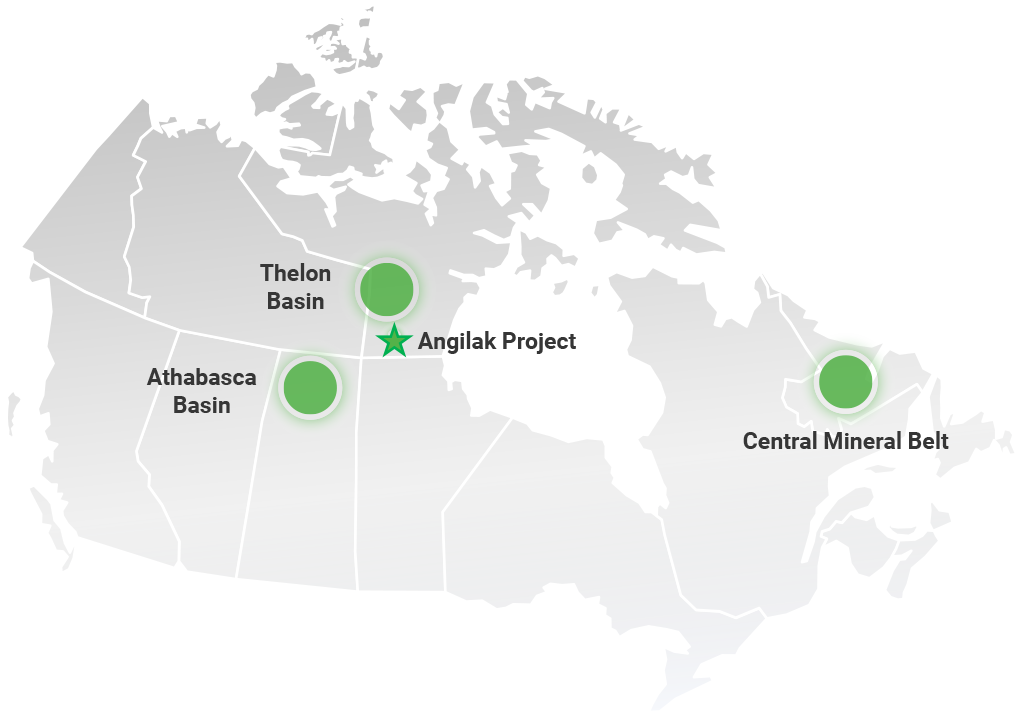
ATHA Energy, an exploration-stage company advancing the Angikuni Basin uranium project in Nunavut, raised $63 million in the first quarter of 2026, providing roughly 24 months of exploration funding and reducing its near-term need for additional equity. That 24-month runway allows ATHA to advance exploration without raising equity at a weak share price, reducing near-term dilution risk if uranium equities remain under pressure.
Peer Valuation Discount & Higher Uranium Grade Create a Repricing Test
Atomic Eagle, the same Zambia-focused developer referenced above, traded at A$3.12 per pound of Measured and Indicated resource as of its March 25, 2026 corporate presentation, against A$6.56 per pound for Deep Yellow and A$4.80 per pound for Bannerman, two regional peers. That gap exists despite a higher Measured and Indicated grade of 359 parts per million uranium oxide, against 285 parts per million for Deep Yellow and 223 parts per million for Bannerman. A grade-adjusted valuation discount that predates a company's latest exploration results is a testable, falsifiable data point rather than a subjective read on sentiment.
US Uranium Supply Gap & Processing Gains Support New Domestic Capacity
IsoEnergy is pairing its permitted Utah uranium portfolio with DISA Uranium, backed by a US$105 million private placement and implying a pro forma equity value near US$505 million. At Tony M, testing increased grade from 3,500 to 14,087 parts per million, achieved 88% recovery, and cut leach time from more than 20 hours to 2 hours. If replicated at commercial scale, those gains could improve project economics and support production from permitted US assets.
Philip Williams, Chief Executive Officer of IsoEnergy, frames the underlying US production gap:
"What you have in the United States is a massive disconnect between the domestic requirements and domestic production, and the gap is not going to be filled by just one processing facility… new processing facility is required."
Political Supply Risk & Reactor Expansion Widen Uranium’s Timing Gap
Niger shows how political control over producing assets can restrict access to uranium even after it has been mined. Niger’s dispute with Orano over the nationalized Somaïr mine includes a contested 156.231-tonne pre-nationalization uranium stockpile and an ICSID tribunal ruling restricting third-party transfers of Somaïr-produced uranium, showing that political and legal disputes can keep already-mined supply from reaching the market.
New reactor programs in China, India, and potentially Saudi Arabia could add uranium demand over several years, while new mine supply requires permitting, financing, and construction before it can respond. China’s State Council approved eight new reactors representing roughly $25 billion in investment in 2026, adding future uranium requirements as those units move toward operation.
India’s SHANTI Act is opening nuclear development to private capital, while Prime Minister Modi’s August 15, 2026 Independence Day address targeted five new reactors within six to seven years, adding another source of future uranium demand if those projects advance. A US-Saudi civil nuclear cooperation agreement signed July 22, 2026 is undergoing a 90-day congressional review, a step that could enable Saudi nuclear development and create another long-term uranium-consuming market. Together, these initiatives could add uranium requirements over the coming decade before new mine supply can be permitted, financed, and built.
Slow Uranium Supply Response & Rising Demand Put the Deficit Thesis to the Test
A background variable worth naming without overstating its pull on physical fundamentals is the Fed's Jackson Hole symposium, scheduled for August 27 to 29, 2026. Real rates affect financing costs for capital-intensive mine restarts and the opportunity cost of holding non-yielding physical uranium inventory in vehicles such as Sprott's physical trust and Yellow Cake, a secondary channel rather than the primary driver of the deficit thesis.
The supply evidence in this article shows that higher uranium prices cannot quickly translate into additional mine output. Sulfuric acid constraints in Kazakhstan and Canada and multi-stage US permitting requirements show why primary uranium supply can take years to respond even when prices support new production. Approved reactors in China, India’s five-reactor target, and potential Saudi nuclear development could add uranium requirements over several years while new mines move through permitting, financing, and construction. The key test is whether constrained supply and additional reactor demand sustain the term-price premium long enough for the uranium thesis to translate into producer cash flow and development-stage valuations.
Kazatomprom is targeting release of its interim results on August 21, 2026, providing the next test of whether its 2026 production guidance remains unchanged. Maintaining guidance near 27,500 to 29,000 tonnes would reinforce the case that stronger second-quarter output is not translating into higher full-year supply, while an upward revision would weaken that part of the deficit thesis.
The Investment Thesis for Uranium
- A slow mine-supply response alongside reactor expansion in China, India, and potentially Saudi Arabia could widen the uranium supply-demand gap over the coming decade.
- Low-cost producers gain greater capital flexibility when uranium margins are strong, with the current long-term price near $97 per pound versus spot near $88 supporting spending beyond core uranium operations.
- Political and legal disputes in producing jurisdictions can restrict already-mined uranium from reaching buyers, as the contested Somaïr stockpile in Niger demonstrates.
- Development-stage companies trading below regional peers on a per-pound resource basis offer a measurable repricing case if project de-risking and stronger term pricing narrow that valuation gap.
- Exploration-stage companies with multi-year funding can continue work without raising equity at weak share prices, reducing near-term dilution risk while uranium equities reprice.
- Processing technology that increases grade, maintains high uranium recovery, and shortens leach time could improve project economics if those results translate to commercial-scale operations.
Upcoming production guidance, utility contracting activity, and permitting milestones will provide stronger tests of the uranium thesis than a single spot-price move. Kazatomprom’s August 21 interim results, utility contracting activity through year-end, and US permitting milestones can test whether constrained mine supply and long-term contracting demand continue to support the roughly $9 premium of term pricing over spot. The financial consequence will differ by company stage because producers already realize uranium revenue, while developers and explorers depend more heavily on future financing, project de-risking, and equity-market valuation. Production-stage companies can already convert contracted uranium prices into revenue and cash flow, as Cameco’s 2026 realized-price guidance of $91 to $96 per pound shows against spot near $88. Development and exploration-stage companies could see greater valuation upside if stronger term pricing improves financing conditions, supports offtake negotiations, or narrows documented peer-valuation discounts, but that outcome remains company-specific.
TL;DR
Uranium’s long-term price near $97 per pound sits about $9 above spot, strengthening mine economics even as spot trading remains thin. Supply is slow to respond as Kazakhstan holds production guidance, Cigar Lake faces sulfuric acid constraints, and US projects remain subject to permitting delays. Meanwhile, reactor additions in China, India, and potentially Saudi Arabia could lift long-term demand before new mines are built. Low-cost producers benefit from stronger margins, while funded developers and explorers have greater flexibility to limit dilution and advance projects. Contracting activity, production guidance, and permitting progress will test whether the current imbalance develops into a multi-year deficit or proves temporary.
FAQs (AI-Generated)
Analyst's Notes





Subscribe to Our Channel









Stay Informed