Capital-Structure Moat: Tight Share Count Amplifies Per-Share Leverage at US Gold Corp.


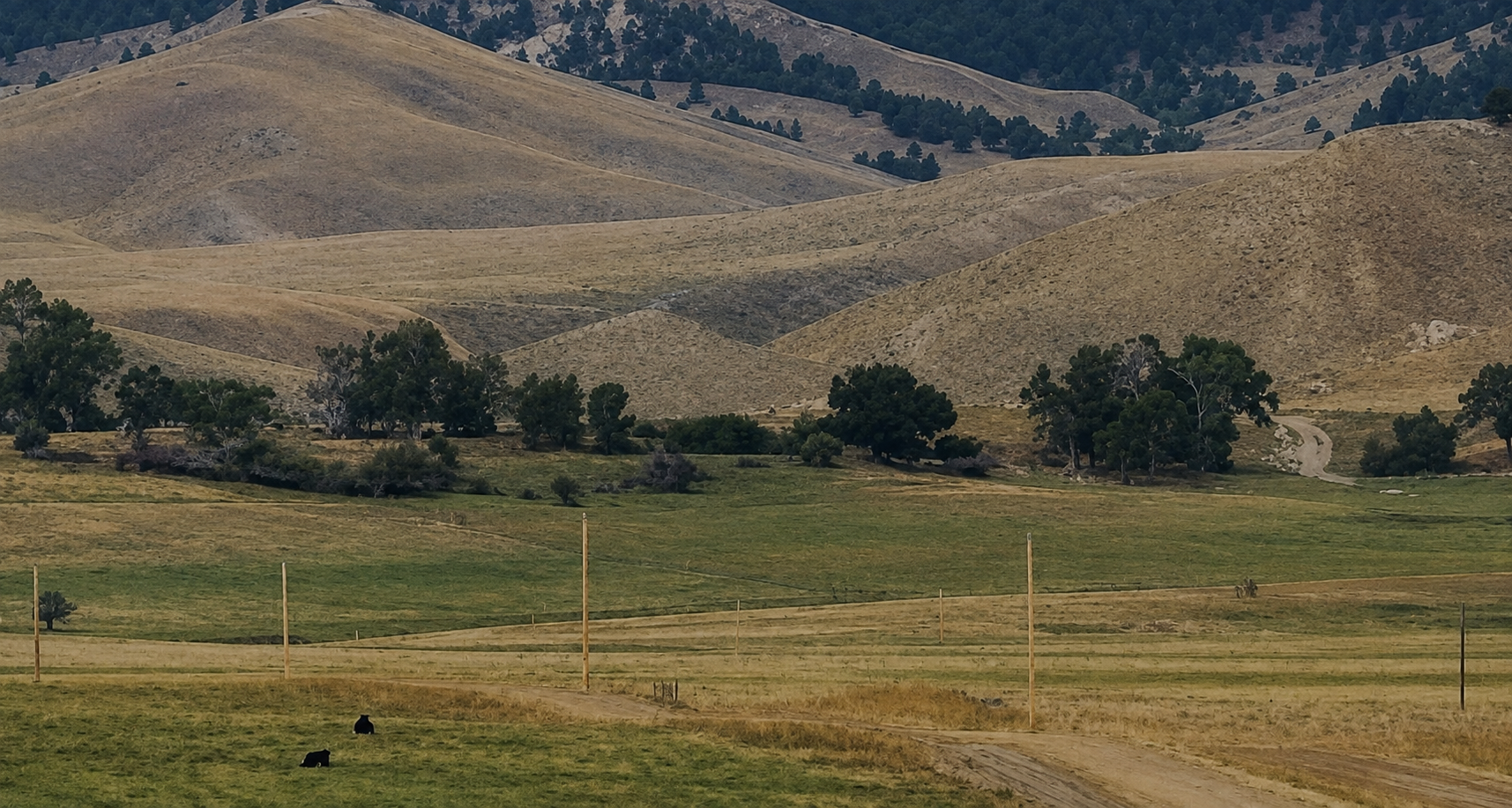
US Gold Corp advances the CK Gold Project in Wyoming with full permitting, dual-track strategic options, non-dilutive funding, and zero federal delays.
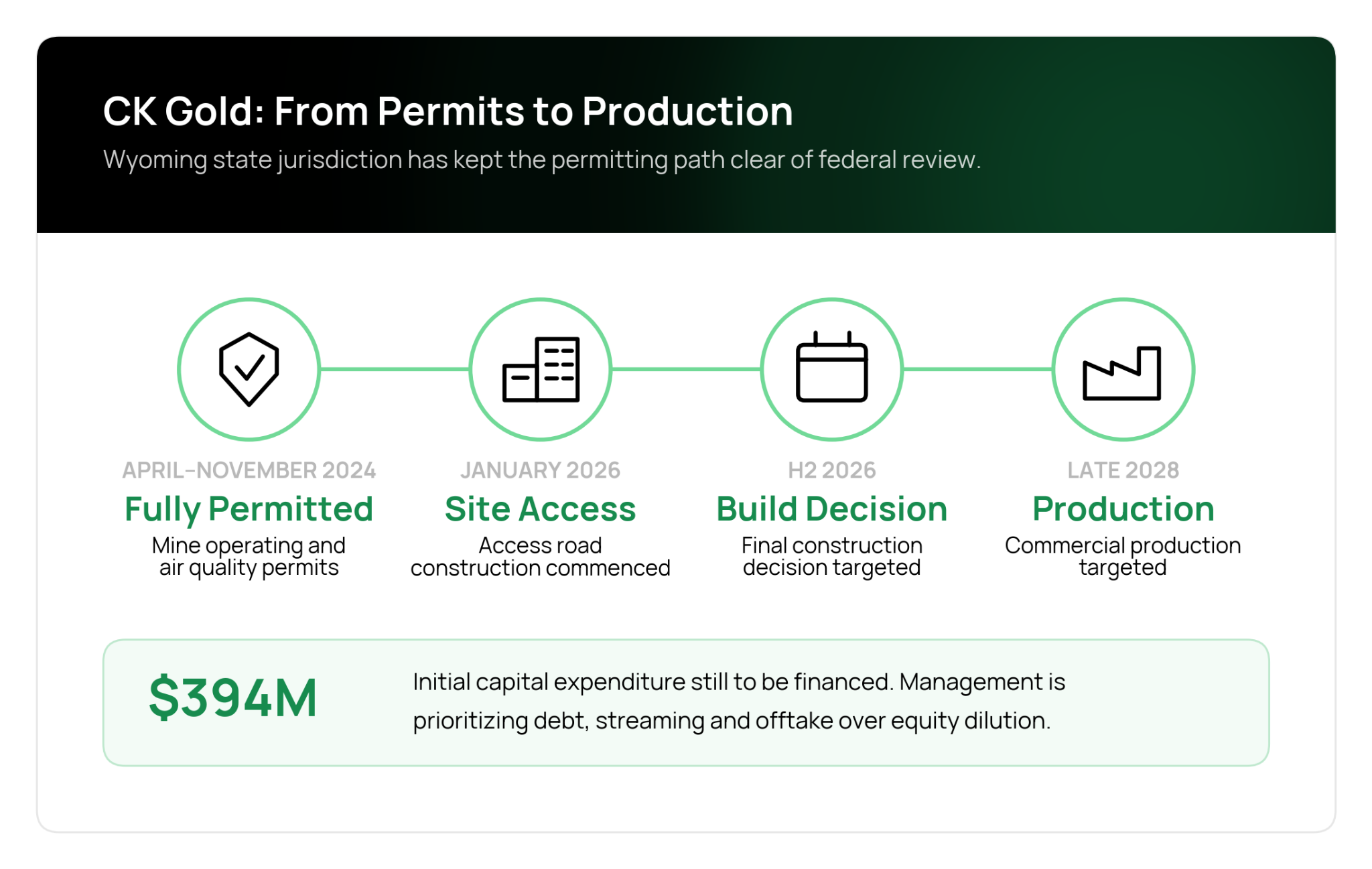
- US Gold Corp. has received full permitting for its CK Gold Project in Wyoming on state-managed land, thereby avoiding federal regulatory delays and enabling the construction of the initial mine access road in January 2026.
- Following its August 20, 2026 update, a Special Committee is evaluating Mergers & Acquisitions, joint-venture (JV), and corporate merger proposals, as well as negotiations for standalone project financing.
- With a tight share base of 16,526,163 common shares, the CK Gold Project yields an after-tax Net Present Value (NPV5%) of $632 million and $1.37 billion.
- Transitioning to production requires an estimated $394 million in initial capital expenditure (CAPEX) to hit a late-2028 commercial production timeline, exposing the company to debt-market, inflation, and execution risks.
- Management is protecting its share count by evaluating a spin-out of the Nevada Keystone Project into a standalone entity, while advancing non-dilutive debt, streaming, and offtake funding options.
What Has Happened
US Gold Corp (NASDAQ: USAU) has successfully transitioned its flagship CK Gold Project in southeast Wyoming from an exploration asset into a fully permitted development project, establishing a regulatory base for near-term mine construction. According to the company's August 20, 2026 corporate update, this permitting milestone has attracted strategic interest from development capital providers and mergers & acquisitions (M&A) counterparties. To address these inquiries, the board of directors has established a Special Committee alongside appointed financial advisors to evaluate joint-venture, asset-level, and corporate merger proposals. The committee is working in parallel to ongoing negotiations with potential project financing partners, establishing a dual-track process that compares strategic corporate options directly against standalone funding packages to secure the most non-dilutive structure. Concurrently, the company is preparing for a final construction decision targeted for the second half of 2026, supported by an approved Industrial Siting Permit that has been extended through December 2027.
Per-Share Leverage of S-K 1300 Project Economics
The technical economics of the development, established by the S-K 1300 Feasibility Study (FS) completed by Halyard-Micon International, Inc. in March 2026, take on heightened significance when mapped against the company's tight share count. Under base-case pricing assumptions of $3,250 per ounce of gold, $4.50 per pound of copper, and $40 per ounce of silver, the study outlines an after-tax net present value (NPV5%) of $632 million, an after-tax internal rate of return (IRR) of 27%, and a 2.5-year payback period. With only 16,526,163 common shares outstanding, the per-share concentration of these cash flows distinguishes the project from peer developers with massive share bases. The reserve footprint contains 1.015 million ounces of gold, 260 million pounds of copper, and 3.031 million ounces of silver, supporting an 11-year open-pit mine life with a processing rate of 20,000 tons per day.
When computed using recent spot commodity prices of approximately $4,500 per ounce of gold and $4.50 per pound of copper, the project's after-tax NPV5% is approximately $1.37 billion. This spot-price sensitivity dramatically amplifies the project's intrinsic per-share value, compressing the payback period to 1.6 years. This extreme mathematical leverage to rising metal prices, combined with a tight capital structure, forms a key pillar of management's valuation thesis.
Despite these robust economics, transitioning from a feasibility model into an operating mine carries inherent execution, financing, and cost-inflation risks. Securing the estimated $394 million in initial capital expenditure (CAPEX) in a competitive debt market is a significant hurdle, as any delay in finalizing terms directly threatens the targeted late-2028 commercial production timeline. Furthermore, industry-wide capital and operating cost inflation risks driving actual construction expenditures beyond the March 2026 FS baseline. Sophisticated investors must also consider strategic process risks, as the Special Committee's review of incoming proposals does not create binding commitments and may not result in a completed transaction.
.png)
Dilution Defense & The Keystone Spin-Out Shield
To finance the estimated $394 million initial capital requirement, management is advancing discussions with traditional debt, streaming, and offtake partners, prioritizing non-dilutive structures over equity dilution. Because management and founders are tightly aligned with equity holders, their primary goal is protecting the per-share value of their current share structure.
To further protect the parent company's tight share count, management is actively evaluating spinning out its Keystone Project in Nevada's Cortez Trend as a standalone exploration entity. The 20-square-mile property sits 11 miles south of Nevada Gold Mines' Cortez Complex, sharing geological features like the Wenban Formation and Carlin-type gold mineralization. This planned transaction is designed as a structural shield, isolating early-stage exploration costs and funding requirements to prevent equity dilution at the parent level. Similarly, the secondary Challis Gold Project in Idaho is an early-stage exploration property with a historical mineral resource of approximately 313,825 ounces of gold at a grade of 1.22 grams per ton, providing exploration optionality without diverting capital from Wyoming.
The CK Gold Project's regulatory profile further insulates it from development risks, as it is located on State of Wyoming land with no direct federal involvement. This jurisdictional advantage enabled the Wyoming Department of Environmental Quality to approve the Mine Operating Permit in April 2024, followed by the air quality permit in November 2024. Physical site construction on the mine access road commenced in January 2026, establishing early site access to the proposed run-of-mine pad under the Industrial Siting Permit. By operating outside federal bureaucratic frameworks, the company has insulated its development footprint from midstream regulatory delays that typically affect public-land operations.
What to Watch Next
The primary near-term catalyst is the conclusion of the Special Committee’s strategic review, which will determine whether the company pursues a corporate transaction, joint venture, or standalone construction. Under the standalone path, the next milestones are a project financing package and a targeted final construction decision in the second half of 2026. A planned drilling program will also test geophysical anomalies beyond the current open-pit reserve shell.
Other developments include final board approval and shareholder ratification for the Keystone spin-out. The company is also evaluating opportunities to improve project economics, including selling waste rock as aggregate and rail ballast at local prices of $20 to $25 per ton, enhancing gold recovery through alternative tailings treatment, and potentially converting the exhausted open pit into a municipal water reservoir.
FAQs (AI-Generated)
Analyst's Notes





Subscribe to Our Channel


.png)





Stay Informed