




ValOre Heads Into Pedra Branca PEA With Under $0.8M as Junior Capital Returns


ValOre Metals targets a Pedra Branca PEA in the fourth quarter of 2026 with under $0.8M cash as returning capital shortens junior mining timelines.
- Discovery Group principal and ValOre Metals Chairman Jim Paterson says capital returning to junior mining lets funded teams plan 2 to 3 years ahead, lowering costs and the cost of capital.
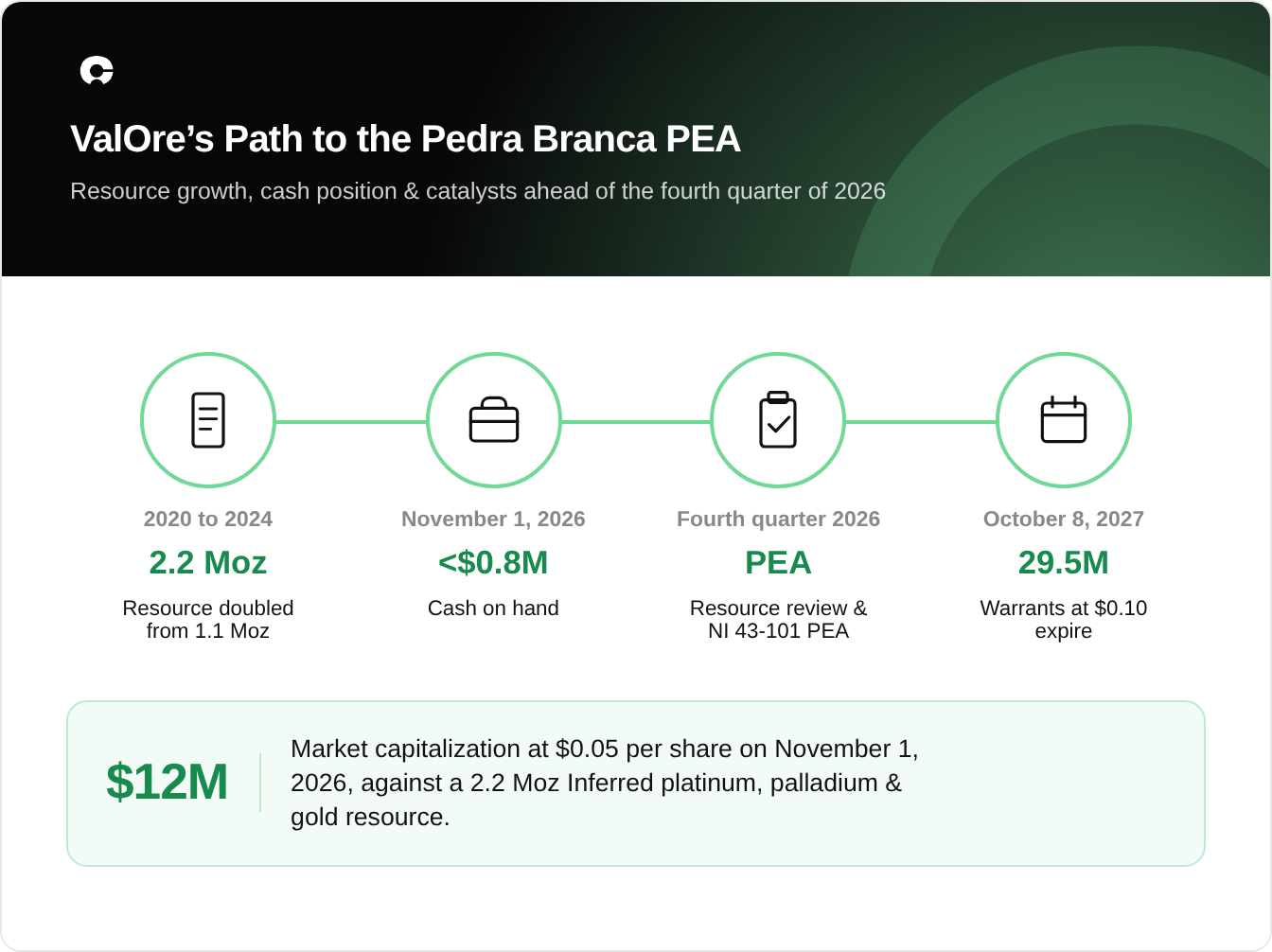
- ValOre is targeting a resource review and an NI 43-101 preliminary economic assessment (PEA) for its Pedra Branca project in Brazil in the fourth quarter of 2026.
- As of November 1, 2026, ValOre held less than $0.8 million in cash, with a $12 million market capitalization at $0.05 per share and 255 million shares outstanding.
- Pedra Branca hosts a 2.2 million ounce inferred platinum, palladium and gold resource across 7 near-surface deposits on an 80 km trend in Ceará State.
- Insiders and advisors hold 20% of ValOre's shares, and resource and mining funds hold 25%, while Paterson argues that executives who buy their own stock focus on per-share value.
What Has Happened
Capital is reaching experienced junior mining teams again, and Jim Paterson, a principal of Discovery Group and Chairman of ValOre Metals Corp. (TSX-V: VO | OTCQB: KVLQF | FSE: KEQ0), described the change at the Beaver Creek conference. In his account, money now arriving in the sector allows funded teams to execute on multi-year plans, and he named Discovery Group members Prospector and K2 as having plenty of capital for next year, with Kodiak fully funded and drilling.
Paterson, who has been in the business since 1997, contrasted that with most of his career:
"For the majority of my career, none of the companies that I was associated with or my friends in the business had enough capital to move fast. They were always waiting to raise money."
ValOre is at a different point in that cycle. Its preliminary economic assessment (PEA) for Pedra Branca is underway and targeted for the fourth quarter of 2026, alongside a review of the Mineral Resource, while cash stood at less than $0.8 million as of November 1, 2026. Paterson describes capital returning to the sector; ValOre still needs new funding to carry Pedra Branca past the PEA.
Why Funded Plans Lower the Cost of Exploration
Paterson's argument is mechanical. Companies with no capital sometimes raise money for a single drill hole to answer 1 question. A company with a 2 to 3 year budget can negotiate with drilling contractors, geophysical contractors and camp providers, and can offer the best people secure employment for 2 years instead of waiting to see how things go after one drill hole.
He also described how underfunding distorts the market's response to results. Good news from a cash-short company sometimes triggered a liquidity event for investors, so instead of a gap up in valuation after a success, the company had to fight the market to raise money and go back to work. Funded teams avoid that cycle because the next program is already paid for.
Paterson linked planning to lower costs:
"It totally benefits shareholders, because if you're planning, your costs are going to be lower, and if you're spending money over 2 years versus over a couple of weeks, obviously, and your cost of capital goes way down."
ValOre's Capital Structure Ahead of the PEA
ValOre had 255 million shares outstanding and 304.4 million fully diluted as of November 1, 2026. Outstanding instruments include 20 million options at $0.12 expiring October 12, 2030, and 29.5 million warrants at $0.10 expiring October 8, 2027. At a $0.05 share price, both are priced above the market, and the 52-week range is $0.045 to $0.160.
ValOre has invested roughly US$10 million at Pedra Branca, funding more than 23,500 m of diamond drilling, AI-assisted targeting through VRIFY, soil geochemistry, trenching and Trado auger drilling. With less than $0.8 million in cash and a $12 million market capitalization, the next stage of engineering, metallurgy and exploration depends on new funding.
ValOre's stated funding routes are access to international capital markets through TSX and B3 listings supported by an experienced board, and ownership interests held by strategic equity partners. As of its November 2026 corporate presentation, ValOre had not disclosed a financing amount or commitment against these routes. Discovery Group, of which Paterson is a principal, has raised more than $1.3 billion in equity across its member companies since its founding in 2002. Its growth plan also covers acquisitions of advanced-stage gold projects in northeastern Brazil, which would add a second claim on whatever capital the company raises.
What the PEA Has to Answer
The PEA covers 6 workstreams: resource review, mine plan, processing flowsheet design, site infrastructure including water and power supply, market studies, and capital cost, operating cost and economic analysis. The whole resource is in the Inferred category, so the PEA will be preliminary in nature, and Inferred resources are considered too speculative geologically to support the economic considerations required for Mineral Reserves.
The study will attach economics to a resource the company doubled from 1.1 million to 2.2 million ounces, including about 250,000 ounces added through Trado-guided exploration. The Salvador discovery is not included in the current resource, and the company has identified more than 20 mineralized targets across the district. ValOre is advancing that resource into a market where the company cites a multi-year platinum and palladium deficit of 500,000 to 700,000 ounces, with South Africa and Russia holding 97.1% of world platinum group metal reserves, according to US Geological Survey data.
Metallurgy is the main technical input. Testwork reported on March 26, 2026, returned 73% platinum and 74% palladium recoveries from weathered material, about 30% of the resource, using bio-pretreatment and cyanide leaching. Fresh material, about 70% of the resource, returned 83% platinum and 71% palladium through conventional flotation, while high-grade chromitite, about 5% of the resource at 5 to 10 grams per tonne, returned 66% platinum and 79% palladium using caustic pretreatment and cyanide leaching. Flotation and leaching testwork continues with the University of Cape Town and Lycopodium South Africa, a low-cost hydrometallurgical process is under evaluation, and test results may not represent commercial-scale performance.
Management Ownership & the Discovery Group Model
Paterson also pointed to alignment between management and shareholders. On getting executives to focus on value per share instead of headline market capitalization, he answered from what he called human behavior:
"The only way is if the CEO, the C-suite are big owners of the stock and they paid for it. That's the only way, but that's rare."
At ValOre, insiders and advisors hold 20% of shares, close associates 10%, resource and mining funds 25%, and retail and other holders 45%. The board brings Discovery Group's deal record: more than $2.6 billion in mergers and acquisitions activity across the group and $1.7 billion in deals driven by ValOre directors, with member company exits to Kinross, Goldcorp, Royal Gold and Coeur Mining.
Paterson brings 28 years of executive leadership. Chief Executive Officer Nick Smart, a chemical engineer, spent 21 years at Anglo American and De Beers on large-scale project design, construction and operation, including nickel in Brazil, and Vice President Exploration Thiago Diniz, P.Geo., is a Brazilian geologist with more than 15 years in exploration and project development in Brazil and Canada.
Broader Context & What to Watch Next
The market backdrop supports the financing effort. On October 12, 2026, platinum traded at US$1,701 per ounce, up 88% since the end of 2024, palladium at US$1,157 and gold at US$4,198, according to ValOre's presentation. Platinum's spot price was also well below its record of about US$2,920 per ounce set on January 26, 2026.
Paterson added a caution about the same cycle. He said capital has not yet overwhelmed the sector, but warned that when generalist money arrives in volume, some of it funds projects that do not deserve to advance, and that a project with difficult metallurgy or a hard location will not work no matter how much money is spent on it. ValOre needs the PEA to show whether the resource, the recoveries achieved by ore type, the infrastructure needs and the capital costs can support an economic development case.
The items to track are the Pedra Branca Mineral Resource review and the NI 43-101 PEA, both targeted for the fourth quarter of 2026, the size and terms of any financing relative to the $0.05 share price, metallurgical optimization results, progress on the 8 km Pitombeiras target, and any acquisition or partnership in northeastern Brazil. Further out, the 29.5 million warrants at $0.10 expire on October 8, 2027.
FAQs (AI-Generated)
Analyst's Notes





Subscribe to Our Channel






Stay Informed


