F3 Uranium Expands PLN Drilling After Strong Radioactivity Beyond JR & Tetra


F3 Uranium adds a second rig after a 4,400 cps step-out 1km east of Tetra. CEO Ross McElroy on assays, 2027 spending, JR scale & share consolidation.
- A step-out hole about 1 km east of the Tetra Zone returned a 4,400 cps peak, the highest handheld reading in an F3 exploration hole on PLN outside the JR and Tetra zones.
- F3 added a second drill rig to follow up the hole and is targeting about 5,500 m to 6,000 m of fall drilling before freeze-up.
- Assays are pending, and CEO Ross McElroy said he is not expecting high grade from counts at that level.
- F3 held about $16.8 million in cash on November 3, 2026, and plans at least $8 million of ground spending in 2027.
- McElroy said the JR Zone needs 2 to 3 times its current scale and could serve as satellite feed for mills planned by nearby producers.
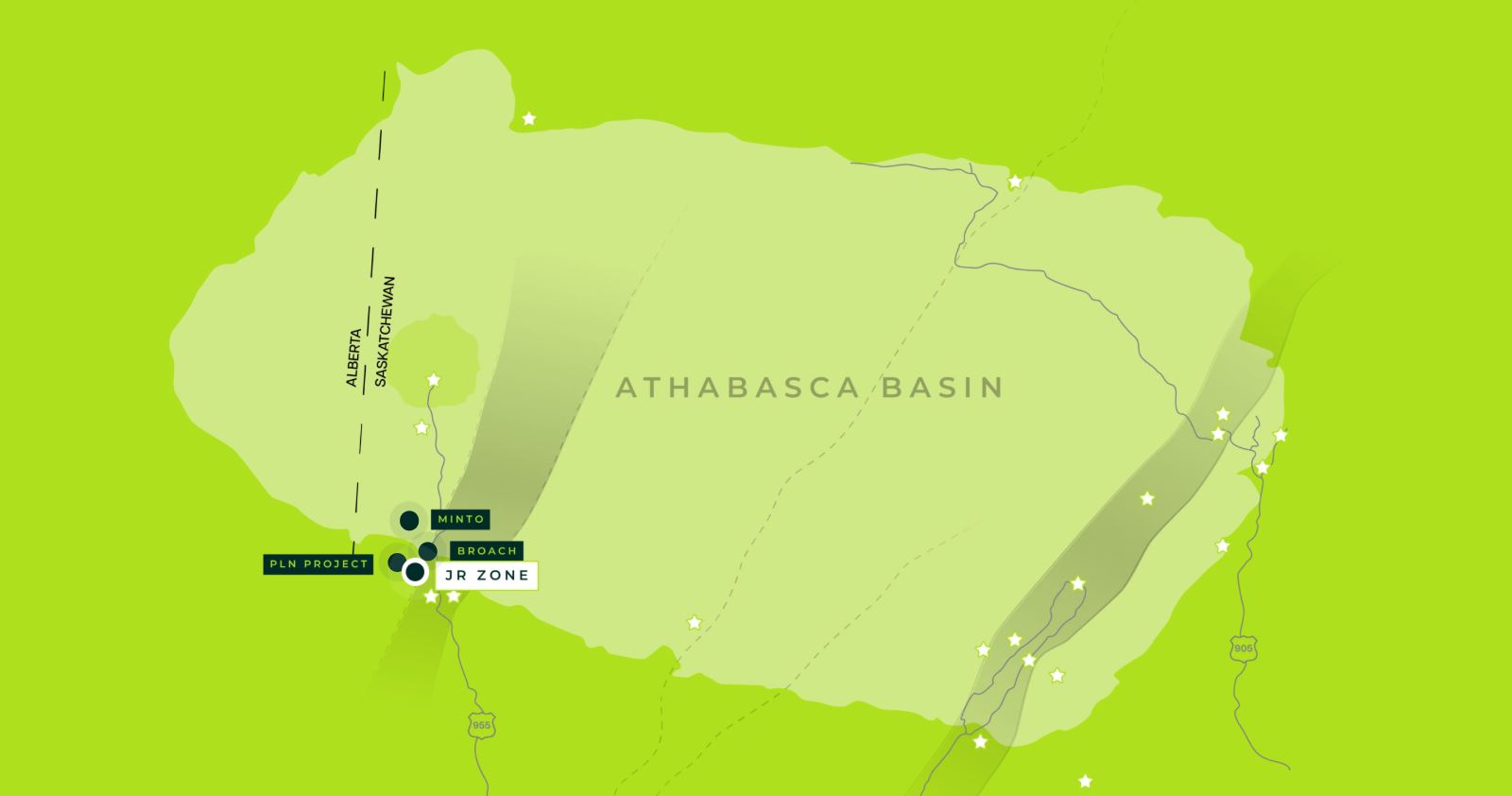
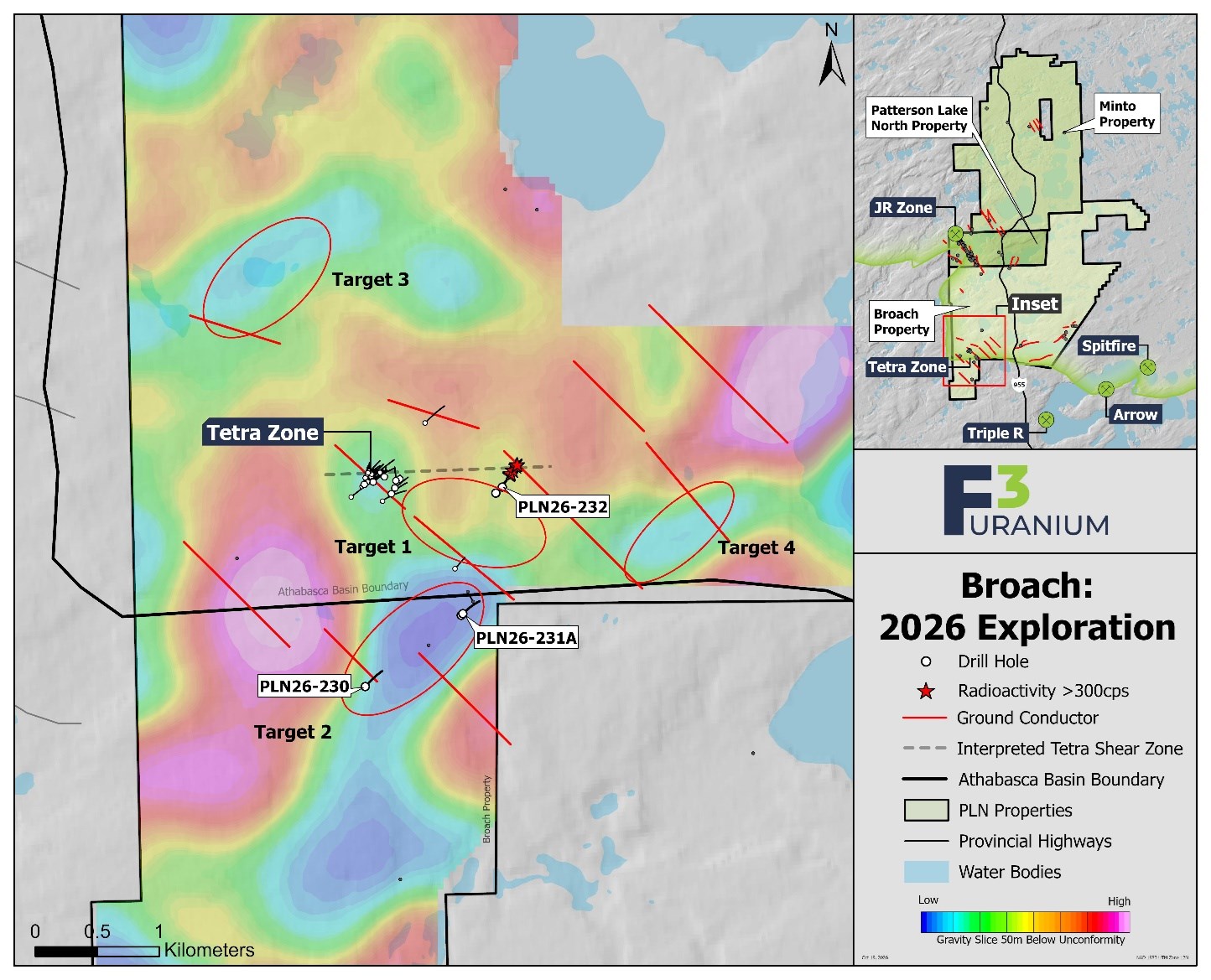
F3 Uranium Corp. (TSXV:FUU) has added a second drill rig at its Patterson Lake North (PLN) Project in Saskatchewan’s western Athabasca Basin. The rig follows a step-out hole about 1 kilometre (km) east of the Tetra Zone discovery that returned the highest handheld radioactivity the company has recorded in an exploration hole on the project outside its JR and Tetra zones. The hole intersected 5 discrete intervals of anomalous radioactivity in strongly altered basement rock, peaking at 4,400 counts per second (cps). Assays are pending.
The company held approximately $16.8 million in cash as of November 2026, against a market capitalization of about $70 million. Director & Chief Executive Officer (CEO) Ross McElroy explained how the second rig will be deployed, how F3 plans to fund a minimum 2027 budget, and how the high-grade JR Zone deposit could fit into a western-basin mill network as nearby producers build out.
A 1 km Step-Out Changes the Drill Plan
The new hole followed an earlier step-out drilled almost 1 km east of Tetra, where McElroy said the basement alteration and the unconformity looked encouraging. F3 then drilled up-dip of that hole. The follow-up encountered the same degree of alteration and structural preparation and, for the first time in that area, anomalous radioactivity. The 5 intervals each measured 0.5 metres (m) to 1.0 m between 352.0 m and 649.5 m downhole, with the 4,400 cps peak recorded from 610.5 m to 611.0 m.
Two other holes completed in the same programme, located about 1.3 km southeast and 1.6 km south of Tetra, tested modelled electromagnetic conductors and gravity-low anomalies. Both encountered strong alteration near the unconformity but no radioactivity above 300 cps.
The second rig will stay on the new area until the season closes for freeze-up in December, while the first rig moves to the regional targets F3 had always planned to test. McElroy said the summer and fall programme started with about 4,000 m in roughly half a dozen holes. F3 is now targeting about 5,500 m to 6,000 m before the December shutdown, with crews back on the property by mid-January.
Reading 4,400 cps Before the Assays
McElroy said he is not expecting high grade from counts at that level. He offered a loose estimate of something in the area of 0.25% uranium oxide and said the lab results will settle it. F3’s release cautions that handheld spectrometer readings are preliminary and are not directly or consistently correlated with assay grades. The company classes readings above 300 cps as anomalous and readings above 10,000 cps as highly radioactive. For scale, the Tetra discovery hole in April 2025 recorded a peak of 37,700 cps and returned 22.5 m at 0.26% uranium oxide, including 1.0 m at 2.50%.
The new radioactivity follows a quieter winter. The approximately 3,350 m winter 2026 programme, which tested Tetra extensions along strike and down plunge, returned one reportable interval of 0.5 m at 0.06% uranium oxide, and no other hole met the reporting criteria.
CEO of F3 Uranium, Ross McElroy, said the company has not yet established the geometry of the new zone:
“Now I guess the plan would be to continue testing up dip or around there and see if radioactivity increases or what direction we might find more radioactivity. Which way is the actual control? That can only be determined by the drill bit.”
He tied further spending in the area to hole-by-hole improvement. If drilling around the new hole stops improving, the rigs move to a different target. The results will also shape the design of the 2027 drill programme.
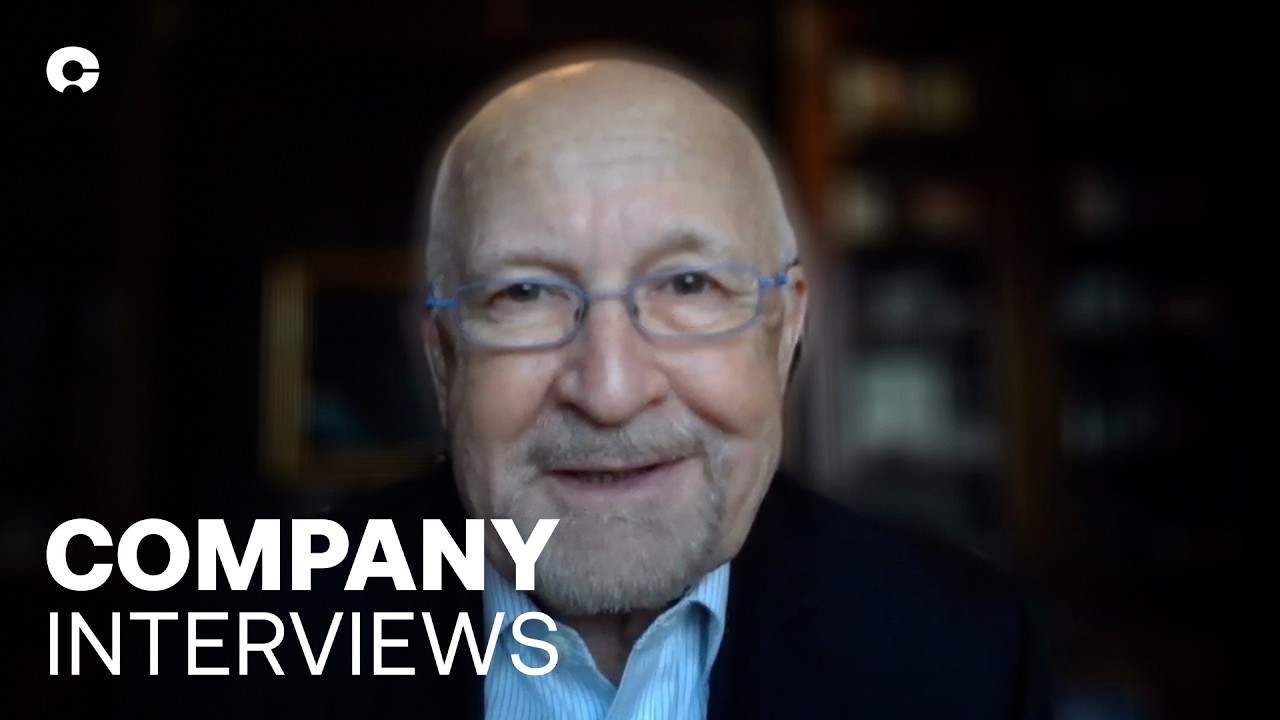
Interview with Ross McElroy, Director & CEO of F3 Uranium
An East-West Corridor Comes Into Focus
McElroy expects any mineralization in the new area to be a separate occurrence from Tetra, related through the broader corridor but not physically linked. F3 has drilled about 20 holes into Tetra, which has an interpreted mineralized plunge length of 135 m. Tetra lies near the apex where north-south and east-west trends appear to converge.
When F3 began drilling Tetra, its conductors pointed to north-south controls, but the mineralization proved to run east-west. Farther east in the Broach area, the conductors also run east-west, and McElroy said the more encouraging signs so far follow that direction. The company’s release describes an interpreted mineralized trend that could strike east-northeast from Tetra.
McElroy described about 4 parallel east-west conductive corridors in the district, including the Patterson Lake South (PLS) corridor that hosts Paladin Energy’s Triple R deposit and NexGen Energy’s Arrow deposit. The northernmost is the Carter corridor, which hosts a known occurrence called Lightning outside F3’s ground. McElroy said he believes Lightning may belong to the same Carter trend.
Funding the Programme & the 2027 Budget
F3 raised flow-through funds that must be spent before the end of 2027. McElroy said the company is looking at a minimum of about $8 million of spending on the ground in 2027. He acknowledged a disconnect between the uranium market and uranium equities, and said F3 is balancing 2 goals: avoiding a raise at an inopportune time and staying active enough to make discoveries.
The other fixed commitment is the Denison Mines convertible debenture. Denison invested $15 million in 2023 through debentures carrying a 9% coupon payable quarterly over a 5-year term, convertible at Denison’s option at $0.56 per share. McElroy said he believes the debenture falls due in 2028, with interest payments continuing through 2027. F3 has the option to pay part of the interest in shares, and McElroy said he expects to keep paying about 1/3 in shares and 2/3 in cash.
JR Scale, Satellite Feed & the Share Structure
The JR Zone holds an Indicated resource of 11.8 million pounds (Mlb) at 4.41% uranium oxide, including a high-grade domain of 10.8 Mlb at 12.23%. McElroy said the deposit’s grade and basement-hosted setting are strengths, but the project needs something about 2 to 3 times JR’s size. His benchmark is a total in the order of 30 Mlb or more across PLN, whether from growth near JR or from a new discrete discovery such as the area F3 is testing now.
He sees a route for JR as satellite feed. McElroy said NexGen is on the way to production in 2030 or 2031, with Paladin not far behind at Triple R, and that each is expected to build its own mill. On the eastern side of the basin, he noted, early operations such as Key Lake and Rabbit Lake built their own mills, after which smaller deposits could feed them. F3 intends to keep its conversations going with Paladin, NexGen, and other future producers in the southwest basin.
F3 had 663.4 million shares issued and 815.9 million on a fully diluted basis as of November 3, 2026. The company is working through the steps for a 10-for-1 consolidation aimed at a float below 100 million shares. McElroy said the goal is to attract buyers beyond the Canadian retail base, including institutions and investors in Europe and the US.
The Investment Thesis for F3 Uranium
- A step-out hole about 1 kilometre east of the Tetra Zone returned 5 intervals of anomalous radioactivity with a peak of 4,400 counts per second, the highest handheld reading in an exploration hole on Patterson Lake North outside the JR and Tetra zones.
- F3 Uranium added a second drill rig to follow up that hole and is targeting about 5,500 to 6,000 metres of drilling before the December freeze-up.
- The company held about $16.8 million in cash and plans to spend at least $8 million on the ground in 2027 to meet its flow-through commitments.
- The JR Zone holds 11.8 million pounds of Indicated uranium oxide at 4.41%, and management is targeting a project total of about 30 million pounds or more.
- Mills planned at the nearby Arrow and Triple R developments create a potential satellite-feed route for JR without F3 funding its own mill.
- Assays from the step-out hole and results from the second rig are the next watch items, followed by the 10-for-1 share consolidation.
F3 is funding a focused test of a new east-west target while holding a high-grade resource that management says needs more scale. The step-out assays and second-rig holes will show whether the area east of Tetra can supply it.
Macro Thematic Analysis
Saskatchewan’s Athabasca Basin hosts uranium grades 10 to 20 times the global average, according to F3’s November 2026 presentation, and the western side of the basin is moving from exploration toward production. NexGen’s Arrow and Paladin’s Triple R are advancing toward mine development, and BHP has assembled a land position of about 160,000 hectares in the region. For an explorer, that build-out changes the size threshold for a viable deposit. Mills and roads built for the first producers lower the cost of processing smaller deposits nearby, the model McElroy described from the eastern basin.
Demand indicators in the presentation point the same way. Citing the World Nuclear Association as of July 8, 2026, F3 lists 441 reactors in operation and 80 under construction. The company also cites the COP28 pledge by the US and more than 20 other countries to triple nuclear power by 2050.
The equity market has not followed the commodity. McElroy, who said F3’s team has worked through every cycle in the sector, drew a line between the two:
“We need to stay busy to make discoveries, we know the business, we've been in all cycles of the uranium sector where there is that dissociation of equities. But overall, I couldn’t be more optimistic about where the uranium sector’s at price-wise, commodity, the supply-demand numbers, they all look positive."
That gap shapes how juniors fund themselves. Companies holding cash and flow-through commitments can keep drilling without pricing a raise at depressed share prices, and McElroy said F3 is trying to stay active while avoiding a financing at the wrong time. F3’s presentation charts the share-price response to the Triple R discovery in 2012 and the JR discovery in 2022, and the company is putting its second rig on the area east of Tetra while it holds the cash to do so.
TL;DR
F3 Uranium added a second drill rig at its PLN Project after a step-out hole about 1 km east of the Tetra Zone hit 5 narrow intervals of anomalous radioactivity, peaking at 4,400 cps, the highest handheld reading outside its JR and Tetra zones. Assays are pending, and CEO Ross McElroy is not expecting high grade. Fall drilling rises to about 5,500 m to 6,000 m before December. With about $16.8 million in cash, F3 plans at least $8 million of 2027 ground spending, a 10-for-1 consolidation, and talks with nearby producers on using JR as satellite mill feed.
FAQs (AI-Generated)
Analyst's Notes





Subscribe to Our Channel

Stay Informed