




Amex Gold Mining to Fund Perron Gold Mine with Pre-Production Cash Flow


Amex Gold Mining (TSXV:AMX) is using a 40,000t bulk sample at Perron to fund Phase 1, targeting 147koz/yr at US$910/oz AISC without new equity.
- Amex is building its 40,000-tonne bulk sample to Phase 1 specification with an estimated C$60 million spend going into reusable infrastructure.
- The Phase 1 FS outlines 147,000 ounces per year at US$910/oz AISC, with a post-tax NPV5 of C$1.127 billion and a 0.5-year payback at US$3,500/oz.
- Management aims to fund Phase 1 from bulk sample and pre-production revenue, with a forward sale preferred over equity if a gap remains.
- The toll-milling LOI with Eldorado Gold is not yet definitive, and the Phase 1 permit is targeted for Q3 or Q4 2027.
- About C$24 million is allocated to 2027 exploration, with six drills testing targets across Quebec and Ontario.
Amex Gold Mining (TSXV:AMX) is attempting something most junior gold developers never get the chance to try. Rather than following the traditional decade-long sequence funded by repeated equity raises, the company is using a fully permitted 40,000-tonne bulk sample at its Perron Gold Project in Quebec as the first stage of the mine itself. President and CEO Victor Cantore describes a business now running on two tracks: one is the exploration work that has defined Amex for the past ten years, and the other is a staged route into production with Phase 1 designed around contract mining and toll milling of the high-grade Champagne Zone.
The Phase 1 Feasibility Study (FS) uses a base-case gold price of US$3,500/oz. At that level, the question for investors is less about whether a 12 g/t deposit can make money. It is about how quickly Perron can start generating cash, and whether that cash can replace the dilution that usually pays for a mine build.
Building Bulk Sample to Phase 1 Specification
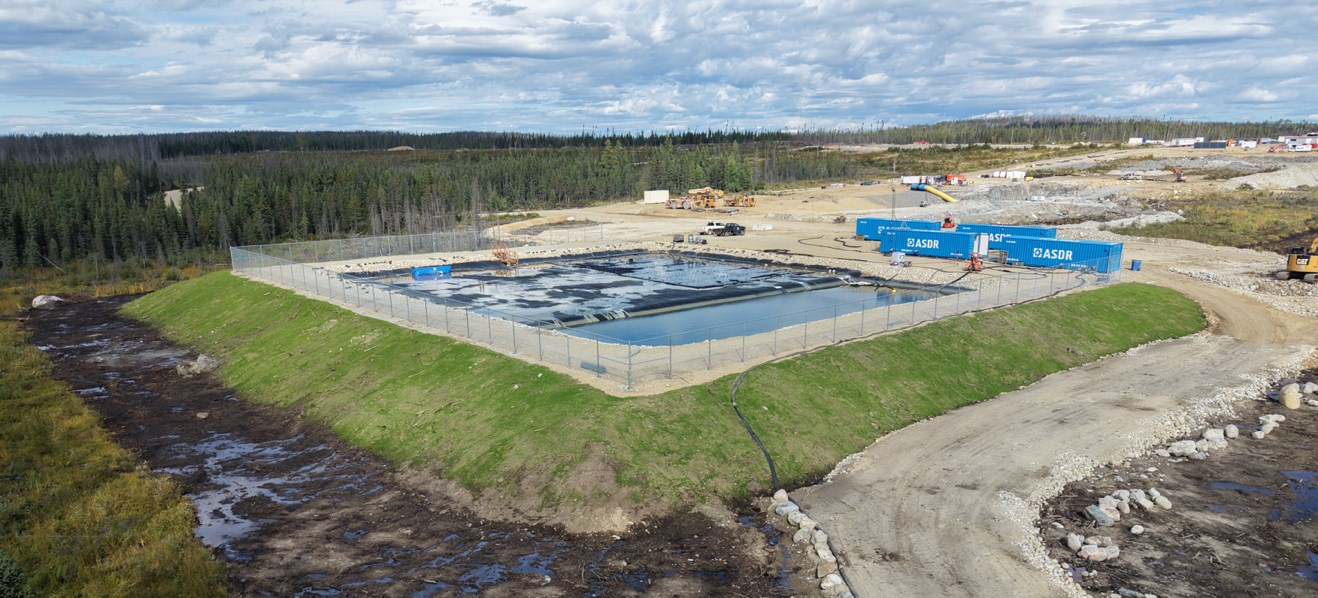
The core of the strategy is that very little of the bulk sample spend is throwaway. Cantore estimates the bulk sample will cost about C$60 million, of which roughly C$40 million is infrastructure that Phase 1 would need anyway. Instead of running on generator sets, Amex is spending about C$7.7 million to connect to a nearby transformer station. Posts are arriving on site, and Cantore expects the line to be connected by January.
The water treatment plant on surface has also been sized for Phase 1. Cantore said the main differences between the bulk sample and Phase 1 are the volume of material moved and the size of the waste piles. The company's presentation notes that the FS does not reflect these synergies in its stated initial capital.
Ramp Development Underway
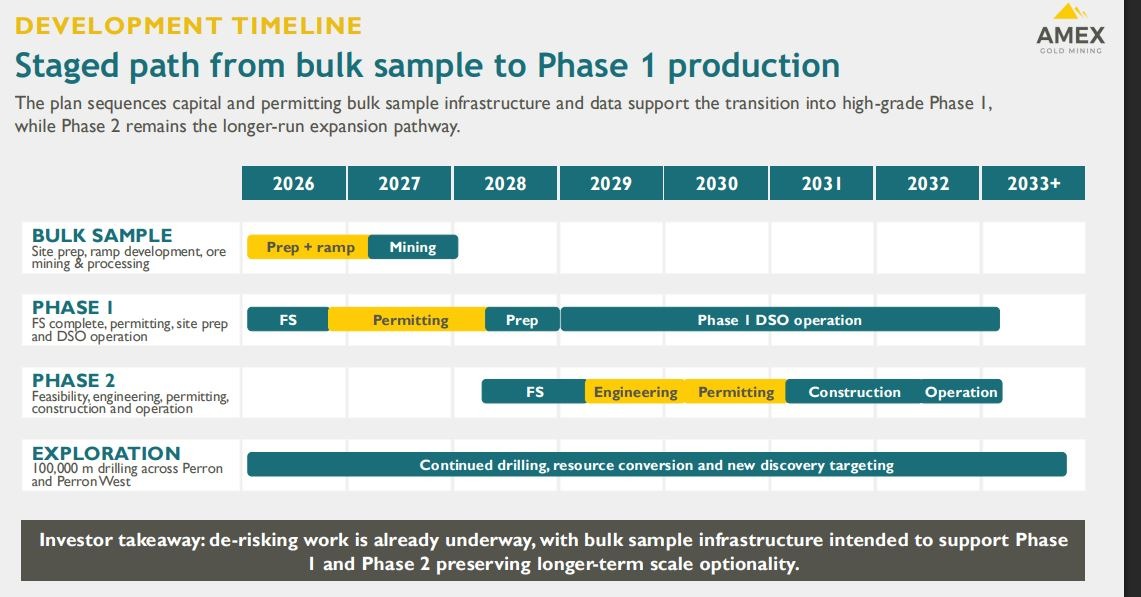
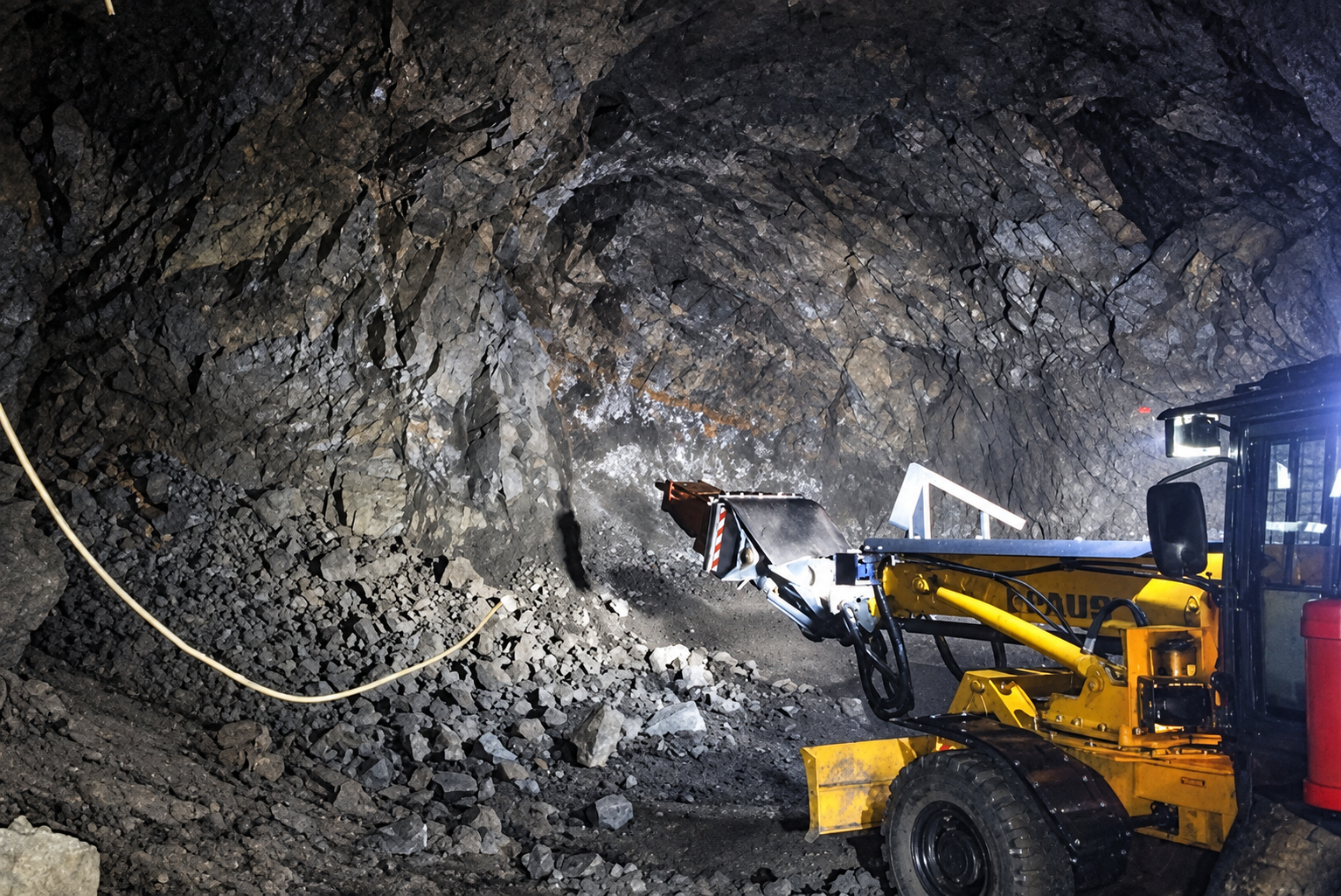
The most visible progress is underground. The ramp has 75 metres of underground decline development completed, and is advancing at around 5-6 metres per day, which he expects to average 150-180 metres per month. The full ramp will run approximately 1.5 kilometres down to the 235-metre level, with bulk sample mining planned across a 50-metre block above that horizon.
Underground work is being carried out by contractor CMAC, which Cantore described as a well-known mining contractor in the Abitibi, and Amex has been hiring experienced miners. Cantore was candid that it is early days, but argued that starting with a decline is deliberate because tunnelling is among the most predictable activities in mining. The bulk sample is intended to generate real mining, geotechnical and metallurgical data to test the FS assumptions before Phase 1 begins in earnest.
Permitting & Toll Milling
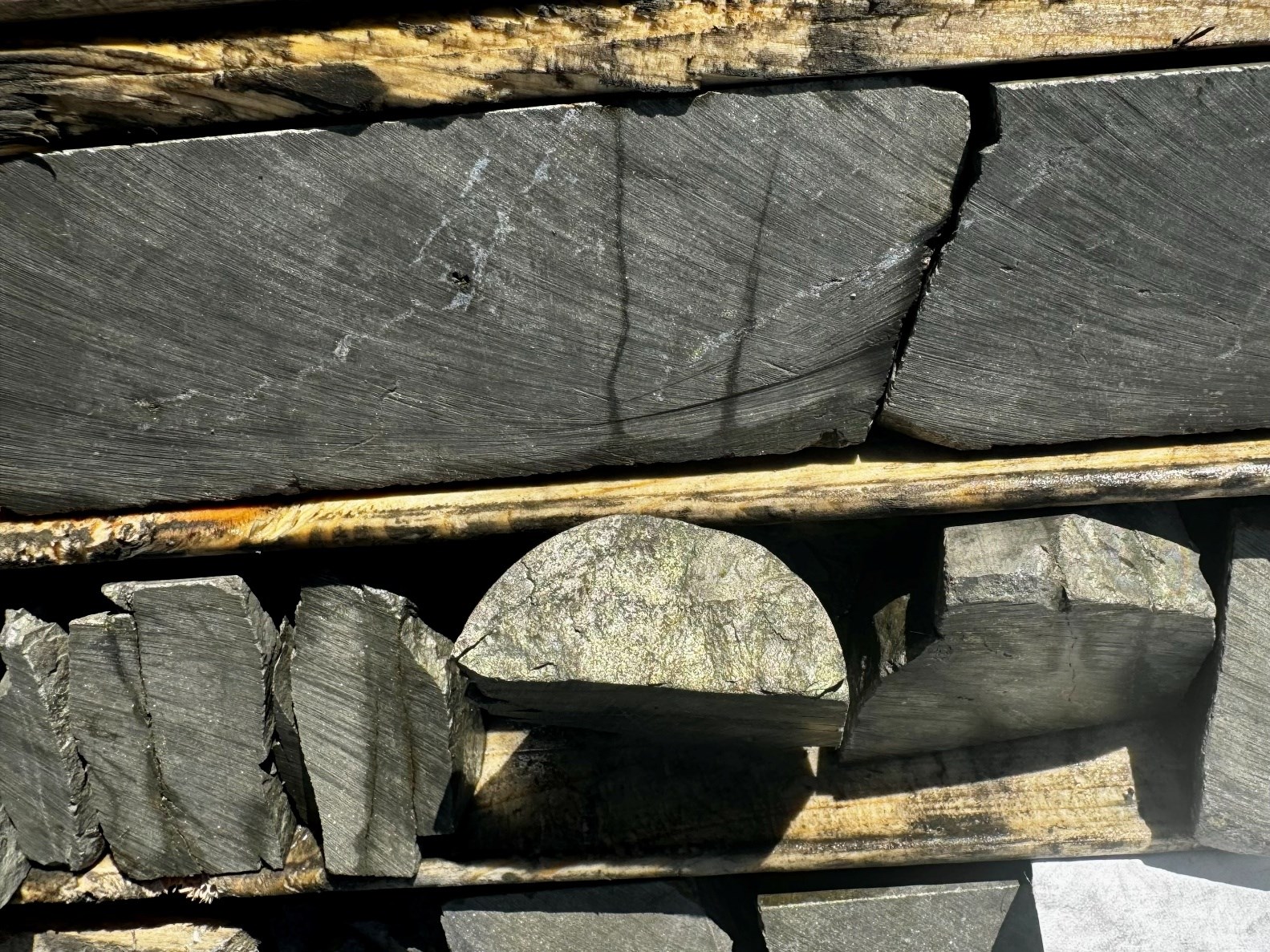
Amex has filed its Project Notice for Phase 1, the first formal step in Quebec's environmental assessment process. The FS schedule assumes a Phase 1 permit around mid-2028, but Cantore said the company is working to have it in place immediately after bulk sample extraction, which he expects in Q3 or Q4 2027. Amex holds a letter of intent (LOI) with Eldorado Gold, its 27% strategic shareholder, to toll mill both bulk sample and Phase 1 ore, but Cantore confirmed there is no definitive agreement yet. He pointed to four or five other mills in the region that need feed, and described Champagne ore as free gold in quartz with no deleterious elements. FS metallurgical test work returned more than 97.5% overall recovery from a gravity and cyanidation flowsheet. Cantore traced the whole approach back to a simple conviction.
"For a while now I've been telling people the Champagne Zone on its own. If I had nothing else, this is a mine... So now I'm showing you this is a mine."
The Funding Arithmetic
Phase 1 initial capital at C$193.9 million. Pre-production revenue of C$68.1 million, from gold sold before commercial production is declared, brings the net initial funding requirement down to C$125.8 million. The company expects the bulk sample to produce 20,000-28,000 ounces. Using 25,000 ounces, a US$4,000 gold price and an exchange rate of 1.35, that would generate about US$100 million, or roughly C$135 million. Adding the C$40 million of shared infrastructure brings the contribution to about C$175 million, before the FS pre-production revenue is counted. Commercial production is defined as three months of continuous operation at 660 tonnes per day, and all gold sold before that point goes against capital. The FS shows a post-tax payback of 0.5 years.
Cantore believes that, if sequencing goes to plan, the project could pay back before commercial production is declared. If additional funding were needed, he said he would prefer a simple forward sale of around 10,000 ounces in 2027, delivered in 2029, over new equity.
Phase 1 Economics & Valuation
Phase 1 is built on proven and probable reserves of 774,000 ounces at 12.10 g/T. The FS outlines a five-year operation averaging 147,000 ounces per year at an all-in sustaining cost (AISC) of US$910/oz, with 751,000 ounces recovered in total. At the US$3,500/oz base case, cumulative pre-tax free cash flow reaches C$2.492 billion, which Cantore rounds to roughly C$500 million a year. Post-tax, the study gives a net present value at a 5% discount rate (NPV5) of C$1.127 billion and an internal rate of return (IRR) of 114.6%.
Amex had a market capitalisation of about C$715 million at the end of August 2026, around 0.63 times the post-tax NPV, and Cantore views the company should trade at three to five times annual free cash flow once production.
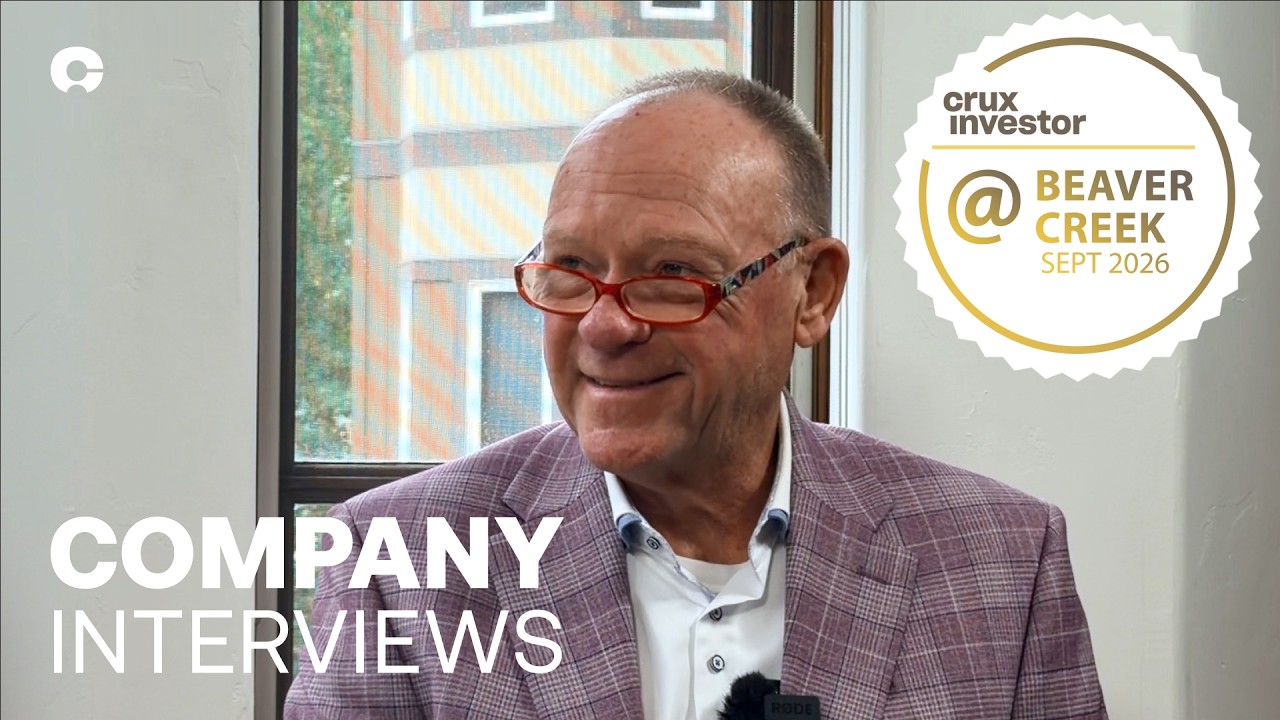
Interview with Victor Cantore, President & CEO of Amex Gold Mining
The Exploration Track
Exploration continues at full pace. Amex had a budget of about C$25 million for 2026 and has allocated about C$24 million for 2027 which Cantore said could fund 70,000-80,000 metres of drilling. Six drills are turning, four in Quebec and two in Ontario, and drilling runs year-round. The land package now covers about 570 square kilometres with more than 70 kilometres of strike in the Abitibi Greenstone Belt, after Amex consolidated ground to the provincial border and added claims in Ontario.
In Quebec, new zones such as the recently announced Rosé Zone could be accessed from the underground infrastructure already in place. In Ontario, early drilling has intersected volcanogenic massive sulphide (VMS) mineralisation, and the team is now vectoring towards gold. Deeper potential at Champagne is also on the list. The zone has returned high-grade intercepts at 1.6 kilometres, and Cantore plans to test depth from underground once mining reaches the 800-1,000 metre levels. Longer term, a Phase 2 concept envisages a 2,000 tonne-per-day on-site mill around 2033, sized according to exploration success.
The Investment Thesis for Amex Gold Mining
- Amex is converting a 40,000-tonne bulk sample into the first stage of a mine, with roughly C$40 million of an estimated C$60 million spend going into infrastructure that Phase 1 will reuse.
- Phase 1 targets 147,000 ounces per year at US$910/oz AISC from 12.10 g/T reserves, giving a post-tax NPV5 of C$1.127 billion and a 0.5-year payback at US$3,500/oz.
- Management's stated aim is to fund the build from bulk sample and pre-production revenue, supported by a forward sale if needed, rather than new equity.
- The toll-milling LOI with Eldorado Gold is not yet definitive, so investors should monitor progress towards a binding processing agreement.
- Investors should watch the ramp's advance towards the 235-metre level and the first bulk sample grades, which will test the reserve model against real mining.
- The timing of the Phase 1 permit is a key catalyst, with management targeting Q3 or Q4 2027 against an FS assumption of mid-2028.
- A C$24 million 2027 exploration budget across Quebec and Ontario keeps discovery upside alive alongside development.
Macro Thematic Analysis
The gold price has changed what a junior developer can realistically attempt. At a US$3,500/oz base case, a small, high-grade underground operation can generate cash on a scale that previously required a much larger mine. The traditional Canadian approach has been to keep drilling, grow the resource and build big, accepting long timelines and heavy dilution along the way. Cantore argues that a project following that route would reach production around 2032 or 2033. Time carries its own cost and nobody knows where gold will trade by then:
"We all hope gold is going to go higher. On a fundamental basis, you expect it to go higher, but there's no guarantees in anything. That's why you want to get money You want to monetize as fast as possible. As long as you can do it in a proper way where you're not cannibalizing your own mine."
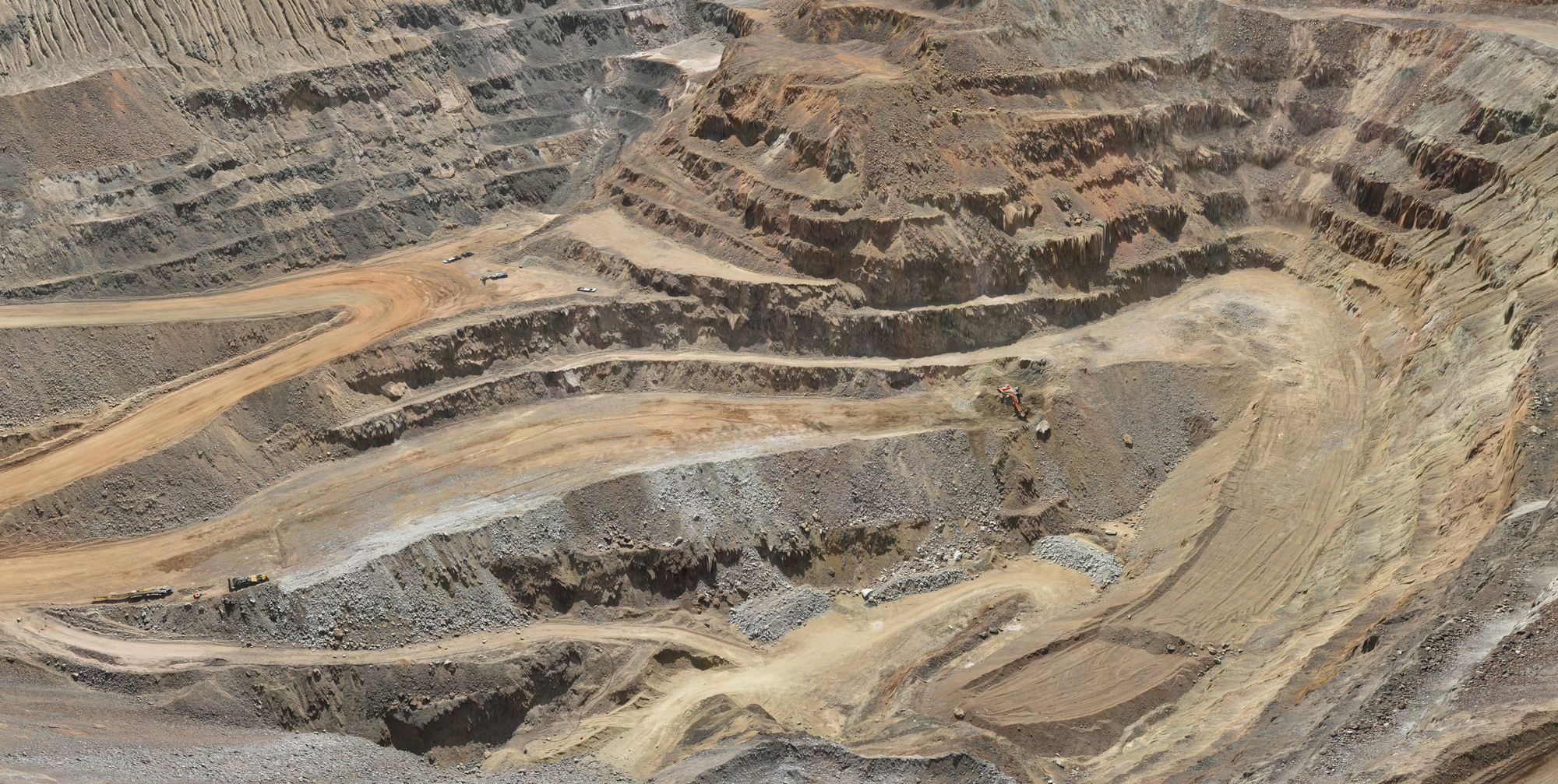
Cantore highlighted the monetisation of the Champagne Zone while prices are high, without high-grading it or cutting corners on the mine plan. The Abitibi makes this model easier to run than most regions. Perron sits about 8 kilometres from the town of Normétal, with road access, grid power and a local workforce. Several mills in the region are looking for feed, which gives a toll-milling strategy real optionality.
Cantore also cited community and First Nations support, and a footprint that does not encroach on rivers, lakes or streams, as reasons the permitting pathway can move faster. The broader theme is a funding model that reduces reliance on equity markets that have been unreliable for juniors through past cycles.
TL;DR
Amex Gold Mining is using a fully permitted 40,000-tonne bulk sample at its Perron Gold Project in Quebec as the first stage of production, building the ramp, grid power and water treatment to Phase 1 specification. The FS outlines 147,000 ounces per year at US$910/oz AISC from 12.10 g/T reserves, with C$193.9 million of initial capital falling to C$125.8 million net after pre-production revenue. CEO Victor Cantore believes bulk sample gold could close the remaining gap and that no new shares need to be issued. Key watch-items are a definitive toll-milling agreement with Eldorado Gold, first bulk sample grades and Phase 1 permit timing, targeted for late 2027. Exploration continues with six drills across 570 km².
FAQ (AI-generated)
Analyst's Notes





Subscribe to Our Channel



Stay Informed






















