




By-Product Credits Put CK Gold's AISC at $1,094 per Ounce Versus $1,814 Co-Product


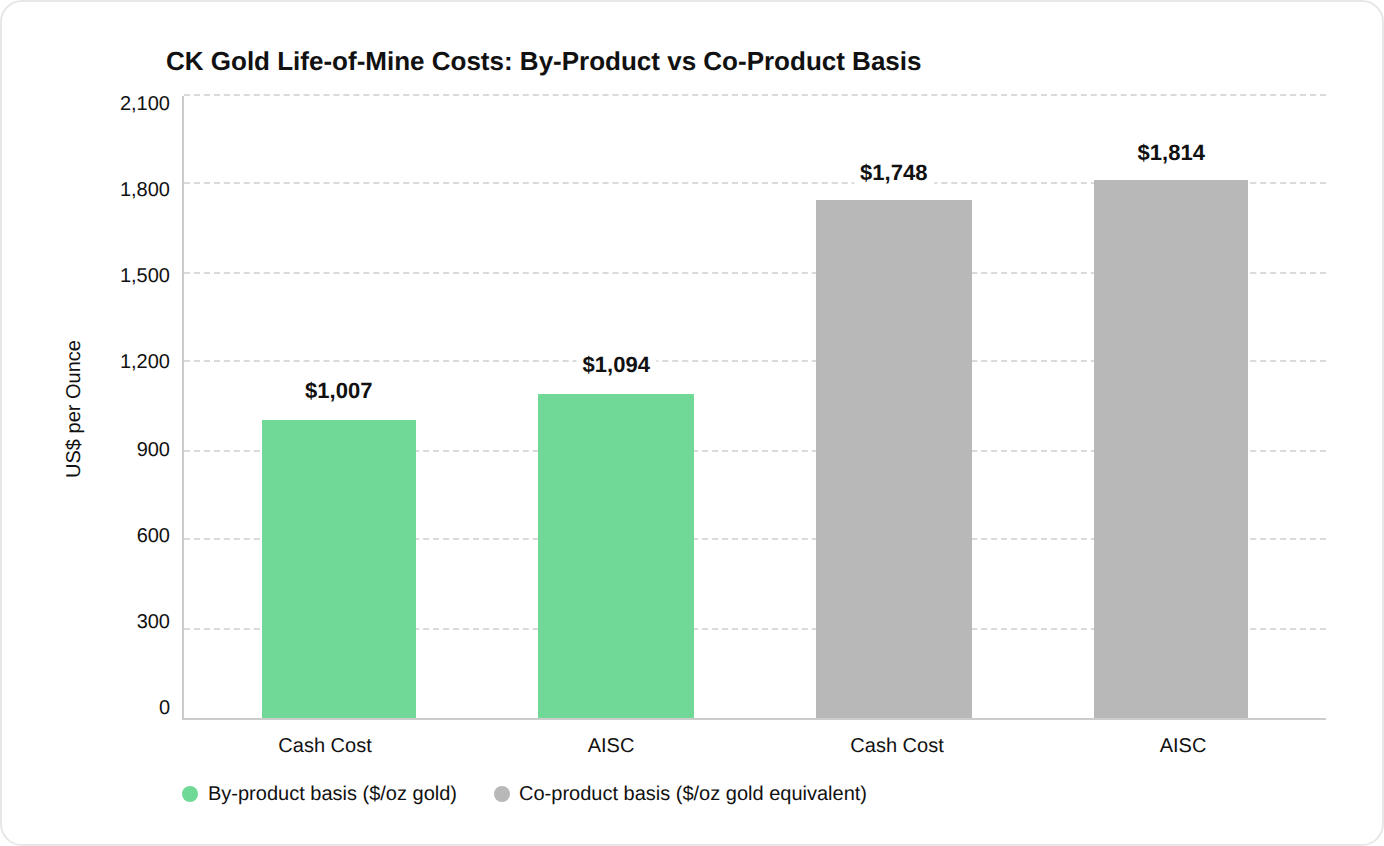
CK Gold's feasibility study gives an AISC of $1,094 per ounce of gold by-product and $1,814 per gold-equivalent ounce co-product, a gap set by by-product credits.
- CK Gold's feasibility study (FS) provides two all-in sustaining cost (AISC) figures for one operation: $1,094 per ounce of gold on a by-product basis and $1,814 per gold-equivalent ounce on a co-product basis.
- The by-product AISC nets copper, silver, and aggregate revenue against costs, using base-case prices of $4.50 per pound of copper, $40 per ounce of silver, and $3,250 per ounce of gold.
- Over its 11-year life, the Wyoming project is targeting 707,200 ounces of payable gold, 186.726 million pounds of payable copper, and 1.874 million ounces of payable silver.
- Before any by-product credits, the operation has a 0.89 waste-to-ore strip ratio and a total site operating cost of $18.462 per ton processed.
- Life-of-mine (LOM) recoveries average 71.5% for gold, 80.6% for copper and 68.7% for silver, with Jameson cell flotation adopted in the process design.
A Gold-Copper Project With a Split Cost Profile
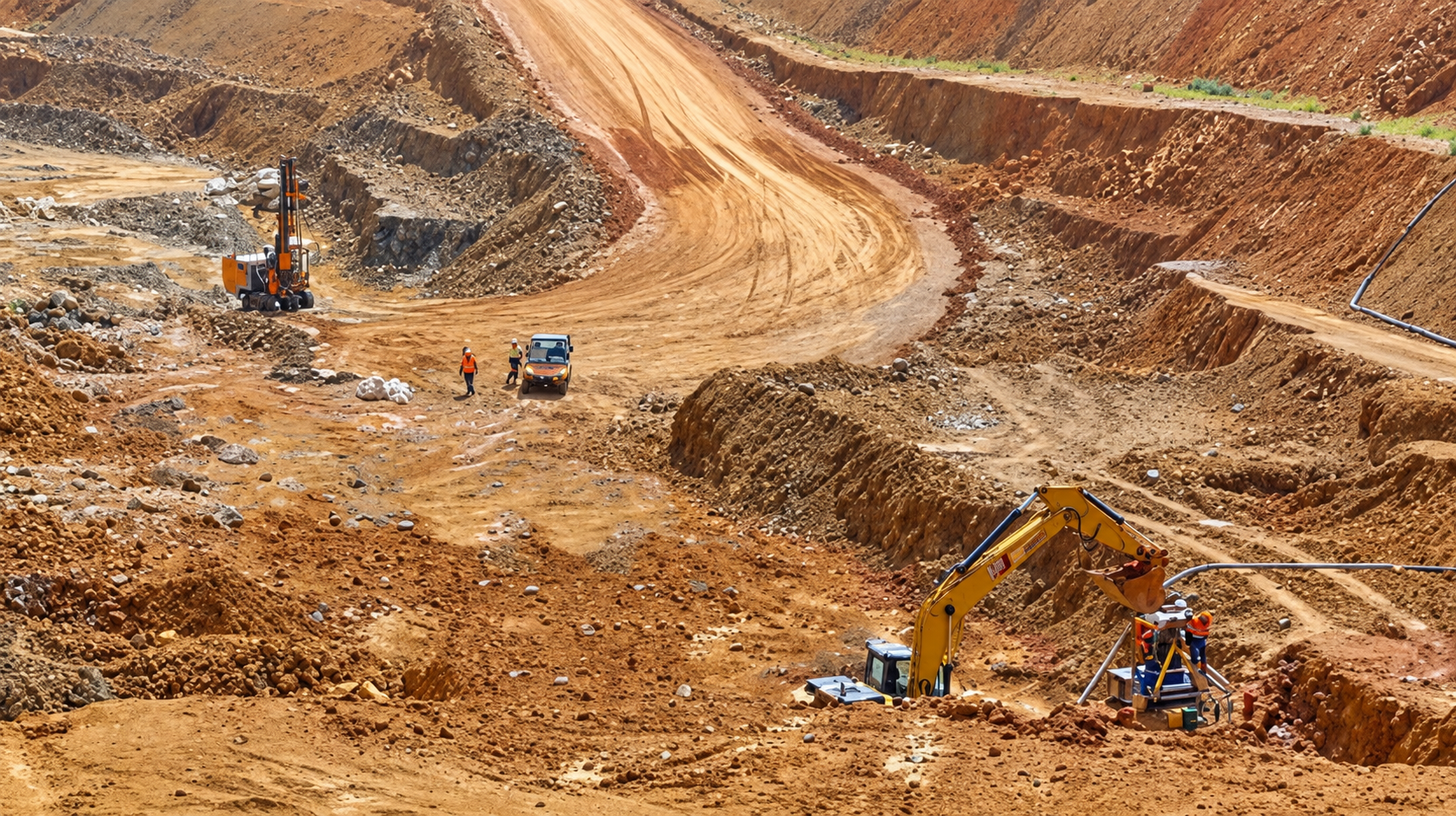
U.S. Gold Corp (NASDAQ: USAU) is advancing CK Gold, a permitted gold-copper open-pit project about 20 minutes west of Cheyenne, Wyoming. According to the March 2026 feasibility study (FS), the project has an after-tax net present value (NPV5%) of $632 million and an initial capital cost of $394 million. The deposit's metal mix is most clearly reflected in its costs. The same operation has an all-in sustaining cost (AISC) of $1,094 per ounce on one basis and $1,814 per gold equivalent ounce on another. The difference stems from how copper, silver, and aggregate revenue are treated, and from which ounces are counted.
One Operation, Two Cost Figures
On a by-product basis, CK Gold's life-of-mine (LOM) cash cost is $1,007 per ounce of gold, and its AISC is $1,094 per ounce of gold. Revenue from copper, silver, and aggregate is deducted from costs, and what remains is divided across gold ounces only.
On a co-product basis, costs are spread across all payable metal, converted into gold-equivalent ounces. That method yields a cash cost of $1,748 per gold-equivalent ounce and an AISC of $1,814 per gold-equivalent ounce. U.S. Gold calculates gold equivalent ounces on a recovery-weighted basis across the deposit's 3 metallurgical types: oxide, mixed oxidation, and sulfide.
Both figures use the FS base case of $3,250 per ounce of gold, $4.50 per pound of copper, and $40 per ounce of silver. The site costs are identical under each method. The by-product number, however, moves with the copper and silver credit, so the $ 4.50-per-pound copper assumption feeds directly into the lower headline cost.
Copper & Silver in the Payable Stream
Management describes CK Gold as a gold-led porphyry with a copper component. Non-Independent Chairman of U.S. Gold Corp, Luke Norman, described the split in the deposit:
"Our project, the CK project, is predominantly gold, 70% gold, 30% copper. It's a porphyry exposed at surface."
The proven and probable reserves contain 1.015 million ounces of gold, 260 million pounds of copper, and 3.032 million ounces of silver, totaling 1.598 million gold-equivalent ounces. Over the LOM, the company is targeting payable production of 707,200 ounces of gold, 186.726 million pounds of copper and 1.874 million ounces of silver. That totals 931,000 gold equivalent ounces.
All 3 metals report to a single product. The plant produces a gold-copper concentrate that U.S. Gold describes as clean and high-grade in gold, with little or no deleterious elements, and ships it to off-site smelters. The deposit has clean, simple mineralogy and low overall sulfide content. The copper credit in the by-product AISC comes from the same concentrate that carries the gold.
The Cost Base Before Credits
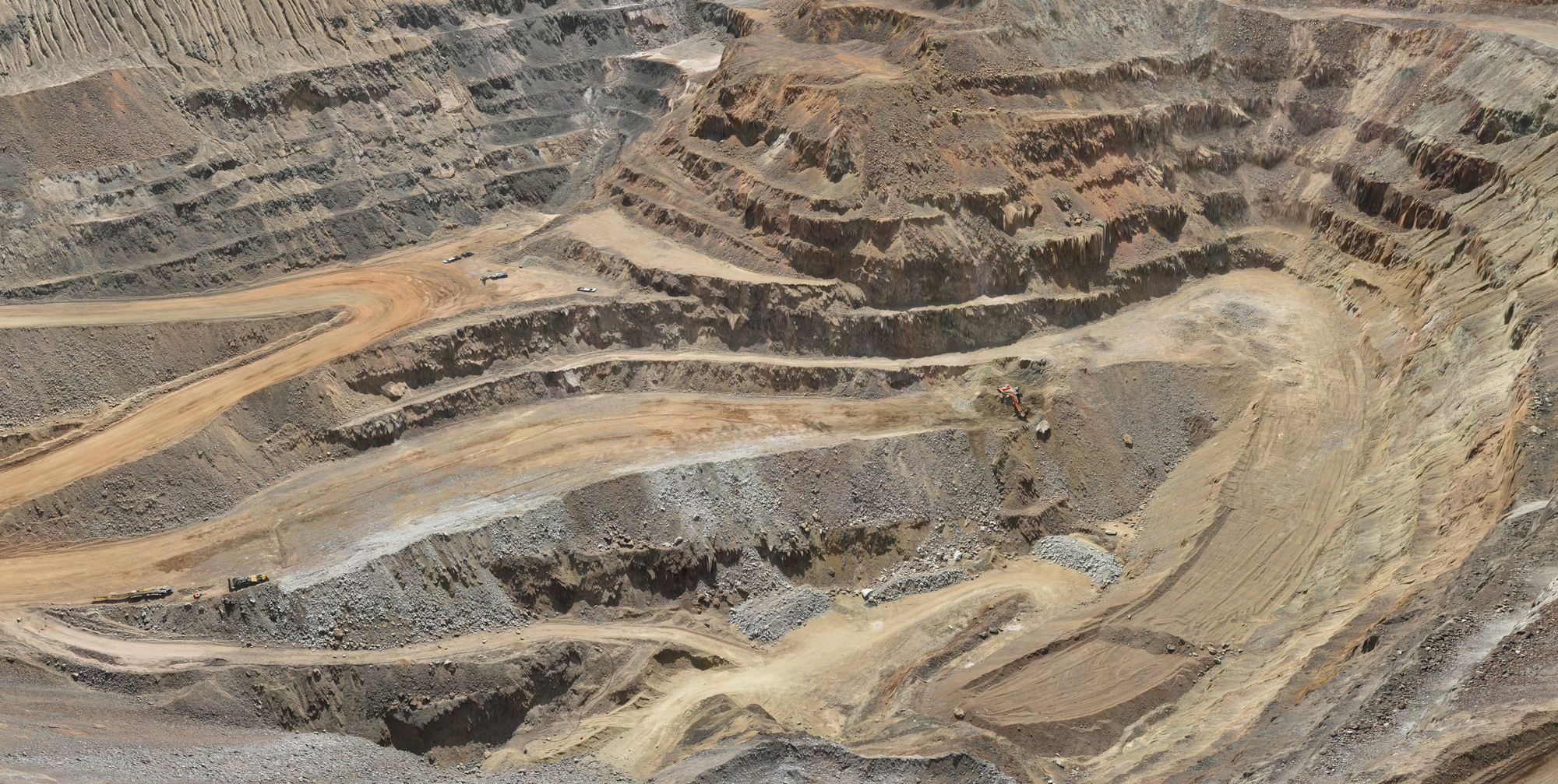
The operating structure is the same under either cost basis. Under the FS mine plan, the operation mines 140.597 million tons in total, including 74.5 million tons of ore, at a strip ratio of 0.89 tons of waste per ton of ore. Mining costs $3.88 per ton mined, or $7.30 per ton processed. The fleet is small: 100- to 150-ton trucks and 20-yard loaders working over short-haul distances.
Processing, including tailings placement, adds $9.59 per ton, and general and administrative costs add $1.54 per ton. Total site operating cost is $18.462 per ton processed, through a plant rated at 20,000 tons per day. These gross unit costs do not change between the $1,094 and $1,814 figures. The spread between the 2 AISC numbers reflects 2 things: the treatment of copper, silver, and aggregate revenue, and the ounce count used as the divisor. It does not reflect any difference in the cost of mining and processing the rock.
Recoveries & the Process Design
LOM recoveries in the FS average 71.5% for gold, 80.6% for copper, and 68.7% for silver. The circuit grinds ore to 90 microns through a semi-autogenous grinding mill and a ball mill, then floats a rougher concentrate in Jameson cells. That concentrate is reground to 25 microns in a Vertimill and cleaned in a second stage of Jameson cells before filtering. Tailings are thickened and vacuum filtered for dry-stack storage.
U.S. Gold adopted Glencore Technology's Jameson cell flotation in the FS to improve recoveries and reduce capital and operating costs.
Norman linked the flotation choice to recovery performance:
"Metallurgical work-wise, we're more than happy. We brought in Jameson Cell, and recoveries are looking even better at the mine."
The company also identifies potential gold recovery gains through later tailings treatment and an optimized grind size. Higher gold recovery would add payable ounces of gold from the same tons processed.
What Each Cost Basis Answers
The $ 1,094-per-ounce by-product AISC measures the cost for CK Gold to produce an ounce of gold, after crediting copper, silver, and aggregate revenue at base-case prices. That is the figure to set against gold producers that report on a by-product basis, provided the comparison uses a similar copper price.
The $1,814 per gold-equivalent ounce co-product AISC measures the cost to produce a unit of total payable metal, with copper and silver treated as outputs in their own right. Management characterizes the deposit as 30% copper, and for that mix the co-product measure gives the fuller view of the cost per unit of payable metal. Read together, they describe a project whose gold cost depends on its copper, silver and aggregate credits. On the cost side, the next variables are the copper price relative to $4.50 per pound and any gains from the recovery improvements the company has identified.
FAQs (AI-Generated)
Analyst's Notes





Subscribe to Our Channel



Stay Informed






















