




West Red Lake Gold Adds Continuity Evidence at 904 & 955 Ahead of 2027


West Red Lake Gold's Madsen drilling adds continuity evidence at 904 & 955; true thickness, stope-scale grade and 2027 mine-plan inclusion remain open.
- West Red Lake Gold Mines reported 5.3 meters at 176.04 grams per tonne gold, including 1 meter at 925.52 grams per tonne, from the Austin 904 complex at the Madsen Mine in Red Lake, Ontario.
- The September 22, 2026 results were the 4th set of 2026 drill results for 904 and the 2nd for the 955 complex. The holes were drilled from Levels 12 to 14 at depths of roughly 600 to 700 meters.
- At 955, intervals of 14.5 meters at 5.29 grams per tonne, 12.8 meters at 7.93 grams per tonne, and 11.7 meters at 8.09 grams per tonne were reported alongside 6.85 meters at 35.72 grams per tonne.
- The company describes the mineralized panels as being continuous across multiple areas. Visible gold occurs with biotite alteration, pyrrhotite and quartz-carbonate veining, and the company names silicification and quartz-carbonate or diopside veining as its best high-grade indicators.
- Assays are reported uncapped, true thickness has not been calculated, and the company describes integration into the 2027 Madsen mine plan as a potential outcome.
The Evidence Question at 904 & 955
Definition drilling at a restarted underground mine produces 2 kinds of information. Grade shows up in headline intercepts. Geometry emerges more slowly, as successive holes test the same panel from different positions. At the Madsen Mine, geometry now has more bearing on the 2027 mine plan than any single assay.
West Red Lake Gold Mines (TSXV: WRLG | OTCQX: WRLGF) reported its 4th set of 2026 drill results from the Austin 904 complex on September 22, 2026. It was also the 2nd set from the neighboring Austin 955 complex. The results included 5.3 meters at 176.04 grams per tonne gold at 904, 4.5 meters at 128.32 grams per tonne in South Austin, and 6.85 meters at 35.72 grams per tonne at 955.
Several releases now define 904 and 955 at depth. The analytical focus is therefore shifting from whether high-grade mineralization is present to how successive results establish continuity, geometry and confidence ahead of mine-plan integration. The September results add to that evidence base in measurable ways. True thickness, grade distribution at the scale of potential mining stopes, and eventual inclusion in the mine plan are still unresolved.
September Results Against the 2026 Drill Record
The 904 complex is an approximately 200-by-200-meter panel of intact gold mineralization that has not been mined historically. Drilling there in 2026 began with 219.73 grams per tonne over 4.8 meters, 148.36 grams per tonne over 3 meters, and 133.13 grams per tonne over 2.5 meters. April 13 followed with 215.46 grams per tonne over 5.35 meters, 50.34 grams per tonne over 4.05 meters and 61.70 grams per tonne over 3 meters. On July 7, drilling returned a wider intercept of 10.22 grams per tonne over 13.35 meters. The first 955 results included 43.48 grams per tonne over 3.85 meters and 53.87 grams per tonne over 3.1 meters.
The September 904 holes came from 2 levels, 13 and 14, at roughly 650 and 700 meters. The standout returned 5.3 meters at 176.04 grams per tonne, including 1 meter at 925.52 grams per tonne. Core from that hole showed a large clot of visible gold associated with biotite alteration inside a quartz-porphyry dike. A second hole from the same setup returned 6.2 meters at 17.87 grams per tonne, including 3.1 meters at 35.02 grams per tonne. From 13 Level, 2 holes returned 8.75 meters at 4.12 grams per tonne and 6.4 meters at 4.50 grams per tonne.
Across 4 releases, the 904 record now combines very high-grade short intervals with lower-grade intervals several meters wide. The July intercept of 13.35 meters is the widest of the highlighted 904 intercepts cited for 2026. High-grade mineralization has been reported repeatedly from the 904 drilling across those releases.
Wider 955 Intervals Test Grade Distribution
The 955 results came from 12 levels at a depth of approximately 600 meters. Their distinguishing feature is width. The drilling returned 14.5 meters at 5.29 grams per tonne, 12.8 meters at 7.93 grams per tonne, 11.15 meters at 7.31 grams per tonne, 11.7 meters at 8.09 grams per tonne, and 12 meters at 3.00 grams per tonne.
These intervals report grade over longer core runs, while shorter intercepts can be driven by a single high-grade sample. The contrast is visible within the same drill fan. The 6.85-meter intercept at 35.72 grams per tonne includes 1 meter at 233.76 grams per tonne, where stringers of visible gold ran along the foliation. The 11.7-meter interval at 8.09 grams per tonne shows both patterns simultaneously, as it includes 1 meter at 59.96 grams per tonne. Other 955 intervals, such as 7.35 meters at 9.69 grams per tonne within the 12.8-meter intercept, are reported without a single-meter high-grade inclusion.
For reference, Madsen's Probable mineral reserve grade is 8.16 grams per tonne, estimated at a gold price of US$1,680 per ounce. Drill intervals are undiluted and not directly comparable with a mining reserve. The wider 955 intervals ranged from 3.00 to 8.09 grams per tonne.
Geological Indicators & Assay Protocols
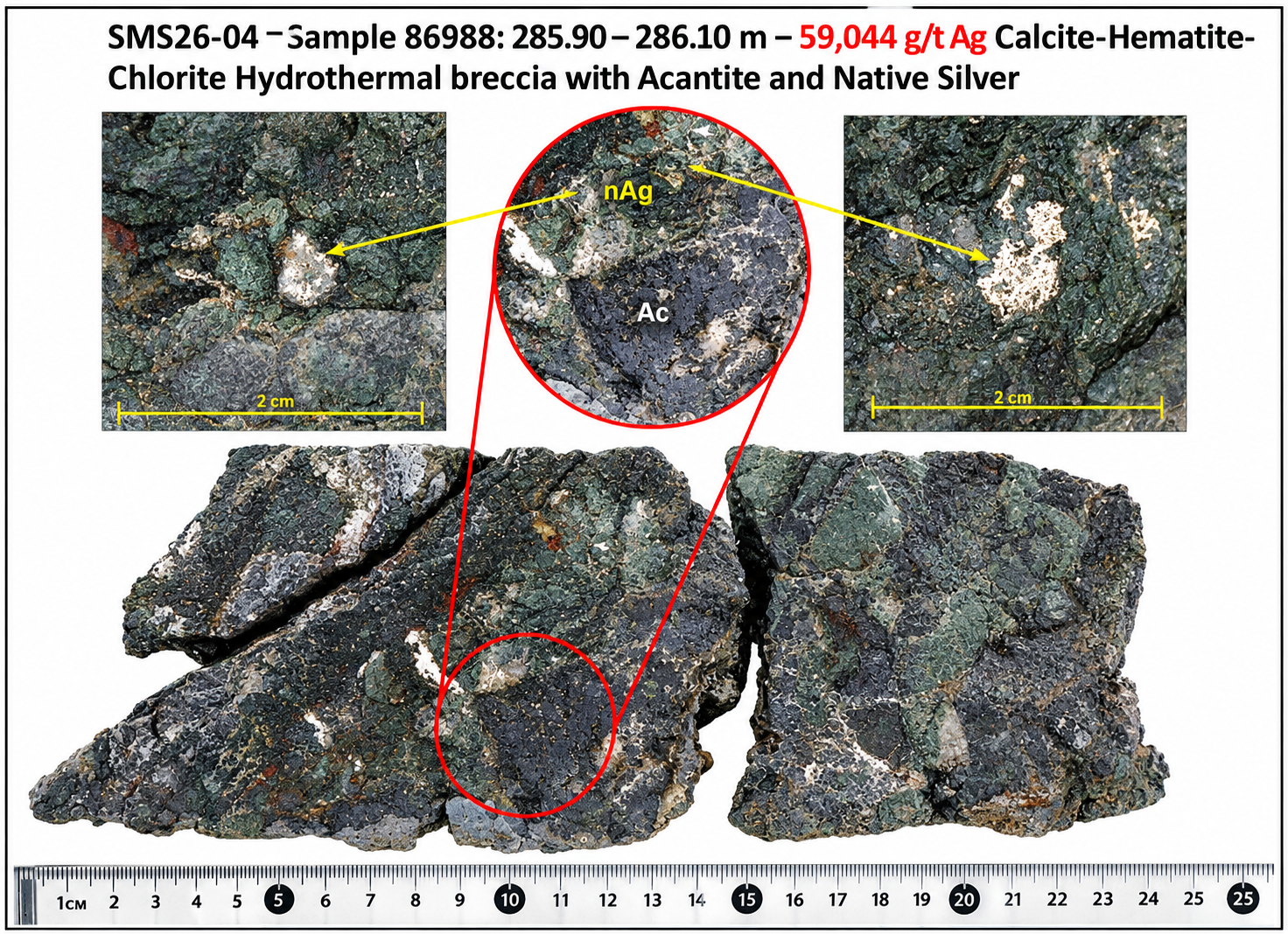
Each highlight hole contains visible gold in different geological settings. At 904, visible gold occurs with biotite alteration inside a quartz-porphyry dike. In South Austin, it appears alongside pyrrhotite, biotite alteration, and quartz-carbonate veining. At 955, it forms stringers along the foliation. The company identifies free gold, pervasive silicification, and quartz-carbonate or diopside veining as the best indicators that an interval lies within a high-grade zone, and notes that high-grade intervals generally show visible gold on the outside of the core. The company uses these features to identify high-grade zones in drill core and at underground faces.
Vice President of Exploration of West Red Lake Gold Mines, Will Robinson, gave the company's assessment of how the panels are behaving:
"The mineralized panels within the 904 and 955 complexes are holding together quite well with strong grades and continuity demonstrated across multiple areas. These results continue to build our confidence in the geological model and the potential for these areas to be integrated into the Madsen mine plan in 2027."
The company's assay protocols address the reliability of each high-grade number. Samples containing visible gold are also run through metallic screen analysis, and samples returning more than 100 grams per tonne are re-assayed with a gravimetric finish. Definition core is whole-core sampled. Certified standards, blanks, and duplicates are inserted at a target rate of 5%, and assays are completed by SGS under an ISO/IEC 17025 quality system. These controls support the reliability of the reported assay results. They do not show how far a single high-grade meter extends into the surrounding rock.
Drill Geometry: Coverage From Shared Setups
The collar data show how the drilling was laid out. Most of the 955 holes were collared from a single setup on 12 Level, at nearly identical coordinates, and fanned across azimuths from 154 to 181 degrees, with dips from -2 to -18 degrees. The 904 holes drilled from a shared setup on 14 Level ranged in azimuth from 124 to 152 degrees, with dips from -27 to 9 degrees. Each fan places intercepts at different positions across the panel from a single underground station.
This pattern demonstrates directional coverage from each setup. It does not independently demonstrate continuity. Continuity is supported where neighboring intercepts return comparable widths and grades, and the geological model correlates them as the same zone. The company states that continuity has been demonstrated across multiple areas, and that is the company's own assessment.
What the Drilling Cannot Yet Establish
The September results leave 3 questions open. Each one needs more evidence before 904 and 955 material can be assessed for mine design.
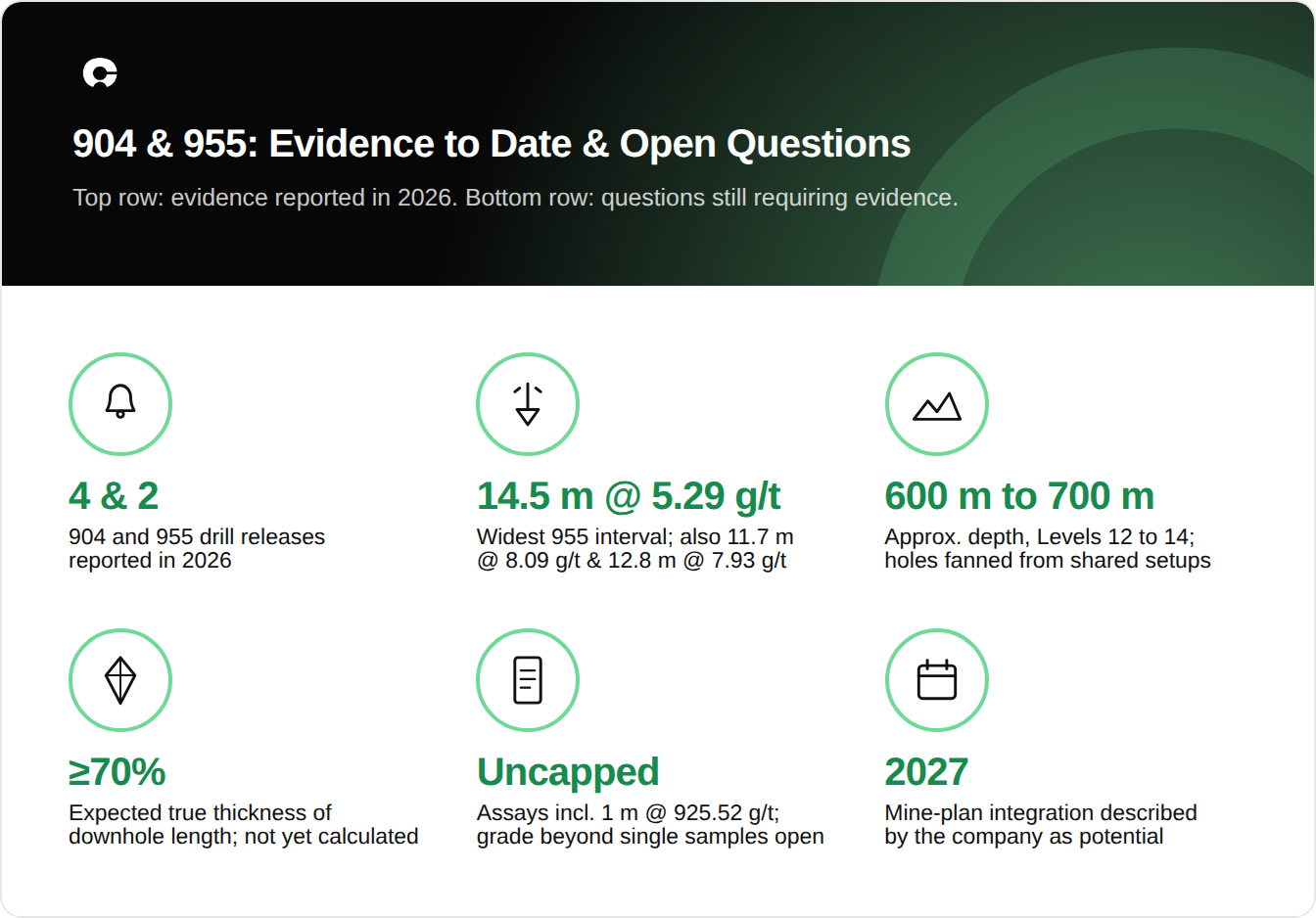
The first is thickness. True thickness has not been calculated for these intercepts, though the company expects it to be at least 70% of downhole length based on intercept angles observed in the core. The second is stope-scale grade, meaning whether grade distribution holds at the scale of potential mining stopes. All assays are reported uncapped, so isolated extreme values such as 925.52, 566.81, and 233.76 grams per tonne describe individual samples, not the broader intervals that contain them. Internal dilution within reported composite intervals does not exceed 1 meter of samples grading below 0.1 grams per tonne.
The third is mine-plan inclusion. The company describes the integration of these areas into the 2027 Madsen mine plan as a potential outcome and notes that 904 is in development for the first half of 2027. Moving from drill intercepts to designed stopes depends on how the broader dataset holds up once thickness and stope-scale grade are assessed.
What Further Definition Drilling Would Need to Show
The company states that underground drilling at Madsen is focused on defining near-term mining inventory and growing the current mineral resource. It is targeting the more continuous, higher-grade parts of the Austin and South Austin zones, and anticipates continuing that approach through 2026. Those priorities give future results 3 measurable tests.
Adjacent holes returning comparable widths and grades would strengthen the correlation between intercepts. Reported true thicknesses would convert downhole lengths into actual widths. At 904, more intervals of several meters at moderate grade, like the July 13.35-meter intercept, would show whether grade holds beyond single high-grade samples.
The Investment Thesis for West Red Lake Gold Mines
- The September 22, 2026 results were the 4th set of 2026 drill results for the Austin 904 complex and the 2nd for the Austin 955 complex at the Madsen Mine.
- The best new intercept at 904 was 5.3 meters at 176.04 grams per tonne gold, and the best at 955 was 6.85 meters at 35.72 grams per tonne gold.
- Wide intervals at 955, including 14.5 meters at 5.29 grams per tonne and 12.8 meters at 7.93 grams per tonne, provide evidence of grade distribution beyond single high-grade samples.
- Visible gold in the highlight holes occurs with biotite alteration, pyrrhotite and quartz-carbonate veining, and the company identifies silicification and quartz-carbonate or diopside veining as its best field indicators of high-grade zones.
- Holes fanned from shared underground setups on Levels 12 to 14 provide directional coverage of both panels at roughly 600 to 700 meters depth.
- True thickness has not been calculated, assays are reported uncapped, and integration into the 2027 Madsen mine plan is described by the company as potential.
Successive drill releases provide an expanding evidence base for assessing 904 and 955. The next tests are true thickness, grade distribution at the scale of potential stopes, and inclusion in the formal mine plan.
TL;DR
West Red Lake Gold's September 22, 2026 results added 5.3 meters at 176.04 grams per tonne gold at 904 and wide 955 intervals, including 14.5 meters at 5.29 grams per tonne, from holes fanned across Levels 12 to 14. It was the 4th 904 release of 2026. The September results add to the geological evidence around 904 and 955, but true thickness, stope-scale grade and 2027 mine-plan inclusion remain open.
FAQs (AI-Generated)
Analyst's Notes





Subscribe to Our Channel




Stay Informed






















