




Cabral Gold: Building a High-Return Oxide Starter Amid Strong Gold Prices


Cabral Gold builds low-capex Brazilian oxide mine on track for Q4 2026 first gold; 85-90% IRR at current prices with district-scale exploration upside and zero dilution.
- Cabral Gold secured US$45M gold loan in November 2025 and commenced building Stage 1 heap-leach operation targeting first pour Q4 2026.
- July 2025 PFS delivers 78% after-tax IRR and US$74M NPV₅ at US$2,500/oz; economics improve to approximately 85-90% IRR at current spot price of US$2,687/oz.
- Initial capital of US$37.7M supports 6.2-year mine life producing 113,155 oz at AISC of US$1,210/oz, offering 10-month payback.
- Four new hard-rock discoveries at PDM, Machichie NE, Machichie Main and Jerimum Cima; three drill rigs expanding the 1.2 Moz resource base.
- Team credited with five grassroots Brazilian gold discoveries totaling over 5 Moz, operating adjacent to G Mining's Tocantinzinho mine.
Introduction
Gold's sustained strength above US$4,600 per ounce as of January 2026, driven by safe-haven demand and expectations of Federal Reserve rate cuts, continues to enhance the economics of development-stage projects. Cabral Gold Inc. (TSXV: CBR | OTC: CBGZF) finds itself well-positioned: construction is underway on a fully-funded, low-capex oxide heap-leach operation in Brazil's Tapajós Gold Province, while three drill rigs expand a district-scale resource base. For investors seeking leveraged exposure to bullion prices without construction risk, the company's combination of near-term production, strong project economics and exploration upside merits close attention.
Cabral’s recently announced construction progress, confirming site clearing, earthworks and procurement of long-lead items including the ADR plant from Como Engineering, remain on schedule for Q4 2026 first gold. The Stage 1 operation will mine 128,903 oz of proven and probable oxide reserves at MG, Central and Machichie deposits over 6.2 years, generating forecast EBITDA of US$154.4M under the July 2025 PFS base case of US$2,500/oz gold.
At current spot prices over US$4,600/oz after-tax IRR rises to approximately 85-90% and NPV₅ climbs to approximately US$85-90M, representing meaningful upside and underscoring the leverage in near-surface, low-strip oxide deposits.
Company Overview
Cabral Gold is a Canadian-listed mineral exploration and development company focused on the Cuiú Cuiú gold district in Pará State, northern Brazil. The company holds 100% interest in a contiguous 194 km² land package within the Tapajós Gold Province, a region that hosted an artisanal gold rush from 1978 to 1995 during which 30 Moz of placer gold was recovered according to Brazil's ANM (National Mining Agency). President and CEO Dr. Alan Carter has personally invested C$1.95M, making him the largest individual shareholder.
Management comprises geologists and mining engineers with a combined track record of five grassroots gold discoveries in Brazil totaling over 5 Moz of 43-101 compliant resources. Notable prior successes include the Tocantinzinho deposit now operated by G Mining Ventures as Brazil's third-largest gold mine, commissioned in September 2024, and the Coringa underground mine, owned an operated by Serabi Gold. Cuiú Cuiú lies adjacent to Tocantinzinho along the same northwest-trending structural corridor, yet Cuiú Cuiú produced an estimated 2 Moz of historical placer gold compared to Tocantinzinho's 0.2 Moz per ANM records.
As of December 12, 2025, Cabral reported 273,297,316 basic shares outstanding at C$0.74, yielding market capitalization of approximately C$202M (US$150M). Institutional holders control 57% of the float, with Phoenix Gold Fund, Arbiter Partners, Myrmikan Capital, J Zechner Associates and Eric Sprott representing the core shareholder base. Cash on hand stood at US$64.5M following the November 2025 close of the US$45M gold loan.
Key Development: Stage 1 Construction Underway
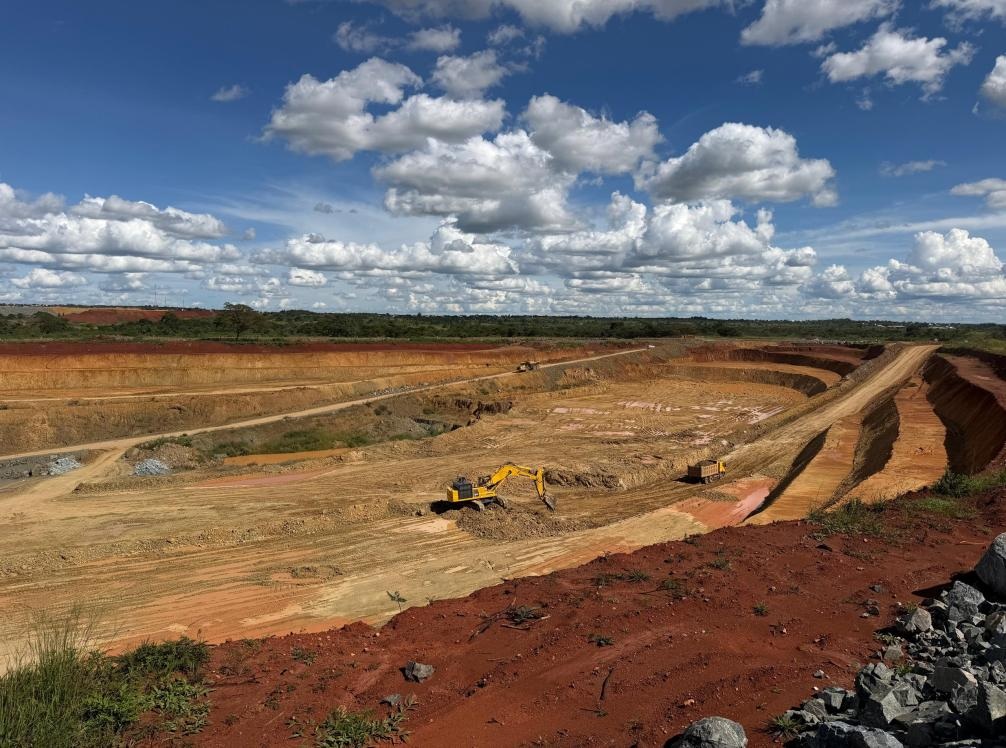
Cabral's operational update confirms detailed engineering, procurement and mobilization are progressing on schedule for Q4 2026 first gold. Key milestones include site clearing, commencement of earthworks for heap-leach pads and process-plant area, and placement of orders for critical equipment. The 2-tonne-capacity ADR (Acid Wash / Desorption / Regeneration) plant is under fabrication by Como Engineering and represents the longest-lead item.
President and CEO Alan Carter gave this update:
"We are extremely pleased with the progress on site and the level of engagement from our construction team and contractors. Every day brings us closer to first gold production, and the current gold price environment validates our decision to move forward now rather than wait for further permitting or resource expansion."
Construction is managed under an EPCM contract awarded to Ausenco Brazil, which led the updated PFS released July 29, 2025. Cabral appointed Luiz Celaro, MBA, as Construction Manager; Celaro brings over 30 years of experience with gold-mining projects including six mine-construction roles. The flowsheet is straightforward: ROM oxide material requiring no drilling or blasting will be fed to a mineral sizer, then agglomerated with cement and stacked on four on-off leach pads designed for 3,000 tonnes per day throughput. Column-leach metallurgical tests returned recoveries between 72.5% and 96%, with 88% average factored into reserve estimates.
Strategic Significance: Timing, Location & Economics
Gold traded at US$4,687/oz as of January 13, 2026 per Kitco, representing approximately 7% upside to Cabral's PFS base case of US$2,500/oz. This differential translates to meaningful improvements in project economics. The PFS sensitivity analysis demonstrates that at US$4,687/oz, after-tax IRR increases to approximately 85-90% from base-case 78%, while NPV₅ rises to approximately US$85-90M from US$74M. Because heap-leach incurs relatively fixed operating costs, incremental gold-price increases above base case flow almost entirely to margin.
Cabral's ground lies immediately adjacent to G Mining's Tocantinzinho operation, which poured first gold September 2024 and ranks as Brazil's third-largest gold mine. Both properties sit on the Tocantinzinho lineament, a northwest-trending crustal break controlling known mineralization. Shared geology implies that exploration techniques, metallurgy and permitting precedents established at Tocantinzinho are directly applicable at Cuiú Cuiú, reducing technical and regulatory risk.
Cabral's US$37.7M initial capex represents roughly one-tenth the typical spend for a conventional mill-based operation of similar throughput. Moreover, the rapid 10-month payback period at US$2,500/oz base case and strong free-cash-flow profile make the project attractive as a self-funding platform for district-wide exploration. Small, high-grade oxide systems particularly those amenable to heap leaching are comparatively rare in the development pipeline.
Current Activities: Parallel Drilling & Reserve Growth
While construction crews mobilize equipment and excavate leach-pad foundations, Cabral's exploration team runs three diamond drill rigs across four priority targets: PDM, Machichie NE, Mutum and areas adjacent to existing Central and MG deposits. PDM, located 2.5 km northwest of Central deposit, was initially recognized as a gold-in-oxide blanket before drilling intersected underlying primary mineralization. Recent results include 22 m at 4.8 g/t Au (including 1.35 m at 62.0 g/t), 18 m at 2.5 g/t and 47 m at 1.8 g/t.
Machichie comprises four discrete zones within 1 km² immediately north of MG. A maiden resource estimate released October 21, 2024 calculated indicated oxide resources of 1.3 Mt at 0.56 g/t Au (24,123 oz) and inferred oxide resources of 0.7 Mt at 0.54 g/t Au (12,403 oz) for Machichie Main. At Machichie NE, step-out holes completed late 2025 yielded 11 m at 33.0 g/t (including 4 m at 89.3 g/t), 12 m at 27.7 g/t (including 5 m at 65.5 g/t) and 6 m at 13.3 g/t (including 1 m at 77.5 g/t).
Cabral's December 2025 presentation identifies more than 50 targets district-wide, many defined by high-grade boulder trains such as the Alonso target 3 km southeast of MG where 24 surface samples averaged 91.7 g/t Au. This parallel approach advancing both development and exploration is designed to expand the resource base in time for a potential Stage 2 study on hard-rock underground or open-pit mining of primary sulphide zones.
Investor Takeaway: Financial Structure & Dilution Avoidance
Cabral's US$45M gold loan closed on November 26, 2025, with Precious Metals Yield Fund (an affiliate of Phoenix Gold Fund) exemplifying a financing structure tailored to preserve shareholder value. The outstanding balance is denominated in fine gold kilograms based on the gold price at each drawdown. The 39-month term carries an annual interest rate of 10%, payable quarterly in cash, with principal repayments of 39 kg per quarter, commencing March 31, 2027. The lender received 10 million warrants exercisable at C$0.71 with a two-year term.
By borrowing rather than issuing equity, Cabral preserves upside for existing shareholders. At a market cap of approximately C$202M (US$150M), an equivalent US$45M bought-deal equity financing would have resulted in roughly 30% dilution. Instead, the loan allows the company to retain 100% of the economic interest in Stage 1 cash flows, projected at US$95M after-tax over the mine life.
Management stated that Stage 1 free cash flow will fund ongoing drilling aimed at expanding the global resource to more than 2Moz and completing a PEA on potential Stage 2 hard-rock operation. This sidesteps the equity-dilution cycle common among exploration companies transitioning to development. If drilling success adds 500,000 to 700,000 oz to the resource base by mid-2027, a Stage 2 PEA could contemplate either underground mining of high-grade veins or conventional open-pit mill feed.
The Investment Thesis for Cabral Gold
- Acquire exposure to leveraged gold-price upside: Project NPV increases approximately US$1.7M per US$100/oz rise above US$2,500 base case; current prices near US$2,687/oz imply approximately 15-20% valuation lift.
- De-risk construction through EPCM structure: Ausenco-led EPCM with in-house oversight by 30-year mining engineer avoids fixed-price contract overruns.
- Capitalize on scarcity of low-capex oxide assets: US$37.7M initial spend and 10-month payback rank in top decile globally for development-stage gold projects.
- Position for district-scale resource growth: Four new discoveries and over 50 targets offer multi-year exploration pipeline funded by Stage 1 cash flow.
- Leverage management track record in Tapajós belt: Team's five prior Brazilian discoveries including adjacent Tocantinzinho mine provide operational expertise.
- Monitor quarterly progress toward Q4 2026 first gold: Near-term catalysts include ADR-plant commissioning, pad construction completion and maiden resource estimates.
Cabral Gold stands at the intersection of favorable gold prices, fully-funded construction and district-scale exploration upside. The Stage 1 heap-leach operation delivers strong economics 78% after-tax IRR at US$2,500/oz base case, improving to approximately 85-90% at current spot prices over US$4,000/oz while requiring only US$37.7M of initial capital. Construction milestones achieved keep first production on track for Q4 2026, positioning Cabral to capture favorable gold prices without greenfield execution risk.
Three drill rigs are expanding a combined 1.2 Moz resource base across deposits and discoveries that exhibit both near-surface oxide potential and deeper, high-grade primary zones. Recent intercepts 11 m at 33.0 g/t Au at Machichie NE, 22 m at 4.8 g/t at PDM, 39 m at 5.1 g/t at Jerimum Cima underscore the district's prospectivity in a region that historically produced 30 Moz of placer gold.
For investors seeking leveraged exposure to gold's strength above US$4,000/oz, Cabral offers a compelling combination: a shovel-ready project with construction underway, strong project economics improving at current gold prices, a financing structure avoiding near-term dilution, and a multi-year exploration pipeline in a proven gold district. The company's US$150M market capitalization implies modest valuation relative to after-tax NPV₅ and provides entry at a discount to both Stage 1 economics and district-scale optionality.
TL;DR
Cabral Gold is building a fully-funded, low-capex oxide heap-leach operation in Brazil's Tapajós Gold Province with first production targeted for Q4 2026. July 2025 PFS shows 78% after-tax IRR at US$2,500/oz gold, improving to approximately 85-90% IRR at current spot prices near US$2,687/oz. The company secured a US$45M gold loan to complete Stage 1 construction without equity dilution, while three drill rigs expand a 1.2 Moz resource base across four new discoveries.
FAQs (AI-Generated)
First gold pour from Stage 1 heap-leach operation is scheduled for Q4 2026, with construction currently on track per recent company update.
At current spot prices near US$2,687/oz, after-tax IRR reaches approximately 85-90% and NPV₅ climbs to approximately US$85-90M versus initial capex of US$37.7M.
Cabral closed a US$45M gold loan on November 26, 2025 with Precious Metals Yield Fund, avoiding equity dilution and providing full funding for 12-month build.
As of December 2025, the company reports 1.2 Moz total resources comprising 450,200 oz indicated primary, 216,182 oz indicated oxide, 455,100 oz inferred primary and 70,569 oz inferred oxide. ]
Ongoing drilling at PDM, Machichie NE, Mutum and Jerimum Cima has returned high-grade intercepts up to 33 g/t Au, with maiden resource estimates expected during 2026.
Analyst's Notes





Subscribe to Our Channel







Stay Informed






















