




Canada Nickel's Midlothian Project: 7 Things You Need to Know


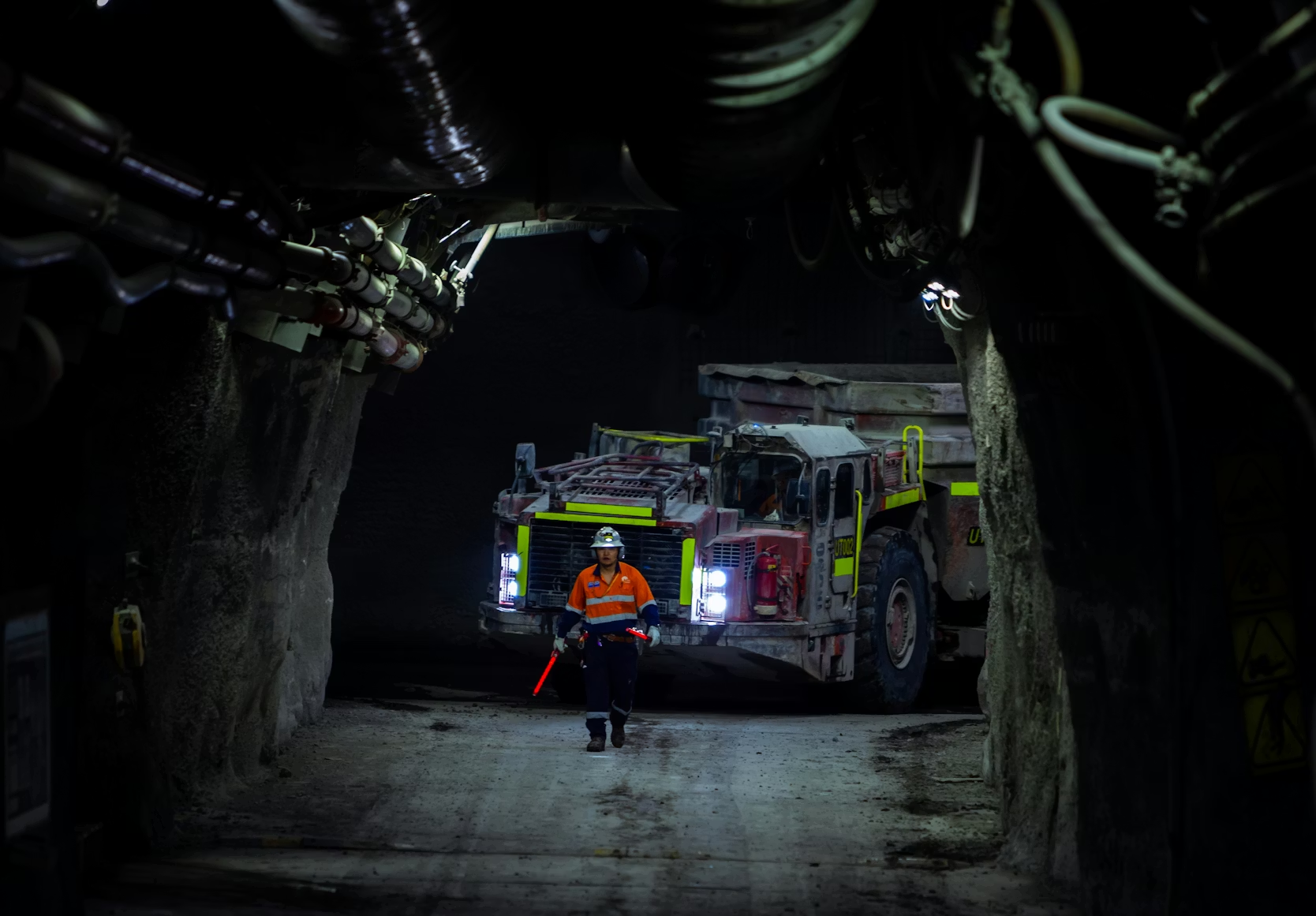
Midlothian adds a distinct awaruite and carbon storage angle to Timmins, expanding the district story beyond Crawford's current development path.
Project Overview
The Midlothian update shifts attention from project sequencing to district optionality. Canada Nickel reported mineralogical and metallurgical results from its 100% owned Midlothian Project that confirmed significant recoverable awaruite, alongside a carbon-related mineral profile that differs from Crawford.
Chief Executive Officer of Canada Nickel, Mark Selby, frames the broader supply backdrop this way:
"When you're dependent on one region for the supply of something that is important to your economy, you put your economy at significant risk, and what's happening right now is just bold and underlined."
1. Midlothian's Scale Places It in the District Conversation
Midlothian is not a small satellite target, because its current scale is large enough to affect how the broader Timmins portfolio is assessed.
An initial resource published in December 2025 outlined 590 million tonnes inferred at 0.28% nickel, containing 1.68 million tonnes of nickel. The body is approximately 2.5 kilometres long and up to 520 metres wide, with a 1.7-square-kilometre geophysical footprint, placing Midlothian in the same district-scale conversation as Crawford's Main and East Zones combined.
2. Awaruite Hosts 79% of Total Nickel
Midlothian stands out because most of its nickel is hosted in awaruite, which changes the deposit's technical character.
Mineralogical work on 177 samples from the first 14 of 22 drillholes shows that 79% of the total nickel at Midlothian is contained in awaruite. Nickel mineralisation is dominated by awaruite, with minor heazlewoodite support, and both are high tenor nickel minerals ranging from 65% to 75% nickel.
Midlothian also has the highest average nickel grade in the company's portfolio at 0.28%, with total nickel grades more than 30% above those of other leading awaruite deposits.
3. DTR Testing Opens a Recoverable Nickel Line
The first Davis Tube Recovery (DTR) results support a recoverability case through magnetic concentration, but they do not yet establish a finished processing route.
Four composite samples were tested by DTR. DTR nickel grades were 0.15%, 0.14%, 0.12%, and 0.07%, while DTR iron grades ranged from 2.6% to 3.6%. DTR nickel recoveries were 48%, 46%, 40%, and 25%.
Those tests were run at a primary grind size of approximately 190 µm, versus 75 µm cited for other deposits. The result is that nickel has been liberated from olivine minerals through serpentinisation and can be recovered in a magnetic concentrate. The unresolved question is whether finer grinding can improve grade and recovery across a wider sample base.
4. Brucite at 5.6% Exceeds Crawford's Main Zones
Midlothian's brucite abundance suggests a stronger carbon sequestration profile than Crawford's currently disclosed main zones.
Quantitative Evaluation of Minerals by Scanning Electron Microscopy (QEMSCAN) work identified brucite as a key mineral indicator for carbon sequestration potential. Average brucite content at Midlothian is 5.6%. That level is significantly higher than both Crawford's East and Main Zones and more than 2.5 times higher than Crawford on the current disclosed comparison.
For a company already building multiple carbon-related pathways around its Timmins assets, that mineral difference extends beyond geology and into long-term project design flexibility.
5. Midlothian Stands Apart from Crawford on Mineralogy
Midlothian represents a separate technical and development route within Timmins, rather than a smaller analogue of Crawford.
The direct comparison points are clear enough to support that framing. Midlothian's geophysical footprint is 1.7 square kilometres, compared with Crawford's 1.6 square kilometres. Midlothian's inferred resource grade is 0.28% nickel, compared with Crawford's grades of 0.24% Measured and Indicated and 0.22% inferred.
The more important contrast is technical rather than chronological. Midlothian exhibits stronger awaruite dominance and higher brucite content, whereas Timmins hosts multiple ultramafic deposits with distinct metallurgy and carbon-related attributes.
6. Timmins as a Multi-Asset Nickel District
Midlothian adds weight to the argument that Timmins is a multi-asset nickel district with varied development pathways.
The Timmins Nickel District contains more than 20 consolidated targets with a 42-square-kilometre geophysical footprint, or 25 times the 1.6-square-kilometre scale used for Crawford. Ten properties have target footprints larger than Crawford, while eight published resources contain 10.1 million tonnes of Measured and Indicated nickel and 12.5 million tonnes of inferred nickel. Reid, Mann West, and Midlothian are identified as the three largest targets in the portfolio, collectively called the "Three Giants."
That portfolio is being linked to a downstream and carbon strategy, not just an upstream resource inventory. NetZero Metals is intended to develop downstream nickel processing and stainless steel facilities in Timmins. The district's carbon pathways include IPT Carbonation, the NetCarb Alliance, and a partnership with the University of Texas at Austin and the US Department of Energy Advanced Research Projects Agency Energy.
Selby is direct about the wider market context for alternative supply routes:
"The good piece is that Indonesia's two-thirds of supply has that entire cost base sliding up the cost curve. For other assets that can get on the other side, the kind we've got at Canada Nickel and others like it, if you end up on the other side of that cost curve, you've got all this supply to the right of you and should be in a position to be cash flow generative across the cycle."
7. What Midlothian Still Has to Demonstrate
Midlothian has opened a credible new technical line of interest, but it still needs more work before it can carry the same strategic weight as a more advanced project.
The current mineralogical dataset covers only the first 14 of 22 drillholes, with results from the remaining eight holes still pending. The company also plans to assay all existing and future drill holes to calculate a DTR nickel resource grade alongside the total recoverable nickel resource.
That leaves three clear proof points outstanding. The resource remains entirely inferred; the finer-grind hypothesis has not yet been tested; and the recoverable-grade case still depends on wider assay coverage.
Key Takeaway for Investors
- Midlothian's 590 million tonne inferred resource and 1.7 square kilometre footprint support a Timmins valuation frame built on multiple assets rather than a single flagship project.
- The concentration of nickel in awaruite gives Midlothian a distinct metallurgical identity that could broaden future processing options across the district.
- Early Davis Tube Recovery results do not yet establish a full development route, but they do connect geology with a potentially recoverable magnetic nickel stream.
- Brucite content above Crawford's disclosed main zones strengthens the district's carbon narrative and could expand future project design options.
- Midlothian supports the argument that Timmins can be developed as a district with multiple large assets, varied mineral profiles, and more than one long-term pathway into nickel and stainless steel markets.
Bottom Line
The Midlothian update does not alter Crawford's role as the flagship project, but it does broaden the technical range of what the Timmins district could become. Midlothian now looks relevant because it is already large enough to matter, it hosts nickel in a different mineral form, and it appears to carry a stronger carbon storage signal than Crawford's main zones.
Selby is precise on the policy and capital backdrop for that broader district case:
"As this year goes on, I think you're going to see a self-reinforcing loop where governments are going to start providing chunky funding across other minerals, more generalist investors are going to come into the space and start to pick up some of the other commodities, and it should hopefully be a self-reinforcing loop as we move through 2026."
The next points to watch are whether pending mineralogical work confirms the same pattern across the remaining holes, whether finer grind testing improves concentrate quality, and whether Midlothian starts to build a recoverable grade framework that can sit alongside its current inferred resource.
Analyst's Notes





Subscribe to Our Channel

.png)

.png)




.png)
Stay Informed


