




Tudor Gold Launches 2026 Drilling at Treaty Creek: Targeting High-Grade Expansion Near Goldstorm



Tudor Gold drills two satellite zones at Treaty Creek to test whether higher-grade gold can expand one of Canada's largest undeveloped gold deposits.
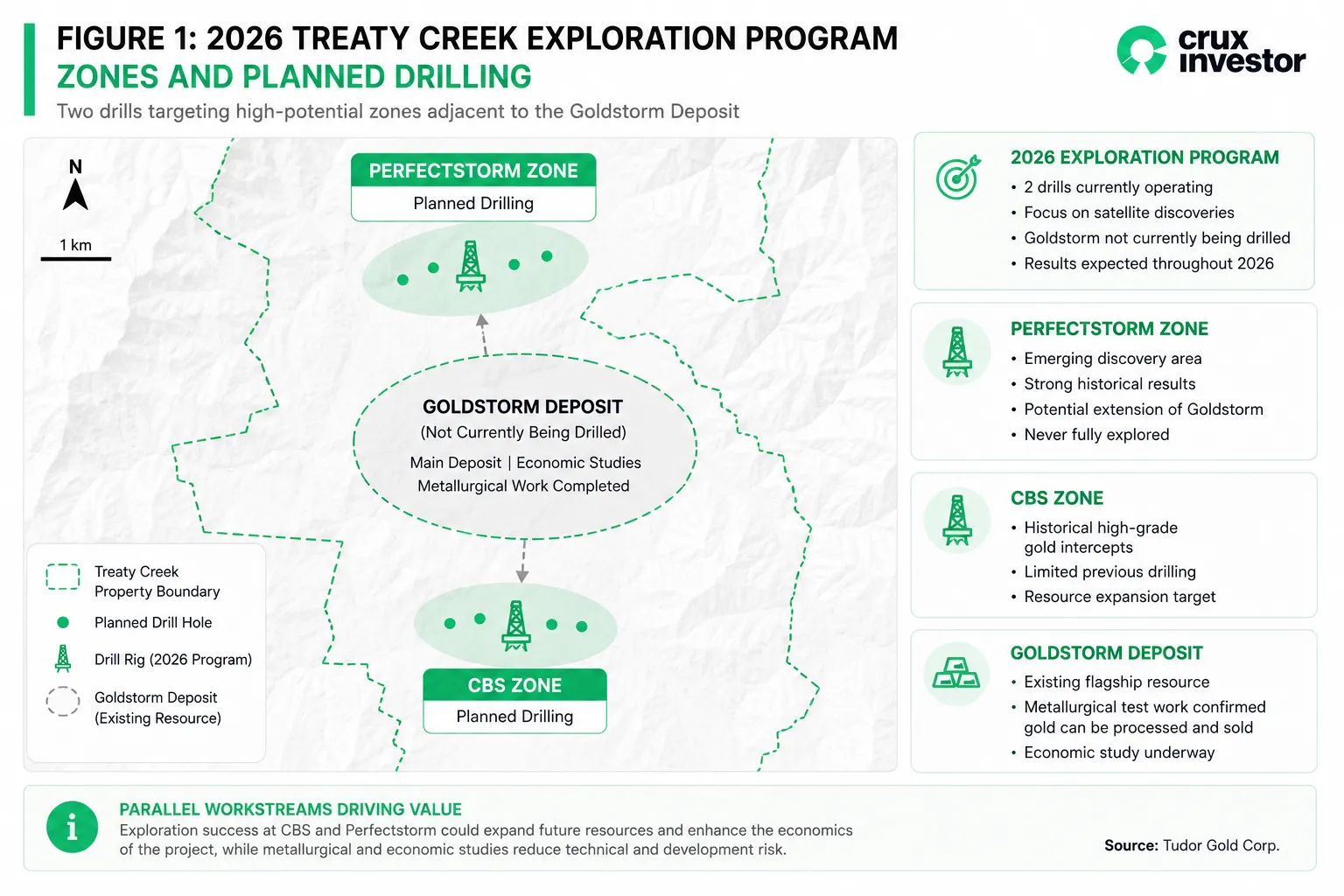
- Tudor Gold has started its 2026 drilling program at the Treaty Creek Project in British Columbia's Golden Triangle, with two drills targeting the CBS and Perfectstorm zones that sit outside the project's main defined deposit.
- The CBS Zone is being tested using a revised geological model, developed with the University of British Columbia's Mineral Deposit Research Unit, that targets potentially better grades closer to the main Goldstorm Deposit.
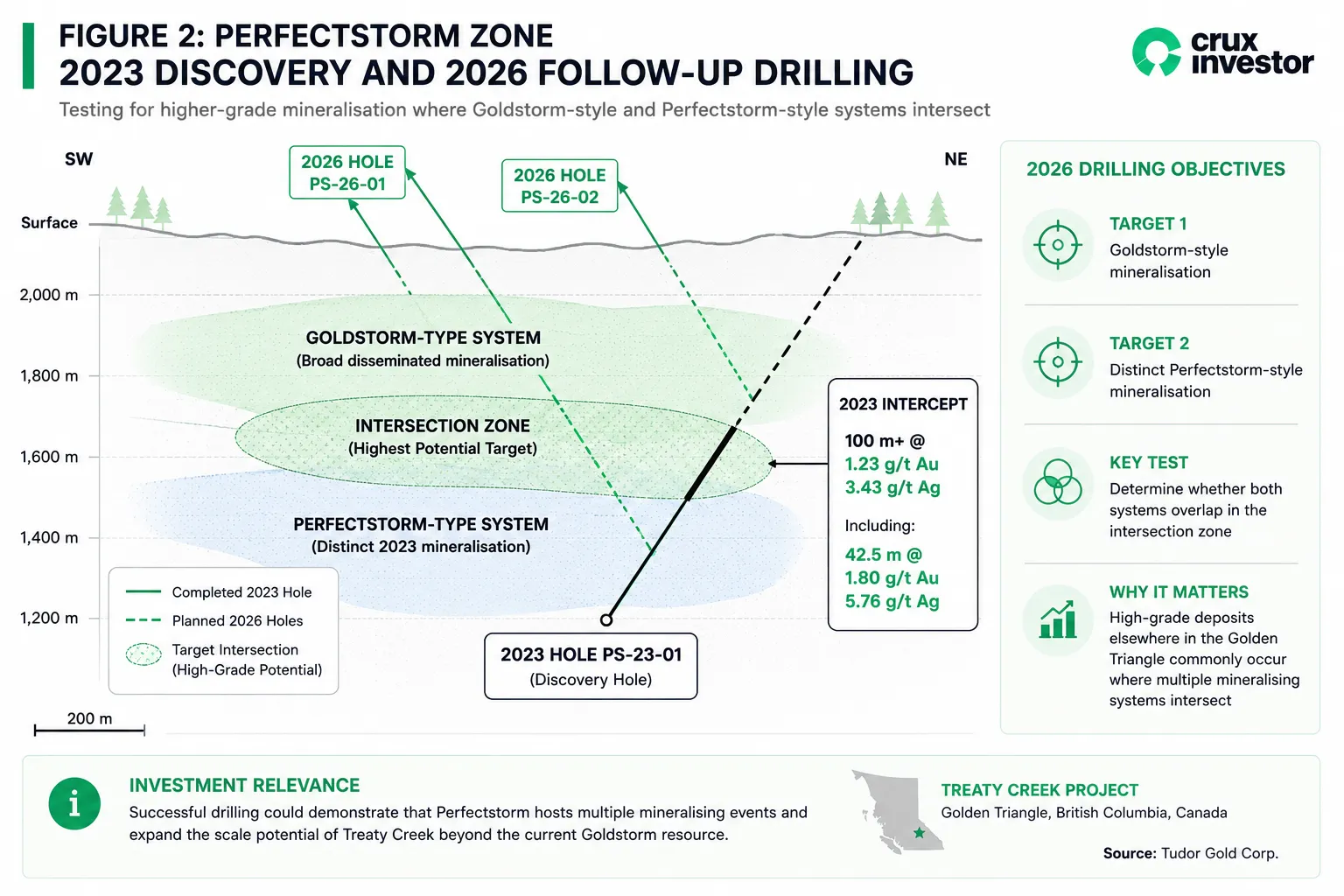
- The Perfectstorm Zone, receiving the bulk of the season's drilling, returned its best result in 2023 at grades more than double the Goldstorm resource average, making it the program's most closely watched target.
- A recent laboratory test confirmed that rock from the Goldstorm Deposit can be processed into sellable gold, silver, and copper concentrates, reducing a key technical uncertainty for the project.
- A Preliminary Economic Assessment on the Goldstorm Deposit is targeting completion in the third quarter of 2026, which will establish the first formal estimate of what it might cost to build and operate a mine at Treaty Creek.
What Has Happened
Tudor Gold (TSXV: TUD | FRA: H56) has started its 2026 drilling program at the Treaty Creek Project in British Columbia's Golden Triangle, with two drills now turning at zones that sit outside the project's main gold deposit. The program is targeting the CBS Zone and the Perfectstorm Zone, two areas that have returned promising gold results in previous seasons but have never been drilled thoroughly enough to determine their true size or grade. One of those zones, Perfectstorm, previously delivered results at grades more than double the average of the main deposit, which is what makes this season's follow-up drilling the most consequential work Tudor has done outside of Goldstorm to date.
For a new investor, it helps to understand what is at stake. Treaty Creek already has one of the largest defined gold deposits in Canada. The question this drilling program is trying to answer is whether the zones sitting next to that deposit could make the overall project even more valuable by adding higher-grade gold to what is already there. Higher grades matter because they directly affect how profitable a mine can be: the more gold in each tonne of rock processed, the lower the cost of producing each ounce.
This drilling update arrives at a moment when the project is advancing on several fronts at once. A laboratory test published just days before the drills started confirmed the main deposit's gold can be processed and sold. A formal economic study is also underway, targeting completion before the end of the year. Each of those developments feeds into the other, and together they mark Treaty Creek as a project that has moved beyond pure exploration into the early stages of asking what a mine here might actually look like.
What Is Treaty Creek & Where Does the Project Stand Today
Treaty Creek is a gold, silver, and copper project in British Columbia, owned 80% by Tudor Gold. Its main asset is the Goldstorm Deposit, which holds nearly 25 million ounces of gold in the Indicated resource category. For context, an Indicated resource is not a promise that all that gold can be mined profitably. It is a quantity that qualified geologists have mapped out with enough confidence to use as the starting point for economic studies. Think of it as the baseline from which the project's financial case gets built.
Goldstorm is large enough that it already sits in a category occupied by very few undeveloped projects in Canada. The deposit has now cleared two significant milestones in quick succession: the gold has been shown to be processable in a laboratory setting, and a formal economic study is now being prepared. Those two steps move the project from the "exploration" column closer to the "development" column in the way the mining industry classifies its assets.
The 2026 drilling program does not change what is already defined at Goldstorm. What it could change is the total picture of what Treaty Creek becomes. If the CBS and Perfectstorm zones are found to carry substantial higher-grade gold, they could add material that improves the average grade of the project as a whole, which in turn could improve the economics of a future mine.
Why the Satellite Zones Are Being Drilled Now
The first phase of the program focuses on the CBS Zone, which sits at a lower elevation than the rest of the Treaty Creek targets. That lower position means crews can access it earlier in spring and keep drilling later into autumn, extending the working season in a region where mountain weather limits how long field work can continue each year. Past drilling found gold across wide sections of rock at CBS, but the grades were below the stronger sections of the main deposit.
What changes the logic of drilling CBS in 2026 is a revised geological model developed with researchers from the University of British Columbia's Mineral Deposit Research Unit. The new interpretation suggests that the CBS Zone and the Goldstorm Deposit may have been created by the same underground geological event, and that drilling towards Goldstorm from the CBS side could intersect better grades than previous holes found. That is a testable hypothesis, and the 2026 program is designed specifically to test it.
The second phase sends the bulk of the season's drilling to the Perfectstorm Zone, and that is where the clearest prior evidence of high-grade potential sits. In 2023, one drill hole at Perfectstorm intersected gold and silver grades over more than 100 metres, with a higher-grade section of 42.5 metres grading 1.80 grams per tonne gold and 5.76 grams per tonne silver. Those grades are more than double the average across the Goldstorm resource, which means that if Perfectstorm can be shown to carry that grade consistently across a larger area, it becomes a genuinely meaningful addition to the project. The 2026 program will test two distinct types of mineralisation at Perfectstorm: one that looks similar to what is found inside the Goldstorm Deposit, and a second type identified in the 2023 hole that appears to represent a different gold-forming process entirely. In the Golden Triangle, where both types have been found together at other projects, some of the district's best grades have come from exactly that combination.
Why the Processing Results Matter Before a Single Hole Is Assayed
Just before the drills started turning, Tudor published the results of laboratory testing on rock from the Goldstorm Deposit. The tests confirmed that all three of Goldstorm's internal sections can be processed into sellable concentrates of gold, silver, and copper. For investors new to mining, this is worth pausing on. A large gold deposit is not valuable simply because the gold is there. The gold has to be physically separable from the rock around it, and the resulting product has to be of high enough quality that a smelter will buy it. Some deposits fail that test. Goldstorm did not.
The results showed that when material from all three zones was blended and processed together, more than 80% of the gold was successfully recovered, and the Lower Zone on its own achieved a gold recovery of 87.3%. In practical terms, that means the process used in the laboratory captured most of the gold in the samples tested, which is a strong result for this type of deposit and gives the economic study now underway a solid technical foundation to work from.
For the CBS and Perfectstorm program specifically, these results carry a useful implication. If those zones are geologically connected to Goldstorm, as the company's model suggests, their rock is likely to behave in a similar way when processed. That removes one layer of uncertainty from any future scenario in which the satellite zones contribute to the project's overall resource.
The Economic & What New Investors SHould Know About It
Fuse Advisors Inc. of Vancouver is preparing a Preliminary Economic Assessment for the Goldstorm Deposit, targeting completion in the third quarter of 2026. For investors new to the mining sector, a Preliminary Economic Assessment (PEA), is the first serious attempt to model whether a deposit can become a profitable mine. It estimates what it would cost to build the mine, what it would cost to run it each year, what revenue the gold, silver, and copper sales would generate, and what kind of return on investment that might produce under a stated set of assumptions.
A PEA is not a decision to build a mine. It is a model, and models carry uncertainty. But it is the document that allows the market to begin attaching a potential value to the project, and for Treaty Creek it will be the first time that calculation has been formally published and independently reviewed. Understanding that Tudor is pursuing an underground-first development approach rather than a large open-pit operation is important context for reading the PEA when it arrives, because it shapes the cost structure, the production rate, and the capital required to build.
When the PEA is released, investors should resist focusing only on the headline value figure. The assumptions underneath it, including the gold price used, the size of the modelled mine, the length of the mine life, and the estimated construction cost, are what determine whether the economics are realistic and how the project compares with others at a similar stage of development.
Where Treaty Creek Fits in the Golden Triangle
Treaty Creek sits between two projects that serve as useful reference points for understanding the region. To the southwest is Seabridge Gold's KSM property, one of the largest undeveloped gold-copper projects in the world. To the southeast is Newmont Corporation's Brucejack Mine, an active producing gold mine. Brucejack matters here because it is direct evidence that a large gold mine can be built and operated in this specific part of British Columbia, a question that is not always easy to answer in remote mountain terrain.
KSM offers a different kind of context. It has been in development for decades and has not yet reached production, which illustrates how long the path from large resource to operating mine can be for projects of this scale in this jurisdiction. That is not a negative reflection on Treaty Creek specifically, but it is an important reality check for investors trying to understand what kind of timeline they are working with.
Treaty Creek sits between those two reference points in its development journey. It has a large defined resource, is clearing its first processing and economics hurdles, and is still actively testing the boundaries of what the project could ultimately become. That combination means the project is at a stage where new information still has genuine power to change the picture.
What to Watch Next
CBS Zone results will be the first to arrive, with the smaller Phase 1 scope and the zone's favourable early-season access likely putting initial assays in front of investors before mid-year. The question that matters most is whether holes drilled towards the Goldstorm contact, using the revised geological model, return better grades than previous CBS drilling found. If they do, that supports the theory that CBS and Goldstorm are connected underground and opens the possibility of a larger combined resource envelope.
Perfectstorm results will follow later in the season. The volume of metres directed there means the program should be large enough to determine whether the strong 2023 hole reflects a broad, consistent zone or was a single high-grade occurrence. Broad continuity across multiple holes would be the more significant outcome, as it is the kind of result that can feed into a resource estimate and eventually into engineering work.
The PEA targeting the third quarter of 2026 will be the most market-moving release of the year for Tudor Gold. Tudor has also applied for a permit to build an underground ramp into a higher-grade section of the Goldstorm Deposit. Approval would allow drilling that surface programs cannot replicate and would sharpen the picture of the deposit's high-grade core ahead of any follow-on feasibility work. Each of these milestones carries the potential to materially shift how the market values Treaty Creek, and investors should watch for all three before the year is out.
FAQs (AI-Generated)
Analyst's Notes





Subscribe to Our Channel




.png)



.png)
Stay Informed






















