




From Gold Rush to Porphyry Play: Carolina Rush Drills Deeper in South Carolina


.webp)
Carolina Rush drills for porphyry copper-gold in South Carolina with OceanaGold backing, testing whether the region can deliver world-class deposits alongside near-surface gold.
When Layton Croft moved back to North Carolina from two decades in Mongolia and Asia, he brought with him an unusual résumé for a junior mining CEO: Peace Corps volunteer turned nonprofit executive turned Ivanhoe Mines strategist on one of the world's largest undeveloped copper-gold deposits. That unconventional path now underpins Carolina Rush Corporation's thesis that the southeastern United States - birthplace of North America's first gold rush - may still hold geological surprises that modern exploration has overlooked.
The company is currently halfway through the second of three deep drill holes designed to test whether the historic Brewer gold mine in South Carolina sits atop a porphyry copper-gold system similar to world-class deposits found elsewhere. If the results prove compelling, Carolina Rush will have cracked open a frontier that no geologist would typically associate with such mineralisation - and done so with a C$12 billion partner footing the bill.
Drilling Underway, Assays Pending
Carolina Rush began its maiden deep drilling program in January 2026 under an earn-in joint venture with OceanaGold, which operates the adjacent Haile gold mine just 15 minutes away. The three-hole commitment represents a minimum spend of US$1.5 million, the floor of a larger agreement that could see OceanaGold invest US$20 million over five years to earn an 80% interest. Carolina Rush remains free-carried through the entire exploration program, preserving its 20% stake without additional capital requirements.
"Should I stay or should I go? Is Oceana going to stay with us or not?" Croft framed the central question for 2026 in a recent interview at PDAC, referencing The Clash with characteristic informality. The answer depends on what the assays reveal when they return in the coming months. Laboratory turnaround times have stretched beyond historical norms due to industry-wide capacity constraints, but the geological and geophysical data collected so far point to a system with the right architecture.
The US Geological Survey identified Brewer as a porphyry target with copper potential as early as the 1970s. The property shares geological characteristics with Haile, which contains approximately five million ounces and provides OceanaGold with existing infrastructure that could, in theory, process ore from a future Brewer operation. Croft was careful not to speak for his partner's plans, but the operational synergies are difficult to ignore.
"They have a mine, they have a mill. It's literally 15 minutes in a car," he noted.
A Two-Pronged Opportunity
While the deep porphyry thesis captures the high-risk, high-reward imagination, Carolina Rush has already established a de-risked baseline. The company published a maiden resource estimate in 2025 totaling approximately 500,000 ounces of gold, compliant with NI 43-101 standards, derived from just 36 drill holes. That near-surface mineralisation operated as an oxide heap leach mine during the 1980s and 1990s before being abandoned and later reclaimed.
Croft believes additional focused drilling could expand the near-surface resource significantly. "I think with more drill holes that number could get to one or two million ounces," he stated, though he acknowledged that the real prize lies deeper. The porphyry target would require substantial capital and expertise to test properly - resources that were beyond the reach of a junior explorer operating independently, which is precisely why the OceanaGold partnership was structured.
Under the terms of the earn-in, OceanaGold must spend US$8 million over the first two years to earn 50%, with an option to invest an additional US$12 million over three subsequent years to reach 80%. If OceanaGold elects to exercise the underlying option to purchase the property from the US government (held under option by Carolina Rush), the acquisition price is estimated at US$27 million. OceanaGold would be responsible for 100% of that cost to secure its 80% interest, leaving Carolina Rush with a free-carried 20% in a potentially significant asset.
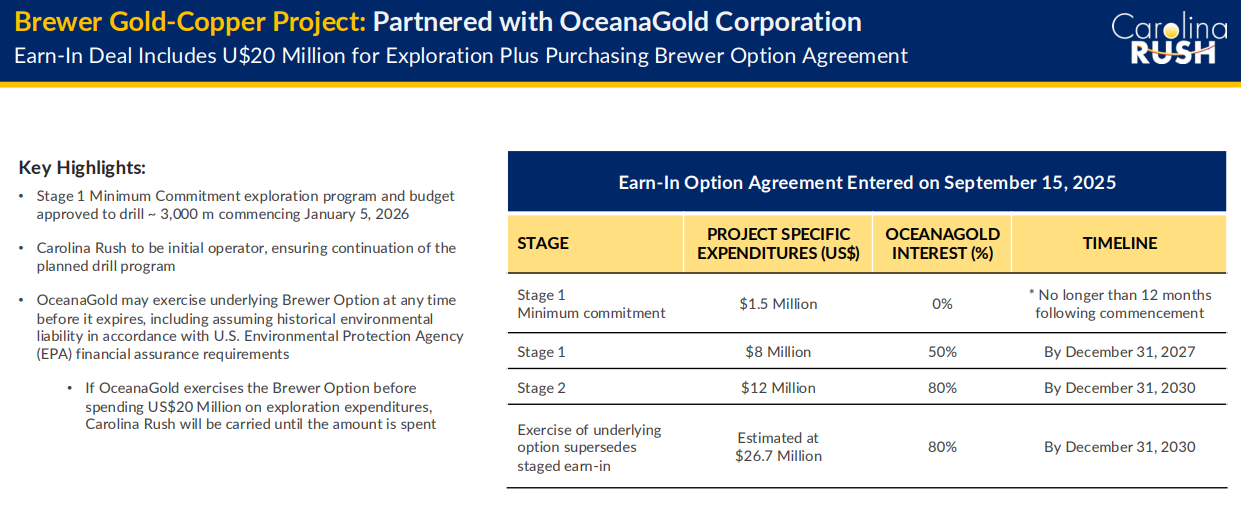
The initial three-hole program is designed to provide preliminary data on the deep porphyry potential while capping OceanaGold's downside. If results warrant continuation, the partnership could accelerate drilling to reach the US$8 million first-phase target within the two-year window.
Building a Regional Platform
Beyond Brewer, Carolina Rush positions itself as a regional consolidator with specialised knowledge of southeastern US mineral potential. The company maintains a proprietary database of prospects compiled over several years, digitising historical mining data dating back to the late 1700s. That database represents a competitive asset in a region where private land ownership creates challenges for assembling adequate exploration packages.
Carolina Rush previously held two additional gold projects under private lease but dropped them to focus resources on Brewer. The company continues to evaluate opportunities for partnerships and acquisitions that would expand its portfolio without requiring significant capital deployment. Croft emphasised that any new projects would need to demonstrate rapid value creation and a clear pathway to monetisation, particularly given the current market environment where creative structuring has become viable.
If the porphyry system at Brewer proves mineralised and economic, Croft suggested, "we've cracked the code on the southeast," which would likely attract significant interest from larger mining companies seeking similar targets in the area. The company's technical team, led by exploration manager Patrick Quigley, actively engages in discussions with landowners and project owners throughout the region.
Interview with Layton Croft, CEO, Carolina Rush
Jurisdiction and Permitting Pathway
One challenge facing Carolina Rush is that Brewer is designated as a Superfund site controlled by the US Environmental Protection Agency. The classification can deter investors concerned about environmental liabilities and regulatory complications. However, Croft believes South Carolina offers advantages that offset these concerns, particularly after the successful permitting and development of the Haile mine by Romarco (later acquired by OceanaGold).
Haile navigated a challenging process involving wetlands, endangered species concerns, and US Army Corps of Engineers oversight. That precedent has established a regulatory pathway in South Carolina that Croft considers favorable compared to neighboring North Carolina, which has higher population density and more complex land assembly challenges despite also being pro-mining.
The Year Ahead
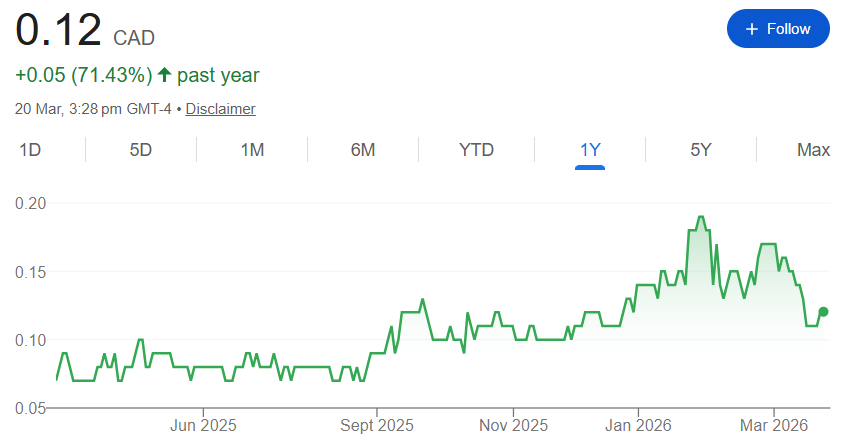
Carolina Rush shares have responded positively to the drilling catalyst, rising more than 71% over the past year to trade around $0.12 CAD as of late March 2026. The company's market capitalisation of approximately $10 million reflects the early-stage nature of the exploration thesis, with significant upside embedded in the porphyry discovery scenario.
Near-term value inflection points include the arrival of assay results from the initial three drill holes (expected in Q2-Q3 2026), OceanaGold's decision on whether to continue funding beyond the minimum commitment, and potential announcements regarding new project acquisitions. The longer-term catalyst remains the ultimate validation or rejection of the deep porphyry thesis, which could fundamentally reshape perceptions of the region's mineral endowment.
For Croft, the opportunity represents a convergence of geology, infrastructure, jurisdiction, and partnership that rarely aligns in junior exploration. Whether the drill bit confirms that convergence will determine if Carolina Rush's bet on an unconventional frontier pays off - or if the southeastern United States remains better known for its historical gold rushes than its future copper-gold discoveries.
Analyst's Notes





Subscribe to Our Channel



.png)




Stay Informed






















