Larvotto Strikes Gold at Midas as Hillgrove Transitions into Active Commercial Production


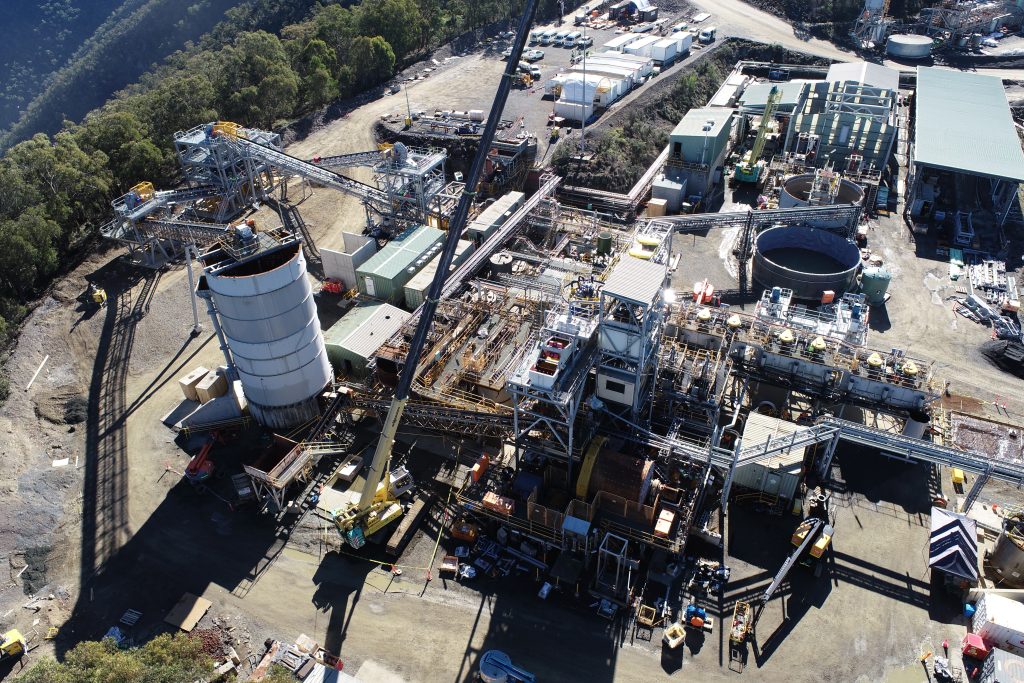
Larvotto Resources (ASX:LRV) starts Hillgrove production on schedule, with the Midas gold discovery and tungsten upside adding to the antimony growth story.
- Larvotto Resources commissioned the Hillgrove processing plant last August 2026 hitting its production start-up timeline management previously committed to.
- A newly discovered gold zone, Midas, sits 50 metres from existing underground workings and carries an exploration target of 223,000 to 2.95 million ounces gold equivalent.
- Tungsten is emerging as a third payable metal with 90% recovery achieved into the rougher float amid sharply higher tungsten prices.
- Offtake agreements with Glencore (gold) and Wogen Resources (antimony) are locked in for over 12 months, and a residential Armidale-based workforce has cut planned headcount from 250 to around 180.
- Management argues Hillgrove's share price has not kept pace with the doubling and tripling of gold and antimony prices, or with the project's on-time, on-budget delivery.
Larvotto Resources (ASX:LRV) has crossed the threshold every developer promises and few deliver on schedule: the Hillgrove Antimony-Gold Project in New South Wales fired up its processing plant in August, exactly when managing director Ron Heeks said it would. That milestone lands amid a critical minerals market moving faster than most companies can build into it - antimony prices have roughly tripled and gold has doubled since Larvotto acquired the historic Hillgrove field in late 2023. With commissioning underway, a new gold discovery sitting metres from existing workings, and tungsten emerging as a third payable metal, Hillgrove is shifting from construction story to producer - even if, as Heeks points out, the share price has yet to fully catch up.
Commissioning Complete, Production Ramping Up
Hillgrove's processing plant began operating on 31st August 2026, on the timeline Heeks set out when the two last spoke. Commissioning was budgeted at four months to reach full production of 500,000 tonnes of ore per annum, targeting 40,500 ounces of gold and 4,900 tonnes of antimony metal a year, roughly 7% of global antimony demand. Heeks expects the ramp-up to run considerably faster than the four-month allowance, noting the plant has already logged nearly double the operating hours originally forecast. Teething issues so far have been the routine kind budgeted for on any commissioning job, spread across a circuit producing two concentrates plus gold doré.
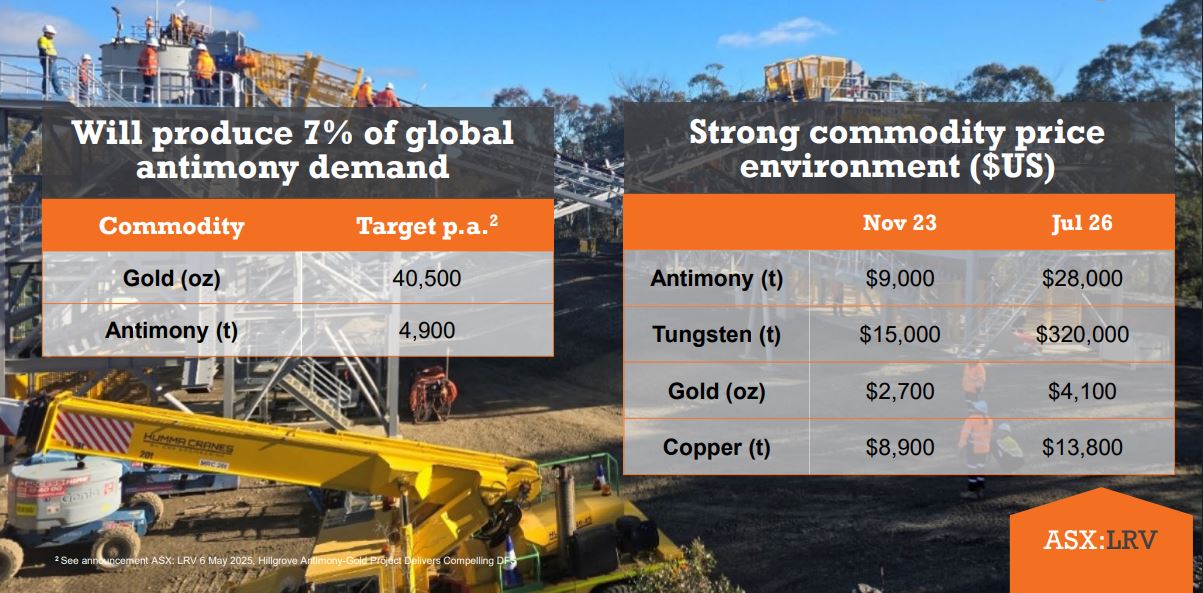
Heeks was candid about the gap between operational delivery and share price response. Antimony has climbed roughly threefold and gold has doubled since the project was acquired, yet Hillgrove's share price has lagged well behind that move despite management hitting every milestone it committed to.
"If you just do the numbers on what we should be putting out now, it looks pretty bright for where we are. I think we've demonstrated quite nicely that we built it on time and on budget - when was the last time you heard that?"
The Midas Discovery: Exploration Upside
The standout development since Larvotto's last update is the Midas zone, a new gold lode identified directly adjacent to current underground workings.
"We've found a new [lode] body, the Midas zone, which didn't exist last time we talked, and it looks like it's going to be a cracker. It's only 50 metres away from where we're currently mining. We just didn't know anything about it."
The company's Initial Midas Lode Exploration Target puts the zone at 2.7 to 10.7 million tonnes grading 2.58 to 8.55g/T AuEq for between 223,000 and 2.95 million ounces of gold equivalent which is a wide range Heeks attributes to deliberately conservative modelling by Larvotto's chief geologist, with the mid-case sitting around one million ounces. Because Midas sits directly off existing underground development, it can potentially be brought into the mine schedule ahead of deeper, more capital-intensive targets. All five of Larvotto's active drill rigs - three on surface, two underground - are currently focused on the zone, following the completion of the Clarks Gully programme, where assay results have been delayed roughly two months by a backlog at Australian labs. A separate Initial Metz Exploration Target adds a further 670,000 to 1.08 million ounces of gold equivalent to the pipeline. Note that Exploration Targets are conceptual: there has been insufficient drilling to classify a Mineral Resource, and it is uncertain whether further work will result in one.
Tungsten Emerges as a Third Payable
Hillgrove has always contained tungsten, historically discarded to the tails dam because nobody wanted it. That has changed: metallurgical work is now achieving 90% recovery of tungsten into the rougher float, and Heeks says work to bring the metal fully online is moving further forward as commissioning bandwidth allows. The timing is dramatic, global tungsten prices have strengthened substantially since late 2023, trading in the range of $300-350 per metric ton unit, turning what was once waste into a genuine third revenue stream alongside gold and antimony concentrate. Crucially, none of that tungsten upside is captured in Hillgrove's existing JORC Ore Reserve or Mineral Resource figures, both of which are calculated on gold and antimony alone, meaning any tungsten cash flow falls largely outside value already priced into the project rather than substituting for it.
Hillgrove also hosts what was Australia's highest-grade tungsten mine in the 1960s, roughly 200 metres from the current haul road - additional upside for later in the development sequence once commissioning bandwidth frees up. Rare earth drilling flagged in earlier updates has not proceeded; Heeks described it as "a bridge too far" for now, with the Perth-based exploration team redeployed instead to Hillgrove and to Larvotto's Mt Isa copper project in Queensland, a reallocation toward the two assets management currently treats as highest priority.
Interview with Ron Heeks, Managing Director of Larvotto Resources
Offtakes, Approvals & Regional Growth
Offtake arrangements have been locked in for more than 12 months: gold concentrate goes to Glencore, and antimony concentrate to Wogen Resources, with current payables benefiting from disruption in Chinese supply chains. Glencore is also positioned to take copper from Larvotto's Mt Isa project once that advances, given its smelter sits a short distance from Larvotto's tenure. On approvals, the company is progressing the regulatory pathway required to expand Hillgrove toward its full 500,000 tonne-per-annum production target; Larvotto has submitted its latest responses to government questions and reports no flagged issues, though Heeks acknowledged the process "takes as long as a piece of string," a common frustration with government approvals generally.
Growth beyond Hillgrove is centred on the Mt Isa Copper Project in Queensland, where Larvotto says it is explicitly replicating its Hillgrove development model. The company holds more than 1,000 square kilometres of copper tenure in the region and has acquired the historic Blockade Mine, where a recent reverse-circulation drilling programme validated historical results including 31 metres at 1.16% copper from 63 metres, with high-grade intercepts up to 4.08% copper and associated elevated cobalt. Existing historical mining and infrastructure at Blockade are expected to compress development timelines relative to a greenfield project, giving Larvotto a second, earlier-stage growth platform to run alongside Hillgrove's cash generation.
Workforce Efficiency, Balance Sheet Strength
Larvotto originally modelled Hillgrove as a fly-in fly-out operation requiring around 250 workers. By building a residential workforce based in nearby Armidale, the company has cut that to roughly 180 people for the same output, a structural cost saving Heeks credits to the calibre of staff the location attracts. Power costs are similarly de-risked: the underground fleet runs on grid electricity from a solar array adjacent to site, with only a handful of haul trucks and light vehicles using diesel. All staff hold shares in the company, which Heeks says has kept morale intact through a volatile trading period even as commissioning absorbs day-to-day attention.
Larvotto took Hillgrove from acquisition to first production in roughly two and a half years, funding the build through a $150 million debt facility secured within eight weeks of completing its Definitive Feasibility Study, followed two days later by a $70 million equity raise, a sequence that left the project fully funded through construction and commissioning. As of June 2026, the company reported cash of $87.9 million against debt of $152.9 million, with a market capitalisation of $581.6 million. The company's financing structure, paired with the workforce savings above, gives Larvotto headroom to pursue its stated growth priorities on exploration, acquisition, and financial and technical capability without an immediate reliance on further dilutive capital raises.
The Investment Thesis for Larvotto Resources
- Hillgrove reached first production in August 2026 on the exact timeline management set, a rare execution track record in junior mining development.
- Full-production targets of 40,500 ounces of gold and 4,900 tonnes antimony annually would make Hillgrove Australia's largest antimony producer and supply roughly 7% of global demand.
- The Midas Lode Exploration Target (223,000-2.95Moz gold equivalent) sits directly off existing underground infrastructure, offering a low-capital route to near-term resource and mine-life growth.
- Tungsten recovery of 90% into the rougher float adds a third payable metal at a moment of sharply elevated tungsten pricing.
- Offtake agreements with Glencore and a Wogen Resources counterparty are locked in for over 12 months, reducing near-term marketing and pricing risk.
- Watch items: confirmation of Midas and Metz drill results currently delayed by Australian lab turnaround, progress on the Modification 5 approval needed to reach full 500,000 ton-oper-annum capacity, and whether the share price re-rates to reflect execution and the doubling/tripling of underlying gold and antimony prices since acquisition.
Macro Thematic Analysis
Hillgrove's ramp-up arrives inside one of the tightest critical minerals markets in years. China dominates global antimony and tungsten production and supply, and Western governments have responded by prioritising secure alternative sources: Australia's $1.2 billion Critical Mineral Reserve Strategy names antimony as one of only three prioritised critical minerals, despite it technically being classified as a metal rather than a "mineral" in the traditional sense. Larvotto has built out relationships across the Australian, US, EU, Japanese and Taiwanese governments, alongside defence supply chain contacts and dedicated strategic and government relations advisers, positioning Hillgrove within that broader Western reserve-building push rather than as a purely commercial supply story.
"The gold price is more than double what it was when we started this, and the antimony price is two and a half times what it was when we started this."
For a project that is already in production with payables locked in, that pricing environment converts directly into cash flow rather than remaining a paper valuation argument on the distinction Heeks was pointing to when he questioned why the share price has lagged the fundamentals. With antimony recognised as a defence-relevant critical mineral and China's export posture tightening rather than easing, Hillgrove's position as one of the few new Western antimony sources due online in the next several years is likely to keep attracting government and offtake-partner attention independent of near-term share price sentiment.
TL;DR
Larvotto Resources fired up the Hillgrove processing plant on August 2026, on the exact schedule management promised, and is ramping toward 40,500oz gold and 4,900t antimony annually - about 7% of global antimony demand. A new gold zone, Midas, has been discovered 50 metres from current underground workings, adding an exploration target of up to 2.95 million ounces gold equivalent. Tungsten is emerging as a third payable metal at 90% recovery. Offtakes with Glencore and a UK antimony buyer are locked in, and a leaner, Armidale-based workforce has cut planned headcount from 250 to around 180. Management argues the share price has not yet caught up with execution or with sharply higher gold, antimony and tungsten prices.
FAQs (AI Generated)
Analyst's Notes





Subscribe to Our Channel





Stay Informed