




Cobra Weighs Permeability & Acid Generation Alongside Grade at Boland


Cobra Resources is building permeability, recovery, and acid generation into its maiden Boland resource, with a scoping study to follow later in 2026.
- Cobra Resources is targeting a resource model that captures grade, heavy rare earth enrichment, permeability, recovery, and acid generation and consumption as five inputs into project economics.
- Across 50 samples from the Boland and Head prospects, 70% show permeability comparable to or greater than the installed Boland wellfield.
- Final drilling at Head returned 2.35 metres (m) at 1,567 parts per million (ppm) total rare earth oxide from 11 m depth, with high-grade zones on both margins of the paleochannel.
- The maiden Mineral Resource Estimate is scheduled for the third quarter of 2026, with a scoping study following in the third and fourth quarters.
- A small-scale production study is targeting 400 to 600 kilograms (kg) of Mixed Rare Earth Oxides in the first half of 2027.
Resource Definition Under In Situ Recovery
Mineralization at Boland is hosted in a permeable sand aquifer bounded above by a clay aquitard and below by impermeable saprolite basement. That geology allows controlled aquifer in situ recovery (ISR), a method that requires no excavation, haulage, or beneficiation. Because the rare earths are recovered in solution rather than mined, the rock's capacity to transmit fluid and to generate its own acid governs how much of the contained metal becomes revenue. The Boland process depends on a confined, hyper-saline aquifer in which permeation is driven by permeability, unlike gravity-driven processes operating in unconfined, low-salinity groundwater.
Cobra Resources (LSE: COBR) is constructing a resource model that captures geological, metallurgical and physical parameters together. The economics of the project result from a combination of grade, heavy rare earth enrichment, permeability, recovery, and acid generation and consumption. Grade is one of those five. The criteria being measured in the model extend to ionic metallurgy and to aquifer depth and containment, which determine whether the leaching solution stays where it is injected.
Managing Director of Cobra Resources, Rupert Verco, justifies the front-loaded measurement work on execution grounds:
"If we can address that technical risk up front, it's going to give us high confidence in execution."
The Sonic Core Program & What It Measured
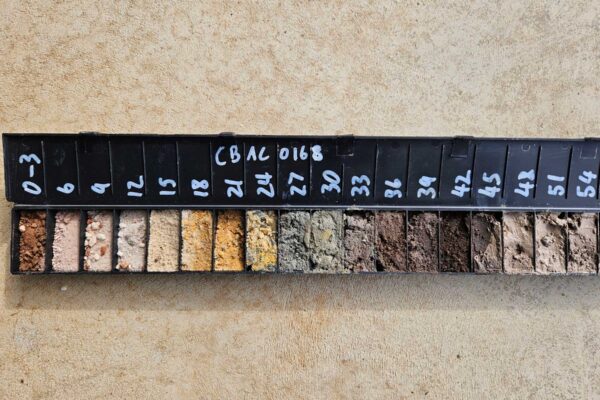
An extensive 74-drillhole sonic core program has been completed, and all assay results have been received. Management says the sonic core was selected because unconsolidated sediments are difficult to sample representatively, and the method returns a high-confidence core from which particle sizing can be tied back to completed hydrology work. Drilling used a 4-inch core, with holes reamed to 6 or 8 inches to accommodate casing and screens. Core samples were scanned with a handheld X-ray fluorescence analyzer to set sample intervals, taken at 10-centimetre intervals through mineralized zones. Total organic carbon, total carbon, and total sulfur were analyzed on selected intervals to support net acid-producing potential (NAPP) estimates.
At the Head prospect, the final results returned 2.35 metres (m) at 1,567 parts per million (ppm) total rare earth oxide (TREO) from 11 m depth in the Garford formation, 4.4 m at 710 ppm from 27.1 m, 2.8 m at 504 ppm from 36.1 m, and 2.75 m at 916 ppm from 38.3 m. Further high-grade mineralization has been defined on the margins of the main incised channel within a floodplain sedimentary sequence enriched in organics, with high-grade zones on both the eastern and western margins of the paleochannel system. Significant zones in the Garford and Narlaby formations, stratigraphically above the Pidinga, will be included in the resource estimate.
The aircore drilling that preceded the sonic program is subject to a known bias. Mineralization occurs within a confined aquifer where groundwater influences sample recovery, and in the Pidinga formation, the rare earths are bound to fine, organic-rich material, so loss of mineralized material from coarser host sands is possible. Any resulting grade bias is expected to be a grade loss, and the potential loss of fine material is being evaluated through sizing-fraction analysis and by twinning aircore holes with sonic cores. Sample recovery from the sonic core itself is considered excellent.
Permeability & Hydrology Inputs
Permeability at Boland and Head has been measured relative to an existing asset. Hydrological assessment of particle-size distribution found favorable productive permeability across the drilled footprint, with 70% of 50 drillhole samples across the two prospects matching or exceeding the permeability of the installed Boland wellfield. The benchmark is an installed wellfield in which the company has already emulated the recovery process, not a design assumption.
A scaled bench study yielded permeabilities greater than 8 m per day and 66% heavy rare earth oxide (HREO) recovery over 17 days, with acid consumption of 3.88 kilograms per tonne (kg/t). Management targets permeability rates above 1 to 2 metres a day, which it associates with productive wellfields, and wellfield spacings of 15 to 25 m. On those permeabilities, Cobra Resources models leach cycles of 30 to 60 days, and shorter cycles reduce the cost of turning each wellfield over.
Field hydrology has produced sustainable discharge rates, lateral connectivity, and uniform drawdown, and laboratory hydrology properties were validated in a field tracer test. Hydrology and tracer recovery studies support the permeabilities achieved in bench-scale testing, and the company has fulfilled regulatory guidelines for a baseline hydrological assessment.
Acid Generation, pH & Recovery Trade-offs
Reagent cost at Boland is partly a function of rock chemistry. High-grade mineralization within the permeable Pidinga formation at Head occurs on the eastern margin of the incised channel, in heavily reduced sands with high net acid-producing potential, which equates to low reagent use. NAPP is calculated from total sulfur less the carbonate carbon component, derived as the difference between total carbon and total organic carbon, so the same sampling that establishes grade also determines how much acid the rock will produce. Management identified carbonate-rich sands as one of its principal concerns at the outset, because carbonates consume acid. Ammonium sulfate reduction tests aim to use the high salt content of Boland groundwater to cut the quantity of ammonium nitrate, a high-cost input, in the leaching solution.
Recovery moves with the acidity chosen. Bench work returned 80% dysprosium and terbium recovery and 75% mixed rare earth oxide recovery at pH 3, falling to 45% and 46% at pH 5, while acid consumption fell from 6.7 kg/t at pH 3 to 1.95 kg/t at pH 4.5 and 1.6 kg/t at pH 5. Australia's Commonwealth Scientific and Industrial Research Organisation has independently demonstrated recoveries of 20% to 25% at pH 7 using sequential leach testing. Management puts natural acid generation potential as high as 60 kg of sulfuric acid per tonne of material treated in some holes, models consumption anywhere from 1 kg/t to about 16 kg/t, and says full capture is unlikely, though capture of up to 50% would deliver a large saving and reduce exposure to a tight sulfuric acid market. Cobra Resources will apply the method behind a net smelter return, the economic modeling threshold that operating mines use to set a variable cut-off grade based on all of their economic inputs.
Verco follows that logic to the point where a lower-grade zone outranks a higher-grade one:
"What that might say is some areas that have very strong metallurgy and very good acid-generating qualities and high permeabilities, but lower rare earth grade may be more valuable and more economic than other zones that are higher grade."
What the Maiden Estimate Is Expected to Classify
Global consulting group ERM is completing the maiden Mineral Resource Estimate (MRE), scheduled for the third quarter of 2026, after which Cobra Resources will proceed to a scoping study to evaluate project economics across the third and fourth quarters. Management anticipates higher confidence in the Pidinga formation, where metallurgical and hydrology work has been done and supports a higher recoverability component, and less confidence across the overlying formations, where more work remains.
Verco divides the coming estimate along that line:
"My expectation is that we will have a component indicated in the resource, and then we'll have an inferred area that will really show the scale and incorporate those additional formations."
Analysis of 43 samples from Head and Boland is underway to support recovery estimates across the wider estimation areas, as well as 2 bulk composite samples totaling about 100 kg. Assessment of drillhole spacing for resource estimation can only be made once a sufficient data set is available for statistical analysis. All 2026 sonic core holes were surveyed by a licensed surveying contractor with base corrections to 0.1-centimetre precision.
Resource definition has covered 2 areas within a 3,200-square-kilometre (km²) paleochannel system: Boland at 16 km² and Head at 85 km², together accounting for less than 5% of the prospective landholding. Against that footprint, the company is targeting a collective maiden resource of 200 million to 400 million tonnes at more than 1,000 ppm TREO, a target set before the final assay results were received and not itself an estimate.
Sequence to a Production Decision
The steps after the maiden estimate are designed to build techno-economic confidence, not to increase resource size. Preliminary engineering design and process modeling have been completed for a small-scale production study at the existing Boland wellfield in the first half of 2027, combining the field trial with the government-backed pilot facilities at the Australian Nuclear Science and Technology Organisation (ANSTO) to expedite permitting and reduce cost. The ANSTO facility is funded through the Australian Government Critical Minerals Research and Development Hub.
The design allows up to 4 wellfields in which natural acid generation, pH control, sequential recovery, and remediation will be trialed and used to validate economic assumptions. The study targets 400 to 600 kg of Mixed Rare Earth Oxides (MREO) within an intermediate product, which will be transported to ANSTO for dissolution, impurity removal, cerium suppression, and product precipitation. The field component is anticipated to take approximately 60 days. Management puts the cost of that work at a couple of million Australian dollars, with much of the wellfield infrastructure already installed.
Permitting has not yet caught up with the engineering. JBS&G Environmental Consultants and Rendement Consulting have been engaged and have commenced the engagement process to secure permit approvals for a small-scale production demonstration, which are not yet in hand, while study construction and installation are scheduled for the first quarter of 2027. Small-scale production is aimed at delivering high levels of techno-economic confidence to support the project's advancement to bankable feasibility, scheduled across 2027, from the first quarter to the fourth.
The Investment Thesis for Cobra Resources
- A resource built on five inputs means the maiden Boland estimate is designed to measure permeability, recovery, and acid generation alongside grade and heavy rare earth enrichment, because in situ recovery economics depend on all of them.
- A permeability benchmark that is already installed provides a reference point for the 70% of sampled material that matches or exceeds the Boland wellfield, drawn from a wellfield in which the recovery process has been emulated rather than assumed in design.
- Acid generation inside the orebody converts a reagent line item into a geological property, with heavily reduced sands at the eastern channel margin showing high net acid-producing potential and low reagent use.
- A variable cut-off grade allows zones with strong metallurgy, high permeability, and good acid generation to outrank higher-grade zones, which changes which parts of the deposit are economic.
- A split classification is anticipated in the maiden estimate, with higher confidence in the Pidinga formation and a wider, lower-confidence area that captures the overlying formations and the system's scale.
- A costed proving step follows the estimate, with a designed small-scale production study at an existing wellfield targeting 400 to 600 kilograms of mixed rare earth oxides in the first half of 2027.
The investment question at Boland is not how many tonnes the maiden estimate reports but how much of that tonnage arrives with the physical and metallurgical parameters attached. Cobra Resources has spent additional months precisely measuring permeability, recovery, and acid generation across the drilled footprint so that the estimate can support a scoping study without a second round of work first. The classification split management anticipates is the visible test of whether that spending worked, and the small-scale production study in 2027 is where the modeled parameters meet a wellfield.
TL;DR
Cobra Resources is defining its maiden Boland rare earth resource using a five-parameter model in which permeability, recovery, and acid generation are measured alongside grade and heavy rare earth enrichment. Under ISR, fluid transmission and the rock's own acid production determine how much contained metal becomes revenue. Across 50 samples, 70% match or exceed the permeability of the installed Boland wellfield, and heavily reduced sands at the eastern channel margin have high net acid-producing potential. The MRE is scheduled for the third quarter of 2026 with a scoping study directly behind it, and management anticipates a higher-confidence component in the Pidinga formation alongside a wider lower-confidence area.
FAQs (AI-Generated)
Analyst's Notes





Subscribe to Our Channel






Stay Informed






















