i-80 Gold's Pivot to Execution: The Remaining De-Risking Hurdles in Nevada


With $1B secured, i-80 Gold has removed its financing overhang. The investment case now depends on mine execution, permitting progress, and resource growth.
- i-80 Gold Corp closed its recapitalisation plan in the first quarter of 2026, exiting the quarter with US$513.5 million in cash after raising more than US$1 billion in secured and available capital across a combination of equity, royalty, prepayment, and convertible note financings.
- The company's 3-phase development plan targets average annual gold output of 150,000 to 200,000 ounces in Phase 1, scaling to 300,000 to 400,000 ounces in Phase 2, and 600,000 ounces or more in Phase 3, all contingent on the successful commissioning of the Lone Tree autoclave processing facility.
- Granite Creek Underground produced 8,857 ounces of gold in the first quarter of 2026 against 2026 full-year guidance of 30,000 to 40,000 ounces, with water ingress into the mine workings representing the primary near-term operational risk.
- The company's portfolio contains a total gold mineral resource estimate (MRE) of 6.5 million ounces measured and indicated (M&I) and 7.5 million ounces inferred, with the bulk of the inferred base requiring conversion to M&I categories before formal reserves can be declared at any property.
- Feasibility studies (FS) for Granite Creek Underground and Cove Underground are targeted for the second quarter of 2026, representing the company's first formal reserve declarations and a critical operational de-risking milestone.
- The 2026 drill program is the largest in company history, targeting approximately 131,000 metres at Mineral Point Open Pit and approximately 55,000 metres over 140 holes at Lower Archimedes Underground to support pre-feasibility study (PFS) and FS timelines.
What Has Happened
Following the closure of its recapitalisation plan in the first quarter of 2026, i-80 Gold (NYSE: IAUX | TSX: IAU) reported a cash balance of approximately US$513.5 million as at March 31, 2026. The plan assembled more than US$1 billion in secured and available capital through approximately US$300 million in equity financings, a US$250 million royalty financing with Franco-Nevada Corporation, approximately US$288 million in convertible senior notes, and a US$150 million gold prepayment facility with National Bank of Canada & Macquarie Bank. Approximately US$165 million of legacy debt was retired from the proceeds, completing the transition from a financing story to an execution story.
Chief Operating Officer of i-80 Gold, Paul Chawrun, described the shift:
"It's a relief, it's exciting. What I feel really proud of is that we have first-rate institutions that have been able to provide us with the confidence to put this together. We went through comprehensive due diligence, we had a competitive process as well, there were a lot of interested parties to be part of this story, and now we're all about execution."
Taming Granite Creek's Water Ingress
With capital secured and construction decisions granted by the Board, the remaining variables that determine whether i-80 Gold reaches mid-tier production status are operational throughput at Granite Creek, permitting progress across Phase 2 and Phase 3 assets, and the pace of resource conversion through its 2026 drill programs. Water management at Granite Creek Underground is the most immediate of these. The mine achieved its 2025 production guidance of 22,977 ounces of gold, and first-quarter 2026 results showed 8,857 ounces produced. However, water inflows into the active working areas have been exerting pressure on underground pumping capacity, necessitating mitigation measures to protect development rates.

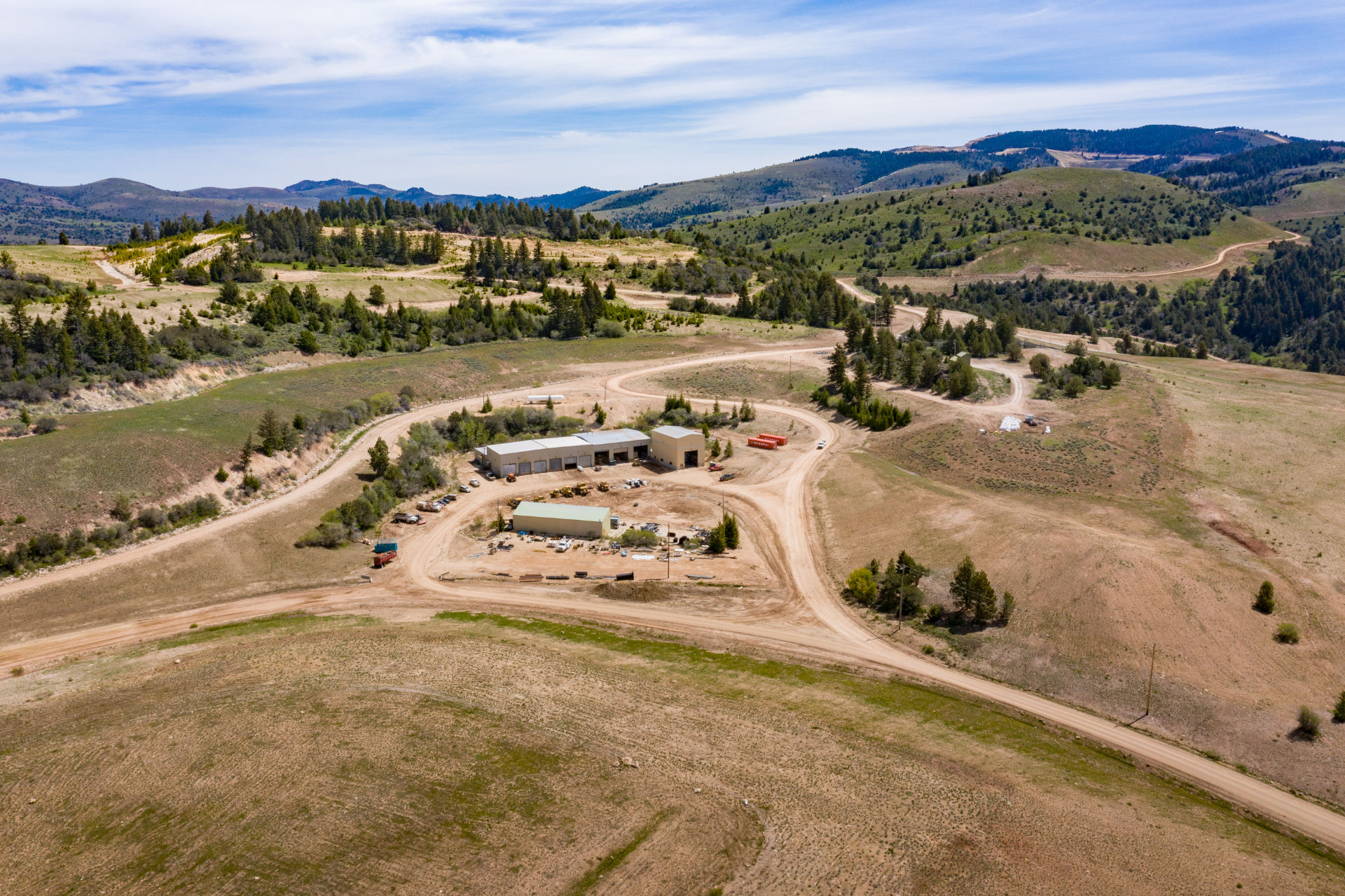
The company's direct response is the installation of a second, expanded water treatment plant targeted for commissioning in June 2026, complementing dewatering infrastructure upgrades already completed during 2025. First-quarter 2026 operational data indicate that the current mitigation measures are working, reporting a reduced water-related impact on operations and main decline development progressing on plan. The 2026 annual production guidance for Granite Creek is 30,000 to 40,000 ounces. This infrastructure supports the planned second quarter 2026 feasibility study (FS), which represents the project's first formal reserve declaration. The company has allocated US$10 million to US$15 million in 2026 growth capital specifically for this water treatment infrastructure.
The Permitting Clock for Phases 2 & 3
Permitting is the rate-limiting factor for the later stages of i-80 Gold's hub-and-spoke processing model. The Cove Underground and Granite Creek Open Pit projects both require completion of an Environmental Impact Statement (EIS) through the Bureau of Land Management (BLM), with each EIS process estimated to take approximately 3 years. Construction at Cove is targeted for 2028, with production in 2029, while the timing of the Granite Creek Open Pit FS is currently under review.

The Lone Tree Plant refurbishment requires secondary permit approvals, including water rights, water pollution control, and structural permits. The water rights permit is targeted for the second quarter of 2026, the water pollution control permit for the fourth quarter of 2026, and all environmental and structural permits for the second quarter of 2027, with mechanical completion in the fourth quarter of 2027 and first gold pour targeted for late December 2027.
For Mineral Point Open Pit, the portfolio's largest asset at 3.4 million ounces indicated and 2.1 million ounces inferred, the pre-feasibility study (PFS) is targeted for 2027, with timing under review. The company has allocated US$50 million from the Franco-Nevada royalty financing to Mineral Point infill drilling, engineering, and early-stage permitting during 2026, with the stated aim of initiating the EIS earlier than originally planned and potentially compressing the production timeline by 1 to 2 years.
Converting Inferred Ounces to Bankable Reserves
i-80 Gold's portfolio holds 7.5 million ounces inferred across the portfolio, compared to 6.5 million ounces in the measured and indicated categories. The distinction matters because inferred resources cannot form the basis of an FS or be converted to mineral reserves under NI 43-101 or Regulation S-K Subpart 1300. Until infill drilling converts a sufficient portion to indicated or measured status, the published Preliminary Economic Assessment (PEA) economics for each project carry a materially higher level of geological uncertainty than a completed FS would reflect.
The gap is most visible at Archimedes Underground, where the inferred resource of 988,000 ounces at 7.3 grams per tonne gold is significantly larger than the indicated resource of 436,000 ounces at 7.6 grams per tonne gold. At Cove Underground, the inferred resource of 1.16 million ounces at 8.9 grams per tonne gold is significantly larger than the indicated resource of 310,000 ounces at 8.2 grams per tonne gold. Both projects require formal reserve declarations before construction financing can be finalised.
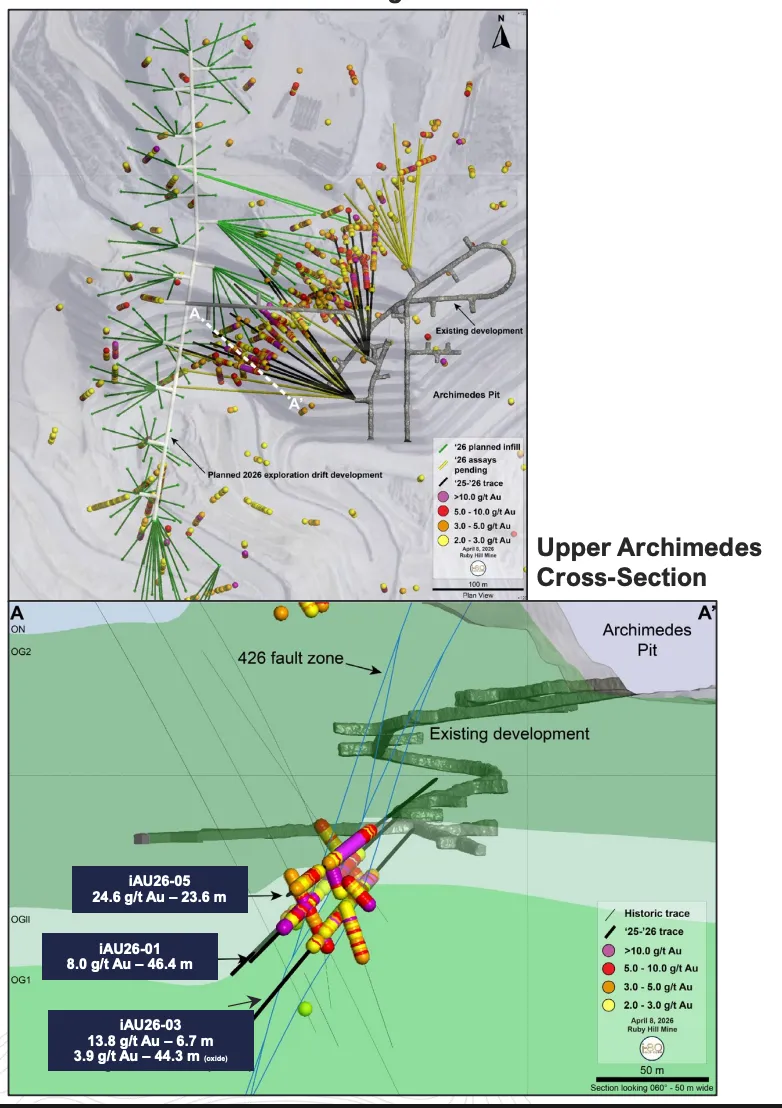
The 2026 drill program is the primary mechanism for resolving this. At Lower Archimedes, approximately 55,000 metres across 140 holes, targets measured and indicated (M&I) conversion to support a late first-quarter of 2027 FS. At Mineral Point, approximately 131,000 metres is planned to convert inferred resources ahead of the 2027 PFS. Upper Archimedes drilling completed in the second quarter of 2026 returned intercepts including 24.6 grams per tonne gold over 23.6 metres, consistent with the 2025 PEA model.
Chawrun addressed the resource by speaking specifically on the Mineral Point objective:
"We're going to be looking to convert all of that to measured and indicated to eventually get to a prefeasibility study in the early part of 2027."
Valuation Context
The combined PEA-level after-tax net present value (NPV) across all 5 projects totals US$4.9 billion at a gold price assumption of US$3,000 per ounce, against a market capitalisation of approximately US$1.3 billion. It’s undervalued relative to its net asset value (NAV) and growth profile. This represents a significant valuation gap relative to the combined NAV, reflecting the market's current discount for execution, permitting, and resource-conversion risk.
The milestones that close that discount are specific and measurable. FS delivery converts PEA-stage NPV into reserve-backed NPV. Lone Tree commissioning eliminates the 55% to 60% toll-milling payability drag and shifts Granite Creek, Archimedes, and Cove to approximately 92% gold recovery, thereby directly improving per-ounce cash margins. Mineral Point, with a PEA-level after-tax NPV of US$2.3 billion at US$3,000 per ounce gold and US$35.00 per ounce silver, represents the single largest re-rating event in the portfolio, but it is also the furthest from production, with construction not targeted until 2030.
What to Watch Next
Second quarter 2026 FS for Granite Creek Underground and Cove Underground will deliver the company's first formal mineral reserve declarations, converting PEA-stage economics into reserve-backed metrics. The Granite Creek Underground PEA reported an after-tax NPV5% of US$155 million at US$2,175 per ounce gold and US$373 million at US$3,000 per ounce gold. The Cove Underground PEA reported an after-tax NPV5% of US$271 million at US$2,175 per ounce and US$626 million at US$3,000 per ounce. Concurrent with the FS, the June 2026 commissioning of the second water treatment plant at Granite Creek will confirm whether the water management programme can sustain the development rates needed to meet 2026 production guidance of 30,000 to 40,000 ounces.
The second half of 2026 commencement of main construction at the Lone Tree Plant, following targeted demolition in the second quarter, advances the refurbishment plan to support the late-2027 first gold pour target. The refurbishment engineering study confirmed a total project cost of US$430 million and a nameplate processing capacity of approximately 827,800 tonnes per annum, with approximately 50% of capital commitment targeted by mid-2026.
FAQs (AI-Generated)
Analyst's Notes





Subscribe to Our Channel

.png)


Stay Informed