




Lower-Grade Muntanga East Ore Recovers 81% to 86% as Atomic Eagle Drills for Scale


Muntanga East test work recovered 81% to 86% of its uranium on low acid use as Atomic Eagle drills to grow the resource behind a larger Muntanga operation.
- Atomic Eagle's Muntanga East test work recovered between about 81% and 86% of the uranium, with extraction substantially complete after about 20 days.
- Acid consumption was about 3 kilograms per tonne (kg/t) during extraction, below the average achieved across the broader Muntanga Project.
- The test material averaged about 167 parts per million (ppm) uranium oxide, which is lower in grade than the mineralization historically tested at several other Muntanga deposits.
- The 2025 feasibility study (FS) did not consider 44% of Muntanga's JORC resource.
- First-pass drilling outlined an open zone at Muntanga North Target 5 and a wide zone of generally thin intercepts at Namakande Target 2.
Muntanga East Leach Test Results
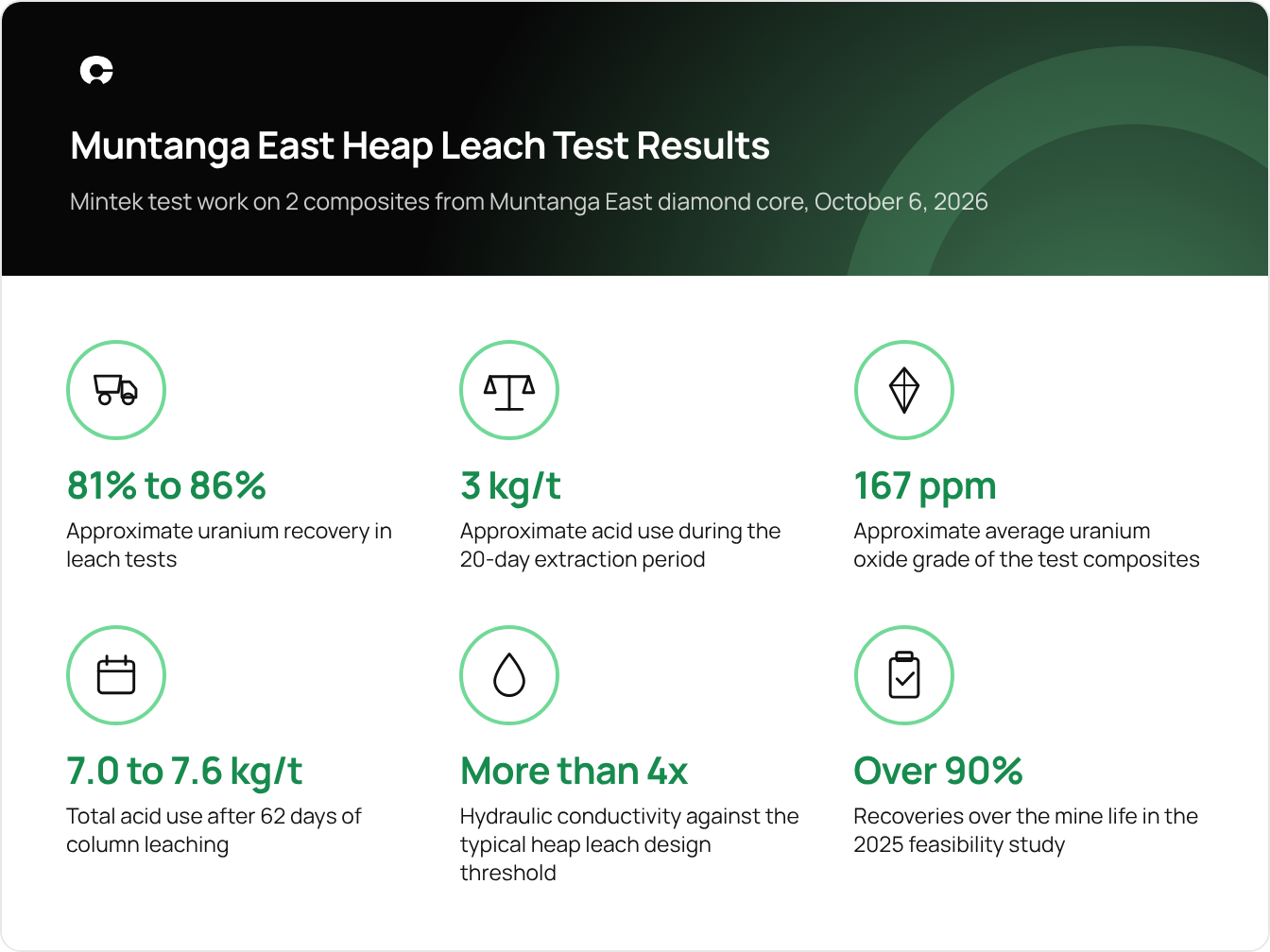
Atomic Eagle (ASX: AEU | OTCQX: AEUXF) has completed metallurgical test work on diamond drill core from the recently discovered Muntanga East uranium deposit, part of its 100%-owned Muntanga Uranium Project in Zambia. Leach tests recovered between about 81% and 86% of the uranium, and extraction was substantially complete after about 20 days. Acid consumption over that extraction period was about 3 kilograms per tonne (kg/t). Mintek, in South Africa, ran the program on 2 composite samples prepared from core drilled for metallurgical evaluation after the Muntanga East resource was delineated.
The composites averaged about 167 parts per million (ppm) uranium oxide and were crushed to a nominal top size of 25 millimeters prior to diagnostic, bottle-roll, column, and heap leach geotechnical testing. Heap leaching is a process in which an acid solution percolates down through crushed ore stacked on a lined pad. In bottle-roll tests, which tumble crushed ore in acid solution, composites ME1 and ME2 recovered 85.9% and 81.9% of their uranium after 25 days at about 3 kg/t of acid. Dissolution was largely complete after about 7 days, and the results indicate that about 80% of the uranium occurs in minerals that dissolve readily under conventional acid heap leach conditions.
Column tests, run in columns 1 meter (m) high under conditions representative of a heap, recovered 81.0% for ME1 and 80.8% for ME2. Recovery curves flattened after about 15 to 20 days, by which point acid consumption stood at about 3 kg/t. Leaching continued to 62 days with only modest further recovery, while total acid consumption rose to 7.0 kg/t for ME1 and 7.6 kg/t for ME2. The material showed a low content of very fine particles and minimal generation of fine particles during leaching, which reduces the risk of a heap losing permeability. Stacking tests simulating a 6 m heap returned hydraulic conductivity, the rate at which solution passes through stacked ore, of about 4,396 to 4,537 liters per square meter per hour, more than 4 times the design threshold typically required for heap leaching operations.
Heap Leach Metallurgy Beyond the Historical Deposits
Muntanga's heap leach performance now reaches past its historical deposits to Muntanga East, a recently discovered deposit. The test material graded lower than mineralization historically tested from several of the project's other deposits, and its recoveries came in line with those of earlier programs. Acid consumption of about 3 kg/t during extraction was below the average across the broader Muntanga Project.
The 2025 feasibility study (FS) outlined low-strip open-pit mining and conventional heap leach processing at Muntanga, with recoveries exceeding 90% over the mine life and acid consumption averaging 20 kg/t of ore treated.
Chief Executive Officer of Atomic Eagle, Phil Hoskins, named simplicity as the reason Muntanga suits a junior developer:
"We believe that Muntanga is a perfect development asset for a junior given its simplicity."
The Muntanga East results give additional confidence in the deposit's potential integration into future mine development planning.
Permits, the 2025 FS & the Excluded 44%
Muntanga is fully permitted. Its resources are on mining licenses, and the project's environmental and resettlement approvals are in place across a 1,126-square-kilometer license package that has seen limited exploration over the last 15 years. The JORC resource totals 58.8 million pounds (lb) of uranium oxide at 309 ppm.
The FS described an operation spanning about 12 years, processing 3.5 million tonnes per annum through a heap leach plant. It projects production of 25.3 million lb of uranium oxide over the mine life, averaging 2.2 million lb per year. Pre-production capital in the FS is US$282 million, and operating costs are US$32.20/lb. The project has sealed road access, power nearby, water within the mining license, and an export route through a known uranium port.
Atomic Eagle is targeting a larger operation built on resources the FS left out and on resource growth from drilling. The FS did not consider 44% of the JORC resource. That share is made up of satellite deposits holding 8.7 million lb that showed positive cash flow, 6.0 million lb of inferred resources at Muntanga and Dibbwi East that were excluded under NI 43-101 rules, and 11.4 million lb of inferred resources from the 2026 resource upgrade. Infill drilling and technical studies will seek to convert those pounds into ore feed.
Drilling Results at Muntanga North & Namakande
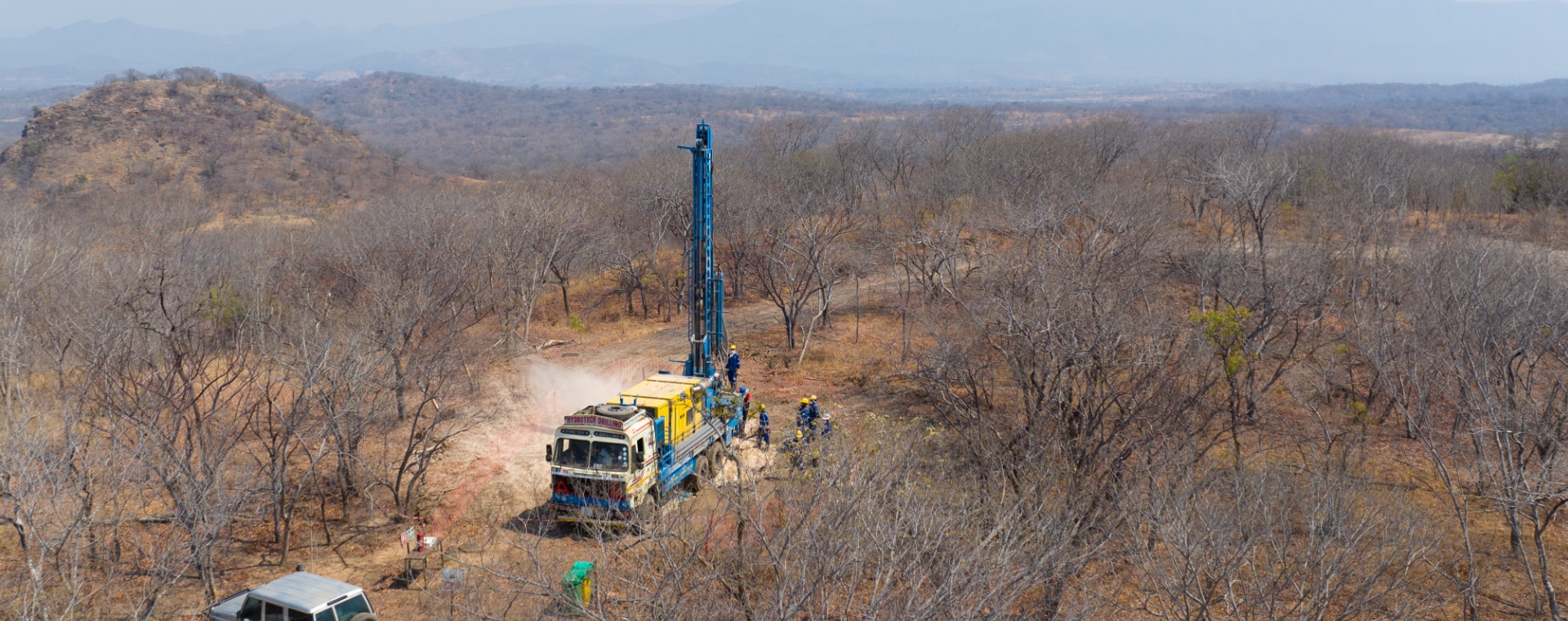
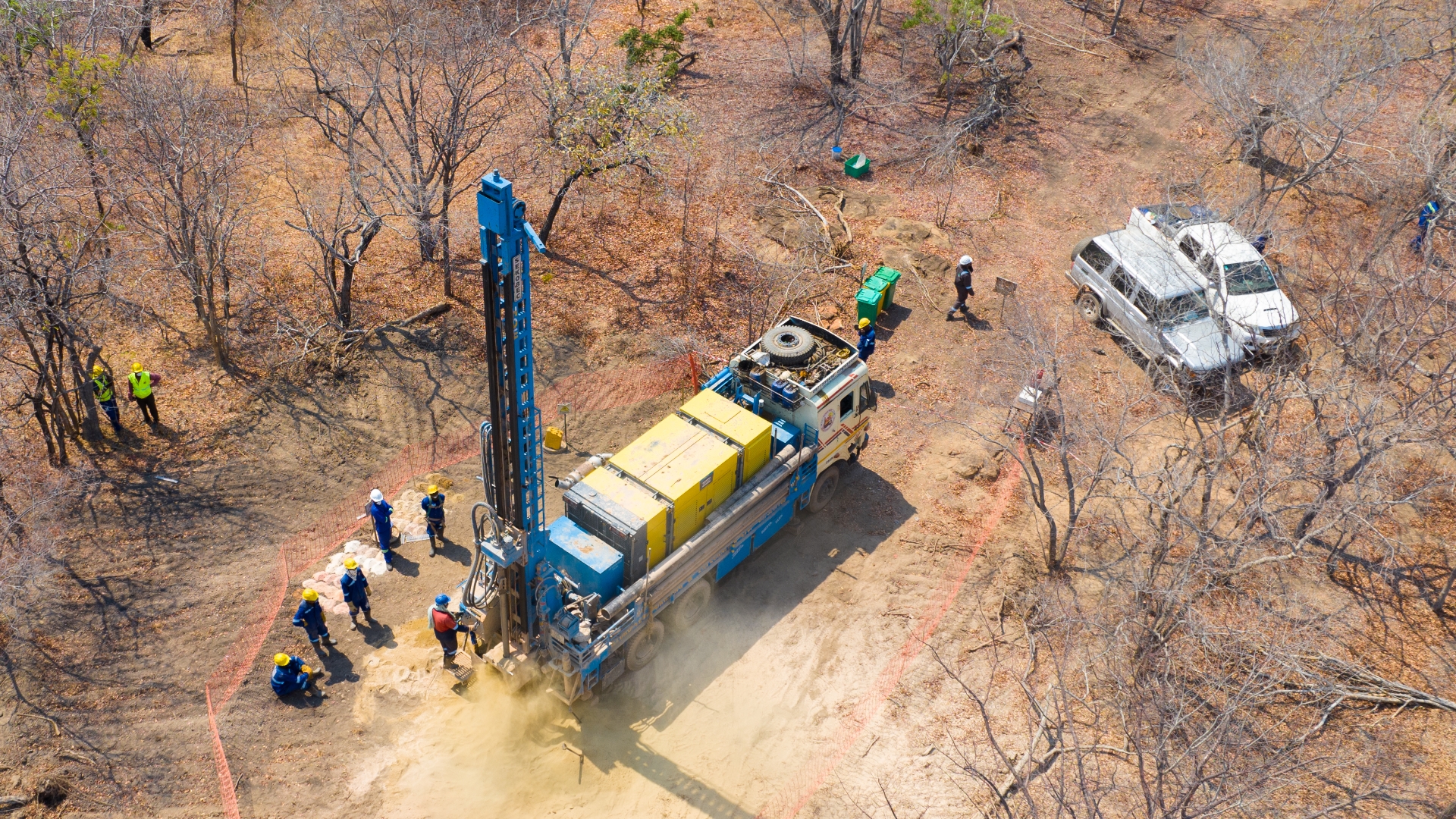
Resource growth depends on drilling, and further expansion and infill drilling are required to test the scale, continuity, and significance of the mineralization found so far at Muntanga North and Namakande. The 30,000 m program combines infill at Chisebuka with wide-spaced drilling on a 400 m by 400 m pattern across greenfield targets at Muntanga North and Namakande. Grades at those targets are estimated from downhole gamma readings rather than laboratory assays, because no samples were collected for assay. As of September 16, 2026, the program was more than halfway through.
At Muntanga North, 64 wide-spaced holes for 5,995 m have tested Targets 1 to 5. Target 5 returned a zone interpreted to be about 600 m by 200 m, open along-strike and down-dip to the east. Its intercepts include 7.07 m at 132.39 ppm from 79.53 m depth and 3.1 m at 343.78 ppm from 27.65 m depth. Targets 1 to 3 returned no anomalous mineralization, and their radiometric response is interpreted as near-surface uranium enrichment from weathering. Target 4 produced 1 discrete anomalous intercept but no zone warranting immediate follow-up, and Target 5 is in the early stages of evaluation.
First-pass drilling is complete at Namakande, with 60 holes for 6,832 m. Target 2 returned a broad, shallow-dipping zone of about 1,000 m by 400 m. Some of its intercepts exceeded 500 ppm, including 1.50 m at 1,342 ppm from 22.1 m depth, 1.55 m at 916 ppm from 26.1 m depth, and 1.15 m at 767 ppm from 37.5 m depth. Intercepts in that zone have generally been thin, at less than 2 m. At Target 1, mineralization is generally less than 3 m thick and discontinuous.
Drilling & Study Inputs Still Ahead
The next tests of resource growth at Muntanga are already in the drilling plan. Follow-up drilling at Target 5 will test the zone's interpreted extensions along-strike and down-dip to the east. Large-scale Muntanga North Targets 6, 7, and 8 are next, with ground radiometric surveying continuing and first-pass drilling planned to establish the geological source of their anomalies and whether further work is warranted.
Atomic Eagle is targeting completion of drilling at the current Muntanga North targets in the fourth quarter of 2026. The Namakande data will be combined with the geological, radiometric, and geochemical datasets to refine the targeting model and rank later exploration. At Chisebuka, infill drilling is designed to achieve a spacing sufficient for resource estimation, and the Muntanga East results will feed into the ongoing technical studies supporting the project.
Permits are in place, and heap leach performance has now been tested on a newly discovered, lower-grade deposit. The Target 5 follow-up, first-pass drilling at Targets 6, 7, and 8, and the Chisebuka infill are the next data points on how far Muntanga's resource can grow beyond the current 58.8 million lb.
The Investment Thesis for Atomic Eagle
- Muntanga East test work recovered between about 81% and 86% of the uranium, with extraction substantially complete after about 20 days.
- Acid consumption of about 3 kilograms per tonne during extraction was below the average achieved across the broader Muntanga Project.
- The tested material averaged about 167 parts per million uranium oxide, lower in grade than mineralization historically tested at several other Muntanga deposits.
- Muntanga is fully permitted, with its resources on mining licenses and its environmental and resettlement approvals in place.
- The 2025 feasibility study did not consider 44% of the JORC resource, which infill drilling and technical studies will seek to convert into ore feed.
- Atomic Eagle is targeting completion of drilling at the current Muntanga North targets in the fourth quarter of 2026, with Targets 6, 7, and 8 still to be tested.
Muntanga's permits are in place, and heap leach test work now covers the newly discovered Muntanga East deposit. At the same time, a larger operation rests on converting the resources the 2025 feasibility study left out and on how much new resource the 2026 drilling adds. The Target 5 follow-up, first-pass drilling at Targets 6, 7, and 8, and the Chisebuka infill are the points at which that growth can be measured through the fourth quarter of 2026.
TL;DR
Atomic Eagle's Muntanga East test work recovered between about 81% and 86% of the uranium at about 3 kg/t of acid during extraction, on core from a recently discovered, lower-grade deposit. Muntanga is already permitted, and the FS did not consider 44% of its JORC resource. First-pass drilling has outlined an open zone at Muntanga North Target 5, and drilling at Targets 6, 7, and 8 is the next step in assessing how far the resource can grow.
FAQs (AI-Generated)
Analyst's Notes





Subscribe to Our Channel



Stay Informed


