Kazakhstan Risk Leaves 28% of US Uranium Supply Exposed


Kazakhstan and Niger supply risks lift uranium to $89.50 as costs rise, permits shift, and long-term demand tests whether the deficit will last.
- TradeTech’s weekly spot price indicator rose to $89.50 per pound of uranium oxide in the week ending August 21, 2026, up 4.7% since mid-July and its highest level in six months.
- Kazakhstan supplied 28% of US utility uranium deliveries in 2025, according to the Energy Information Administration’s 2025 Uranium Marketing Annual Report, while rising extraction costs and a six- to 12-month sulfuric acid plant delay increased the risk of tighter supply.
- Niger reassigned two uranium permits in August 2026, increasing ownership and permitting uncertainty during the same three-week period as Kazakhstan’s supply setback.
- TradeTech’s $88-per-pound mid-term indicator sat slightly below the $89.50 spot price, while its $97 long-term indicator and utility requests covering deliveries through 2034 showed buyers assigning a premium to longer-term supply.
- The combination of higher production costs, state-directed permit changes, and contracting through 2034 strengthens the case for uranium production and processing capacity in jurisdictions with more predictable permitting and export policies.
Kazakhstan & Niger Supply Risks Lift Uranium Prices & Raise US Replacement-Cost Exposure
TradeTech’s uranium oxide spot indicator rose $1.75 to $89.50 per pound in the week ending August 21, 2026, extending its gain since mid-July to 4.7% and reaching a six-month high. Only 450,000 pounds changed hands across five transactions that week, including deliveries to conversion facilities in France and the US, while limited offers above $90 per pound indicated that buyers faced a thin spot market near the six-month price high.
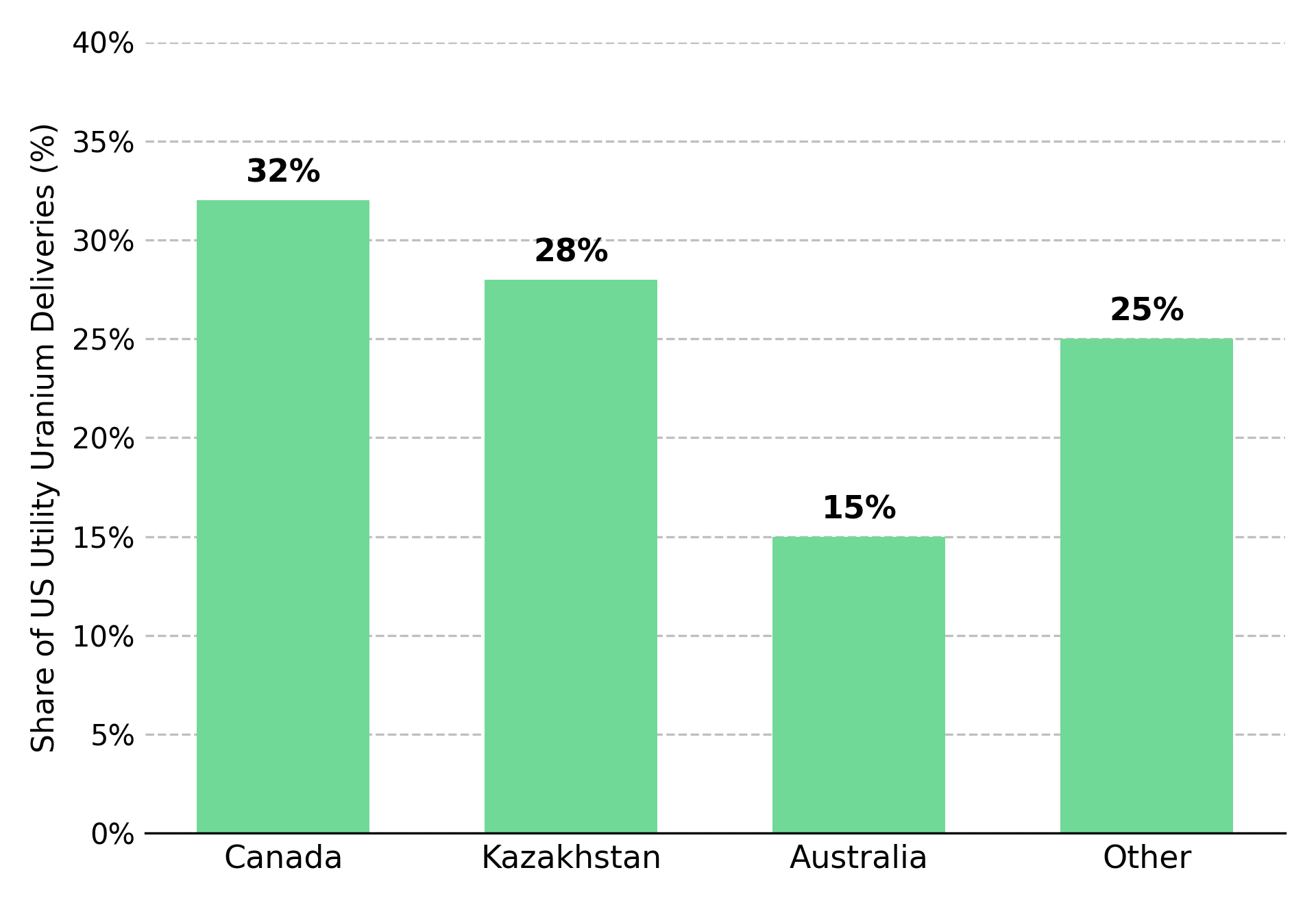
The Energy Information Administration’s 2025 Uranium Marketing Annual Report reported that US utilities paid a weighted average of $58.46 per pound for uranium delivered in 2025, up 11% from 2024 but 35% below the $89.50 spot price recorded on August 21, 2026. The same report showed that Canada, Kazakhstan, and Australia supplied a combined 75% of US utility uranium deliveries in 2025, accounting for 32%, 28%, and 15%, respectively. A disruption affecting Kazakhstan would expose 28% of US utility deliveries to replacement-cost risk, increasing the importance of alternative contracted supply from other jurisdictions.
Within the same three-week period, Kazakhstan reported higher uranium production costs and a delayed sulfuric acid plant, while Niger transferred the Somair permit and reawarded the Madaouela I permit, reducing supply visibility across two uranium-producing jurisdictions. Further delays to Kazakhstan’s sulfuric acid plant, unresolved permit disputes in Niger, and utility contracting into the mid-2030s over the next two quarters would indicate that the supply risk extends beyond a temporary spot-market disruption.
Kazakhstan’s Rising Costs & Proposed Contracts Raise Western Uranium Supply Risk
Kazatomprom’s August 2026 disclosure moved the targeted commissioning of its TQZ sulfuric acid plant from the first quarter of 2027 to between the third quarter of 2027 and the first quarter of 2028, extending the timeline by six to 12 months. According to the same disclosure, the contractor encountered potential paleontological specimens during earthworks, requiring construction to stop until authorities grant clearance under Kazakhstan’s heritage rules. Sulfuric acid is a key reagent in Kazatomprom’s in-situ recovery operations, so the commissioning delay prolongs reliance on external supplies and increases exposure to reagent costs and availability constraints.
Kazatomprom’s first-half 2026 results reported a 9% year-over-year increase in consolidated revenue to 717.8 billion Kazakhstani tenge, while C1 cash cost rose 37% to $24.48 per pound, indicating that unit-cost inflation outpaced revenue growth. The average weekly uranium spot price over the same period was $85.98 per pound, up 24% from the first half of 2025. C1 cash cost therefore increased 13 percentage points faster than the spot-price benchmark, raising the share of the uranium price absorbed by direct production costs despite the higher commodity price.
In a general meeting notice filed on August 21, 2026, Kazatomprom sought shareholder consideration of a spot and term uranium contract with China’s State Nuclear Uranium Resource Development Company and a supply contract with Uranium One Group, which is linked to Rosatom. Shareholder voting is scheduled to conclude on October 7, 2026, but the notice does not provide enough volume or duration data to quantify how much Kazakh supply the contracts could commit. If approved, the contracts could direct additional Kazakh uranium to Chinese and Russian counterparties, reducing the uncommitted supply available to US and European utilities; however, the effect cannot be measured until contract volumes and delivery periods are disclosed.
Kazakhstan Supply Risk & Canadian Diversification Make Resource Definition the Valuation Test
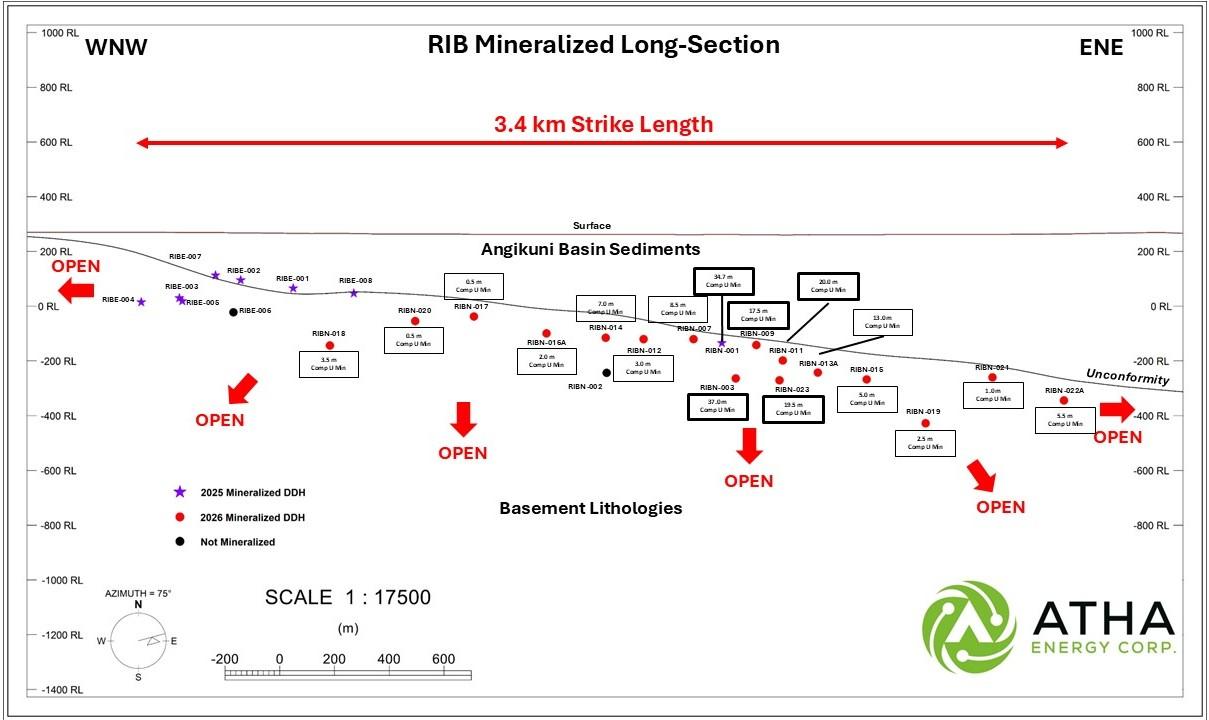
Canadian uranium exposure reduces dependence on Kazakhstan-specific supply decisions, but exploration projects in the Athabasca and Angikuni basins remain subject to Canadian permitting and resource-definition risk. ATHA Energy, an exploration-stage company, reports approximately 6.8 million acres of uranium-prospective ground, including more than 3 million acres in the Athabasca Basin and its flagship Angilak project in Nunavut’s Angikuni Basin, although acreage alone does not establish an economically recoverable resource. At Lac 50, the disclosed exploration target of 60.8 million to 98.2 million pounds of uranium oxide is conceptual and does not constitute an NI 43-101 mineral resource estimate, so valuation depends on drilling converting that target into a compliant resource before it can support mine planning.
Troy Boisjoli, Chief Executive Officer of ATHA Energy, ties the company's land position directly to how management reads the broader uranium market:
"Based on where we see this macro space going, where we see this uranium market going, our objective was to maximize our exposure to the best uranium jurisdictions in Canada."
Niger Permit Reassignments & Legal Disputes Raise Supply Risk as New Production Remains Unproven
According to Nigerien cabinet minutes published in August 2026, Niger transferred the Somair uranium permit to state-owned Tsumco SA, replacing the structure in which Orano previously held a 63% interest. Orano is contesting the transfer through legal proceedings, leaving control of the operation unresolved. Separately, Niger reawarded the Madaouela I permit for an initial fee of $10 million, giving development-stage Atomic Eagle a 60% interest under the new mining convention.
The convention provides two years to update feasibility work and reapply for environmental approvals using a foreign estimate of 116.5 million pounds of uranium oxide grading approximately 0.13%. The estimate cannot be treated as a current JORC Mineral Resource or support an Ore Reserve until further technical work verifies it. Its historical pit shell used a $70-per-pound uranium assumption, 28% below the $89.50 spot price on August 21, 2026, but updated costs and recoveries are still needed to test project economics. Atomic Eagle is targeting a JORC 2012-compliant Mineral Resource estimate in the fourth quarter of 2026.
Phil Hoskins, Chief Executive Officer of Atomic Eagle, frames the timing of new production against the deficit the market is now pricing:
"Particularly in a uranium market where the deficit, come the time this project's capable of coming online, is going to be significant, and people will be scrambling for new production assets."
China-Led Nuclear Growth & Utility Planning Extend Uranium Demand Visibility Through 2034
The supply thesis would be weaker if the price increase reflected only the disruptions in Kazakhstan and Niger. However, term pricing and utility procurement activity were already extending beyond the spot market before either event became public, indicating that buyers were planning for longer-term supply risk.
The International Energy Agency’s Electricity 2026 report stated that nuclear generation reached a record in 2025 and forecast further growth through 2030, with China accounting for approximately 40% of the global increase. This expansion supports higher long-term uranium requirements. TradeTech’s $88-per-pound mid-term indicator stood $1.50 below spot, while its $97 long-term indicator carried a $7.50 premium. A separate buyer sought 2027 delivery, while a US utility requested 400,000 pounds annually from 2030 through 2034. These requests are not completed contracts, but they show that utility procurement planning extends into the mid-2030s.
Federal Permitting & Private Capital Advance US Uranium Capacity, but Production Timelines Remain Unclear
The US supply response begins with federal permitting, which can remove a major development barrier but does not replace required state approvals. enCore Energy, a production-stage company, received a 20-year renewal of its Nuclear Regulatory Commission Source Materials License for the Dewey Burdock ISR project in South Dakota, extending federal authorization through June 2046. The renewal followed the project’s August 2025 addition to the FAST-41 Program and included an Environmental Assessment, a Finding of No Significant Impact, and an agreement covering historic-preservation requirements. South Dakota permits remain outstanding with no decision timeline disclosed, leaving Dewey Burdock without a production schedule despite the completed federal review.
Permitted mines also require restart capital and viable processing technology before their resources can return to production. IsoEnergy, a development-stage company, contributed five permitted, past-producing uranium projects in Utah to DISA Uranium Corporation in exchange for a 33% interest represented by 1,677,350 shares. The transaction closed alongside a $105 million private placement, including $33 million from IsoEnergy, providing capital to evaluate restarting the mines using High Pressure Slurry Ablation technology. DISA also holds an NRC license covering uranium recovery from abandoned mine waste across multiple sites, although commercial output remains dependent on technology execution and mine restart timelines.
Mine restarts can add domestic uranium supply only if sufficient licensed processing capacity is available to convert mined material into uranium concentrate. Energy Fuels, a production-stage company, operates the White Mesa Mill in Utah, which its latest annual filing identifies as the only fully licensed and operating conventional uranium processing facility in the US. This existing capacity gives the company a processing advantage as domestic mines restart, although actual throughput depends on sufficient uranium-bearing feed and operating economics.
Term Contracting & Project Milestones Will Test Whether the Uranium Deficit Lasts
The case for a lasting shortage does not rest on a single event. Kazakhstan's acid plant delay and Niger's nationalization are unrelated in cause but identical in effect, each removing flexibility from the same tight physical market inside the same three-week window, at a moment when term demand was already extending past 2030 independent of either disruption.
The signal to track over the next two quarters is not the spot price itself. It is whether term contracting volume continues extending toward the mid-2030s, whether Kazatomprom's acid plant timeline holds without further slippage, and whether Niger's court disputes with Orano resolve in a way that restores predictability to that supply base. US project-level progress, enCore's completed federal permitting, IsoEnergy's funded technology platform, and Energy Fuels' production guidance, is a more durable confirmation of a structural deficit than any single week's price print, because each represents capital already committed against the assumption that the gap does not close on its own.
The Investment Thesis for Uranium
- Kazakhstan supplied 28% of US utility uranium deliveries in 2025, while Niger’s permit decisions added separate legal and operating uncertainty within the same three-week period, broadening supply risk beyond one jurisdiction.
- TradeTech’s $88-per-pound mid-term indicator stood $1.50 below the $89.50 spot price, while its $97 long-term indicator carried a $7.50 premium, showing that longer-duration supply commanded the higher price.
- Canadian and US uranium projects reduce exposure to supply decisions in Kazakhstan and Niger, but their value still depends on resource quality, permitting progress, and viable project economics.
- A foreign estimate cannot be treated as a current compliant Mineral Resource or Ore Reserve, limiting its use in resource-based valuation and mine planning until further technical work verifies it under a recognized reporting standard.
- The FAST-41 Program coordinates federal reviews for priority infrastructure projects, but designation does not replace state permits or guarantee that an approved project will reach production.
Uranium reached a six-month high of $89.50 per pound after Kazakhstan reported higher production costs and a delayed sulfuric acid plant, while Niger reassigned the Somair and Madaouela I permits within the same three-week period. TradeTech’s $88 mid-term indicator remained below spot, but its $97 long-term indicator and utility requests covering deliveries through 2034 showed stronger demand for longer-term supply. Executed contracts, permitting decisions, and mine restarts will determine whether these risks produce a lasting deficit.
TL;DR
Uranium reached a six-month high of $89.50 per pound as Kazakhstan reported a 37% increase in C1 cash costs and delayed a key sulfuric acid plant, while Niger reassigned two uranium permits. Longer-term demand also supports the market, with TradeTech’s $97 long-term indicator above spot and utility procurement planning extending through 2034. Canadian and US projects offer alternative supply, but resource verification, state permits, processing capacity, and restart execution remain critical. Term-contract volumes and project milestones over the next two quarters will show whether the current supply pressure develops into a lasting deficit.
FAQs (AI-Generated)
Analyst's Notes





Subscribe to Our Channel











Stay Informed