




Metals Exploration Explores Philippines' Copper Asset as Gold Build in Nicaragua Advances


Metals Exploration's La India gold build is ~50% complete, on track for Dec 2026 first gold, while new Batong Buhay copper deal adds Philippine upside.
- Metals Exploration's La India construction is approximately 50% complete and remains on schedule and on budget for first gold in December 2026.
- The previously flagged Nicaragua power-transmission risk has been resolved through a new government-designed, company-built delivery model.
- Metals Exploration has signed a series of agreements securing exclusive rights to the Batong Buhay copper-gold porphyry project in the Philippines.
- Runruno in the Philippines generated record FY2025 free cashflow of $115.3 million which continues to fund La India's construction without shareholder dilution.
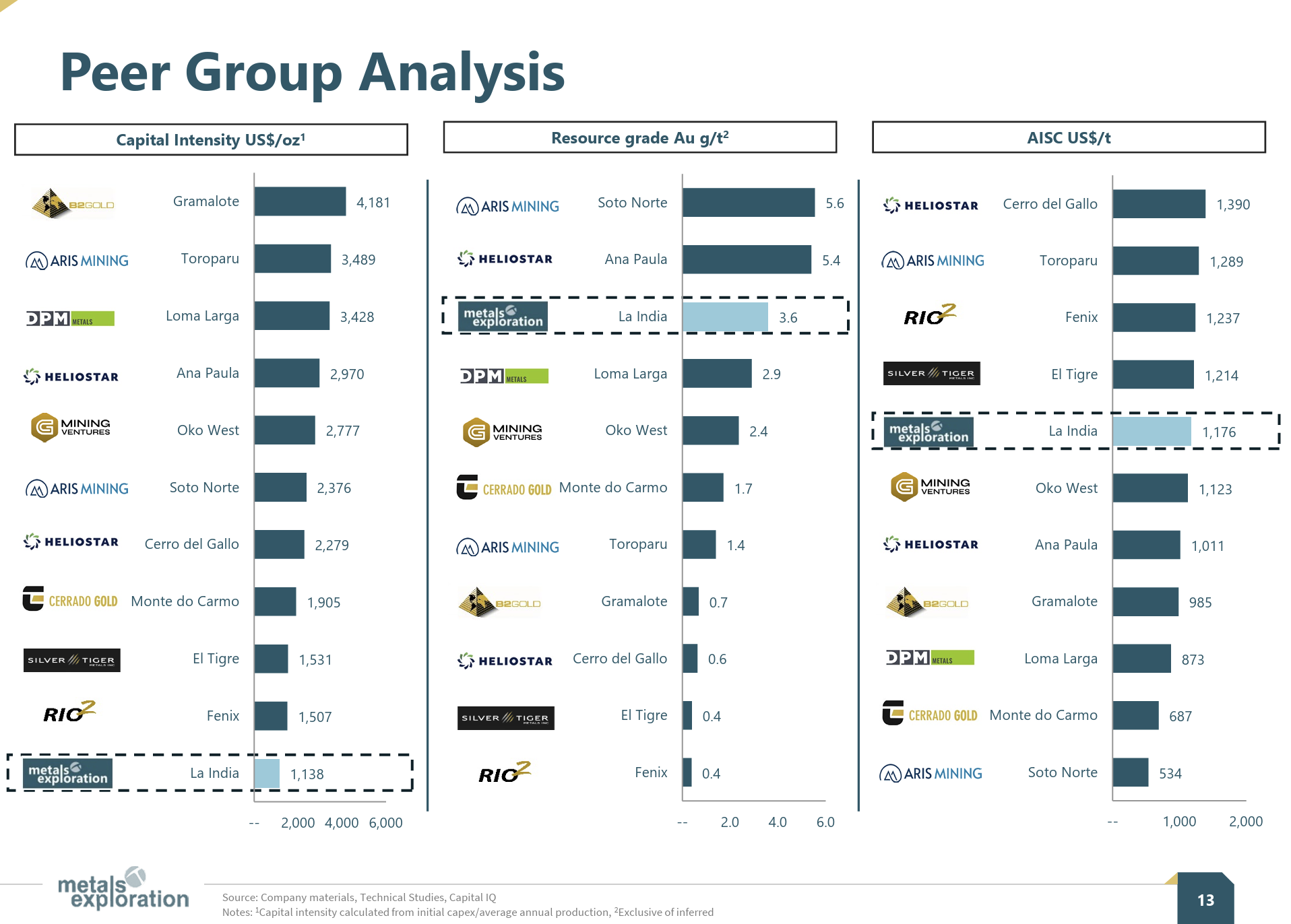
- Peer analysis identifies La India as the lowest capital-intensity project, at $1,138 per ounce, among its tracked development peer group.
Gold developers with fully-funded, near-term production stories have been among the best-rewarded equities of the current cycle, and Metals Exploration (LSE:MTL) is positioning itself as one of them. With gold prices holding near record levels through 2026, self-funded developers that can bring new ounces online without diluting shareholders are increasingly prized - and Metals Exploration's La India project in Nicaragua is now roughly halfway built, targeting first gold in December 2026. The company has just added a new growth angle: a set of agreements giving it exclusive rights to explore the Batong Buhay copper-gold porphyry project in the Philippines.
Construction Progress and De-Risking
CEO Darren Bowden confirmed that construction at La India remains on schedule. Front-end processing infrastructure, including the ROM stockpile and conveyor system, is complete, the CIL tanks are 50% built, and both mills are currently being lifted into place by specialist crews. Bowden singled out one risk that has now been substantially resolved: power transmission to site, previously flagged as a key execution risk.
"We've worked very closely with the government over the last six months, and we've come up with a solution where they do the design and we do the construction. It's not the same risk profile as it had when we last talked which is terrific," Bowden said.
While some logistics slippage has occurred, an elution circuit from Australia and high-voltage cabling have been delayed by a few weeks, which Bowden attributed partly to regional shipping disruption, but the company maintains that the December 2026 first-gold target intact supported by a stockpile strategy that will have roughly 4-5 months of ore banked ahead of commissioning.
Financial Metrics
Runruno, the company's operating mine in the Philippines, delivered record FY2025 results: revenue of $208.4 million and free cashflow of $115.3 million, taking the company to a net-debt-free position. That cashflow is funding La India's build internally. FY2026 Runruno guidance of 40,000-48,000 ounces represents a step down from FY2025's 65,287 ounces, reflecting the mine's declining reserve base a natural transition rather than an operational setback as it approaches the end of its life, with La India designed to take over as the primary cashflow driver from December 2026.
La India's economics remain robust: a pre-tax NPV6 of $882 million at $2,500/oz gold, rising to $1,378 million at $4,000/oz, an initial capital intensity of $1,138/oz (the lowest in Crux's tracked development peer group), and 12+ years of potential mine life across open pit and underground.
Interview with Darren Bowden, CEO of Metals Exploration PLC
Project Overview: Batong Buhay
The newer story is Batong Buhay, a 440-hectare copper-gold porphyry licence in Kalinga Province, Northern Luzon, secured via a series of agreements announced in June 2026. The project hosts at least two historically drill-tested porphyries, Dickson and Maalinao North, plus a high-sulphidation gold vein system named Level 5. Dickson carries a historical, non-JORC-compliant resource of 86.9 million tonnes at 0.60% copper and 0.25 g/t gold.
Bowden framed the government backing as a key differentiator versus the company's other Philippine exploration efforts:
"Given the government is a primary owner, and they are saying that this is one of two projects on their books that they want running within the next 3-5 year, makes it a very different prospect to what we've seen previously. It gives us a lot that it's backed by a government that wants it to happen."
Under the deal structure, Metals Exploration's subsidiary FCF holds 80% of the operating entity (Faratuk Exploration and Mining Corporation), with a 20% free-carried, non-dilutable stake held by the Balatoc Kalinga Tribe. The state-owned Philippine Mining Development Corporation holds the underlying licence, which satisfies the Philippines' 60% Filipino ownership requirement automatically. Initial exploration using LIDAR, magnetic and radiometric surveys, geological mapping is underway with a drill programme targeted for H2 2026.
Competitive Positioning
Peer comparison places La India favourably against a set of development-stage copper-gold and gold projects including Gramalote, Toroparu, Loma Larga and Ana Paula on both capital intensity and all-in sustaining cost, though its resource grade sits mid-pack depending on whether inferred ounces are included. Near-term catalysts include: first gold pour at La India (targeted December 2026); the H2 2026 Batong Buhay drill programme; the H2 2026 Abra tenement drilling at Manikbel and Domenglay; and continued exploration results from Cacao and La Grecia within the broader La India land package which has been extended to 1,222 km².
Key risks include continued execution risk through La India's commissioning phase particularly around mill synchronisation, which Bowden flagged as the most technically sensitive step, the natural decline in Runruno's production profile as it approaches end of mine life, and the early-stage nature of Batong Buhay, where historical drilling has not yet been verified to modern JORC standards.
Investment Thesis
- La India construction is roughly 50% complete and tracking to schedule and budget for first gold in December 2026, with the previously flagged power-transmission risk now substantially resolved.
- Runruno's record FY2025 free cashflow ($115.3 million) is funding La India's build without equity dilution; while watching FY2026 Runruno guidance (40,000-48,000oz) as a natural, disclosed decline rather than an operational miss.
- The new Batong Buhay agreements add a government-backed copper-gold porphyry option in the Philippines, with drilling due to start H2 2026.
- La India screens as the lowest capital-intensity project ($1,138/oz) in tracked development peer set with NPV6 of $882 million at $2,500/oz gold and grows to $1,378 million at $4,000/oz.
- The management's track record, turning Runruno from a loss-making asset into a >$100 million free cashflow generator, reduces execution risk on the current La India build.
- Abra and Cacao drilling results which are both due H2 2026 will represent underappreciated exploration upside within the existing land package, separate from the Batong Buhay optionality.
Macro Thematic Analysis: Golden Key of Self-Funding
Gold developers able to self-fund construction from existing cashflow, rather than tapping equity markets, have commanded a premium through 2026 as investors reward growth stories that don't dilute existing shareholders during a period of elevated gold prices. Metals Exploration's model, using Runruno's operating cashflow to fully fund La India's build, fits squarely into that theme, and the company's own NPV sensitivity (running scenarios as high as $4,000/oz gold) reflects how much upside optionality current pricing offers self-funded developers.
At the same time, the Philippines government's stated ambition to fast-track critical-minerals projects during the current presidential term is opening a parallel opportunity for companies already operating credibly in-country. Bowden's framing of the company's forward strategy captures both threads at once:
"We get our mine running in Nicaragua as priority one. It generates the cash flow. We need to look at how this business evolves into what looks like a copper streaming business out of the Philippines and a gold business within the Central America region."
That dual-commodity, dual-jurisdiction positioning, gold cashflow funding growth, copper optionality layered on top via government-backed agreements, all reflects a broader theme playing out across the mid-tier developer space: companies with proven in-country execution are being offered access to strategically important, historically drill-tested assets that governments want developed quickly, in exchange for structures that satisfy local ownership and community requirements.
TL;DR
Metals Exploration's near-term investment case remains anchored to execution at La India, where construction is tracking to schedule and the government has closed out a previously flagged power-transmission risk. With Runruno continuing to generate substantial free cashflow and the build funded internally, the company heads toward its December 2026 first-gold target without the dilution risk that weighs on many developers at this stage. The newly signed Batong Buhay agreements add a distinct second growth vector, a government-backed, historically drill-tested copper-gold porphyry system, without requiring the company to divert capital away from its primary near-term catalyst. Investors should watch for the finalised La India capital figure in the next quarterly update, initial Batong Buhay and Abra drill results in H2 2026, and confirmation that commissioning proceeds smoothly through the technically sensitive mill-synchronisation phase. Taken together, the update reinforces a story of a self-funded gold producer nearing a step-change in production, with credible, government-supported optionality building alongside it in copper.
Frequently Asked Questions (FAQs) AI-Generated
Analyst's Notes





Subscribe to Our Channel



Stay Informed






















