ATHA Energy's RIB North Discovery Expands to 1.45 Kilometers of Uranium Continuity


ATHA Energy extends RIB North uranium continuity to 1.45 kilometers at Angilak, with two mineralized horizons, pending assays, and further drilling now planned.
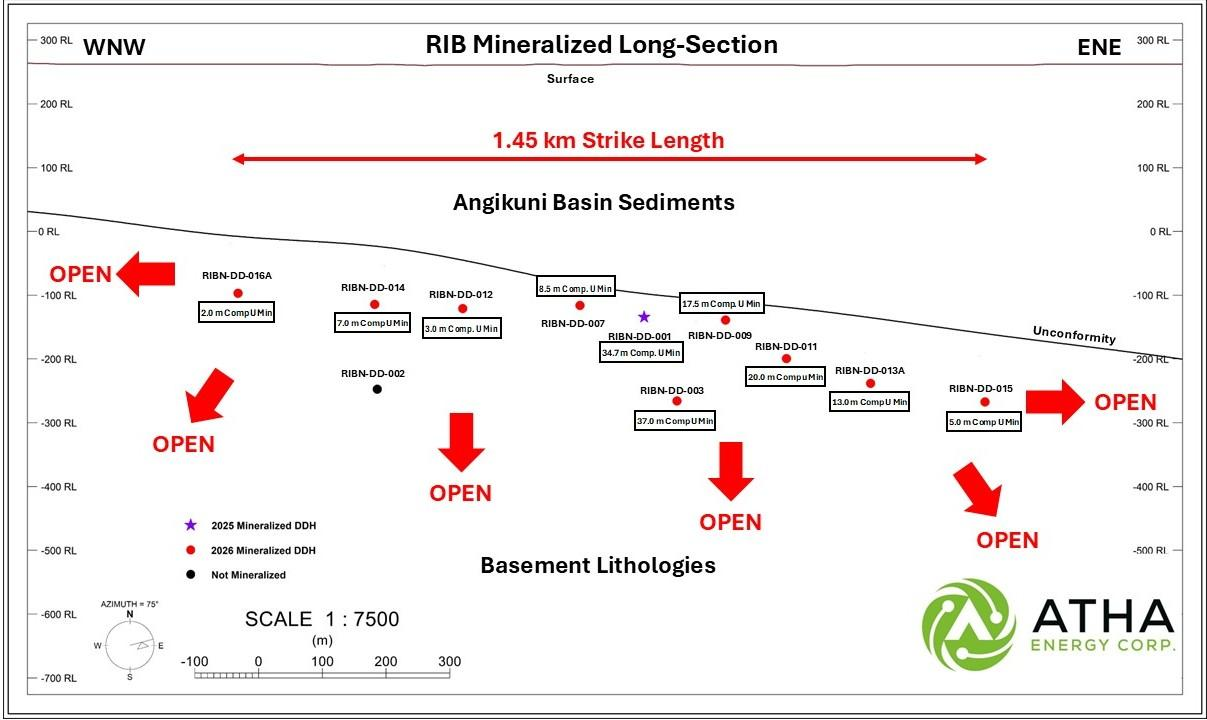
- ATHA Energy Corp. reported results from 7 additional diamond drill holes at the RIB North discovery within its 100%-owned Angilak Uranium Project in Nunavut, Canada, extending traced mineralization continuity from 300 meters to 1.45 kilometers.
- The widest step-out intercept returned 20.0 meters of total composite uranium mineralization across 15 zones, including 1.3 meters of high-grade mineralization, defined as radioactivity above 10,000 counts per second (CPS) on the downhole gamma probe.
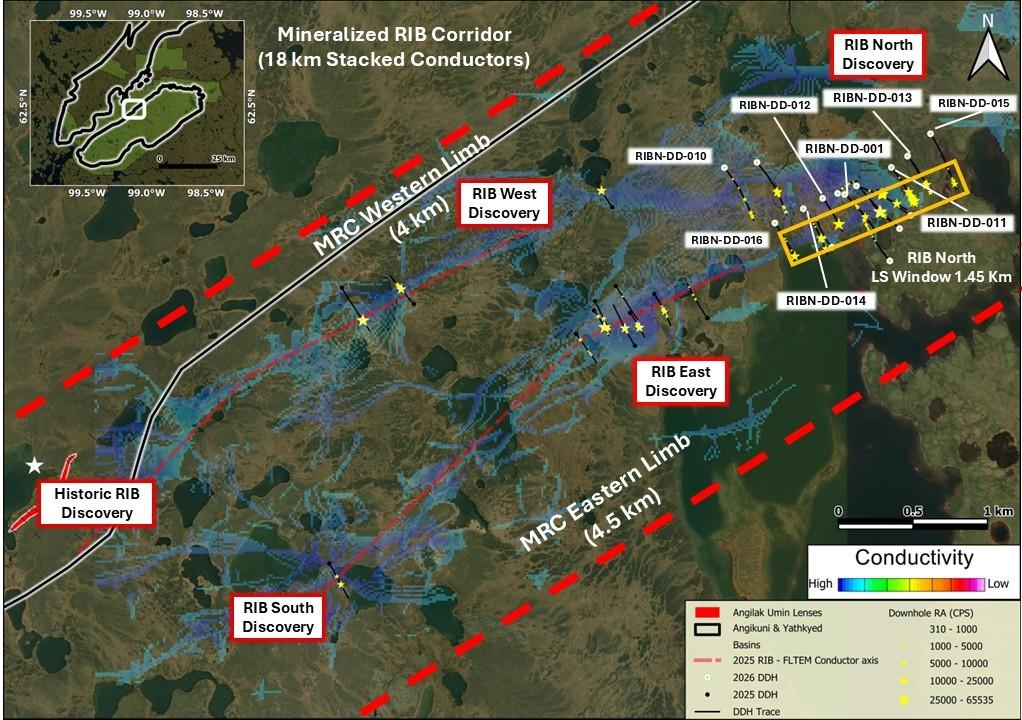
- Mineralization at RIB North occurs on 2 separate horizons within the Mineralized RIB Corridor (MRC): a primary, eastern-limb trend anchored by a 2025 discovery hole, and a secondary, western-limb trend identified more recently.
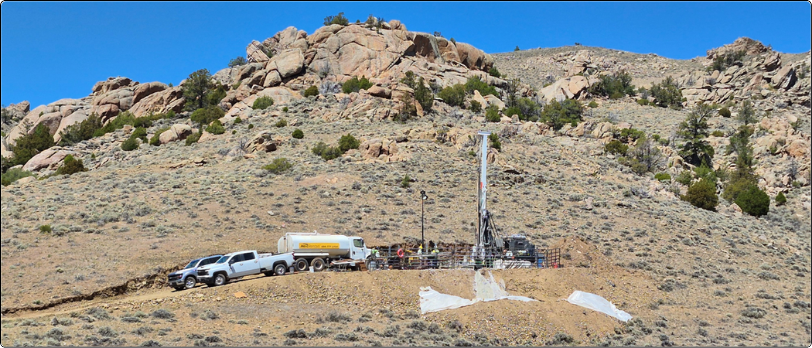
- The results form part of the 2026 Angilak Exploration Program, the largest exploration program conducted on the Angilak project to date, combining 3 diamond drill rigs running from May 1, 2026, through the end of September with an aerial MMT survey completed in late July, with 3-dimensional (3D) inversion modeling results anticipated for the fourth quarter of 2026.
- All 7 holes reported returned uranium mineralization, and the company describes the RIB North system as remaining open in every direction, meaning the current strike length reflects where drilling has stopped rather than where mineralization ends.
What Has Happened
ATHA Energy Corp. (TSX.V: SASK | FRA: X5U | OTCQX: SASKF) released preliminary results on September 8, 2026, from 7 additional diamond drill holes completed at the RIB North discovery on its Angilak Uranium Project. The release follows initial results which covered 8 drill holes, and account for the full first phase of step-out drilling at RIB North within the broader 2026 Angilak Exploration Program.
The headline figure is continuity: mineralization at RIB North has now been traced over 1.45 kilometers of strike length, up from the 300 meters established after the maiden discovery hole in 2025. That hole intersected 34.7 meters of composite uranium mineralization with grades up to 8.16% triuranium octoxide over 0.5 meters. The current program was designed specifically to test how far that discovery extends, using widely spaced step-out holes to outline the continuity of the mineralization.
The widest step-out intercept in this release returned 20.0 meters of total composite uranium mineralization over 15 separate zones between 494.0 meters and 700.5 meters depth, including 1.3 meters of high-grade mineralization. This hole targeted mineralization approximately 250 meters along strike to the northeast of the 2025 discovery hole, meaning the step-out distance itself is now a data point on how far the mineralized system extends beyond the original discovery.
Two Mineralized Horizons, One Structural Corridor
RIB North is not a single mineralized zone but 2 parallel trends within the Mineralized RIB Corridor, an 18-kilometer structural feature comprising 2 limbs. The primary horizon, which hosts the bulk of drilling to date, lies on the corridor's eastern limb and has produced the 1.45-kilometer continuity figure. A secondary horizon on the western limb, first intersected earlier in the 2026 program, was followed up in this release by a hole that returned 3.0 meters of total composite uranium mineralization across 4 zones from 412.5 meters to 576.5 meters, extending that trend approximately 220 meters to the southwest.
The distinction matters for how investors should read the strike-length figure. The 1.45-kilometer continuity applies only to the eastern limb; the western limb is a separate, earlier-stage trend with its own shorter continuity so far. Having 2 independently mineralized horizons within the same corridor is a different proposition than having 1 long zone, since it implies the controls on mineralization operate at the scale of the broader structure rather than being confined to a single fault or lithological contact.
ATHA describes the mineralization at both horizons as basement-hosted and structurally controlled, associated with strong albite and hematite alteration, graphitic and sulfide-bearing structures, and overprinting silicification. Two further step-out holes reinforce the along-strike case: one 370 meters northeast of the discovery hole intersected 13.0 meters of composite mineralization over 5 zones, with the widest single interval spanning 4.0 meters, and one 430 meters southwest of the discovery hole intersected 7.0 meters of composite mineralization over 6 zones, including a highest-grade interval that peaked at 20,138 counts per second (CPS).
Reading the Radiometrics
ATHA's reported intervals rely on downhole gamma probe readings taken with a Mount Sopris 40TGU-1000 Triple Gamma Geiger probe, measured in CPS. The company classifies any interval exceeding 10,000 CPS as high-grade, and defines the broader "composite uranium mineralization" cutoff as an average above 300 CPS over a 0.1-meter interval, lowered from a prior threshold above 500 CPS after 2024 and 2025 assay results showed that readings above 300 CPS typically correspond to grades above 0.01% U3O8.
That distinction matters when comparing intercepts: the reported composite and high-grade widths are gamma-probe classifications, not laboratory assay grades. All drill core is submitted to the Saskatchewan Research Council Geoanalytical Laboratories in Saskatoon, an ISO/IEC 17025:2005-accredited facility, for multi-element analysis and uranium determination by fluorimetry, and the company has not yet determined true thickness for any of the reported intercepts, since all figures to date are reported as core-length or core width measurements.
The Wider Angilak Picture
RIB North is 1 of 4 discoveries the 2025 program identified along the Mineralized RIB Corridor, and it sits within a considerably larger 2026 program that also includes drilling at the Lac 50 Deposit Corridor, where the company is testing new 3D inversion targets along strike from the existing Lac 50 Deposit. That work has already produced a separate discovery, Lac 50 Northwest, located 4 kilometers along strike from the main Lac 50 Deposit area, with 11.5 meters of composite uranium mineralization including 7.0 meters of continuous mineralization and 1.6 meters of high-grade mineralization. Alongside the drilling, ATHA completed an aerial MMT survey across the Angikuni Basin in late July, with 3D inversion modeling results anticipated in the fourth quarter of 2026 to help define further drill targets across the wider, 100%-owned basin.
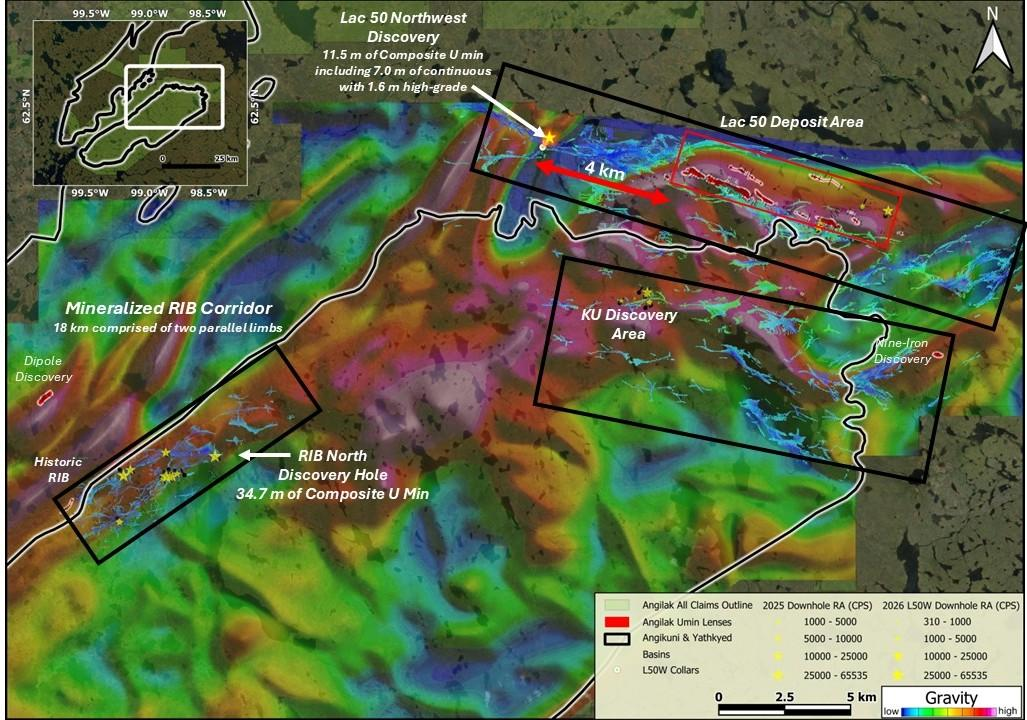
Across the Mineralized RIB Corridor, the 2026 program has now delivered 16 successful step-out holes since the single 2025 discovery hole, expanding the known system from a point intercept to a mapped structural trend. That progression is consistent with viewing Angilak as a potential multi-corridor uranium system spanning the Mineralized RIB Corridor, the Lac 50 Deposit Corridor, and the wider Angikuni Basin, though that view still rests on confirmatory assays and further step-out drilling across all 3 areas rather than on an established resource.
What Remains Unproven
Several elements of the RIB North picture are still indicative rather than confirmed. The reported intercepts are gamma-probe classifications pending laboratory assay from the Saskatchewan Research Council; the actual uranium grades across the composite and high-grade intervals will not be known until those results are returned. True thickness has also not been determined for any hole, so the reported core-length widths could be narrowed once drilling defines the orientation of the mineralized structure relative to the hole angle.
Continuity itself is inferred rather than proven at every point along the 1.45-kilometer trend. The step-out holes are widely spaced by design, meaning the ground between individual intercepts has not been drill-tested and could contain gaps and additional mineralization. The western-limb horizon is also considerably earlier stage than the eastern limb, with only 220 meters of traced continuity so far against 1.45 kilometers on the primary trend, so it should not yet be read as comparable in scale. Finally, Angilak's remote Nunavut location presents logistical and capital-intensity considerations for any future development that are separate from and in addition to the exploration risks above.
What to Watch Next
The 2026 diamond drilling program is scheduled to continue through the end of September with three rigs, meaning further step-out results from RIB North, and potentially from Lac 50, should follow in the coming weeks. The company has indicated it will continue to release preliminary results from the program over the coming weeks. The more structurally significant catalyst may sit slightly further out: the 3D inversion modeling from the Angikuni Basin-wide MMT survey, anticipated in the fourth quarter of 2026. That dataset is designed to generate new regional drill targets across the full basin rather than just refine the 2 corridors currently being tested, and it will be the first indication of how representative RIB North and Lac 50 are of the basin's broader potential.
Investors will also want to watch whether follow-up step-outs continue to expand strike length at the current pace, since the discovery being open in every direction means the 1.45-kilometer figure is a snapshot rather than a final number, and whether the secondary, western-limb horizon at RIB North begins to show the same continuity that has emerged on the eastern limb.
FAQs (AI-Generated)
Analyst's Notes





Subscribe to Our Channel






Stay Informed