$2.7 Billion Enrichment Investment Raises Need for Deliverable Uranium Feedstock


$2.7 billion in US enrichment funding increases the need for deliverable uranium as import reliance and 15-to-20-year mine timelines constrain supply.
- The United States Department of Energy (DOE) has committed $2.7 billion to domestic uranium enrichment, but downstream capacity cannot strengthen fuel security unless sufficient uranium concentrate enters the front of the cycle.
- United States reactor operators purchased 46.9 million pounds of triuranium octoxide equivalent (U₃O₈e) in 2025, while domestic material supplied only 7% of deliveries and Canada supplied the largest share at 32%.
- The Prohibiting Russian Uranium Imports Act converts geopolitical concentration into a long-duration procurement constraint, while waivers expiring no later than January 1, 2028 leave a limited transition period for alternative supply.
- United States uranium production more than tripled to 2.1 million pounds of U₃O₈ in 2025, but the scale remains small relative to annual reactor purchases and prospective fuel-cycle requirements.
- The investment opportunity therefore depends on deliverability rather than uranium exposure alone. Producers, permitted developers and funded explorers must convert geology, licences and capital into traceable supply on commercially relevant timelines.
$2.7 Billion Enrichment Investment Increases Need for Uranium Feedstock
Western nuclear policy is extending from reactor support to domestic fuel manufacturing, increasing the strategic importance of uranium concentrate entering the US supply chain. In January 2026, DOE awarded $2.7 billion across three milestone-based task orders to expand domestic low-enriched uranium (LEU) and high-assay low-enriched uranium (HALEU) capacity over 10 years. The awards support fuel security for the US fleet of 94 commercial reactors and future advanced reactors, but enrichment facilities still require a dependable supply of natural uranium feedstock.
Downstream Expansion Makes Reliable Uranium Feedstock Essential
New domestic enrichment capacity can reduce reliance on foreign enrichment services, measured in separative work units (SWU), but it cannot operate without natural uranium feed. This dependency increases the commercial relevance of upstream projects capable of supplying traceable uranium concentrate on reliable delivery schedules.
Because DOE awards fund enrichment rather than mine development, they do not directly change uranium prices, project cash flows or equity market capitalizations. The awards instead increase the procurement relevance of upstream projects that can demonstrate resource quality, metallurgical recovery, infrastructure access, permitting progress and credible capital requirements.
Russian Uranium Restrictions Accelerate Non-Russian Supply Contracting
The Prohibiting Russian Uranium Imports Act generally prohibits imports of Russian natural uranium and unirradiated LEU from August 11, 2024, through December 31, 2040, requiring US utilities to secure alternative supply. Because the prohibition also covers exchanged, swapped or otherwise obtained material used to circumvent the law, buyers must verify uranium origin throughout the fuel cycle, increasing the commercial importance of traceable non-Russian feedstock.
2028 Waiver Expiry Accelerates Non-Russian Uranium Contracting
The Secretary of Energy may grant temporary waivers when no viable alternative source can sustain reactor operations or when an import serves the national interest, but all waivers expire no later than January 1, 2028. This temporary relief limits near-term supply disruption while requiring utilities, converters and enrichers to qualify and contract non-Russian supply before the deadline.
US Import Dependence Strengthens Canada’s Uranium Supply Role
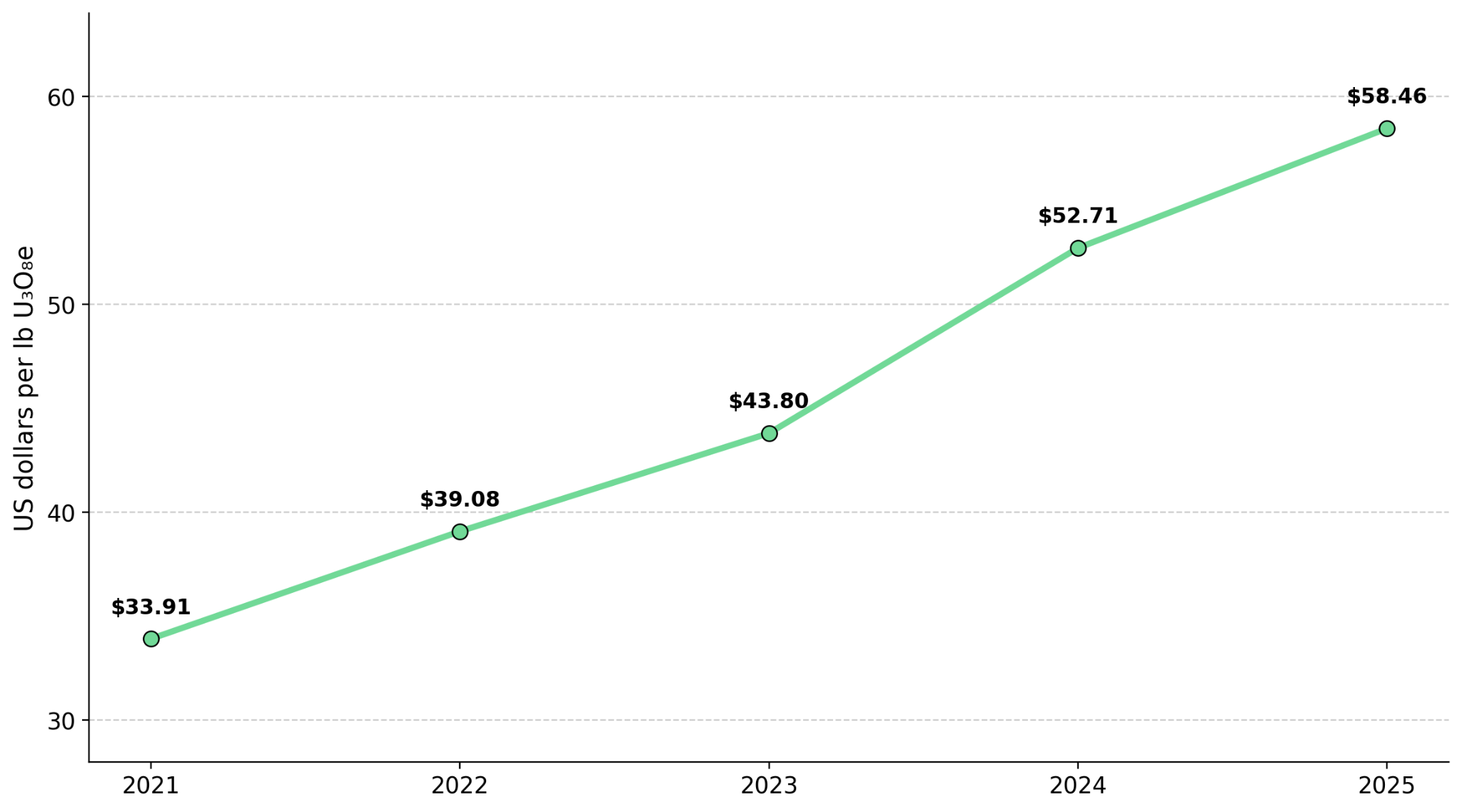
The US Energy Information Administration’s (EIA) 2025 Uranium Marketing Annual Report shows that Canadian supply offsets limited US-origin uranium deliveries. Reactor owners and operators purchased 46.9 million pounds of U₃O₈e in 2025 at a weighted average price of US$58.46 per pound, 11% above the 2024 average.
Canada supplied the largest share at 32%, compared with 28% from Kazakhstan, 15% from Australia and only 7% from US-origin material, making Canadian feedstock central to North American fuel security.
Canada’s 32% Share & Supply Scarcity Increase Need for New Uranium Projects
Canada’s 32% share of 2025 deliveries demonstrates an established procurement route into US reactors, but undeveloped resources do not represent scheduled supply. Explorers must confirm continuity and grade through chemical assays, convert exploration targets into compliant mineral resources, and define metallurgy, infrastructure requirements, environmental approvals and capital needs before utilities can assess delivery timing.
ATHA Energy extended mineralization continuity at RIB North from 300 metres to 1.45 kilometres, with all seven newly reported holes intersecting uranium. Backed by C$63 million raised in the first quarter of 2026, the company can complete its approximately 20,000-metre, three-rig program and fourth-quarter three-dimensional modelling, providing a clearer basis for further drilling and eventual resource definition.
Troy Boisjoli, Chief Executive Officer, explains why new uranium projects must advance:
“We’re moving into a uranium market where all the assets need to get built. You look at declining production rates going into the 2030 to 2040 decade and the scarcity of assets that are backfilling those.”
US Supply Gap Increases Need for High-Grade Canadian Uranium Development
Higher uranium grades can reduce the volume of ore mined and processed for each pound of U₃O₈, but technical studies must confirm whether that advantage is recoverable. Radioactivity readings require chemical assays to establish grade, mineral resources require economic and technical studies before conversion into reserves, and contained pounds do not establish annual production rates. Water management, ground conditions, metallurgical recovery and development capital ultimately determine whether high grade translates into lower unit costs and viable production.
IsoEnergy is advancing the Hurricane deposit, which contains an indicated resource of 48.6 million pounds of U₃O₈ at 34.5% and an inferred resource of 2.7 million pounds at 2.2%. Its expanded 2026 drilling recorded the strongest radioactivity to date across the 600-meter South Trend, including beyond the existing resource footprint, creating an opportunity for resource growth while pending assays guide its 2027 drilling priorities.
Phil Williams, Chief Executive Officer, quantifies the United States uranium supply gap:
“What you have in the United States is a massive disconnect between domestic requirements and domestic production, and the gap is not going to be filled by just one processing facility. We need 50 million pounds of production in the United States, so a new processing facility is required.”
Low US Uranium Output Raises Need for Permitting Progress to Expand Supply
EIA data show that US uranium concentrate production more than tripled in 2025 to 2.1 million pounds of U₃O₈, its highest level since 2017. Exploration drilling reached 1,824 holes covering more than one million feet, while development drilling reached 3,708 holes and 1.30 million feet, indicating increased field activity without establishing future production volumes or timing. Domestic output still equaled less than 5% of the 46.9 million pounds purchased by reactor owners and operators, leaving US demand heavily dependent on imported uranium.
US Output Below 5% of Purchases Raises Need for Multiple Projects
US-origin material supplied 7% of reactor deliveries in 2025 even though domestic mines produced less than 5% of annual purchase volume, indicating that inventories and other market channels supplemented current output. Closing even part of the supply gap requires multiple projects to complete permitting, secure construction capital, build wellfields or processing facilities and achieve modeled costs and recovery rates during production.
enCore Energy completed federal permitting for Dewey Burdock after the Nuclear Regulatory Commission (NRC) renewed the project’s Source Materials Licence through June 2046. The 20-year authorization reduces regulatory uncertainty and moves the South Dakota in-situ recovery (ISR) project closer to development, with state approvals representing the remaining permitting stage.
93% Import Dependence Expands Role for Funded Non-Russian Developers
EIA data show that foreign-origin uranium accounted for 93% of US reactor deliveries in 2025. At year-end 2025, maximum contracted deliveries for 2026 through 2035 totaled 174 million pounds of U₃O₈e, while maximum unfilled requirements reached 186 million pounds within 360 million pounds of combined maximum anticipated requirements. Unfilled requirements therefore represented approximately 52% of the total, identifying potential future procurement volume rather than guaranteed purchases.
Project Funding Advances Non-Russian Uranium Supply Development
Because North American mine output remains below US reactor demand, non-Russian projects outside the region remain necessary to broaden eligible supply. Commercial value depends less on whether material is domestic or foreign than on verified origin, available financing, dependable transport and enforceable offtake contracts.
Atomic Eagle secured a commitment from Menel Energy and Resources to exercise options early, providing approximately A$10.9 million and increasing pro forma cash to about A$23 million. The funding supports its stated strategy through 2028 and enables parallel advancement of the fully permitted Muntanga project in Zambia and the larger, higher-grade Madaouela project in Niger.
15-20-Year Mine Timelines Make Uranium Feedstock the Supply Constraint
Western enrichment spending, Russian import restrictions and reactor demand make the time required to convert uranium resources into production a central constraint on fuel security. The Nuclear Energy Agency (NEA) of the Organisation for Economic Co-operation and Development (OECD) and the International Atomic Energy Agency (IAEA) finds sufficient geological resources to meet projected requirements through 2050, shifting the focus to whether projects can complete permitting, financing and construction on required delivery schedules.
DOE can fund enrichment expansion through milestone-based task orders, while new mines must establish geology and metallurgy, complete environmental and community reviews, secure infrastructure and financing, and construct operating facilities before producing saleable uranium. The typical 15-to-20-year mine-development period can therefore extend beyond downstream construction schedules, making feedstock availability the slower part of fuel-cycle expansion.
US$1.78 Billion Uranium Spending Has Not Added New-Mine Supply
The OECD Nuclear Energy Agency and International Atomic Energy Agency’s Uranium 2026: Resources, Production and Demand reports that global uranium exploration and mine-development expenditure exceeded US$1.78 billion across 2023 and 2024, approximately 46% more than during 2021 and 2022. Global production reached 61,924 tonnes of uranium in 2024, its highest level since 2016. Most of the increase came from restarting previously idled capacity and expanding existing mines, particularly in Canada. Although several projects secured regulatory approvals and advanced toward development, no new uranium mine began production during the period, indicating that increased spending had not yet generated supply from newly developed mines.
The Investment Thesis for Uranium
- Producers with operating mines, scalable processing capacity and utility relationships can respond to procurement demand without first completing mine permitting and construction, although revenue and margins still depend on recovery performance, realized prices and cost control.
- Permitted developers face fewer regulatory steps before construction, but remaining approvals, committed financing and commissioning schedules still determine when contracted deliveries can begin.
- Canadian developers and explorers have access to an established US procurement route, but discoveries must advance into compliant resources, reserves and financeable mine plans before they can support scheduled deliveries.
- Funded non-Russian developers can broaden eligible Western supply where North American output remains insufficient, provided fiscal terms are stable and export and offtake rights are legally enforceable.
- Higher grades and efficient extraction methods can reduce the material handled for each pound of uranium, but recovery rates, capital requirements, operating costs and annual output determine whether those advantages improve unit costs and margins.
- Because a new uranium mine typically requires 15 to 20 years to identify, permit and develop, funding plans must cover defined technical and regulatory milestones to reduce dilution and scheduling risk.
- The thesis weakens if enrichment projects miss construction milestones, legislation extends Russian import relief beyond January 1, 2028, utility contracting slows or upstream projects fail to convert capital spending into dependable production.
Although DOE’s $2.7 billion commitment funds enrichment rather than mining, it strengthens the investment case for uranium producers and advanced developers by increasing demand for secure, traceable feedstock. Miners with permitted projects, credible financing and near-term production schedules are best positioned to secure contracts and convert downstream expansion into revenue. Canada’s share of reactor deliveries and domestic production show that diversification requires multiple supply routes rather than US output alone. Uranium exposure therefore favors projects with verified geology, permitting progress, adequate capital and operating capability to convert policy support into contracted, scheduled supply.
TL;DR
US fuel-cycle policy is increasing the need for uranium projects that can deliver contracted supply. DOE has committed $2.7 billion to enrichment, while Russian import waivers expire by January 1, 2028. Yet domestic mines produced less than 5% of the 46.9 million pounds purchased by reactor operators in 2025, and foreign material supplied 93% of deliveries. Canada provided the largest share at 32%, while funded non-Russian projects remain necessary for diversification. Although identified resources can cover projected requirements through 2050, new mines typically take 15 to 20 years to develop. The central market test is therefore deliverability through verified geology, permitting, financing, infrastructure and operating execution.
FAQs (AI-Generated)
Analyst's Notes





Subscribe to Our Channel






Stay Informed