Newfoundland's Gold Exploration Boom & New Found Gold's Re-Rating Potential as an Emerging Canadian Producer


Newfoundland's gold boom attracts institutional capital as New Found Gold advances high-grade Queensway Project toward 2026 production with strategic Maritime deal.
- Newfoundland and Labrador is experiencing a multi-year exploration boom, driven by high-grade discoveries and accelerated capital inflows across the Gander-Appleton corridor.
- Rising exploration expenditures, strong permitting efficiency, and access to infrastructure position the province as a premier Tier-1 jurisdiction for gold development.
- New Found Gold's Queensway Project remains a central catalyst for regional activity, supported by a preliminary economic assessment released in July 2025, high-grade resource growth, and a transformative acquisition that accelerates its path to production.
- Targeted near-term production from the Hammerdown project in 2026 and continued high-grade drilling at Queensway create a clear re-rating pathway for the combined entity.
- Investors gain exposure to a unique combination of jurisdictional stability, escalating exploration success, and strategic consolidation, key drivers for valuation upside in the current gold market.
Newfoundland's Gold Boom as a New North American Investment Signal
Newfoundland and Labrador is experiencing a mineral exploration surge that rivals the province's historic mining booms. In 2021, prospectors staked more than 100,000 mineral claims, marking the second-highest total in provincial history. This staking rush has been sustained by robust economics and high-grade discoveries across the Gander-Appleton structural corridor, a geological trend that has attracted both junior explorers and major institutional capital.
Following expenditures of $169 million in 2021, exploration spending has maintained levels above $230 million annually from 2022 through 2024, with industry forecasts projecting $258 million for 2025. This sustained capital deployment reflects a structural shift in how investors view Newfoundland, not as a frontier play, but as a mature and increasingly de-risked gold district comparable to established Canadian mining regions.
The province's evolution from exploration hotspot to production-ready jurisdiction has created a wave of strategic consolidation, with companies racing to secure processing infrastructure and accelerate pathways to cash flow. This dynamic is reshaping North American gold investment flows and positioning Newfoundland as a critical supplier in a market increasingly focused on jurisdictional stability.
Why This Matters for Investors
For institutional and sophisticated retail investors, Newfoundland's appeal lies in its ability to compress risk across multiple dimensions. Rapid permitting cycles reduce the time between discovery and production, while access to deep-water ports, hydroelectric power, and skilled labor lowers both capital intensity and operational costs. These factors directly influence net present value calculations and internal rate of return models, making projects in the province more attractive on a risk-adjusted basis.
New Found Gold and its peers are leveraging these advantages to advance projects that would face significantly longer timelines in other regions. The result is a district-level opportunity that combines exploration upside with near-term production visibility, a rare combination in the current market.
Gold's Shift Toward Jurisdictional Premiums
Gold prices remain elevated, supported by central bank buying, persistent inflation concerns, and geopolitical uncertainty. However, investor behavior has shifted beyond simply tracking the spot price of gold. Capital is increasingly flowing toward projects in jurisdictions that offer regulatory transparency, permitting efficiency, and political stability.
Canada, and Newfoundland in particular, has emerged as a beneficiary of this rotation. The province offers a predictable environmental assessment process that aligns with global standards while maintaining competitive timelines. Brandon Gaspar has noted Newfoundland's demonstrated track record regarding the speed of derisking and permitting development projects, while Amanda McCallum pointed out that the Valentine Lake gold mine represents the first greenfield project permitted in Atlantic Canada in more than 15 years.
This jurisdictional premium is reflected in equity multiples. Companies operating in stable regions command higher enterprise value to resource ratios than peers in frontier jurisdictions, even when controlling for grade and tonnage.
Implications for Project Financing & M&A
Permitting speed and infrastructure availability have direct implications for project financing. Shorter development timelines reduce discount rates applied to future cash flows, improving net present value and making projects more attractive to debt and equity providers. In Newfoundland, the combination of established infrastructure and regulatory efficiency allows companies to advance projects with lower capital intensity and reduced execution risk.
Strategic consolidation, where companies acquire permitted infrastructure or advanced-stage projects, has become a key mechanism for accelerating production timelines. This dynamic creates optionality for shareholders, as projects in the region are more likely to attract corporate interest or facilitate value-accretive transactions.
Queensway & the District Catalyst Effect: How One Discovery Triggered a Regional Boom
New Found Gold's 2020 discovery at the Queensway Project catalyzed a multi-year exploration boom across Newfoundland's Gander-Appleton corridor. The initial high-grade intercepts, including visible gold in outcrop and drill core, ignited a staking rush that drew junior explorers, major mining companies, and institutional investors to the region.
The Gander-Appleton corridor has since emerged as Newfoundland's most active exploration trend, with multiple companies reporting significant intercepts along the same structural systems that host Queensway. This clustering of discoveries reinforces the district-scale potential of the region and suggests that the province's gold endowment is significantly larger than current resource estimates indicate.
District Scale & the Importance of Structural Geology
The geological underpinnings of Newfoundland's gold boom are rooted in district-scale fault systems, particularly the Appleton Fault Zone and the JBP Fault. These structures create the pathways for hydrothermal fluids that deposit gold at depth, and their regional extent suggests that discoveries to date represent only a fraction of the district's potential.
For New Found Gold, the Appleton Fault Zone represents both a current resource and a future exploration pipeline. The fault system extends across the company's 110-kilometer property package, with the initial mineral resource estimate, effective as of March 15, 2025, covering less than 5 percent of this strike extent. This asymmetry between drilled and undrilled areas creates embedded optionality that represents significant upside for patient capital.
New Found Gold's Strategic Position in the Newfoundland Boom
New Found Gold's preliminary economic assessment for the Queensway Project, released on July 21, 2025, demonstrates the economic viability of high-grade gold mining in Newfoundland. The study outlined an after-tax net present value at a 5 percent discount rate of C$743 million at a gold price of US$2,500 per ounce, with an after-tax internal rate of return of 56.3 percent. Life-of-mine all-in sustaining costs were estimated at US$1,256 per ounce, with an after-tax payback period of less than two years.
However, investors should note that the preliminary economic assessment is preliminary in nature and includes inferred mineral resources that are considered too speculative geologically to have economic considerations applied to them. There is no certainty that the preliminary economic assessment will be realized.
The project's economics are driven by grade rather than tonnage. High-grade intercepts provide operational flexibility and reduce the dilution typically associated with underground mining.
New Found Gold's Chief Executive Officer, Keith Boyle, has emphasized the importance of high-grade continuity in driving project economics:
"It doesn't matter what project you're on, grade is king."
District Scale & Resource Expansion Pathway
The Queensway mineral resource estimate covers less than 5 percent of the property's 110-kilometer strike extent, indicating substantial untapped potential. New Found Gold has launched an aggressive drilling campaign targeting cumulative drilling of approximately 600,000 meters across the Appleton Fault Zone and blue-sky exploration areas, with a 70,000-meter program currently underway.
Drilling results announced in 2025, including press releases dated February 11, May 21, and July 9, have returned high-grade intercepts that extend mineralization both along strike and at depth. These results suggest that the current resource estimate represents a conservative baseline rather than a ceiling, creating embedded optionality that is not fully captured in current valuations.
The phased development strategy outlined in the preliminary economic assessment supports ongoing resource expansion while advancing near-term production. Phase 1, spanning Years 1 through 4, targets average annual production of approximately 69,300 ounces, followed by Phase 2 in Years 5 through 9, which targets average annual production of approximately 172,200 ounces per year.
Boyle has underscored the company's commitment to organic growth through continued exploration:
"We've got the exploration team and they're not stopping."
Why the Maritime Acquisition Changes the Trajectory
New Found Gold's definitive agreement to acquire Maritime Resources, announced on September 5, 2025 and closed on November 13, 2025, fundamentally alters the company's development trajectory by providing access to fully permitted processing infrastructure. Maritime's Pine Cove Mill, a fully permitted mill and tailings facility rated for 1,300 tonnes per day nominal throughput, is expected to eliminate the need for third-party toll milling assumed in the preliminary economic assessment base case.
The acquisition also provides access to near-term production through the Hammerdown project, targeting production in 2026 with ramp-up to full production anticipated in early 2026. Stockpile processing at Pine Cove commenced in the first quarter of 2025, with processing scheduled to transition to Hammerdown feed in the second half of 2025. Hammerdown is expected to provide early-stage cash flow that supports the development of Queensway Phase 1, targeting production in the fourth quarter of 2027.
Boyle has highlighted how the acquisition transforms the company's risk profile:
"Being able to secure a facility where we could send that Phase 1, it really does derisk. Putting all of that together, we should see a rerate, in particular a better multiple on our stock. For us, it was a win all the way around."
The transaction also enhances operational flexibility by providing real-time data on mining and milling costs:
"We're going to have real-life numbers to work with in terms of costs to mine, costs to mill, and so we'll have very good quality numbers to input into the next phase of our engineering and estimating for Queensway."
Newfoundland's Jurisdictional Advantage: The Underappreciated Value Driver
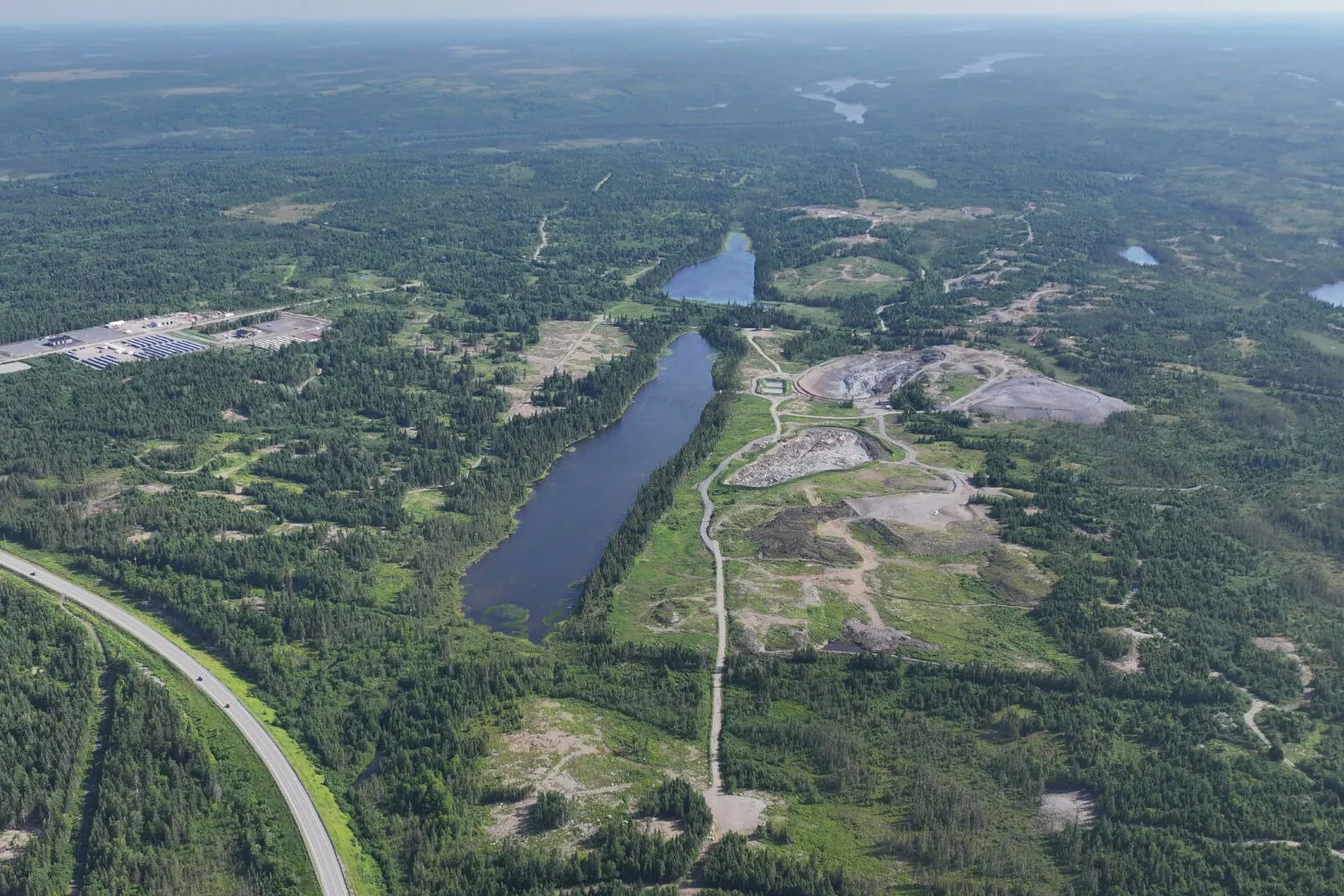
Newfoundland's existing infrastructure network provides a foundation for low-cost mine development. The province possesses deep-water ports that facilitate the import of equipment and the export of concentrate or doré. The Queensway Project is located along the Trans-Canada Highway with access to the Appleton Business Park, ensuring reliable supply chains and workforce mobility. The province's hydroelectric power infrastructure, including current and proposed transmission lines serving the project area, offers low-cost, low-carbon energy.
New Found Gold has demonstrated strong local hiring, with 67 percent of the company's employment coming from Central Newfoundland and 91 percent from Newfoundland and Labrador. This reduces training costs and accelerates project ramp-up.
Permitting Predictability & Speed
Newfoundland's environmental assessment process has demonstrated efficiency relative to other Canadian jurisdictions. The province's regulatory framework balances environmental protection with economic development, creating a permitting pathway that is rigorous but predictable. For investors, this predictability reduces the discount rates applied to future cash flows and lowers the probability of costly delays.
Operational & Financial Strength: Why the Combined Entity Screens Well for Investors
New Found Gold reported cash and marketable securities of C$87 million as of September 30, 2025, in its most recent quarterly disclosure. This balance sheet strength is supported by cornerstone shareholders, including Eric Sprott, who holds 23 percent ownership as of October 1, 2025. On a pro forma basis following the closing of the Maritime Resources acquisition and the announced Exploits Discovery Corp. acquisition, Sprott's ownership is expected to be approximately 18 percent.
The company's funding strategy benefits from access to near-term processing infrastructure following the Maritime transaction close, which is expected to reduce the need for large-scale equity raises to finance standalone milling facilities.
Production Profile & Cash Flow Pathway
The combined entity's production profile creates a pathway to cash flow, with Hammerdown operations commencing Q4 2025 and Queensway Phase 1 targeting the fourth quarter of 2027. This sequencing reduces capital requirements and dilution risk, as internally generated cash can be deployed toward construction and permitting rather than relying solely on equity or debt financing.
The Investment Thesis for New Found Gold
New Found Gold's position in Newfoundland's gold boom offers investors exposure to a rare combination of exploration upside, near-term production visibility, and jurisdictional stability. The following factors underpin the investment thesis:
- High-grade optionality embedded in district-scale exploration potential remains largely untapped, with current mineral resource estimates covering less than 5 percent of the Queensway property's strike extent.
- Accelerated development pathway enabled by the Maritime acquisition reduces capital expenditure requirements, eliminates planned third-party milling dependence, and compresses the timeline to first cash flow.
- Jurisdictional premium derived from Newfoundland's infrastructure, regulatory predictability, and permitting efficiency positions the province as a Tier-1 gold jurisdiction with lower execution risk than frontier markets.
- Robust project economics supported by high internal rate of return, low all-in sustaining costs, and rapid payback periods create strong risk-adjusted return potential.
- Re-rating potential tied to the company's transition from explorer to emerging producer in 2026–2027 represents a valuation catalyst that historically drives multiple expansion in junior mining equities.
Newfoundland's Boom Is Creating New Leaders in North American Gold
Newfoundland's gold exploration boom reflects a structural transformation driven by geology, economics, and strategic consolidation. The province's combination of high-grade discoveries, infrastructure availability, and regulatory efficiency has positioned it as a premier jurisdiction for gold development in North America.
New Found Gold's pathway, from exploration success to targeted near-term production, exemplifies the broader opportunity emerging across the district. The company's strategic acquisition of Maritime Resources, combined with aggressive resource expansion at Queensway, creates a development profile that balances risk and reward in a market increasingly focused on jurisdictional quality and execution certainty.
For investors, key catalysts include ongoing drilling results, permitting milestones, and the targeted commencement of production at Hammerdown in 2026. As Newfoundland continues to mature as a gold district, companies that successfully navigate the transition from discovery to production will define the next generation of North American gold producers.
TL;DR
Newfoundland and Labrador has emerged as a premier North American gold jurisdiction, driven by high-grade discoveries along the Gander-Appleton corridor and sustained exploration spending above $230 million annually since 2022. New Found Gold's Queensway Project exemplifies the district's potential, with a July 2025 preliminary economic assessment demonstrating robust economics including 56.3 percent after-tax internal rate of return and sub-two-year payback. The company's strategic acquisition of Maritime Resources, expected to close in the fourth quarter of 2025, provides access to fully permitted processing infrastructure and accelerates the path to production through the Hammerdown project targeting 2026. Combined with Newfoundland's regulatory efficiency, infrastructure access, and jurisdictional stability, the region offers investors a rare combination of exploration upside and near-term production visibility, positioning companies like New Found Gold for potential re-rating as they transition from explorer to emerging producer.
FAQs (AI-Generated)
Newfoundland offers a combination of jurisdictional advantages including predictable permitting processes, established infrastructure (deep-water ports, Trans-Canada Highway access, hydroelectric power), skilled local labor, and regulatory efficiency. The province has demonstrated its track record with Valentine Lake becoming the first greenfield project permitted in Atlantic Canada in over 15 years. These factors compress development timelines and reduce execution risk compared to frontier jurisdictions.
The July 2025 preliminary economic assessment outlined an after-tax net present value of C$743 million at a 5 percent discount rate (assuming US$2,500/oz gold), 56.3 percent after-tax internal rate of return, US$1,256/oz life-of-mine all-in sustaining costs, and an after-tax payback period of less than two years. However, the assessment is preliminary in nature and includes inferred mineral resources considered too speculative geologically, with no certainty the assessment will be realized.
The Maritime acquisition, announced September 5, 2025 and expected to close in the fourth quarter of 2025, provides access to the fully permitted Pine Cove Mill (1,300 tonnes per day capacity), eliminating the need for third-party toll milling. It also delivers near-term production through the Hammerdown project targeting 2026, which is expected to generate cash flow to support Queensway Phase 1 development targeting fourth quarter 2027, reducing dilution risk and capital requirements.
The initial mineral resource estimate (effective March 15, 2025) covers less than 5 percent of Queensway's 110-kilometer strike extent along the Appleton Fault Zone, indicating substantial untapped potential. New Found Gold has launched a drilling campaign targeting approximately 600,000 meters cumulative drilling, with a 70,000-meter program currently underway. High-grade intercepts in 2025, including 89.5 g/t gold over 5.85 meters, demonstrate continued discovery potential.
Hammerdown is targeting production in 2026 with full production ramp-up anticipated in early 2026. Queensway Phase 1 targets production commencement in the fourth quarter of 2027, with average annual production of approximately 69,300 ounces over Years 1-4. Phase 2, covering Years 5-9, targets average annual production of approximately 172,200 ounces. All timelines are subject to regulatory approvals and financing.
Analyst's Notes





Subscribe to Our Channel









.png)
Stay Informed