




Astra Exploration Doubles Down on La Manchuria With Up to 20,000 Metres of Drilling


Astra Exploration's CEO explains one missed target, Basalto step-outs and five regional targets behind a 10,000-20,000 metre La Manchuria drill campaign.
- Astra's final Phase III assays included 3 metres at 4.34 g/t gold and 363.7 g/t silver at Basalto and 8 metres at 3.12 g/t gold at the Manchuria Hill Eastern Zone, both still open.
- One deeper converging vein target, tested at 300 to 350 metres, missed in poor andesite host rock, which CEO Brian Miller calls a local result.
- Five regional targets across a 4 by 4 kilometre footprint compare with about 1 square kilometre at Manchuria Hill.
- Astra plans 10,000 to 20,000 metres at La Manchuria from November, backed by C$12.5 million in treasury, plus a first Don Mario programme in January or February.
- Key risks are host-rock variability, slow laboratory turnaround and the dependence of the 20,000 metre upper end on funds and results.
Astra Exploration Inc. (TSXV:ASTR) is preparing its largest drilling campaign after a Phase III programme that widened the La Manchuria gold-silver project. The Vancouver-based explorer plans 10,000 to 20,000 metres of drilling at La Manchuria in Santa Cruz, Argentina, and an inaugural programme at its Don Mario project in northern Chile.
CEO Brian Miller explained what the final Phase III assays changed and what they did not. He said the shares traded near their 52-week low during the week of the interview. For investors, the question is whether one failed target alters the case for a much larger system.
Phase III Results Extend the Footprint
Astra released the second and final batch of Phase III assays. The eight holes reported belong to a programme of 16 holes totalling 5,176 metres, drilled between April and June 2026. They were shallow step-outs of 50 to 200 metres, testing the west (Basalto Zone), north (Main and Eastern Zones) and east (Road Zone) of the Manchuria Hill Target.
The strongest intercepts were 3 metres grading 4.34 grams per tonne (g/t) gold and 363.7 g/t silver at Basalto, and 8 metres grading 3.12 g/t gold and 10.3 g/t silver in the Eastern Zone. The Basalto hole was a 50-metre step-out, and 1 metre within it graded 10.97 g/t gold and 619.8 g/t silver. The Eastern Zone hole was a 200-metre step-out to the northwest, and 2 metres within it graded 10.63 g/t gold and 23.9 g/t silver. The company says both remain open, along with the wider Manchuria Hill mineralisation in all four cardinal directions.
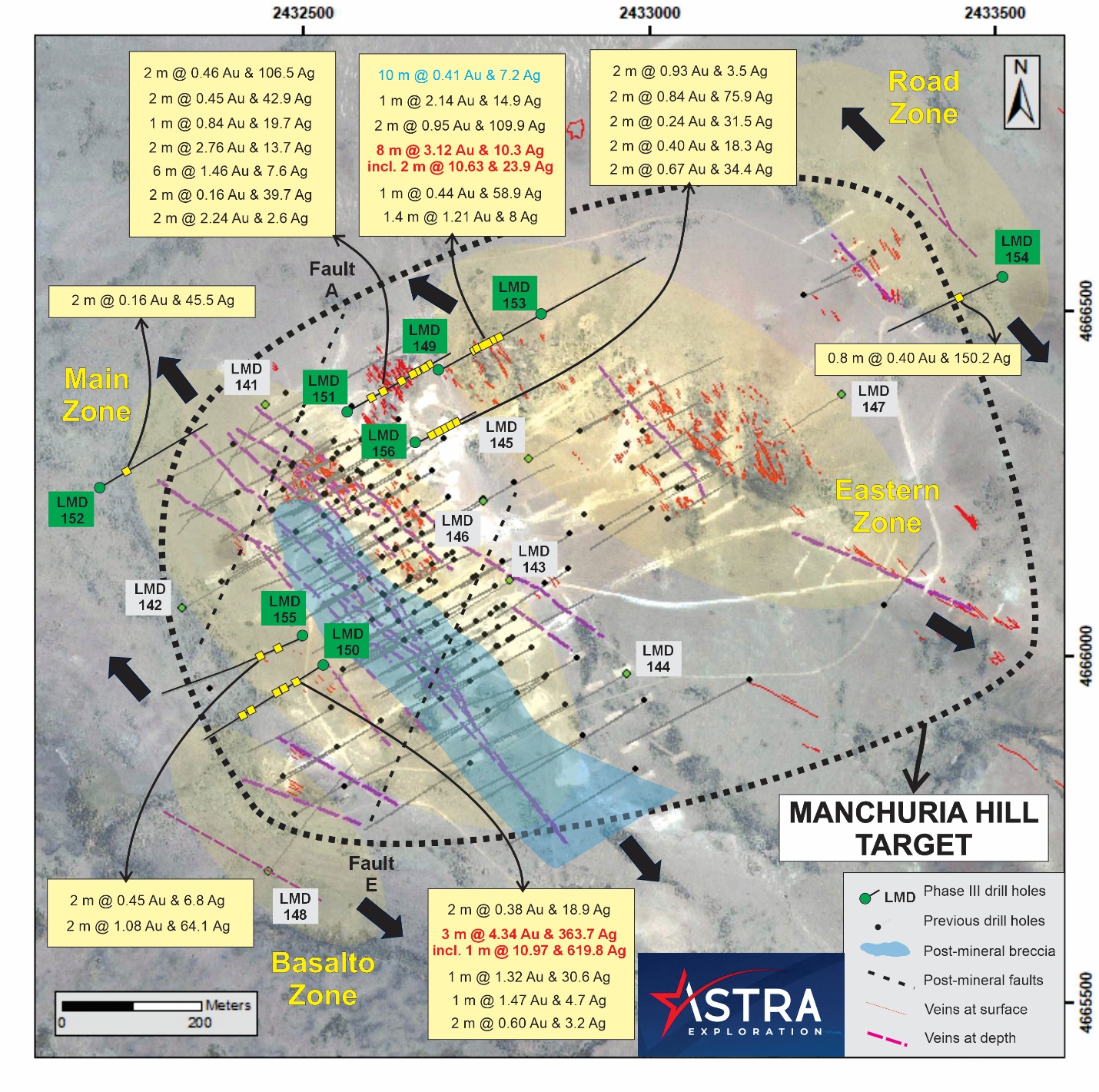
Miller described Basalto as a new discovery first announced in March 2026. He said a follow-up hole returned 80 g/t gold over 2 metres. He also pointed to the bulk disseminated system near surface. There, he said, drilling had for the first time intersected intervals of more than 50 metres grading close to 1 g/t gold equivalent. A 200-metre step-out at that scale adds ounces quickly, he said.
What the Missed Target Changed
Earlier drilling had found veins one to 2 metres thick that appeared to merge into a single structure. Astra drilled beneath them at depths of 300 to 350 metres, the deepest holes on the project. The veins were there, but they were narrow and low grade. The company's release says deeper drilling did not return good vein widths because of poor host lithology.
Miller said the host rock was andesite, where grades can be erratic. Rhyolites and pyroclastics have been more predictable. Andesites were once thought barren, yet earlier holes returned very high grades from them. Future drilling will concentrate on the rocks that have delivered consistently.
Miller said he has been putting the same point to shareholders:
"And what I'm trying to emphasize with people is that it doesn't mean that the project is dead at depth. You have one local area where a target didn't work out. We still have high-grade feeder structures that we're targeting."
Five Regional Targets Widen the Search
Miller said Astra has long viewed Manchuria Hill as one part of a larger epithermal system around a big intrusion. A compilation of geological and geophysical data now defines five priority regional targets over a 4 by 4 kilometre footprint, roughly 16 times the area of Manchuria Hill. Miller said none has been drilled and little work had been done on them.
The regional targets are La Pampa, Breccia, Floats, Solo and Creek. La Pampa lies 3 kilometres northeast, with outcropping quartz veins and vein float samples returning up to 1.8 g/t gold. Breccia is a 2 by 3 kilometre zone of high-level clay alteration and quartz veinlets, with pathfinder geochemical anomalies along strike from Manchuria Hill. Floats has abundant vein float at surface but is covered by younger volcanic deposits. Solo has quartz veins and veinlets within clay alteration in the felsic pyroclastic sequence. Creek is a magnetic anomaly resembling the Main Zone beneath younger volcanic cover.
Miller named Breccia, to the southeast, as the favourite. It sits on strike with the Manchuria Hill vein structures, and he said the system plunges southeast. Preserved mineralisation should continue in that direction, he said. The release says the target is designed to test a boiling zone at depth.
Astra has also expanded the La Manchuria claim group from about 5,600 hectares to about 39,000 hectares by staking open ground.
Interview with Brian Miller, CEO, Astra Exploration
Drilling Programme, Funding & Timing
Miller said the programme carries a 10,000-metre minimum. If every dollar were stretched, and Don Mario also went ahead, it could approach 20,000 metres. He said roughly 12,500 metres have been drilled at La Manchuria to date, so the campaign would nearly double that:
"The next phase of drilling is going to still be focused on expanding size, showing size and scalability."
Two drills are planned. Drilling at La Manchuria is due to start in November, with about 5,000 metres expected by the end of 2026. A second 5,000 metres would follow in the first quarter of 2027, possibly more depending on results. Miller said drilling could continue into June. Argentina offers about nine months of solid drilling weather. Winter cuts productivity and raises cost per metre, so Astra pauses and restarts.
Astra's release puts the treasury at C$12.5 million and says it supports fully funded drilling programmes. Miller said the project is largely set for drilling, with no significant surface work still needed. Assay turnaround has been slow, with a lot going through the laboratory. Astra holds 80% of La Manchuria, with an option to acquire 90% from Patagonia Gold Corp.
Don Mario Adds a Second Drill Target
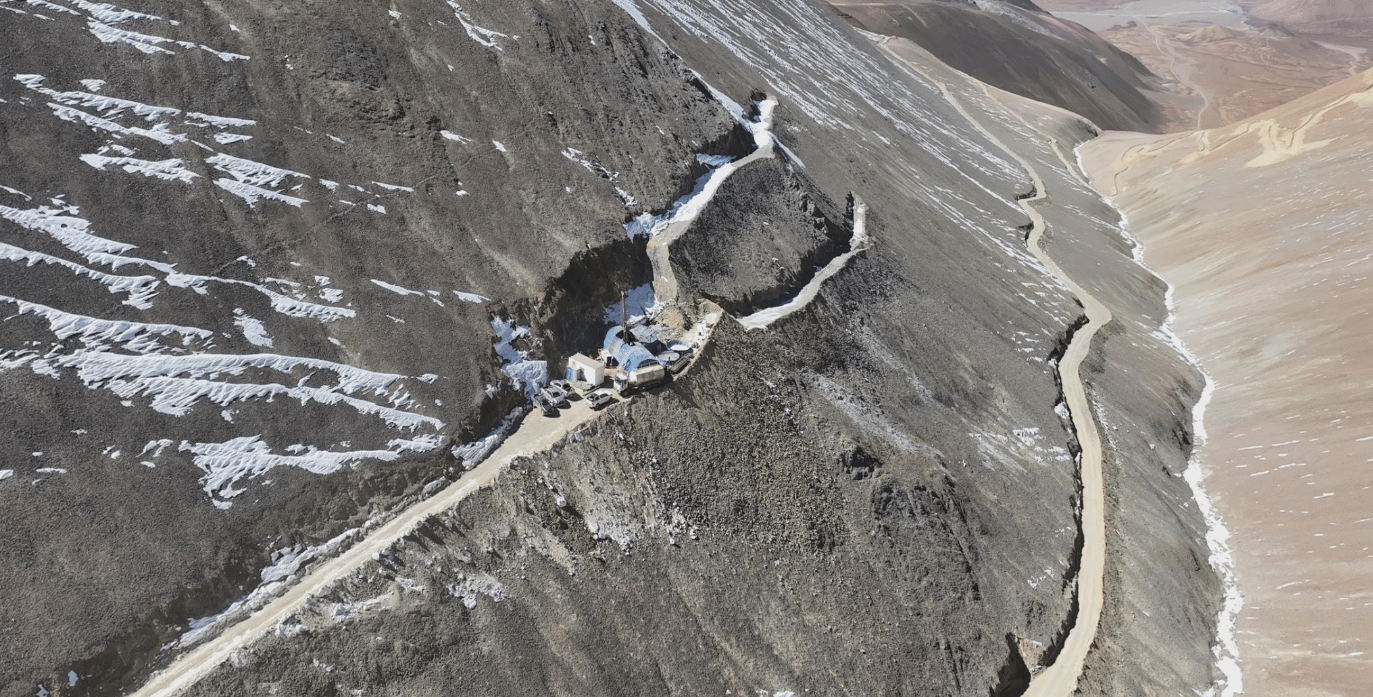
Miller said Don Mario is not a pivot away from La Manchuria, which remains the flagship. He has been raising Don Mario with the market since January. Astra has spent several months bringing it to a drill-ready state. Miller noted that the project is at high elevation, is expensive to explore and has a short exploration window.
The 100% owned project, previously named Cerro Bayo, sits in the Maricunga belt about 20 kilometres from the Refugio Mine. The company describes a high sulphidation epithermal system, possibly with porphyry gold, resembling La Coipa, Refugio and Salares Norte.
The Investment Thesis for Astra Exploration
- Astra plans a 10,000 to 20,000 metre campaign to expand Manchuria Hill and test five regional targets across a 4 by 4 kilometre footprint.
- Phase III step-outs at Basalto (3 metres at 4.34 g/t gold and 363.7 g/t silver) and the Eastern Zone (8 metres at 3.12 g/t gold) remain open.
- The company reports C$12.5 million in treasury, and Miller describes the 10,000 metre minimum as funded. The upper end depends on how far funds stretch and on Don Mario.
- Don Mario adds a second exploration opportunity in a district with large deposits. It is a first-pass programme with high elevation, cost and seasonal constraints.
- The andesite miss shows that host rock controls grade. The deeper high-grade vein thesis has not yet been confirmed at depth.
- Investors should monitor the Don Mario news release, first assays from the November drilling and results from the Breccia target. Laboratory delays could slow news flow.
Macro Thematic Analysis
The Astra discussion reflects a wider tension in junior gold exploration. Headline grades attract attention, but scale determines whether a discovery can become a project. Miller's framing is that the market is split. Analysts favour tonnage and expansion, while the wider market responds to short, high-grade intercepts. The split matters at La Manchuria because the two systems appeal to different audiences. The bulk system offers size. The vein system offers grade. The next campaign is designed to test whether both can grow.
Commodity prices frame the numbers. Astra's gold-equivalent calculations assume $3,600 gold and $60 silver. The Maricunga belt adds another layer. Miller described the district as home to very large deposits. He put the Refugio mine at about 9 million ounces and a nearby deposit at 49 million ounces of gold.
Seasonality is a further factor. Argentine winter can cut productivity and raise costs per metre. Don Mario faces its own limits, with high elevation and a short exploration window. Both projects show how weather and access shape junior exploration calendars.
TL;DR
Astra Exploration's Phase III drilling at La Manchuria extended high-grade mineralisation at Basalto and Manchuria Hill, including 3 metres at 4.34 g/t gold and 363.7 g/t silver, despite one deeper target missing in poor andesite host rock. CEO Brian Miller says the miss was local and that the company still targets high-grade feeder structures. Astra has defined five regional targets across a 4 by 4 kilometre footprint. It plans a 10,000 to 20,000 metre campaign starting in November, plus a first Don Mario programme in Chile. The company reports C$12.5 million in treasury. Laboratory delays and host-rock risk remain key watch items.
FAQs (AI Generated)
Analyst's Notes





Subscribe to Our Channel



Stay Informed






















