

Record US$99 Uranium Contract Price Favors Miners Yet to Sell 2030s Output



Uranium’s long-term contract price hit a record US$99/lb, but older contracts delay gains. Miners with supply left to sell into the 2030s stand to benefit most.
- TradeTech's Long-Term Uranium Price Indicator reached US$99.00 per pound on October 31, 2026, the highest since the series launched in 1996.
- Cameco realized an average US$65.78 per pound in the third quarter, about US$31 below the September 30 long-term price, because deliveries ran under older contracts.
- Uranium shares fell regardless, with the VettaFi Global Uranium Mining Index down 16% and the Nasdaq Sprott Junior Uranium Miners Index down 22% in September.
- Utilities are seeking deliveries from 2027 into the late 2030s, yet Argonaut reports contracting remains below replacement levels.
- Cameco's commitments run above its five-year average through 2028 and below it in 2029 and 2030, leaving its open volume at the end of the decade.
Higher Contract Prices and Nuclear Build Plans Lift the Uranium Term Price to a Record
The long-term uranium price, the benchmark for multi-year utility contracts, reached US$99.00 per pound on October 31, 2026, the highest since the series began in 1996, according to TradeTech’s Long-Term Uranium Price Indicator published November 2. The print follows four straight month-end readings at US$97.00. Uranium shares moved the other way in the weeks before: the Nasdaq Sprott Junior Uranium Miners Index dropped 22% in September and the VettaFi Global Uranium Mining Index fell 16%, MINING.COM reported.
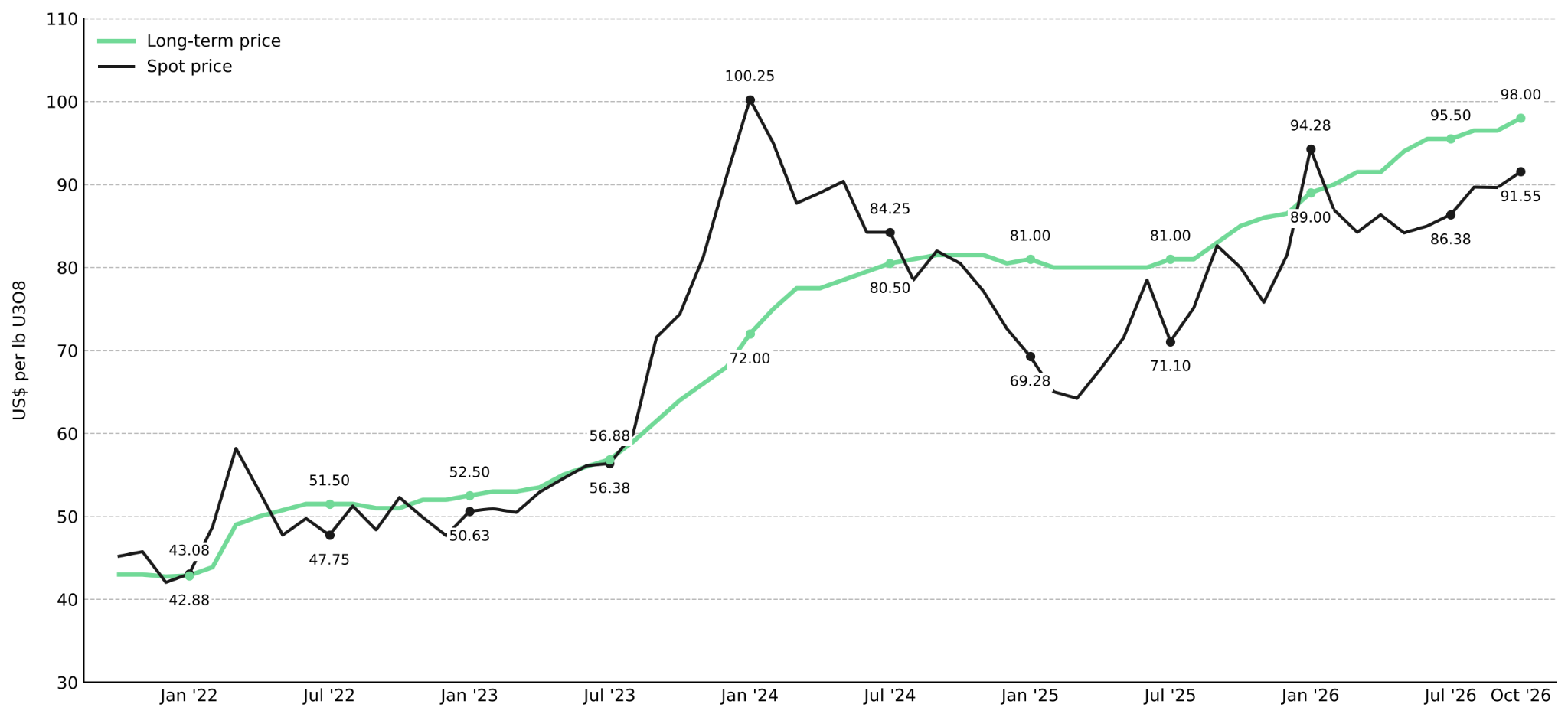
Most uranium is sold under multi-year contracts rather than on an open market, which makes the term price the better guide to what miners earn. TradeTech President Treva Klingbiel said utilities were seeking deliveries from as early as 2027 into the late 2030s. Kazatomprom says the delay will not materially affect mining, but BMI forecasts lower Kazakh output next year. Kazatomprom’s sulfuric acid plant, a supply source for the acid its in-situ mines use, now commissions between the third quarter of 2027 and the first quarter of 2028. BMI also forecasts lower Kazakh output next year.
Older Contracts Hold Miners' Realized Prices About US$31 Below The Term Market
Cameco realized an average US$65.78 per pound in the third quarter of 2026, according to its October 30 results. The long-term price stood at US$96.50 on September 30. The gap exists because quarterly deliveries settled under contracts priced in earlier, cheaper years. Operations widened the shortfall. A longer planned maintenance shutdown at the Key Lake mill lowered output, and Cameco’s third-quarter production of 3.5 million pounds came in 19% below BMO Capital Markets’ forecast. Cost-of-sales guidance rose to C$67 to C$70 per pound.
Fixed-price contracts reprice only as they expire, and market-related contracts capture only part of a price rise. Cameco's commitments average more than 28 million pounds a year over five years, above average through 2028 and below it in 2029 and 2030. Utility contracting remains below replacement levels, Argonaut's Jon Scholtz wrote on October 12. Sprott's Paul Wong wrote on October 28 that tighter liquidity raises the cost of capital and compresses valuation multiples even with an unchanged price outlook. Developers still funding construction carry the heaviest share of the cost.
Below-replacement Contracting Delays When Record Uranium Prices Reach Miner Earnings
The cohort carrying the lag is listed uranium producers selling into older term contracts. Utility procurement, not price, sets how long the lag lasts. Cameco's management addressed the timing directly. Tim Gitzel, Chief Executive Officer, Cameco highlights:
"Contracting activity is rarely linear and market conditions can influence the pace of utility decision-making, customer requirements do not disappear."
BMI’s October 15 outlook carries the upside case. It shows a modest surplus in 2026 turning to deficit in 2027 and spot averaging US$95 per pound next year. It also has reactor requirements growing 4.1% a year to 2035 against 3.3% for mine output. On that path, utilities sign near US$99, and producers with open 2029 to 2030 volume reprice it, closing the realized-price gap. In the counter-case, contracting stays below replacement, the term price stalls near US$97 to US$99, and equities keep trading on liquidity.
TradeTech's month-end indicator separates the two, next due November 30, 2026, alongside Cameco's fourth-quarter contracting disclosure. The earnings horizon is the 2029 to 2030 delivery window. The reversal trigger is a month-end print below US$97.00, the level held from June through September. A print below it would show utilities stepping back and would remove the repricing case for open late-decade volume.
Contract Timing Sets Uranium Miners' Earnings Exposure
Producers with heavy committed volume through 2028 carry rising costs against fixed revenue. Cameco realized C$91.76 per pound in the third quarter against cost-of-sales guidance of C$67 to C$70. Developers carry funding risk. NexGen Energy is targeting first ore at Rook I in the third quarter of 2030. Red Cloud Securities’ David Talbot estimates about C$1.2 billion in remaining funding, to be raised while liquidity sets valuations.
The test separating producers is how much volume each holds uncommitted or market-priced after 2028. Cameco passes, with commitments below average in 2029 and 2030 and new volumes layered in on market-related pricing. Desjardins’ Bryce Adams holds a C$190 target on Cameco against an October 29 close of C$116.63. A producer without open late-decade volume captures little of the record.
Contract terms are private, so no retail holder sees when utilities sign or at what price. September showed the record gives share prices no floor: the junior index fell 22% while the term price held at its high. A uranium equity position can lose a fifth of its value on liquidity alone. Position size, not timing the next contracting wave, is the variable a retail holder controls.
Why the Uranium Payoff Arrives Late
Utilities now pay more for uranium delivered years out than at any point since TradeTech began tracking the price. The record reaches miners' revenue only as older contracts roll off and new ones are signed, not on the day the indicator moves.
Value has shifted toward miners holding unsold or market-priced volume for the next decade, and away from books full of older fixed-price sales. The old assumption, a record price lifting producer earnings in the same year, no longer holds. Contract-book profile belongs in a valuation. Share prices falling while the term price climbs leaves the late-decade repricing largely outside equity values. Utilities buying slowly today leave more of their needs to buy later, against thinner supply.
Analyst's Notes





Subscribe to Our Channel







Stay Informed