




Rick Rule's Interest in New Found Gold Signals Broader Re-Evaluation of Development-Stage Gold Risk



Rick Rule's renewed interest in New Found Gold highlights how PEA economics, Hammerdown production, and owned infrastructure are reshaping institutional views on development-stage gold assets.
- Rick Rule's shift to actively studying New Found Gold reflects a broader investor reassessment of high-grade, near-production gold developers with quantifiable economics.
- The Queensway Preliminary Economic Assessment, completed in Q3 2025, delivers a 56% after-tax IRR and C$743 million NPV at US$2,500 per ounce gold, marking the transition from exploration to institutional-grade development risk.
- First gold at Hammerdown in November 2025 and the ramp to full production in early 2026 alters the funding equation through owned milling infrastructure.
- Jurisdictional positioning in Newfoundland provides permitting visibility, with construction targeted for Q2 2027 following anticipated permit completion in Q1 2027.
- New Found Gold illustrates how development-stage assets attract capital reallocation as gold price dynamics reshape risk-adjusted return expectations.
When Skepticism Turns Into Analytical Reassessment, the Market Listens
The gold sector periodically reaches inflection points where investor attention shifts not because of price momentum alone, but because risk profiles fundamentally change. One such signal emerges when long-standing skeptics revise their stance based on new data. Rick Rule's move from historical caution to active observation of New Found Gold is emblematic of this shift.
This analysis does not center on personality-driven endorsement. Instead, it uses Rule's publicly stated interest as a framework for examining a broader market dynamic: how high-grade gold developers transition into an investable category once economics, capital pathways, and execution visibility converge.
The investment theme is clear. In an environment where gold prices remain structurally supported but capital markets are increasingly selective, companies that cross from geological promise into demonstrable economic viability are being reevaluated.
Rick Rule has stated directly (34:09):
"I have been a skeptic for years around New Found Gold. I'm increasingly attracted to it as the market cap has fallen and as they have done more work on the deposit."
New Found Gold's evolution from exploration success to emerging producer with a PEA-backed development plan provides a timely lens through which to examine this re-rating mechanism. The company's November 2025 acquisition of Maritime Resources, first gold pour at Hammerdown, and C$87 million cash position collectively address the variables that institutional investors weigh most heavily when evaluating development-stage gold assets.
From Exploration Optionality to Development-Stage Risk
The transition from exploration company to development represents one of the most significant inflection points in a mining company's lifecycle. This shift alters how institutional capital evaluates risk, applies discount rates, and models potential returns. For New Found Gold, this transition has been deliberate and structured around specific milestones designed to address institutional requirements.
Institutional Capital & Threshold Crossing
Institutional capital rarely avoids projects because of geology alone. The primary constraints are uncertainty around capital intensity, permitting timelines, and cash-flow visibility. Exploration-stage discoveries, regardless of grade, typically fail these tests because they lack the defined parameters required for institutional underwriting.
What changes investor behavior is threshold crossing: a defined mine plan, conservative cost assumptions, clear capital requirements, and measurable payback periods. The Queensway PEA, completed in Q3 2025, represents this transition. It provides a framework that allows investors to model downside scenarios, stress-test margins, and compare the asset against global cost curves.
Keith Boyle, Chief Executive Officer of New Found Gold, describes the company's recent approach:
"We released a mineral resource, we released a PEA that really did demonstrate a robust project in a phased approach, mindful of capital allocation and potential dilution to the shareholders, and that was really well received by the market."
The Role of a PEA in the Current Gold Cycle
While Preliminary Economic Assessments are not definitive studies, they matter in today's market because they establish first-pass capital discipline, anchor valuation metrics such as enterprise value per ounce and net present value relative to capital expenditure, and allow comparison against peer developers globally.
For companies like New Found Gold, the PEA does not close the investment case. Rather, it opens the project to a broader class of capital that requires quantifiable parameters before allocation.
Queensway Economics & High-Grade Asset Valuation
High-grade gold deposits historically command attention from both retail and institutional investors. However, grade without margin resilience is insufficient in a market environment characterized by cost inflation and capital scarcity. The Queensway PEA reframes the discussion by pairing grade with cost control and capital discipline.
Margin Structure & Cost Positioning
The Queensway PEA outlines economics that position the project favorably relative to global cost curves. At a base case gold price of US$2,500 per ounce, the project generates an after-tax NPV (5% discount rate) of C$743 million with an after-tax IRR of 56%. All-in sustaining costs of US$1,256 per ounce provide meaningful margin protection against gold price volatility while maintaining leverage to price appreciation.
These metrics are particularly relevant in a volatile macro environment where investors demand downside protection first and leverage second. The phased development approach outlined in the PEA reflects awareness of current capital market conditions, where projects requiring large upfront capital commitments face heightened financing risk.
Grade control drilling has further supported confidence in the resource model. Continuity of high-grade mineralization at depth and along strike reduces geological risk and supports the economic assumptions underlying the study.
Capital Intensity, Payback & Risk Factors
The phased approach to development addresses concerns around capital intensity. By structuring the project to generate cash flow from initial production phases before committing to full-scale development, the company maintains flexibility to adjust capital allocation based on market conditions and operating performance.
Rule's commentary centers on economic viability rather than exploration upside. The market increasingly rewards projects that can demonstrate a pathway to self-funding expansion rather than relying on serial equity raises that dilute existing shareholders.
Rick Rule observes:
"The deposit clearly will be economic... I see it as really a string of deposits that ends up being over the million-ounce threshold with centralized process facilities."
Hammerdown Operations & Owned Infrastructure
The acquisition of Maritime Resources, completed on November 13, 2025, fundamentally altered New Found Gold's capital narrative. The transaction introduced near-term production and, critically, ownership of processing infrastructure that supports the broader development strategy.
Production Ramp & Operational Milestones
New Found Gold poured first gold at Hammerdown in November 2025 and is currently ramping toward full production, which is targeted for early 2026. The 2025 guidance indicates approximately 50,000 ounces of annual production at steady state. This operational progress transforms the company from a capital consumer into a producer with demonstrated execution capability.
Keith Boyle explains the strategic rationale behind the acquisition:
"We acquired Maritime Resources, and those were strategic acquisitions. Synergistic in that we were acquiring a developing mine that was going to be starting production in 2025. Just as important was that we were now putting our hands on milling facilities that were key in advancing and staying on track with the advancement of the Queensway project."
Owned Processing Infrastructure
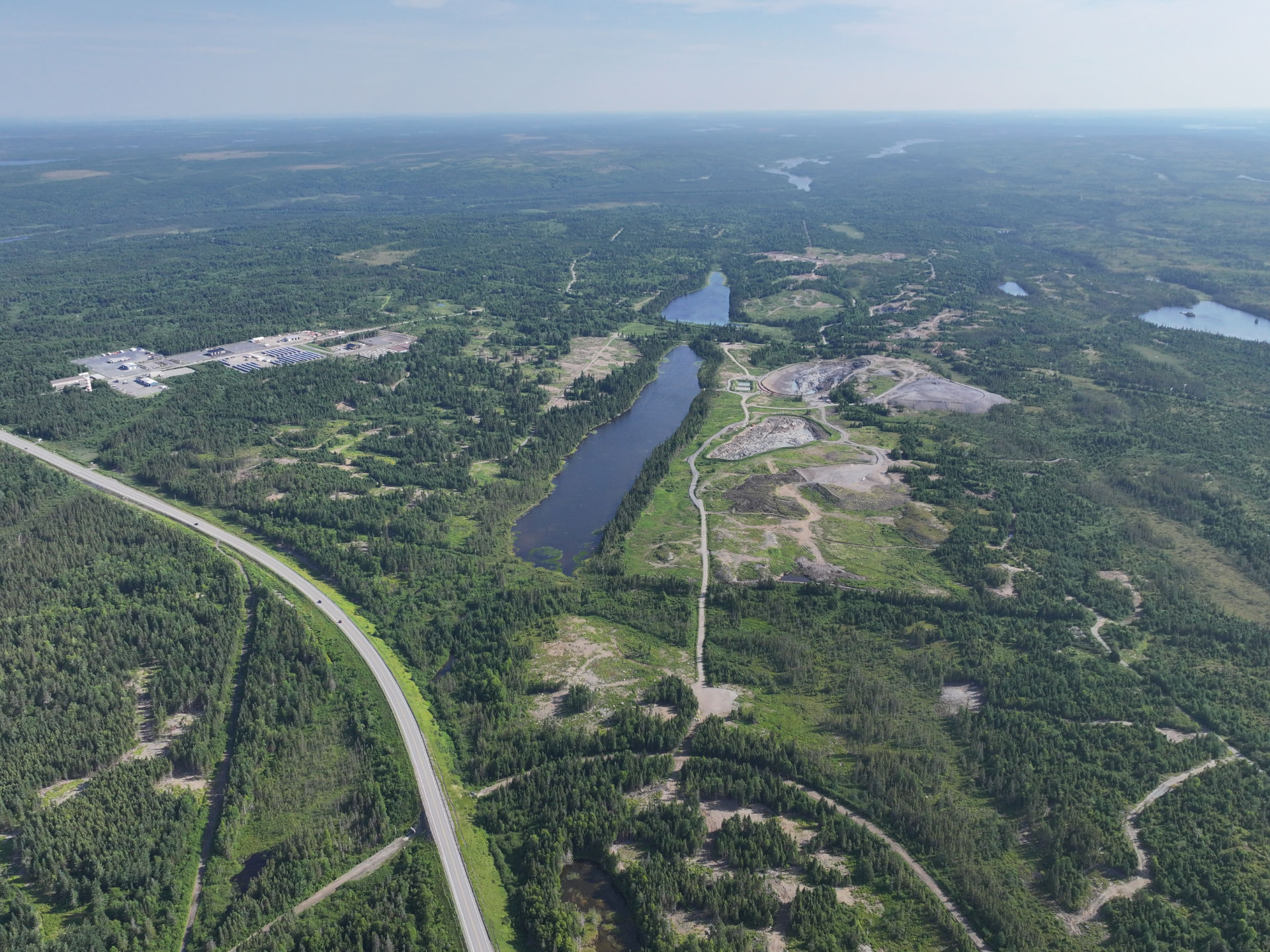
Unlike many development-stage companies that rely on toll milling arrangements, New Found Gold now owns the Pine Cove Mill and the Nugget Pond Hydrometallurgical Gold Plant. The Pine Cove Mill, currently processing Hammerdown feed at 700 tonnes per day and a nominal throughput of 1,300 tonnes per day, provides operational infrastructure without third-party dependency. The Nugget Pond facility, currently idle, offers additional processing optionality as development advances.
This infrastructure ownership is material to the investment case. The Queensway Phase 1 plan utilizes offsite toll milling, but owned facilities provide flexibility and reduce execution risk associated with third-party capacity constraints.
Dilution Management & Capital Optionality
In the current financing environment, dilution risk represents a primary valuation overhang for development-stage companies. Cash flow from Hammerdown as production ramps provides optionality that pure-play developers lack.
Keith Boyle addresses the capital strategy directly:
"Hammerdown coming into production, we feel that these gold prices are going to help us in being able to manage the amount of money that we have to raise externally in order to advance Queensway."
The company held C$87 million in cash and marketable securities as of September 30, 2025, following a $63 million bought deal completed in June 2025 and a $20 million private placement closed in August 2025.
Jurisdictional Considerations in Newfoundland
Gold assets in stable jurisdictions increasingly command a premium as geopolitical risk reshapes global supply chains and capital allocation decisions. Ranked among the top 10 global mining jurisdictions by the Fraser Institute, Newfoundland and Labrador offers a historically supportive permitting environment, established mining infrastructure, skilled labor availability, and access to renewable power.
Permitting Framework & Development Timeline
The Queensway project is currently advancing through environmental baseline work and permitting activities. The development schedule targets permit completion by Q1 2027, with construction commencement in Q2 2027. Additional feasibility study-level metallurgical test work results are expected in H2 2026.
Keith Boyle notes the jurisdictional context:
"Working in Newfoundland, the government's been great... Our approach to that application is the same, and Firefly ended up getting their EA in 45 days, so really quick turnaround. We would expect the permits to come quickly thereafter."
While past precedents provide context, permitting timelines remain subject to regulatory processes and should be monitored as the project advances.
Market Behavior & Valuation Dynamics
Rule's interest is explicitly tied to a familiar pattern in resource markets: share price weakness coinciding with technical advancement. This disconnect often emerges when exploration excitement fades, development timelines extend, and generalist capital exits the sector.
For long-term investors, these periods may create asymmetric entry points provided underlying fundamentals continue to strengthen.
Rick Rule highlights:
"I'm newly attracted to it because of the progress they've made and because of the share price declines that they've experienced and because of their recent merger."
The presence of sophisticated institutional shareholders provides additional context. Eric Sprott holds approximately 19% of New Found Gold, making him the largest shareholder. Rick Rule observes that "having a difference of opinion with Eric is often very hard on one's wallet."
Execution Risk & Outstanding Variables
No development story is without risk. Key variables that investors continue to monitor include permitting timelines, capital cost inflation that could affect project economics, and resource conversion from inferred to indicated categories that would support more advanced engineering studies.
However, execution risk has narrowed as New Found Gold has moved from concept to active development. The management team transition brought operational experience from previous mine builds. Near-term catalysts include continued drill results from the ongoing 70,000-meter campaign (approximately 50% announced to date), the forthcoming technical report at Hammerdown, and Queensway permitting milestones through 2026.
The Investment Thesis for New Found Gold
- Queensway's PEA provides a 56% after-tax IRR and C$743 million NPV at US$2,500 per ounce gold, with AISC of US$1,256 per ounce positioning the project favorably on global cost curves.
- Hammerdown production, with first gold poured in November 2025 and full production targeted for early 2026, introduces operating cash flow that may reduce external funding requirements.
- Owned processing infrastructure through the Pine Cove Mill and Nugget Pond facility eliminates third-party dependency and provides development optionality.
- Tier-1 jurisdictional positioning in Newfoundland offers a historically supportive permitting environment relative to peers operating in less stable regions.
- A C$87 million cash position as of September 30, 2025, provides runway to advance both exploration and development activities.
- Exploration upside at Dropkick and across the broader property package provides resource expansion potential beyond current PEA parameters.
- Current market valuation relative to technical progress may create optionality for capital with appropriate time horizons and risk tolerance.
Why “Reevaluation” Matters in This Market
Rick Rule's decision to actively study New Found Gold reflects a broader recalibration underway in the gold sector, where developers that demonstrate real economics, funded pathways, and jurisdictional strength move into a different valuation cohort.
For investors, the significance lies not in endorsement but in timing. As speculative risk gives way to development risk, and development risk becomes measurable through defined economics and operating cash flow, the market begins to reassess what constitutes value.
New Found Gold sits at that transition point. The convergence of PEA-backed economics, Hammerdown production ramp, owned infrastructure, and a clear development timeline through Q2 2027 construction start positions the company as a case study for how capital may flow as the next phase of the gold cycle unfolds.
TL;DR
Rick Rule's shift from longtime skeptic to active observer of New Found Gold signals a broader institutional reassessment of development-stage gold assets with quantifiable economics. The company's Q3 2025 Queensway PEA delivered a 56% after-tax IRR and C$743 million NPV at US$2,500 gold, while the November 2025 Maritime Resources acquisition brought first gold production at Hammerdown and ownership of the Pine Cove Mill. With C$87 million in cash, a clear path to full production in early 2026, and construction targeted for Q2 2027 in mining-friendly Newfoundland, New Found Gold exemplifies how developers crossing from geological promise to demonstrable economics attract capital reallocation as gold price dynamics reshape risk-adjusted return expectations.
FAQs (AI-Generated)
Rule has stated his renewed interest stems from the company's declining market cap combined with meaningful technical progress, including the release of a mineral resource estimate and a robust PEA demonstrating viable economics through a phased development approach.
The Queensway Preliminary Economic Assessment delivers a 56% after-tax IRR and C$743 million NPV at a base case gold price of US$2,500 per ounce, with all-in sustaining costs of US$1,256 per ounce positioning the project favorably on global cost curves.
First gold was poured in November 2025 with full production targeted for early 2026 at approximately 50,000 ounces annually. This transforms the company from a pure capital consumer into a producer with operating cash flow that may reduce dilutive external funding requirements.
The company owns the Pine Cove Mill (currently processing Hammerdown ore at 1,300 tonnes per day) and the Nugget Pond Hydrometallurgical Gold Plant, eliminating third-party processing dependency and providing development flexibility.
Permit completion is targeted for Q1 2027, with construction commencement planned for Q2 2027. Additional feasibility-level metallurgical test work results are expected in H2 2026.
Analyst's Notes





Subscribe to Our Channel







Stay Informed






















