




Ridgeline’s US$23.15 Million Sale Creates a Cash-Rich Junior Gold Explorer



Ridgeline Minerals sold four gold projects to Nevada Gold Mines for US$23.2M, banking a 350% ROI while retaining its Selena CRD discovery with South32.
- Ridgeline Minerals sold four early-stage gold exploration projects (Swift, Black Ridge, Bell Creek and Atlas) to Nevada Gold Mines for US$23.15 million in an all-cash deal that closed on August 3, 2026, delivering a greater than 350% return on invested capital.
- The transaction leaves Ridgeline with a treasury of C$33.0 million in cash plus C$3.0 million in marketable securities, a combined position that exceeds the company's own market capitalisation of C$24.5 million.
- Ridgeline retains its flagship Selena project, where a 2025 discovery at the Chinchilla Sulfide zone is being advanced through a US$20 million earn-in with South32, fully funding a 2026 drill programme.
- The company also keeps two 100%-owned assets, Big Blue (porphyry copper-silver-tungsten) and Coyote (Carlin-type gold, undrilled and on-trend with NGM's Fallon discovery), alongside a 17.3% equity stake and 1% royalty from its earlier spin-out of Spartan Metals.
- Management says the fully-funded treasury removes near-term financing risk and dilution, with capital earmarked for new staking, exploration on 100%-owned ground, and potentially M&A or shareholder returns.
Junior exploration companies rarely get to choose the terms of their own success. More often, a promising discovery gets diluted away by financing rounds long before it can be proven up. Ridgeline Minerals (TSXV:RDG) is presenting itself as an exception to that pattern. In an interview, President and CEO Chad Peters sat down to explain how the company turned four early-stage Nevada gold projects into a US$23.15 million all-cash payday from Nevada Gold Mines (NGM), a joint venture between Barrick and Newmont, while retaining what it considers its best asset.
The NGM Transaction: Crystallising Value
The deal, which closed on August 3, 2026, saw NGM acquire 100% of Ridgeline's interests in the Swift and Black Ridge earn-in agreements plus outright ownership of the Bell Creek and Atlas projects. Peters framed the timing as opportunistic rather than reactive. The Swift earn-in was entering its final year, with NGM roughly $15 million into a $20 million commitment to earn 60%; once that threshold passed, Ridgeline's leverage to force continued spending would have disappeared, leaving the company on the hook for holding costs on one of the largest junior-held land positions in Nevada.
"We spent about $4 million on those four assets and got... roughly 350% return on invested capital. That's not the end goal of our business model. I don't want to just sit here and keep on doing $20 million wins here every four years."
The consideration represented a 26% premium to Ridgeline's 20-day volume-weighted average price. Peters was candid that the market's initial reaction, which saw the stock trade up 35-40% before settling back toward cash value within days, reflects a familiar problem for prospect generators: investors tend to price the model at book value rather than crediting exploration upside until a discovery is proven.
Balance Sheet Strength
Post-transaction, Ridgeline holds C$33.0 million in cash and C$3.0 million in marketable securities, a combined position that exceeds its own C$24.5 million market capitalisation based on the 20-day VWAP at the July 31, 2026 close. Management and insiders hold 9.1% of the company on a partially diluted basis, with Peters personally holding 4.3%. Institutional names on the share register include Merk Investments, Stephens Investment Management, Extract Capital and MJG Capital, alongside well-known resource investor Rick Rule.
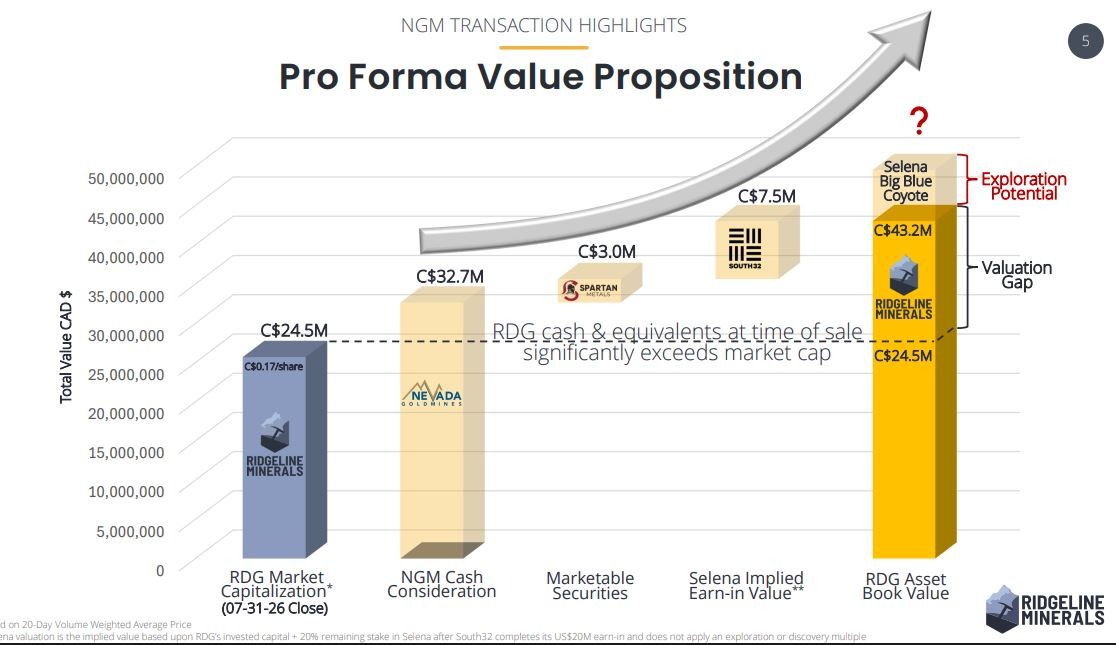
Peters was direct about what the cash is for: removing financing risk.
"I don't want to raise $10 million bucks at 15 cents. It's not a smart move for us as a company. This takes that out of the equation. We're fully funded. We can start getting aggressive, and ideally we can start changing that perception of Ridgeline as just a pure prospect generator."
Selena: The Flagship Retained
The asset Ridgeline chose not to sell is Selena, a 39.0 km² carbonate replacement deposit (CRD) target under a US$20 million earn-in with South32, signed in August 2024. Under the structure, South32 can earn a 60% interest by spending $10 million over five years, with a one-time option to spend a further $10 million for an additional 20% (80% total). Ridgeline is fully carried to production at its retained 20% interest via a pre-arranged debt facility, and remains project operator through Phase One for a 10% management fee. South32 has spent US$5.5 million to date, with a US$4.0 million budget committed for 2026.
The project's significance rose sharply in 2025 when drilling intersected a high-grade massive sulfide discovery at the Chinchilla Sulfide zone, down-dip of the previously known Chinchilla Oxide target. South32's Chief Development Officer, Simon Collins, publicly compared the discovery to the early stages of the company's own Taylor deposit in Arizona, a project South32 acquired for roughly US$2 billion. The comparison carries weight given South32's direct familiarity with both systems, though Ridgeline's own materials caution that Selena remains an early-stage exploration target with no current mineral resource estimate.
Interview with Chad Peters, President & CEO of Ridgeline Minerals
Big Blue and Coyote: The Organic Upside
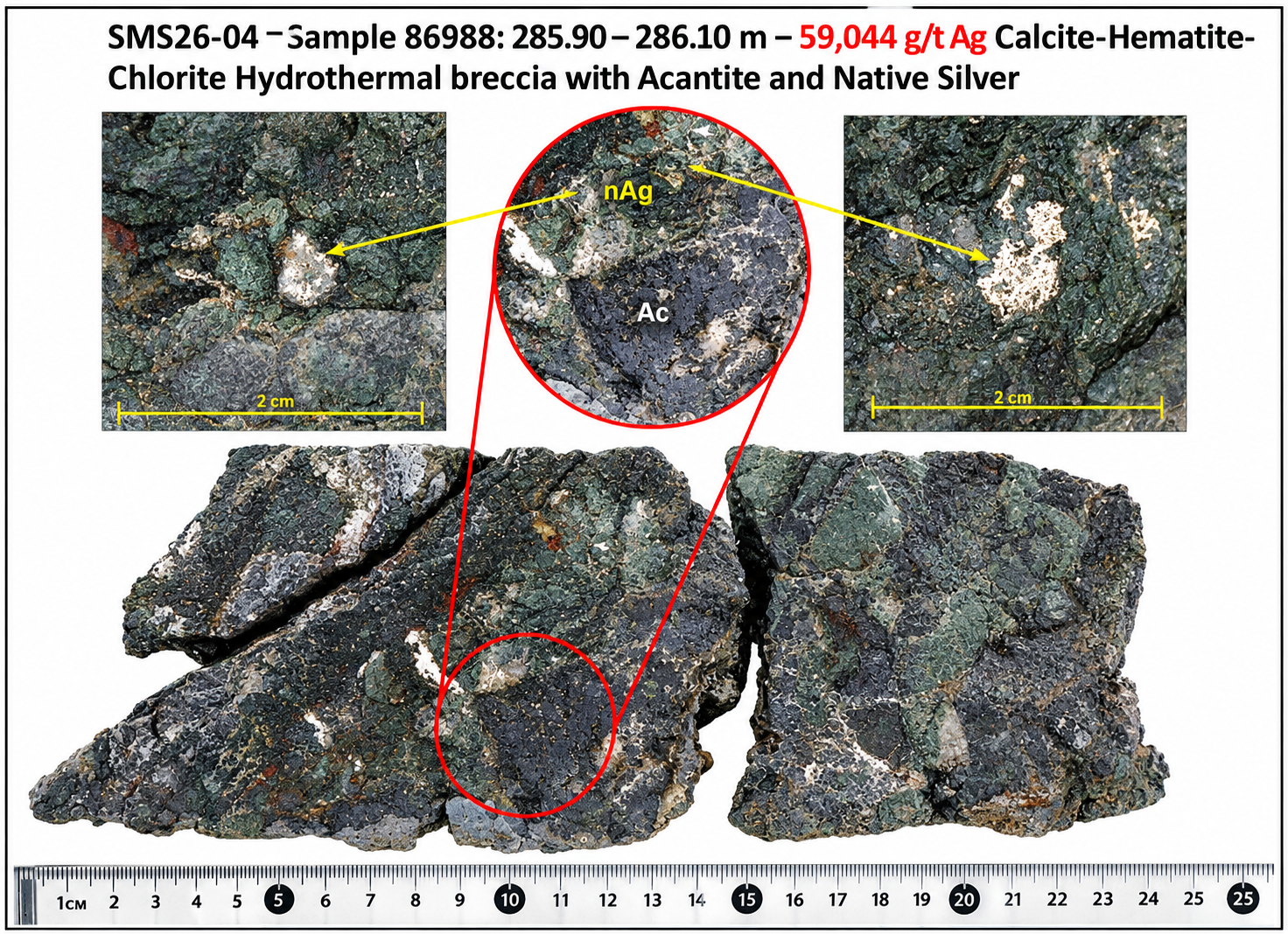
Alongside Selena, Ridgeline retained two 100%-owned Nevada assets. Big Blue is a 50.4 km² porphyry and CRD target hosting the historic Delker copper mine; a 2025 drill hole returned 0.6 metres grading 0.7% copper, 3,194 g/t silver and 2.6% tungsten, while trenching returned 0.6 metres at 15.5% copper. Coyote is a 6.3 km² Carlin-type gold target sitting directly on-trend with NGM's newly acquired Black Ridge project and roughly 4 km along strike from NGM's 1.0 million ounce inferred resource at Fallon. Notably, Coyote has never been drilled, despite NGM's own 2025 drilling at the adjacent Black Ridge (conducted while Ridgeline still owned it) returning Carlin-type pathfinder geochemistry.
Peters confirmed Ridgeline is assessing partnership options for Coyote given its adjacency to NGM ground, describing it as a natural candidate for a future transaction even though it was deliberately excluded from the NGM sale to preserve a land position in the Carlin trend.
Capital Allocation and Catalysts
Asked how the roughly C$36 million in combined cash and securities will be deployed, Peters was expansive rather than prescriptive. "Literally everything you just mentioned is 100% on the table" - referring to staking, exploration, M&A and potential shareholder returns - though he was equally clear that the near-term priority is staking new ground and drilling existing 100%-owned assets, which he described as the fastest way to add value. Ridgeline's geology team is actively staking new projects to rebuild the pipeline, and Peters signalled that royalties may be layered into future deals in a way the company's earlier NGM agreements, encumbered by legacy Elemental Royalty Corp. terms, did not allow for.
Separately, Ridgeline retains a 17.3% equity stake in Spartan Metals (TSXV:W), following the July 31, 2026 issuance of a second tranche of shares tied to the 2025 sale of its Eagle tungsten project, plus a 1% net smelter royalty on all metals from that project.
Investment Thesis for Ridgeline Minerals
- Balance sheet de-risking: C$36 million in combined cash and securities against a C$24.5 million market cap removes near-term financing risk and dilution, a rare position for a junior explorer.
- Partner-funded flagship: Selena's 2026 drilling is entirely funded by South32's US$4.0 million budget, giving shareholders exposure to a high-grade CRD discovery without further capital outlay from Ridgeline.
- Validated model: The NGM transaction, a 26% premium and greater than 350% return on capital, provides external proof that Ridgeline's hybrid generator approach can convert exploration success into cash.
- Organic optionality: Big Blue and Coyote are both 100%-owned, meaning any drilling success accrues fully to Ridgeline shareholders rather than being shared with an earn-in partner.
- Monitor Selena's 2026 assay results: Follow-up drilling on the Chinchilla Sulfide discovery, and whether South32 elects to advance to its Phase Two earn-in, are the clearest near-term re-rating catalysts.
- Watch capital deployment: How Ridgeline allocates its treasury over the next 6-12 months, new staking, drilling, M&A, or shareholder returns, will determine whether the market re-rates the stock above cash value.
- Coyote partnership potential: A future transaction or joint venture at Coyote, given its direct adjacency to NGM's Black Ridge and Fallon discovery, is a plausible medium-term catalyst.
Macro Thematic Analysis
Ridgeline's transaction lands at a moment when generalist capital is rotating back into mining after a multi-year drought, and the market is rewarding companies that can demonstrate a credible path from discovery to cash flow without excessive dilution. The prospect generator model, staking ground, attracting a major partner to fund the drilling, and monetising success, has historically struggled to command a premium valuation precisely because investors discount exploration potential until it is de-risked. Ridgeline's own experience illustrates the tension: even after a 350%-plus return on the NGM sale, the stock settled back toward cash value within days.
What differentiates this transaction from a typical asset sale is optionality retained rather than surrendered. Ridgeline kept its highest-conviction project, structured a fully-carried interest to production, and used the proceeds to eliminate financing risk rather than distribute it. As Peters put it, describing the broader capital allocation logic: "This takes that out of the equation. We're fully funded. We can start getting aggressive." For a sector where dilution has eroded shareholder returns across cycles, a treasury that exceeds market capitalisation is a meaningful, if still unproven, signal. The test now shifts from balance sheet strength to execution: whether Selena's Chinchilla Sulfide zone can be defined into a resource of the scale South32's own comparisons imply, and whether Ridgeline can replicate its Nevada Gold Mines outcome with new staking and partnerships.
TL;DR
Ridgeline Minerals sold four early-stage Nevada gold projects to Nevada Gold Mines for US$23.15 million, a 350%+ return on capital and 26% premium to its trading price, closing August 3, 2026. The company now holds C$36 million in combined cash and securities against a C$24.5 million market cap, while retaining its flagship Selena CRD discovery (fully funded by South32's US$20 million earn-in) plus two 100%-owned assets, Big Blue and Coyote. Management says the treasury removes financing risk and will fund new staking, exploration, and potentially M&A.
FAQs (AI-generated)
Analyst's Notes





Subscribe to Our Channel



Stay Informed






















