




Selkirk Copper Puts C$494 Million Value on a C$186 Million Minto Restart


Selkirk Copper's Minto preliminary economic assessment outlines a 13-year mine life, a C$494 million after-tax value and first concentrate in 2028.
- The Minto preliminary economic assessment shows an after-tax net present value of C$494 million at a 7% discount rate and a 47.8% internal rate of return.
- Initial capital is estimated at C$186 million, with after-tax payback of 1.9 years from first production.
- Mine life is 13 years at 4,100 metric tons per day, drawing on 2 underground mining areas and 2 open pits.
- Measured and indicated resources total 47.8 million metric tons at 0.89% copper, 0.34 grams per metric ton (g/t) gold and 3.2 g/t silver.
- Selkirk Copper is targeting first concentrate production in the second half of 2028, with full ramp-up by the first half of 2029.
- Amended permit applications are to be submitted in the fourth quarter of 2026.
Company Overview
Selkirk Copper Mines (TSXV: SCMI | OTCQX: SKRKF | FSE: IO20) is advancing the restart and redevelopment of the former Minto copper-gold-silver mine in Yukon, Canada, in partnership with the Selkirk First Nation, which holds a controlling interest in the company. Selkirk Copper controls 26,850 hectares of mineral claims in the Minto-Carmacks copper belt, along with existing open-pit and underground infrastructure, including a 4,100-metric-ton-per-day processing plant and a 400-person camp. A preliminary economic assessment published in September 2026 outlined a 13-year mine life with an after-tax net present value of C$494 million and an internal rate of return of 48%, with first concentrate targeted for the second half of 2028.
Study Economics
The preliminary economic assessment (PEA) covers a restart of open pit and underground mining, crushing, grinding and flotation, and concentrate production at the Minto copper-gold-silver project in Yukon, Canada. Hatch Ltd. led the study.
At planning prices of US$5.00 per pound for copper, US$3,600 per ounce for gold and US$50 per ounce for silver, the project carries an after-tax net present value at a 7% discount rate (NPV7%) of C$494 million, a 47.8% internal rate of return (IRR) and an after-tax payback of 1.9 years from first production. At spot prices of US$6.50 per pound for copper, US$4,300 per ounce for gold and US$65 per ounce for silver, NPV7% rises to C$1,023 million with a 78.2% IRR and a 1.3-year payback. An upside case at US$7.50 per pound for copper lifts NPV7% to C$1,385 million and the IRR to 96.3%.
The ratio of after-tax NPV7% to initial capital is 2.7:1 at planning prices and 5.5:1 at spot prices.
Mine Plan & Resource Base
The mine plan draws on 2 underground mining areas and 2 open pits feeding a single plant at 4,100 metric tons per day (tpd), for a mineable inventory of about 18.4 million metric tons and a planned initial mine life of 13 years. Underground mining supplies the entire mill feed in the early years, with the Ridgetop and then Area 118 open pits introduced later.
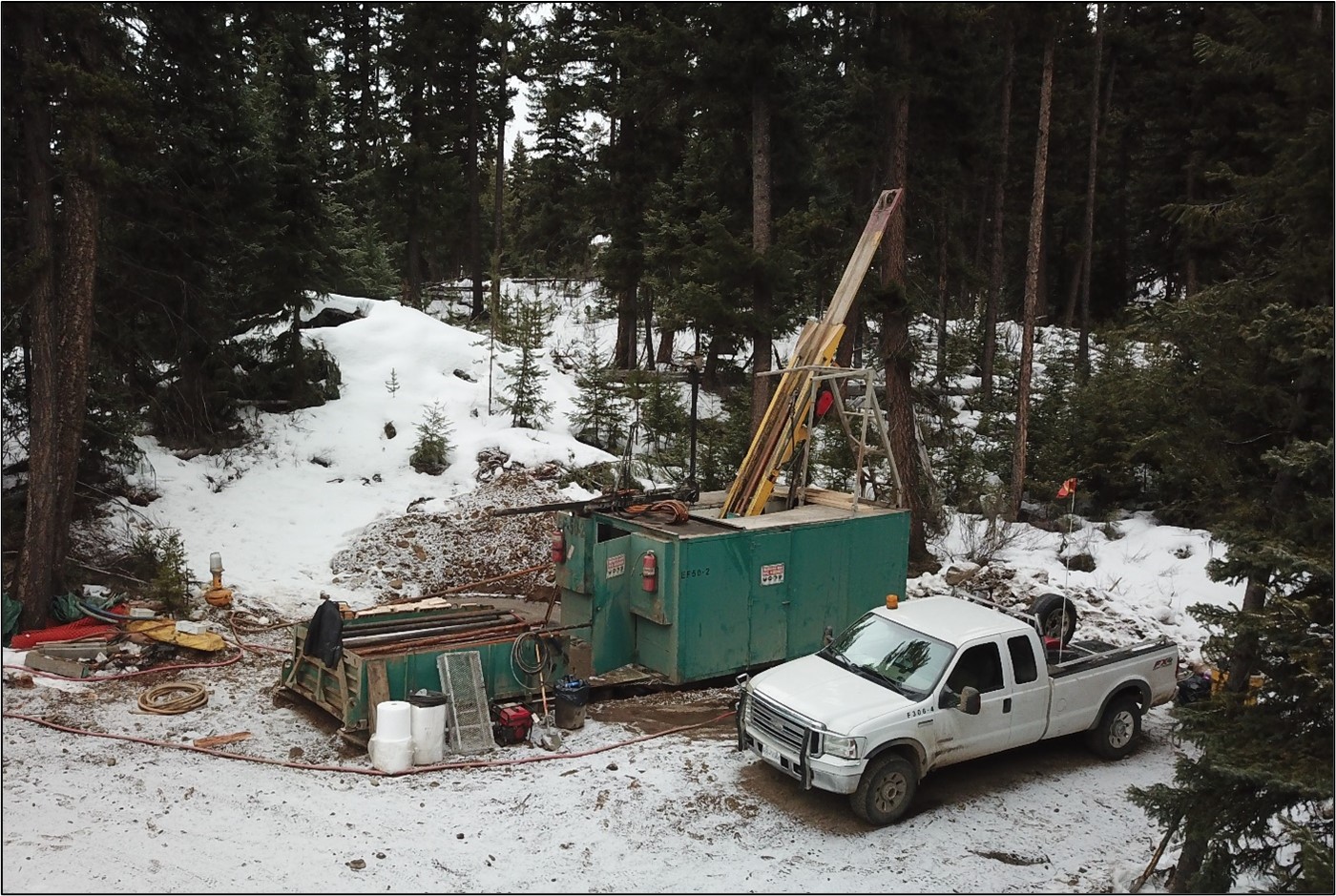
Measured and indicated resources in the 2026 mineral resource estimate (MRE) stand at 47.8 million metric tons at 0.89% copper, 0.34 grams per metric ton (g/t) gold and 3.2 g/t silver. Inferred resources add 16.9 million metric tons at 0.76% copper, 0.26 g/t gold and 2.7 g/t silver. The MRE is effective June 10, 2026 and follows a 52,288-meter Phase 1 drill program completed in April 2026, which raised contained copper, gold and silver by 182%, 184% and 188% over the 2025 estimate.
A 50,000-meter Phase 2 program begun in May 2026 is 98% complete, and its results are in neither the 2026 MRE nor the PEA mine plan.
Processing & Concentrate
The plant restarts with targeted upgrades, not a new flowsheet. Additions include a 3-stage crushing and screening circuit, 2 gravity concentrators to lift gold recovery, and a screw dryer to hold concentrate moisture within limits. The existing grinding and flotation circuits are retained and refurbished, and plant availability is assumed at 92%.
The plant produces a single copper-gold-silver concentrate with a target average grade of 38% copper, 12 to 18 g/t gold and 100 to 150 g/t silver, and negligible deleterious elements. Peak annual output is 48,700 metric tons of concentrate, trucked 425 kilometers along the Klondike Highway to the Port of Skagway, Alaska, after crossing the Yukon River by barge.
Tailings go into mined-out pits for the first 3 years, then move to dry-stack tailings, where filtered material is stacked rather than stored as slurry.
Capital & Operating Costs
Initial capital is estimated at C$186 million, including working capital, owner's costs and contingency, to an Association for the Advancement of Cost Engineering Class 5 accuracy range of -50% to +100%. The modelled capital period runs from July 1, 2027 to June 30, 2028, in second-quarter 2026 Canadian dollars with no escalation applied.
Sustaining capital over the mine life is estimated at C$409 million, covering underground development, equipment replacement, infrastructure renewal and a scoping-level closure and rehabilitation estimate. Life-of-mine operating costs are estimated at C$1,764 million, an average of C$95.77 per metric ton milled, with underground mining the largest component.
Infrastructure from operations that ran to May 2023 remains on site, including the access road, barge facilities, power line and substation and water treatment plant, which assessments found largely in good working order.
Permitting & Water Management
The restart keeps all planned development and operations, including water management, inside the existing Quartz Mining License boundary across the full 13-year mine life. Three authorizations are in scope: the Quartz Mining License, the Type A Water License and the Class 4 Mining Land Use Approval.
Amended applications are to be submitted in the fourth quarter of 2026 to the Yukon Environmental and Socio-economic Assessment Board. They do not propose notable changes to the discharge criteria currently set for the site.
Selkirk First Nation input shaped the restart design, and a 1.5% net smelter return royalty on all payable metals is payable to the First Nation.
Next Steps
Selkirk Copper is targeting first concentrate production in the second half of 2028, with full ramp-up by the first half of 2029. A restart decision is tied to completion of a feasibility study and receipt of the permit amendments in the second half of 2027.
That study work is scheduled to start in the fourth quarter of 2026, with an updated MRE due in the first quarter of 2027 that will include the Phase 2 drill results. A formal concentrate marketing process is planned in parallel.
President and Chief Executive Officer of Selkirk Copper Mines, M. Colin Joudrie, ties the level of detail in the study to the schedule the company is working to:
"The level of detail developed in the PEA study, including integrated mine plans, equipment definition, and detailed capital, operating and sustaining cost estimations, has increased our confidence in our ability to deliver on our focused restart timeline."
No concentrate sales contracts are in place, and the offtake position is unencumbered following removal of the historical agreement and precious metals stream in the bankruptcy process.
FAQs (AI-Generated)
Analyst's Notes





Subscribe to Our Channel



Stay Informed


