




Fitzroy Puts a 3 to 4 Times Re-Rate on Studies, Not Drill Grade


Fitzroy Minerals has published a 3- to 4-times re-rate expectation for Buen Retiro and set 6 study milestones between now and a 2027 financing decision.
- Fitzroy Minerals has published a 3- to 4-times re-rate expectation for Buen Retiro, benchmarked against 3 named peers.
- The 6 study milestones each have a published quarter and are separate from a 2027 Buen Retiro financing decision.
- A claw-back under the Pucobre letter of intent would return about C$20 million against a current treasury of C$23.9 million.
- Fitzroy would retain 70% of Buen Retiro under the Pucobre claw-back and holds 100% of Caballos, with drilling of 5,500 meters beginning in the fourth quarter of 2026.
The Re-Rate Benchmark the Company Has Set Itself
Fitzroy Minerals (TSXV: FTZ | OTCQX: FTZFF | FSE: C3Y) has published a figure for what the next phase of work at Buen Retiro should be worth to shareholders. The company sets a 3- to 4-times re-rate expectation for the project and ties it to 6 pieces of work: preliminary metallurgy, a maiden mineral resource estimate (MRE), a preliminary economic assessment (PEA), final metallurgy, a pre-feasibility study (PFS), and a permit. It attaches a question mark to the multiple and publishes no calculation behind it.
None of those 6 items requires a new discovery: the claim rests on study delivery alone. Against a market capitalization of C$140 million and a treasury of C$23.9 million, a 3 to 4 times outcome would reprice the company on the work it has already scheduled. Fitzroy places the 6 items across the 12 months from the third quarter of 2026 to the third quarter of 2027, and counts the PEA, the PFS, and the exploration drill results among the valuation catalysts in that window.
An investor, therefore, watches different results over the next 4 quarters. Drill results continue to arrive, and the project's highest grade to date still has to be estimated into a resource, but neither is the lever the company itself points at. Buen Retiro is an iron oxide copper gold deposit near Copiapó in Chile, and Fitzroy would retain 70% under a proposed arrangement with a Chilean producer that also governs how the work is paid for. A second asset stays on the page alongside it: Caballos, a copper-molybdenum-gold-rhenium porphyry target, meaning a large intrusion-hosted system, held outright, with 5,500 meters (m) of drilling from the fourth quarter of 2026.
What the Peer Comparison Measures
The 3 companies Fitzroy places beside itself re-rated on different work, and the differences carry as much information as the multiples. Meridian Mining moved from C$0.46 to C$1.84, more than 4 times, across a placement, a PFS, drill results, permits, and financing at Cabaçal in Brazil. Marimaca moved from C$1.20 to C$3.80, more than 3 times, on metallurgical results, an economic assessment, and drill results at its oxide deposit in Chile. Cabral Gold moved from C$0.24 to C$1.20, more than 6 times, following a study published in October 2024 and the granting of a mine permit in March 2026 at Cuiú Cuiú in Brazil.
Read as a set, these are 3 routes to a similar destination, each with its own mix of work. Fitzroy labels the column a 1-year move, yet the 2 milestones credited to Cabral Gold are dated October 2024 and March 2026, which puts part of that company's re-rating outside the window Fitzroy says it is measuring. Marimaca's list alone falls short of a permit and shows the lowest multiple in the set. Fitzroy draws no line between those two facts.
Each of the 3 peer multiples followed the first kind of work: studies that changed what the market could underwrite for a deposit. Of the 3 comparison projects, 2 are in Brazil and 1 is in Chile alongside Buen Retiro, so the set matches on milestone type more closely than on jurisdiction, and Cabral Gold's is a gold project, not a copper one. A second comparison places Caballos alongside 3 discovery outcomes instead of 3 study programs: 60 m at 7.52% copper equivalent at Lunahuasi, 1,160 m at 0.78% copper equivalent at Valeriano, and 851 m at 0.33% copper equivalent at NAK. Against those, Fitzroy lists a 5,500-meter program and a quarter, with no result to compare yet. Fitzroy establishes with the comparison that study milestones have re-rated developers of this size in the recent past, but not that any particular multiple transfers to Copiapó.
The Study Calendar Between Now & a Financing Decision
Fitzroy has published the sequence twice and charted it a third time. Preliminary metallurgy is targeted for the third quarter of 2026. The maiden MRE and the PEA follow in the fourth quarter of 2026; final metallurgy in the first quarter of 2027; the PFS in the second quarter of 2027; and permits in the third quarter of 2027. Fitzroy also places the start of the initial PFS in the first quarter of 2027, a quarter before the delivery date given by the other two statements.
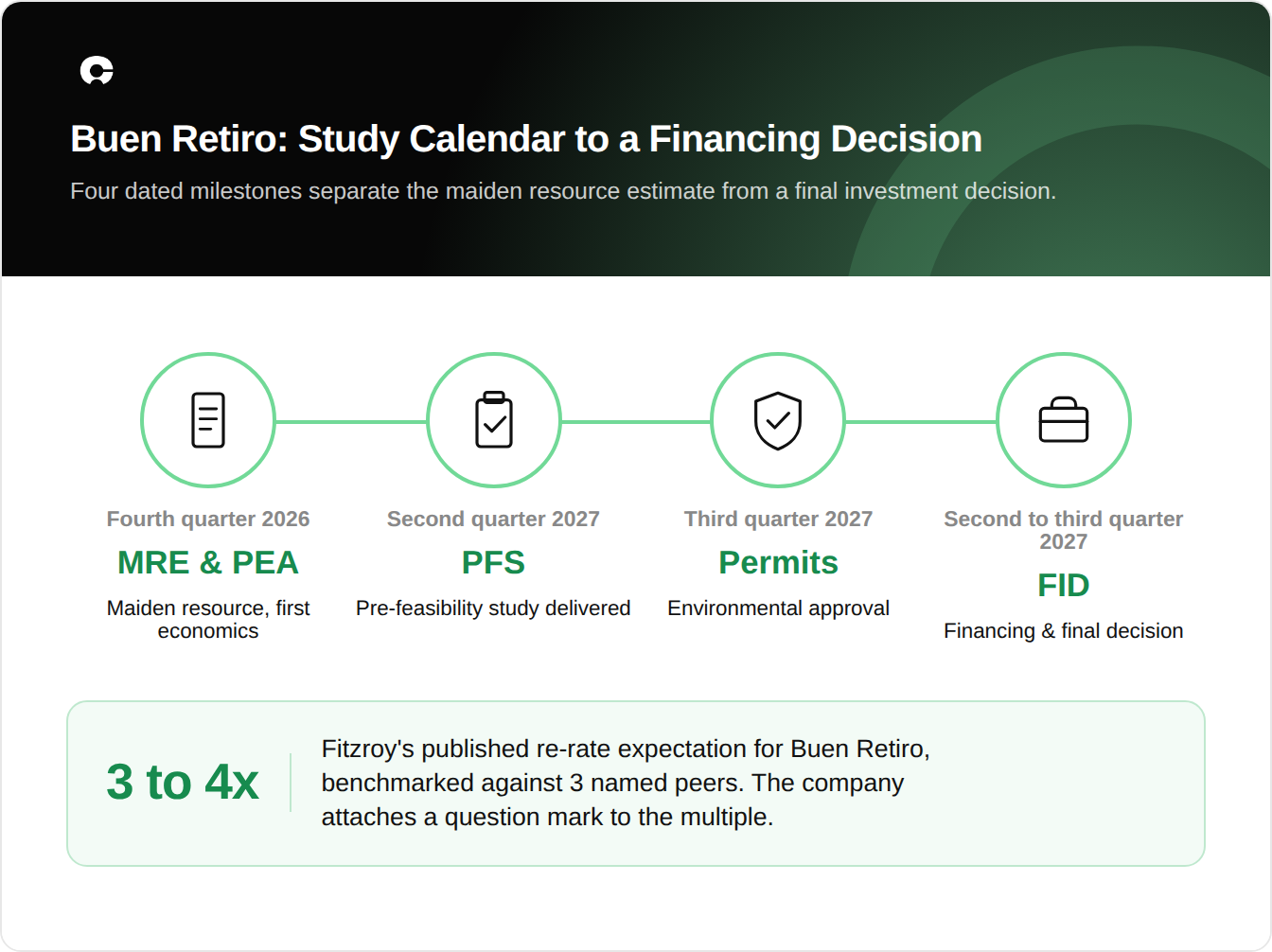
A further 2 items bracket that spine. An environmental submission is scheduled for the fourth quarter of 2026, alongside the supporting baseline study, and financing and a final investment decision are scheduled for the second and third quarters of 2027. The funding event, therefore, lands at the end of the sequence, which leaves the intervening milestones worth pricing one at a time.
The resource estimate is further advanced than its date suggests. Of the 4 rigs working at Buen Retiro, 2 are expected to leave the site in September 2026, having reached a data cut-off that allows time for logging, assaying, and inclusion in the maiden estimate. The meters behind it are already in the ground: 92 diamond holes for 16,376 m since the start of February 2026, within a 2026 program of 22,000 m of which about 6,000 m remain. Drilling from the fourth quarter of 2026 turns to deep and regional targets, with 1 reverse-circulation rig testing shallow ground across the wider property and 1 diamond rig testing targets at depth, so exploration continues through the months during which the estimate is compiled. Caballos moves on its own track through the same months, with a deep induced polarization survey mapping buried sulfide bodies by their electrical response in the third quarter of 2026, ahead of phase 2 drilling extending from the fourth quarter of 2026 into the second quarter of 2027.
How the Work Is Funded for the PFS
The funding arrangement lets that calendar be worked without a financing decision falling due partway through it. Pucobre has signed a letter of intent (LOI) to claw back 30% of Buen Retiro by repaying 90% of the expenditure, leaving a 30:70 split in which Fitzroy holds the larger share and Pucobre takes 30% only after it has repaid most of the expenditure. The same producer has a US$750 million development of its own at El Espino, which indicates the scale of the counterparty. Under that structure, Fitzroy explores and develops the project through the PFS in the second quarter of 2027, with most of its spending recoverable, and keeps 70% of Buen Retiro and 100% of Caballos.
Fitzroy lays out the structure over 3 years. In 2026, a C$23.9 million treasury and C$2.8 million of warrants and options at 25 cents will fund 22,000 m of exploration and de-risking work. In 2027, about C$20 million comes back, alongside C$1.7 million of warrants and options at 45 cents, against the study, financing, and construction phase. In 2028, the structure delivers 70% of an operating mine, plus a further C$18.1 million in warrants and options at 59 cents. Fitzroy attaches a question mark to that 2027 cash-back figure, while describing the LOI itself as signed.

Behind the arrangement is spare processing capacity: Pucobre, a producer with a market capitalization of US$2.4 billion, operates the Planta Biocobre facility at 800 tons per month (9,600 tons per annum) and has offered 50% of its capacity. It is 1 of 6 under-utilized plants within a 180-kilometer radius, and its water is contracted on a take-or-pay basis that Pucobre is currently paying for. Buen Retiro is planned as a conventional and enhanced recovery heap leach feeding solvent extraction and electrowinning, the process that strips copper from solution and plates it as metal, the route that spare capacity serves. The capital structure behind all of this comprises 330.7 million shares, 29.9 million options, and 43.9 million warrants, for a fully diluted 404.5 million shares, with the warrant and option tranches priced at 25, 45, and 59 cents, rising across the same 3 years. Fitzroy's stated ambition for the structure is cash flow that funds exploration without dilution and secures the company's independence.
The Wider Copper Setting Behind the Premium
The wider copper setting explains why study milestones command a premium at present. BHP's copper division lifted margins by 54% year-on-year in a reporting year in which its copper production fell by 3%, and the same producer forecasts a 10 million tons per annum copper supply deficit by 2035, with non-traditional demand growing at 6.5% per annum.
President and Chief Executive Officer of Fitzroy Minerals, Merlin Marr-Johnson, separated money that buys new production from money that holds existing production steady, using one of that producer's growth projects as the case:
"But, actually, this is to extend the life of an asset which is otherwise declining. So those numbers, on a capital-intensity basis, are not new production. It's not a growth. It's not an addition to the market. It's just maintenance."
Replacement spending absorbs a large share of the industry's capital before any of it reaches new supply. Escondida is the case in point: its concentrator replacement reduces output from 1.1 million tons to 800,000 tons, then back to 1.1 million tons, for no net addition at the end.
Marr-Johnson put that against what the spending buys:
"So, they're spending $5 billion to stand still. And that is the copper industry in a nutshell."
Considerations for Investors: Weighing the Calendar
Fitzroy's own disclosure qualifies the case in 3 ways. The multiple is published with a question mark and no workings. The PFS is shown starting in the first quarter of 2027 against a second-quarter delivery date. The 2027 cash return depends on a claw-back, as an LOI has not yet been converted into a completed agreement. None of the 3 is concealed, and each becomes checkable at the company's next update.
Chile supplies 23% of global copper mine production and is forecast to reach 5.7 million tons and 27% of global supply by 2032, with US$105 billion in capital expenditure to 2034, 90% of it in copper and 81% directed at existing operations. Mining accounts for 59% of the country's total exports, and copper for 80% of the mining share. Corporation tax is 23% from 2029, and no royalty applies to production below 12,000 tons of copper per year. For an investor, the calendar is the instrument: preliminary metallurgy and then the first resource estimate are the next 2 results that can be tested against the dates Fitzroy has published, and the first of them falls in the current quarter.
The Investment Thesis for Fitzroy Minerals
- Fitzroy has tied a 3- to 4-times re-rate expectation to 6 pieces of technical work that require no new discovery, which gives investors a specific claim to test.
- Metallurgy, economic assessments, pre-feasibility studies, and permits increased 3 comparable developers by more than 3 to more than 6-fold over a reported 1-year window.
- The study calendar extends from preliminary metallurgy in the third quarter of 2026 through permits in the third quarter of 2027, with a financing decision at the end of the sequence rather than within it.
- Pucobre has signed a letter of intent to repay 90% of expenditure and claw back 30% of the project, which would fund drilling and studies through to the pre-feasibility study.
- Spare Chilean processing capacity removes plant construction from the route to production, with Pucobre offering 50% of the availability of an operating facility that is already paying for its contracted water.
- A funded discovery option accompanies the development case, with 5,500 meters of drilling at the wholly owned Caballos porphyry target from the fourth quarter of 2026.
The case turns on delivery rather than on discovery. Fitzroy has removed most of the usual funding questions for the next 4 quarters by arranging for 90% of its spending to be returned, and it has published the dates against which each piece of study work can be measured. What has not been published is the arithmetic behind its own multiple, and the schedule shows the pre-feasibility study starting a quarter before it delivers. An investor buying the argument is buying execution against a calendar, with the first 2 checkpoints, preliminary metallurgy, and the first resource estimate, falling inside the next 2 quarters.
TL;DR
Fitzroy Minerals is a Chilean copper developer that has put a 3- to 4-times re-rate expectation on Buen Retiro and tied it to 6 pieces of study work, culminating in permits in the third quarter of 2027. The 3 named peers re-rated by more than 3 to more than 6 times on comparable milestone sequences, though each followed a different mix of work, and the October 2024 milestone credited to the largest mover falls outside the 1-year window Fitzroy reports. A claw-back LOI with Pucobre would repay 90% of expenditure, fund the program to the PFS, and return about C$20 million in 2027 against a C$23.9 million treasury. The multiple comes with a question mark and no workings, so the argument is best measured against the calendar itself, beginning with preliminary metallurgy and the first resource estimate.
FAQs (AI-Generated)
Analyst's Notes





Subscribe to Our Channel






Stay Informed


