




Serabi Gold's Hidden Growth Pipeline: Beyond Coringa & Into Tapajós


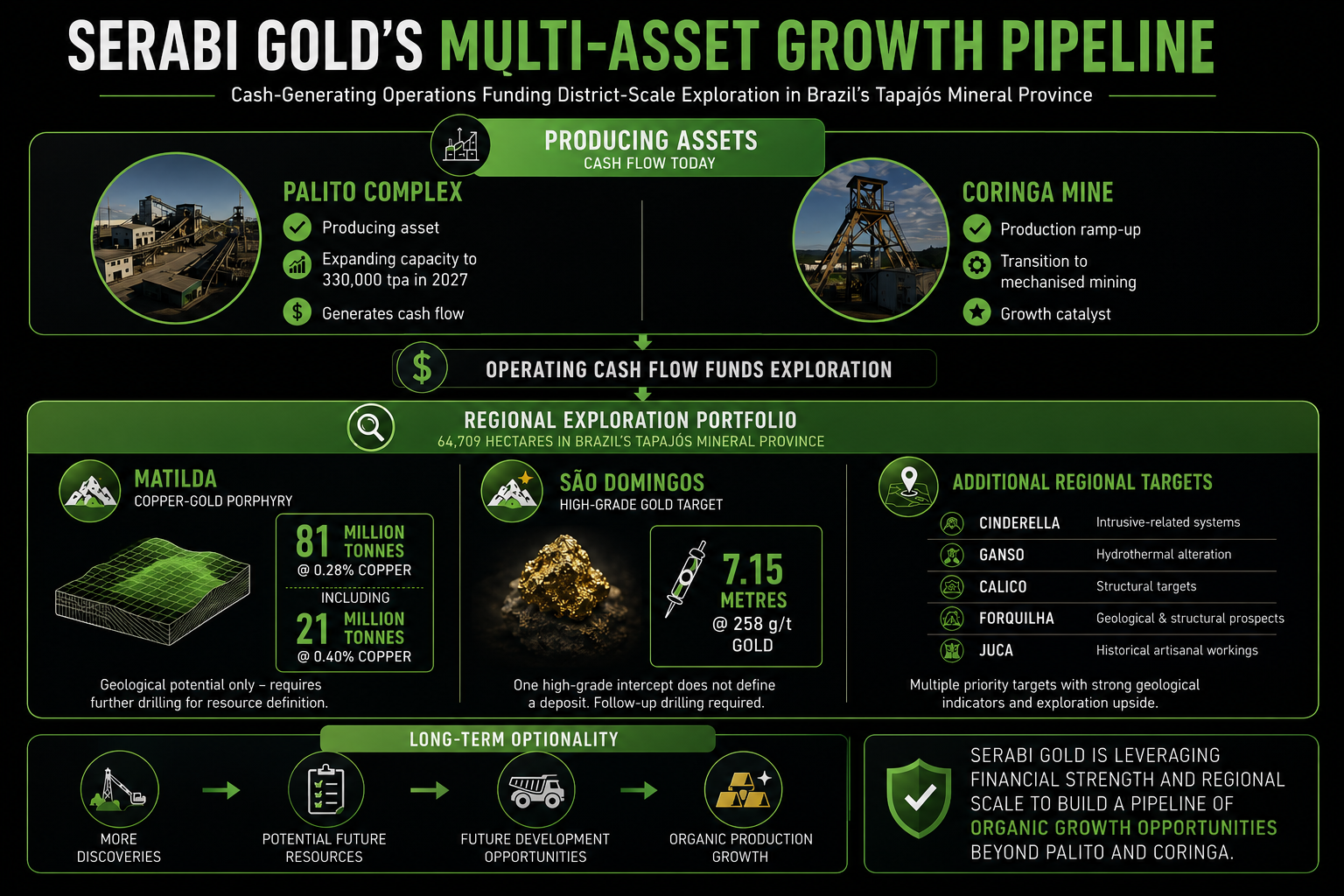
Serabi Gold's Tapajós exploration portfolio expands its growth pipeline beyond Coringa, with Matilda and regional targets supporting long-term organic growth.
- Serabi Gold plc controls a 64,709-hectare land package in Brazil's Tapajós mineral province alongside its producing Palito Complex and Coringa Mine.
- The Matilda copper-gold porphyry has an estimated geological potential of 81 million tonnes grading 0.28% copper, including 21 million tonnes grading 0.40% copper, highlighting district-scale exploration upside.
- The São Domingos target returned a historic drill intercept of 7.15 metres grading 258 grams per tonne gold, supporting additional follow-up exploration within the regional portfolio.
- Serabi's producing operations generated sufficient cash to maintain a debt-free balance sheet while funding exploration across multiple regional targets without relying on acquisitions.
- Near-term operational catalysts at Palito and Coringa continue to support production growth while the broader exploration portfolio provides long-term optionality beyond existing mines.
What Has Happened
Serabi Gold plc (AIM: SRB | TSX: SBI | OTCQX: SRBIF) reported second-quarter 2026 production of 11,007 ounces of gold, bringing first-half production to 23,049 ounces. The company finished June with US$65.7 million in cash, remained debt-free after repaying its Banco Santander facility during the first quarter and maintained guidance for more than 53,000 ounces of gold production in 2026, assuming the Coringa Installation Licence is granted during the fourth quarter.
Those results do more than reinforce Serabi's operational progress. Strong cash generation from the Palito Complex and Coringa Mine is increasingly funding one of the largest regional exploration portfolios in Brazil's Tapajós mineral province without requiring additional debt or equity financing. While investors remain focused on the production ramp-up at Coringa and the Palito plant expansion, the company's broader exploration portfolio has the potential to become an additional source of long-term value creation.
The Tapajós Regional Footprint
Serabi controls 64,709 hectares across Brazil's Tapajós mineral province, an area covering approximately 90,000 square kilometres that has historically produced an estimated 30 million ounces of artisanal gold. Despite that history, only around 7 million ounces have been defined in seven hard rock deposits. The combination of extensive historical production and relatively limited modern resource definition suggests the district remains underexplored by international standards.
Unlike many junior exploration companies entering frontier districts, Serabi already operates producing mines, processing facilities and technical teams within the region. Existing infrastructure lowers the cost of evaluating new discoveries while operating cash flow funds ongoing exploration. Every successful drill programme therefore has the potential to add value without the shareholder dilution that often accompanies early-stage exploration companies.
Chief Executive Officer of Serabi Gold. Mike Hodgson believes the company's opportunity is evolving beyond the underground mining expertise that established the business:
"It's a good question because I do sometimes look at whether we can think big enough. We've been in the trenches for a long time with our current team."
That shift in perspective is significant. Rather than viewing Palito and Coringa as the end points of Serabi's growth strategy, management increasingly sees them as the financial platform supporting a much broader regional exploration programme.
Unpacking the Matilda Copper-Gold Porphyry
The Matilda prospect represents a different style of opportunity from Serabi's producing underground gold mines. The target comprises a 4-by-4 kilometre geochemical anomaly containing a 2-by-2 kilometre gold-copper-molybdenum-tungsten core, supported by magnetic anomalies and alteration signatures commonly associated with porphyry mineral systems.
Exploration has already demonstrated encouraging scale. Three discovery holes completed in 2022 confirmed copper-molybdenum-gold porphyry mineralisation, followed by 21 additional drill holes during 2023. Based on those results, Serabi estimates a geological potential of approximately 81 million tonnes grading 0.28% copper, including 21 million tonnes grading 0.40% copper. These figures represent exploration potential rather than a Mineral Resource Estimate (MRE), meaning additional drilling is required before the company can determine whether sufficient continuity exists to support future resource definition.
Unlike Palito and Coringa, which are high-grade underground gold mines, porphyry deposits typically offer significantly larger tonnage over broader areas. If Matilda continues to demonstrate scale through future drilling, it could introduce an entirely different long-term development pathway alongside Serabi's existing mining operations.
Hodgson discussed the company's exploration philosophy:
"The thing is with all of this drilling, we're not drilling copper deposits which are just continuous. You've got to drill, see the result, drill again. It's got to be a little bit disciplined."
That disciplined approach has already expanded resources at Palito and Coringa. Applying the same methodology to Matilda gives Serabi an opportunity to systematically evaluate one of the largest exploration targets in its regional portfolio while maintaining capital discipline.
High-Grade Optionality at São Domingos
While Matilda introduces exposure to a large-scale copper-gold system, São Domingos reinforces Serabi's core strength in high-grade gold exploration. Located within the broader Palito district, the prospect covers a 4-by-2 kilometre target area that has a long history of artisanal mining, providing evidence of a mineralised system before the application of modern exploration techniques.
The project is anchored by a drill hole which intersected 7.15 metres grading 258 grams per tonne gold. This ranked as the seventh-highest drill intercept reported by a Toronto Stock Exchange-listed company during 2021. While one exceptional intercept does not establish an economic deposit, it provides a compelling geological basis for follow-up drilling to determine whether the high-grade mineralisation continues along strike or at depth.
From an investment perspective, São Domingos represents more than another exploration target. Success would build on Serabi's existing underground mining expertise and regional infrastructure rather than requiring an entirely new operating model. That creates a clearer pathway from exploration success to potential development than many standalone greenfield discoveries.
A Broader Pipeline Beyond Palito & Coringa
Matilda and São Domingos are only part of Serabi's regional exploration portfolio. The company also identifies Cinderella, Ganso, Calico, Forquilha and Juca as priority targets, each displaying geological characteristics such as intrusive centres, hydrothermal alteration, structural controls or historical artisanal workings that warrant further evaluation. Collectively, these prospects provide multiple opportunities to generate future discoveries from licences the company already controls.
That strategy reflects a broader capital allocation philosophy. Across the gold sector, many producers are relying on increasingly expensive mergers and acquisitions to replace reserves and extend mine life. Serabi is pursuing a different approach by using operating cash flow from Palito and Coringa to systematically advance its own exploration pipeline. Every successful drill programme therefore has the potential to create long-term value without the acquisition premiums or shareholder dilution that often accompany external growth.
As Hodgson explained:
"We do have a very disciplined approach to our exploration when I swap M&A. We're not just going to buy for scale. It's got to be a good fit for us because we fancy our chances of growing organically."
That philosophy also reduces strategic dependence on future acquisitions. Rather than competing for scarce development assets, Serabi is attempting to create its next generation of projects from within its existing land package. If successful, that approach could extend mine life, support future production growth and strengthen the company's long-term valuation while preserving financial discipline.
What to Watch Next
Over the next 12 months, investors are likely to assess Serabi on two parallel fronts. Operationally, the company is targeting completion of the fourth ball mill installation at the Palito Complex during the fourth quarter of 2026, increasing annual processing capacity to 330,000 tonnes per annum in 2027. Management is also targeting completion of the transition to mechanised sublevel stoping at Coringa while progressing the remaining approvals required for the Coringa Installation Licence. Assuming the licence is granted during the fourth quarter, Serabi continues to guide for more than 53,000 ounces of gold production in 2026.
Beyond operational delivery, investors should monitor whether the regional exploration portfolio begins to mature into a future growth platform. Additional drilling at Matilda will test whether the copper-gold porphyry demonstrates sufficient scale and continuity for future resource definition, while follow-up work at São Domingos will assess whether its high-grade intercept extends into a larger mineralised system. Although both projects remain at an early stage, Serabi's debt-free balance sheet and cash-generating operations allow management to advance exploration without compromising execution at its producing mines. Palito and Coringa provide the financial foundation for near-term growth, while the broader Tapajós portfolio offers long-term organic optionality that could extend the company's production pipeline beyond its existing operations.
FAQs (AI-Generated)
Analyst's Notes





Subscribe to Our Channel




.jpg)




Stay Informed






















