




Serabi Gold's Palito Replenishment Record Defines Whether 330,000 tpa Becomes a Durable Growth Platform


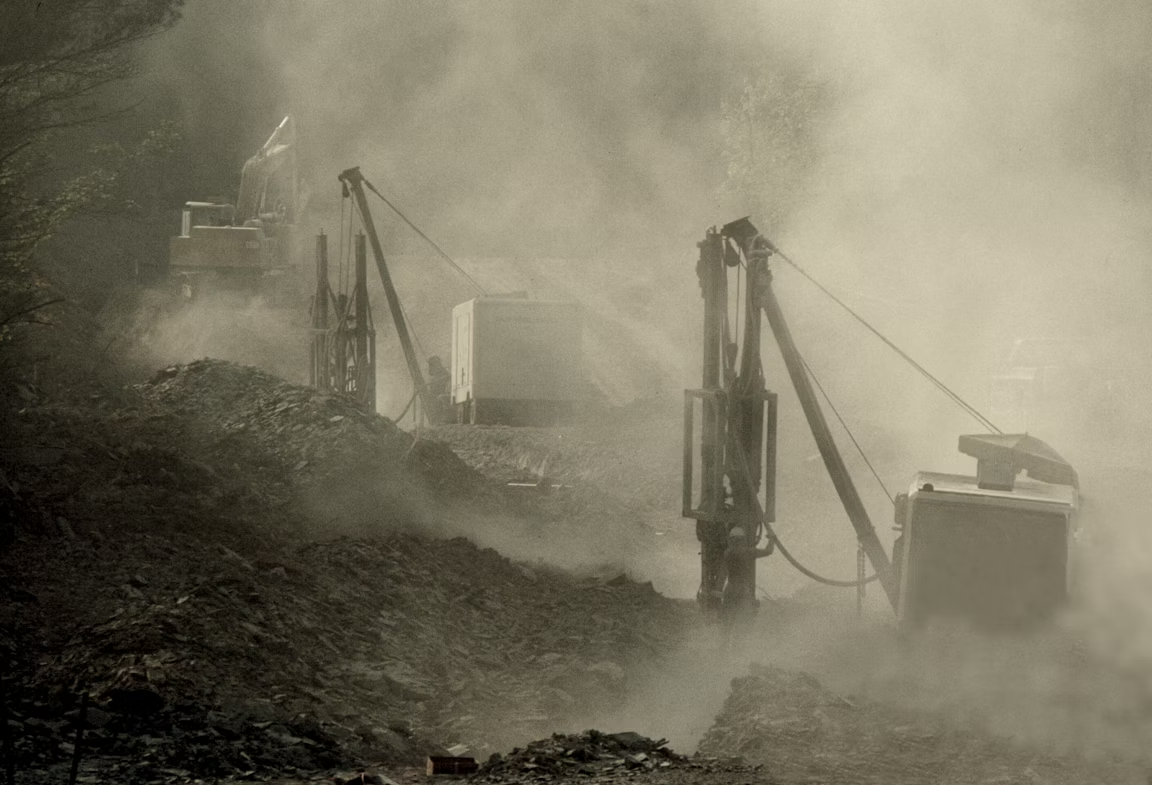
Palito's replenishment record, not the fourth ball mill alone, will decide whether Serabi can sustain a larger production base.
- Serabi Gold's 2026 production guidance of 53,000 to 57,000 ounces still depends on the Palito Complex operating as both an underground mine and the processing hub for Coringa ore.
- The Palito Complex carried an April 2025 mineral resource of 350,000 ounces at 9.9 g/t gold in Measured and Indicated categories and 162,000 ounces at 7.4 g/t gold in Inferred categories after cumulative production had already exceeded the 2005 starting resource base.
- Brownfield drilling in 2025 produced continuity at Senna, corridor potential at Onça and Piauí, and broader alteration signatures at Jiboia and Mutum, although Currutela remains unresolved.
- The approved 2026 brownfield programme allocates US$9 million and 30,000 metres of drilling, with Bill's Pipe, Tatu, and deep G3 being the most relevant to whether Palito can add strike and depth scale.
- A fourth ball mill targeted for late 2026 can raise milling capacity to 330,000 tonnes per annum (tpa) and monetise stockpiles, but the duration of that uplift still depends on converting exploration success into mineable inventory.
Palito Is Already the Hub, the Next Growth Test Starts There
Serabi Gold is not approaching expansion from a greenfield base. The Palito Complex is already the centre of the operating system, with more than 20 years of production history, a conventional 650 tonnes per day flotation and carbon-in-pulp plant, and a long record of annual output in the 30,000 to 40,000 ounce range. Coringa adds a second ore source, but that ore is pre-concentrated through sorting and then trucked about 200 kilometres to Palito for final processing. No standalone plant is planned for Coringa, which leaves Palito as the group's active bottleneck rather than one asset among several.
That operating configuration imposes a dual burden on Palito in 2026. It must continue to produce from its own underground zones while also absorbing third-party feed from within the group. Consolidated guidance of 53,000 to 57,000 ounces, therefore, rests on Palito doing two jobs at once, as a mine and as the processing centre for a two-mine, one-plant model. The strategic issue behind the next growth step is not whether more ore exists somewhere in the broader district. It is whether the hub asset can keep carrying the system as throughput rises.
Chief Executive Officer of Serabi Gold, Mike Hodgson, puts it this way:
"So we're feeding our plant-constrained operation with the best ore we possibly can to get us to about 60,000 ounces. After that, it's plant expansion, and we believe the plant expansion is the right thing to do; it's actually at Palito."
Palito Has a Replenishment History, Not Just a Remaining Resource
Palito's strategic value does not sit in a single resource snapshot. It sits in a longer record of depletion replacement across a mature underground system that remains open laterally, on strike, and to depth across an 8-kilometre north-west to south-east trend. The deposit is intrusion-related and targets a significant vertical extent, which matters because underground life extension at a hub asset is rarely driven by a single new discovery. It is more often driven by repeated renewal along a mineralised corridor with enough structural continuity to keep rebuilding mine plans over time.
That distinction is visible in the historical sequence. The starting resource in 2005 was 405,000 ounces. Cumulative production has since reached 444,000 ounces. Even after that depletion, the April 2025 Palito Complex mineral resource still stood at 350,000 ounces at 9.9 g/t gold in Measured and Indicated categories and 162,000 ounces at 7.4 g/t gold in Inferred categories, for a total of 512,000 ounces. The investment relevance is not that Palito is a large mine by global standards. It is that a relatively compact, high-grade system has already demonstrated the capacity to replace what it mines and still report an inventory larger than it began with. An updated mineral resource estimate is targeted for the late first quarter of 2026, which makes the next numerical readout important not as a standalone event but as the next test of that renewal pattern.
The 2025 Palito Programme Added Evidence of Continuity, Extension & Optionality
The 2025 programme mattered because it did not rely on a single intercept or target area. Across the Palito Complex, the drilling identified three distinct forms of value. The first was continuity in zones already contributing ore. The second was corridor potential that could widen the operating footprint around known structures. The third was geological optionality, including alteration halos and possible lower-grade, higher-volume styles that fall outside the classic narrow-vein template.
There is one scope-definition difference worth carrying through the analysis. The headline summary for 2025 brownfield drilling lists 17,600 metres at Palito and 20,800 metres at Coringa, but the detailed Palito discussion identifies 14,000 metres across 64 holes with two active rigs. For Palito programme composition, the 14,000 metre figure is the more precise operating reference.
Senna Extends an Active Ore Source
Senna carries weight because it is already part of the current feed. This is not a dormant target waiting for a conceptual re-rating. It is one of the primary contributors to current ore production at Palito, so any continuation north and south directly affects near- to medium-term replenishment. Drilling in 2025 identified mineralisation continuing in both directions, including results of 2.56 metres at 7.05 g/t gold and 0.25 metres at 25.42 g/t gold. Additional drilling returned 3.40 metres at 6.63 g/t gold, including 0.60 metres at 26.80 g/t gold, and 1.36 metres at 17.99 g/t gold, including 0.33 metres at 58.40 g/t gold.
For a hub asset, those results matter less because of isolated grade spikes and more because they support continuity around a producing source. A fourth ball mill can create space for more tonnes, but only if the mine keeps refreshing active feed zones. Senna, therefore sits close to the centre of the renewal case because it links brownfield exploration directly to operating inventory rather than to distant conceptual upside.
Currutela Remains a Real but Unproven Extension of G3
Currutela sits in a different category. It is interpreted as the southern extension of the main G3 body and lies more than 500 metres from the current G3 infrastructure, which creates real strategic interest if the geometry holds. A genuine extension of G3 could widen the development envelope around a known system and add mine life in a zone with established relevance to Palito. The current evidence does not yet support that conclusion.
Drilling returned economic grades over widths of less than 1 metre, but the results remain inconclusive pending geological modelling and interpretation. That distinction matters because narrow economic intersections can still fail to convert into a mineable extension if continuity, orientation, or development access do not align. Currutela, therefore, sits in the category of unresolved extension targets rather than proven renewal or resource additions already earned.
Piauí, Onça, Jiboia & Mutum Broaden the Geological Opportunity Set
Piauí and Onça widened the opportunity set around the current mine envelope. Piauí returned multiple significant results and, more importantly, showed a broader hydrothermal alteration halo locally over 10 metres thick with possible lower-grade disseminated mineralisation around high-grade vein zones. Onça also returned mineralisation and opened a prospective corridor of about 500 metres linking Onça with Piauí.
Jiboia and Mutum pushed that broadening effect further. Both showed broad zones of hydrothermal alteration with gold mineralisation, suggesting potential for lower-grade, higher-volume oxidised deposits. None of those targets can yet be treated as near-term feed. Their significance is strategic. If Palito's renewal engine begins to include a wider range of mineralisation styles and corridor-scale targets, the mine is less dependent on repeatedly finding the same narrow high-grade vein geometry to keep the hub full.
The 2026 Drill Plan Moves from Encouraging Evidence to Direct Proof Testing
The 2026 Palito drill plan shifts the question from encouragement to proof. Bill's Pipe, Tatu, and deep G3 matter because they test whether the system can scale along strike and at depth, not merely add scattered ounces around existing workings. Those are the targets that can turn Palito's replenishment story from a strong historical pattern into a numerically larger operating base that suits higher throughput.
Some of that work was deferred from the fourth quarter of 2025 because of technical and strategic considerations and heavy regional rainfall. That delay matters analytically because it means the highest-value Palito targets were not rejected. They were pushed into a later campaign window. Bill's Pipe is planned for the dry season expected in May 2026. Tatu has nine planned drill holes, which indicates a focused test rather than a token first pass. G3 will be tested with two deep holes aimed at intercepting the high-grade plunge at depths of 700 metres to 800 metres, which is the clearest depth test in the current programme.
The logic is straightforward. A hub mine can sustain a bigger plant only if the replacement engine can add enough mineable inventory to keep the mill fed across multiple years. Strike extensions such as Bill's Pipe and Tatu address lateral scale. Deep G3 addresses vertical scale in a system already recognised for depth potential. Together, they provide the most direct 2026 test of whether Palito can remain the centre of gravity in a larger throughput model.
The Fourth Ball Mill Improves Near-Term Utilisation, but Inventory Still Decides Duration
The fourth ball mill is economically attractive even before the full resource proof is in hand, as the capital requirement is nominal relative to Serabi's cash position, and extra throughput can monetise stockpiles already within the system. The planned increase to 330,000 tpa is targeted for late 2026. That timeline is the cautious framing because one source points to the third-quarter operation, while others point to the fourth-quarter operation. The operational point remains the same. Additional milling capacity can be installed and financed quickly enough to create immediate utilisation gains.
Hodgson is direct about the capital logic:
"It's the biggest return for us is putting in a fourth ball mill, which we're doing right now, that'll be operational in the third quarter, and then we'll be able to increase production."
That near-term return does not answer the longer-term inventory question. Stockpiles exist at Coringa and São Chico, and both mines are being expanded to increase material output to the plant. That makes the fourth ball mill an efficient first move because throughput can rise before every brownfield target has been fully converted into resources. The distinction is duration. A plant upgrade can increase utilisation almost immediately. Only a larger, better-defined inventory can sustain that higher utilisation over multiple years without grade pressure or feed dilution.
Resource Growth Is the Bridge Between Palito's Renewal Story & the Next Production Base
Serabi's broader production plan makes resource growth the bridge between geology and capacity. The three-phase strategy sets 2025 to 2026 as the resource accumulation period, targeting 1.5 to 2.0 million ounces across the group, and then prioritises capacity expansion thereafter. The current brownfield objective is to grow the mineral inventory to more than 1.5 million ounces, supported by an approved 2026 brownfield exploration budget of US$9 million and 30,000 metres of diamond drilling. The sequence matters because higher throughput is built on a stated inventory threshold rather than on the assumption that more tonnes will appear.
Hodgson frames that threshold plainly:
"Our objective is we want to get to say 1.6 million ounces, which I think we can get to by the end of this year, and I think that would be sufficient, without South Chico, to support a throughput rate of around 70,000 to 80,000 ounces."
That quote is useful because it ties resource scale directly to production scale. It also clarifies why Palito matters more than a generic group-level resource target. The increased resource base at Palito Complex and Coringa is meant to justify greater throughput, but Palito remains the proof centre of the thesis because it is already the processing hub and the constraint point. If Palito's own brownfield work does not keep rebuilding inventory, a larger consolidated resource number alone would still leave the key operating node exposed.
What Still Has to Be Demonstrated in 2026
The next decisive checkpoint is numerical. Serabi has engaged NCL Ingeniería y Construcción SpA of Santiago, Chile, to complete updated resource estimates for the Palito Complex and Coringa, incorporating the 38,400 metres drilled in 2025, with the release targeted for the late first quarter of 2026. That update is the first hard test of whether the encouraging brownfield evidence translates into a larger mineable inventory. It is also where the Palito thesis becomes measurable rather than interpretive. If active zones such as Senna, extension targets such as Bill's Pipe and Tatu, and broader corridor targets begin to convert into resource additions, the case for 330,000 tpa becomes more durable. If they do not, the plant expansion still has value, but its duration becomes less secure.
Uncertainty remains bounded rather than open-ended. Currutela remains unresolved and should remain in the category of possibility, not proof. Some assay results rely on Palito's internal laboratory work, which has not yet been independently verified by ALS, and the historical comparison above 1 g/t showed an average overestimation of 6.7% relative to external results. That does not invalidate the programme, but it does require caution when weighing individual intercepts. The 2026 question is therefore narrower than broad growth rhetoric suggests: can Palito convert encouraging geological signals into a numerically larger, operationally useful inventory that supports a greater share of the hub's burden over time?
The Investment Thesis for Serabi Gold
- Palito carries more strategic value than a typical mature underground mine because it is the operating bottleneck in a two-mine, one-plant model, which means any geological shortfall at the hub has a group-level effect on throughput.
- The mine's historical sequence of 2005 starting resources, cumulative production, and remaining 2025 inventory supports the view that Palito has functioned as a renewal asset rather than a shrinking residual operation.
- The 2025 drilling results improved the quality of the brownfield pipeline by providing evidence across producing zones, corridor targets, and broader alteration systems, rather than relying on a single narrow discovery.
- The 2026 drill programme at Bill's Pipe, Tatu, and deep G3 will determine whether Palito's renewal engine can sustain a larger milling base across multiple years, or whether the fourth ball mill's output gains are limited to the duration of existing stockpiles.
- The capital cost of the fourth ball mill is modest relative to Serabi's current cash position, enabling throughput uplift and stockpile monetisation without equity dilution or additional debt, leaving the balance sheet intact to fund the broader brownfield programme.
- The resource update targeted for the late first quarter of 2026 is the main evidence event because it will show whether Palito's current target set can move from encouraging exploration signals to mineable inventory proof.
The central investment issue is therefore one of durability rather than installation. Serabi can expand milling capacity with limited balance sheet strain, but the quality of the next production base will be determined by whether Palito continues to replace depletion at a rate that matches its role as the hub asset.
TL;DR
Serabi's next growth step depends less on installing a fourth ball mill than on whether Palito can keep rebuilding the mineable inventory that feeds the group's hub plant. Palito already handles its own underground output and final processing for Coringa ore, which gives its brownfield renewal record unusual strategic weight inside 2026 guidance of 53,000 to 57,000 ounces. The 2025 programme added continuity at Senna, corridor potential at Onça and Piauí, and broader optionality at Jiboia and Mutum, while Currutela remained unresolved. The approved 2026 programme adds US$9 million and 30,000 metres of drilling, with Bill's Pipe, Tatu, and deep G3 carrying the clearest relevance to scale. A 330,000 tpa plant can create immediate value through stockpile processing, but the updated resource estimate, targeted for the late first quarter of 2026, is when the durability of that higher throughput begins to be tested.
FAQs (AI-Generated)
Palito is the group's processing hub and an operating underground mine in its own right. That makes its geological durability more strategically important than a simple plant upgrade or a single feeder mine discussion.
No. It can increase milling capacity and process stockpiles, but it does not, by itself, prove that sufficient mineable inventory exists to sustain higher throughput over multiple years.
It added continuity around Senna, opened corridor-scale potential between Onça and Piauí, and pointed to broader alteration systems at Jiboia and Mutum. Those outcomes widened the renewal pipeline, even though not all targets are ready to be treated as resource additions.
Currutela is interpreted as a possible extension of G3, but the current drilling remains inconclusive pending geological modelling and interpretation. The intersections are encouraging, yet they do not justify calling the target proven renewal.
The updated resource estimate is the first numerical checkpoint because it incorporates the 2025 drilling and shows whether exploration signals translate into a larger mineable inventory. Follow-up drilling at Bill's Pipe, Tatu, and deep G3 will then indicate whether strike and depth growth can continue.
Analyst's Notes





Subscribe to Our Channel








Stay Informed






















