




Sovereign Metals Weighs New York Listing to Capture US's Zero-Domestic-Titanium Supply Gap


Sovereign Metals weighs a NYSE listing as Kasiya advances toward financing, with Toho Titanium qualification strengthening its US critical minerals supply case.
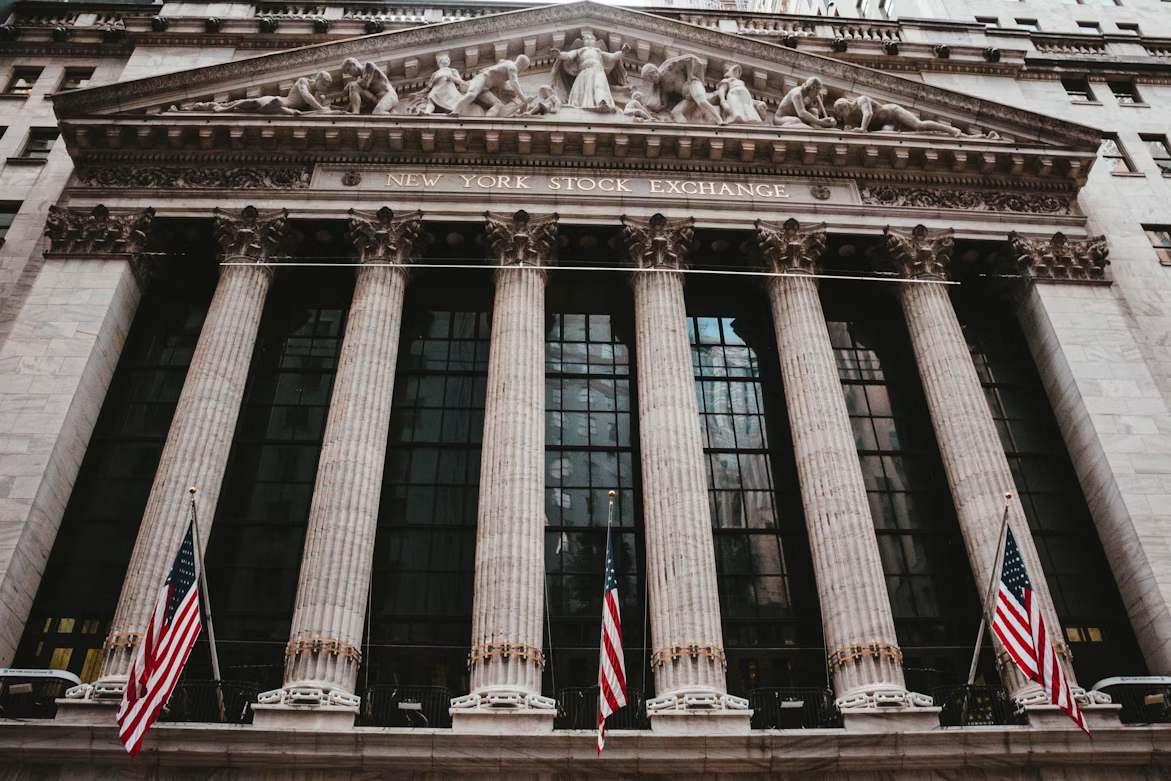
- Sovereign Metals is evaluating a New York Stock Exchange (NYSE) listing to broaden access to US institutional capital ahead of construction financing for the Kasiya Rutile Graphite Project, alongside its existing ASX, AIM and OTCQX quotations.
- Toho Titanium, 1 of only 2 Japanese producers of defense-grade and aerospace-grade titanium metal, has confirmed Kasiya's rutile meets its feedstock specifications.
- The Definitive Feasibility Study (DFS) confirmed a pre-tax net present value at an 8% discount rate (NPV8%) of US$2.2 billion and a 23% internal rate of return (IRR), on capital expenditure to first production of US$727 million.
- Sovereign is targeting a capital structure of approximately 60% debt and 40% equity, prepayments, and offtake finance to fund that capital expenditure.
- Kasiya's DFS operating cost of US$450 per tonne of product, free on board (FOB) Nacala, underpins a repricing argument tying natural rutile demand to US titanium defense-stockpiling requirements rather than historical construction-linked demand.
A US Listing Enters the Conversation
The US produces no titanium sponge domestically and imports the metal entirely from abroad. Sovereign Metals Limited (ASX: SVM | AIM: SVML | OTCQX: SVMLF) has just delivered a Definitive Feasibility Study (DFS) confirming a pre-tax net present value at an 8% discount rate (NPV8%) of US$2.2 billion and a 23% internal rate of return (IRR) for its Kasiya Rutile Graphite Project in Malawi, on capital expenditure to first production of US$727 million. Sovereign is now examining a New York Stock Exchange (NYSE) listing, a capital-markets step that sits alongside its existing ASX, AIM and OTCQX quotations rather than replacing them, aimed specifically at deepening US institutional participation as the Company approaches its construction financing decision.
Chief Commercial Officer of Sovereign Metals, Sapan Ghai, confirmed the listing is under active consideration rather than a distant ambition:
"We've been over there. We already have a lot of US capital on our share register. I think the idea is to increase that US capital portion of the pie chart on our register as we go into the build phase of this project."
A listing decision has not been announced, and no timeline has been disclosed.
Toho Titanium's Qualification & the Western Supply Gap
The listing consideration is arriving alongside a separate commercial data point: qualification from Toho Titanium, 1 of only 2 Japanese producers of defense-grade and aerospace-grade titanium metal following the exclusion of Russian material from Western supply chains after 2021. Toho has confirmed Kasiya's rutile meets its feedstock specifications, a qualification the Company describes as significant given Toho's standing as the more stringent of the 2 Japanese producers on feedstock requirements.
China produces the largest volume of titanium metal globally but fails to meet aerospace and defense specifications; Japan alone produces metal that does; and the US produces none domestically, relying entirely on imports. Kasiya's rutile and natural graphite, both designated critical minerals by the United States and the European Union, are positioned to help address that concentration.
Financing Structure & the Debt-Equity Sequencing Problem
Reaching first production requires the DFS's US$727 million in upfront capital, and Sovereign's working assumption is a structure of approximately 60% debt and 40% equity, prepayments, and offtake finance. That structure runs into a familiar sequencing problem: debt providers typically want committed equity in place before signing, while equity investors often wait for debt to be committed first, leaving each side reluctant to move ahead of the other.
Sovereign has not disclosed a resolution to this sequencing problem, though the Company has linked its US capital markets strategy, including the potential New York listing, to breaking the standoff.
Economic Context: From Construction Demand to Defense Stockpiles
Kasiya's DFS operating cost of US$450 per tonne, free on board (FOB) Nacala, is set against a realized rutile price near US$1,600 per tonne, a level the Company has described as conservative relative to current market conditions. The underlying case is that natural rutile pricing is shifting away from its historical link to paint manufacturing and construction activity, and increasingly reflects US titanium defense-stockpiling requirements tied to platforms including fighter aircraft, submarines and tanks that have no substitute source of rutile-derived titanium.
The Investment Case
For investors, the significance of a potential New York listing is less about the exchange itself and more about what it would signal. A critical minerals developer with a completed DFS, an established low-cost position across both rutile and graphite, and third-party product validation from a qualified aerospace-grade titanium producer is actively courting the pool of US capital that has shown the clearest appetite for non-Chinese critical minerals supply this year. None of this converts automatically into committed financing. The listing decision, the offtake conversion, and the debt-equity sequencing problem remain unresolved, and those are the milestones that will determine whether Kasiya's capital-markets positioning translates into a financed construction decision.
FAQs (AI-Generated)
Analyst's Notes





Subscribe to Our Channel


Stay Informed


