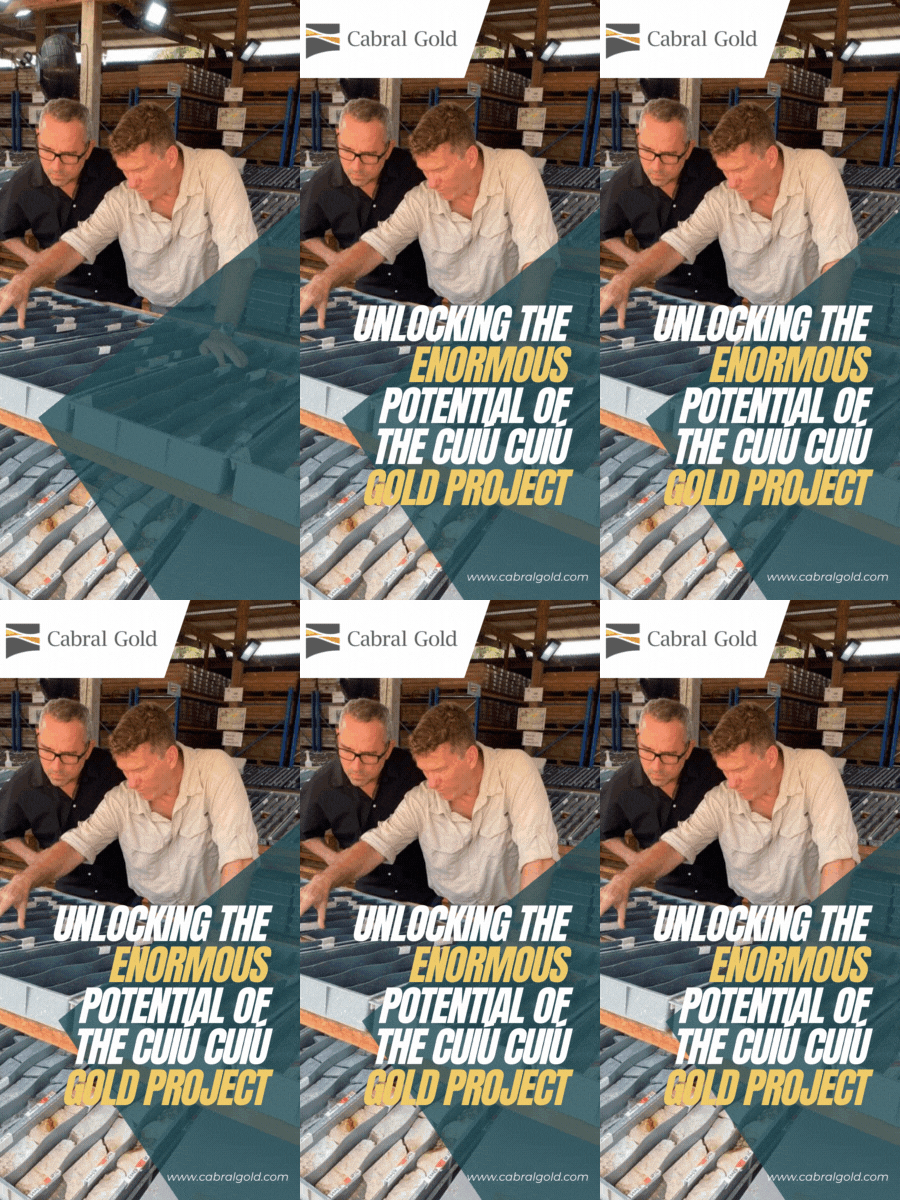
The Junior Mining Bull Market Is Real, Bifurcated, and Mostly Geopolitical - Here's How to Position



Junior Mining is in a Genuine Bull Cycle
The 2026 TSX Venture 50 was 48 out of 50 mining companies, delivering an average 431% share-price gain and 775% market-cap growth in 2025, the largest annual gain since the program began in 2006. That is not sentiment. That is capital moving.
The problem for investors is that the capital is moving unevenly, and the reasons it is moving matter more than the fact that it is.
Two things are true at once. Money is flowing back into the sector, TSX and TSXV raised over $33 billion in equity in 2025, up 60% year-over-year, and June 2026 alone saw juniors raise ~$700 million, up 67% year-over-year. At the same time, that money is bunching at the de-risked end. Grassroots exploration has fallen to a record-low 21% of global exploration spend, and small-cap explorers' share of equity raised has dropped to roughly 12%, from 31% five years ago.
The equity market is confirming the split. Skillings estimates median junior explorer/developer P/NAV at 0.3x–0.6x, deep discount territory despite record metal prices. GDXJ was up only ~12.6% YTD as of 20 August, a fraction of what the underlying metals have done. So the trend is not "juniors are ripping." The trend is "advanced, financed, permitted stories are being rerated, and everything upstream of that is being left behind."
Seasonal Or Geopolitical?
August is a quiet month by convention, light volumes into Diggers & Dealers and Denver Gold Forum. That is the seasonal layer. Below it, the drivers are policy, not calendar:
- The TMX itself attributes the surge to "a new global financing cycle driven by geopolitical uncertainties and industrial policy shifts".
- Section 232 tariff threats, the July 2026 executive order tightening defense procurement of Chinese minerals, the $12B federal "Project Vault" stockpile that acts as a de facto price floor, and the FORGE friend-shoring framework with Australia, Canada, and Japan are actively rerating Western-jurisdiction juniors.
- China has expanded rare-earth export controls, added a whistleblower hotline for smuggling enforcement, and detained two Japanese nationals over alleged rare-earth smuggling in mid-2026.
- Central-bank gold buying is running near 190 tonnes per quarter, a debasement/de-dollarization trade, not a seasonal one.
Read together, these are structural repricings of jurisdiction and supply security. They do not unwind in September.
Fundamentals Says Higher Prices For Silver & Copper
Gold has done most of the psychological work already. Silver and copper are where the physical market case is strongest.
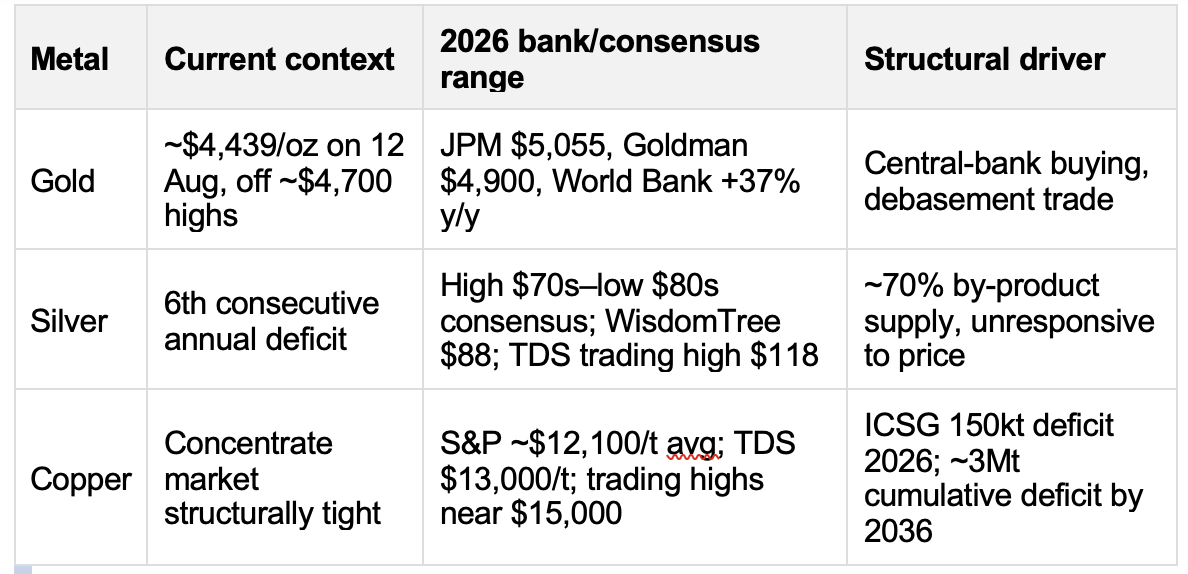
The silver story is the cleanest. Roughly 70% of mined silver comes as a by-product of copper, lead, and zinc, so silver supply does not respond to silver's own price signal. Sixth consecutive deficit, cumulative drawdowns of ~762 Moz since 2021. Copper is the same physical story wrapped around a different demand pull, data centres, grid, and EVs, with Wood Mackenzie modelling a 304kt refined deficit for 2025/26.
These are scenario ranges, not forecasts. But if the physical market matters, silver and copper are where the asymmetry sits from here.
Actionable, Stage-Aware Framework
Higher metal prices help producers first, developers second, and explorers last. Screen accordingly.
Producers
The rerate is already visible in this cohort. What to test now:
- AISC vs. spot. With gold above $4,000/oz, margins are structurally wide. The question is whether management is banking the margin or spending it.
- Reinvestment discipline. Look for capital allocation into brownfield expansion, near-mine exploration, or debt paydown, not acquisitions at the top of the cycle.
- Reserve replacement. Reserves depleted at $1,800 gold need to be recut. Rising reserves at conservative price decks are the signal; declining reserves at spot-price decks are the warning.
Developers (permitted, funded, near-construction)
This is where the capital is concentrating and where the leverage sits.
- Financing structure. Non-dilutive financing is now a genuine differentiator. Cabral Gold closed a US$45M gold-linked loan denominated in ounces, and Thewelo secured a US$25M Monetary Metals gold loan alongside a fully subscribed debenture, routes to first pour without an equity raise. These are business-model examples, not price targets.
- Permit status. Full construction approval is the single biggest de-risking event that is still, in many cases, mispriced.
- First-pour timeline. Months matter, not years. Every dollar gold trades above the feasibility-study price deck flows straight to project NPV, but only if the mine actually gets built.
- Study price decks. A PFS at $1,900 gold with spot at $4,400 hides significant embedded value. Reread the studies at current metal prices.
Explorers
This is the discount cohort, and it is a discount for a reason. Producer metrics do not apply, test the company, not the ounces:
- Treasury and runway. How many months of cash, and at what burn?
- Dilution history. Shares outstanding growth vs. resource growth is a defensible measure of value creation per share.
- Insider behaviour. Insider buying at current prices, or selling into strength?
- Target-killing discipline. Explorers that walk away from marginal targets are more valuable than ones that drill every hole to keep the promote alive.
- Partner validation. Strategic investors, off-take interest, or majors taking equity are external signals that reduce sentiment dependence.
Given the physical market case, tilt exposure toward silver and copper stories where the argument is supply-constrained, not demand-driven. Gold remains supported but has less asymmetric upside from here on consensus math.
Risks Sitting Under The Case
- Consensus is crowded. BI/Business Insider notes some houses see copper falling ~20% by year-end and gold ~21% off current levels if the debasement narrative unwinds. Position sizing matters.
- UBS cut its silver deficit estimate from ~300 Moz to 60-70 Moz in May and lowered its price targets accordingly. The deficit is still real; the scale is contested.
- Policy risk is bidirectional. The same executive orders and tariffs supporting Western juniors could be reversed, delayed, or diluted by Congress or in court. Section 232 price floors remain on the table but are not law.
- Financing access ≠ share performance. Juniors can raise money and still trade sideways if the rest of the market's cash rotates to producers and developers. GDXJ's YTD tells that story clearly.
- Permitting timelines. Even funded, permitted developers face construction execution risk, labour, contractor availability, and grid connections have all been project-killers in this cycle.
What To Watch Next
- Denver Gold Forum (September) and Precious Metals Summit — the sentiment inflection point that historically breaks the summer trading range.
- Q3 earnings from senior producers - whether they are guiding to reinvestment, M&A, or buybacks tells you where the next dollar goes.
- Section 232 outcomes on copper and critical minerals - the difference between rhetoric and enforceable price floors.
- Chinese export-control response - any tightening on rare earths, tungsten, antimony, or gallium reprices the entire critical-minerals junior cohort.
- Gold-linked and stream financings - every new deal on the Cabral or Monetary Metals template validates that developers can build without dilution, which is the single most important structural change in this cycle.
The junior mining trend is real, geopolitically driven, and structurally supported by physical metal deficits, but the market is only paying for the near-production end of the value chain. Investors screening for the next leg should tilt toward silver and copper on fundamentals, favour permitted and funded developers over exploration optionality, and demand non-dilutive financing structures where available. Explorers are cheap for a reason; the discount is only an opportunity when the company itself passes a treasury, dilution, and discipline test, not when the commodity does.
The cycle is favourable. Working of the selection is harder.
Analyst's Notes





Subscribe to Our Channel









Stay Informed