




Tudor Gold & Treaty Creek: Systematically De-Risking the Standalone Path to Production



Tudor Gold advances selective underground plans at Treaty Creek, targeting higher-grade resources, lower capital needs, and a clear 2026 PEA development pathway.
- Tudor Gold holds an 80% interest in Treaty Creek and is evaluating a selective underground mine to reduce upfront capital requirements.
- Goldstorm contains 24.9 million ounces of Indicated gold and 4 million ounces of Inferred gold, alongside substantial silver and copper resources.
- At a US$125-per-tonne net smelter return cutoff, Goldstorm contains 5.8 million Indicated and 2.6 million Inferred ounces of gold.
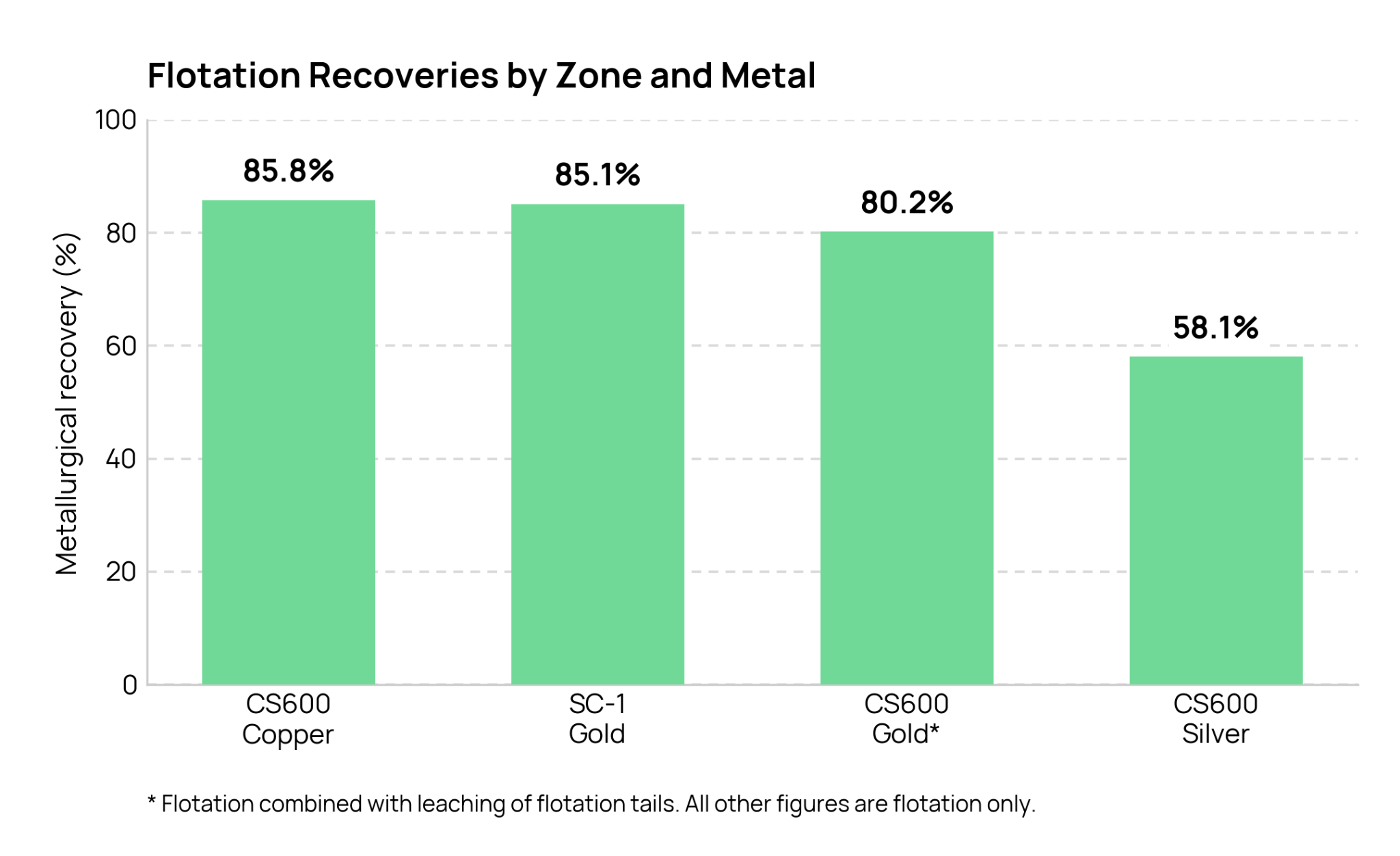
- Testing achieved 85.8% copper recovery from CS600 and 85.1% gold recovery from SC-1 using flotation-based processing.
- Perfectstorm hosts two distinct mineralized systems but contributes 0 reportable ounces, while the 2026 Preliminary Economic Assessment (PEA) and exploration-ramp permit remain key milestones.
Transitioning to Selective Underground Mine Scenarios to Mitigate Capital Barriers
Tudor Gold Corp. (TSXV: TUD) is advancing project-level de-risking at its 80%-owned Treaty Creek Project in British Columbia’s Golden Triangle. The company is shifting from a large-scale, bulk-tonnage development model to a higher-grade, standalone underground mine to improve capital efficiency. Tudor is evaluating a lower-impact starter operation that could avoid the multibillion-dollar infrastructure requirements of an open pit, support independent project financing, and limit equity dilution.
Tudor’s acquisition of American Creek Resources Corp. increased its ownership of Treaty Creek to 80%, consolidating project control and simplifying decision-making ahead of future development studies. Teuton Resources Corp. holds the remaining 20% and is fully carried to a production decision.
Engineering Optimization: Goldstorm Resource Sensitivities & PEA Foundations
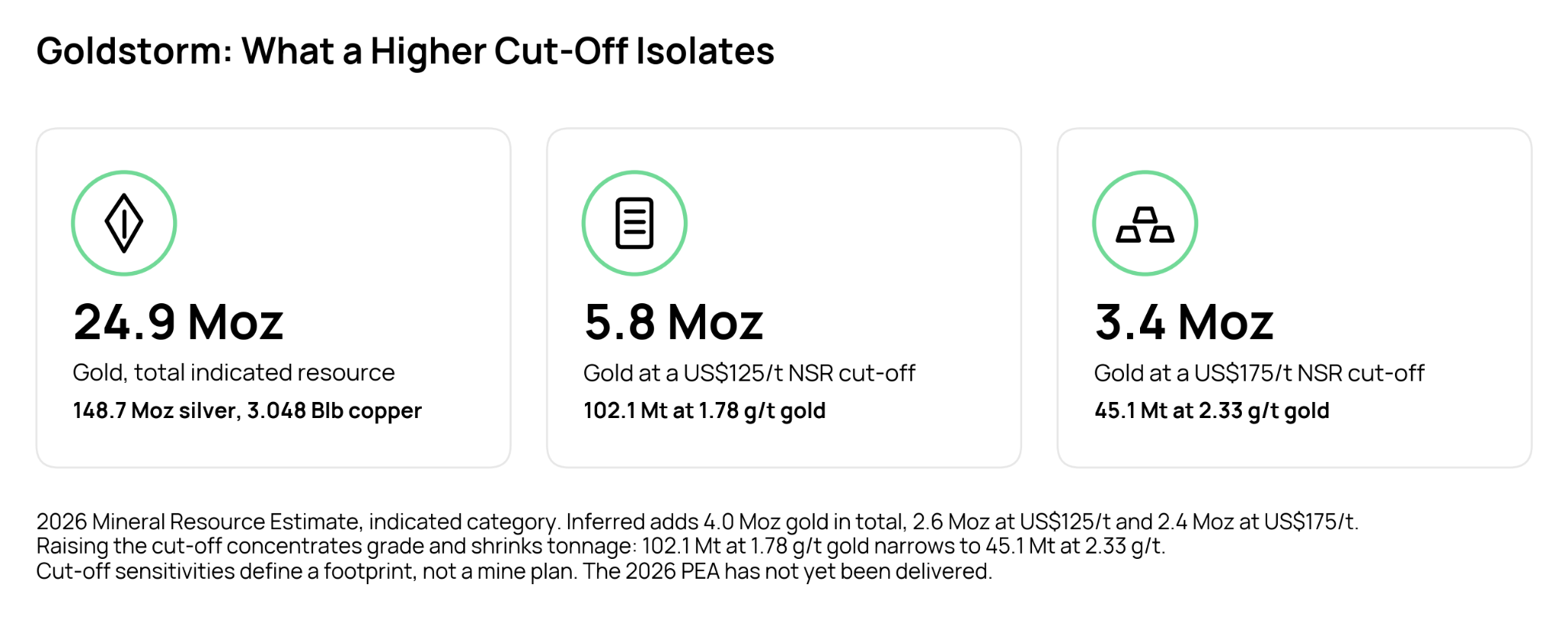
Goldstorm’s 2026 Mineral Resource Estimate (MRE) outlines an Indicated Resource containing 24.9 million ounces of gold, 148.7 million ounces of silver, and 3.048 billion pounds of copper, alongside an Inferred Resource containing 4 million ounces of gold, 18.6 million ounces of silver, and 327.7 million pounds of copper. These figures establish Treaty Creek as a large-scale North American gold-copper-silver project.
Tudor is evaluating higher-grade cut-off sensitivities to define a more selective mining footprint and improve initial project economics. At a US$125 per tonne net smelter return cutoff, the Indicated Resource totals 102.1 million tonnes grading 1.78 grams per tonne gold, 9.19 grams per tonne silver, and 0.27% copper, containing 5.8 million ounces of gold, 30.2 million ounces of silver, and 607.2 million pounds of copper. The corresponding Inferred Resource totals 21.8 million tonnes grading 3.64 grams per tonne gold, 10.22 grams per tonne silver, and 0.14% copper, containing 2.6 million ounces of gold, 7.2 million ounces of silver, and 67.8 million pounds of copper.
At a US$175 per tonne cutoff, the Indicated Resource narrows to 45.1 million tonnes grading 2.33 grams per tonne gold, 9.27 grams per tonne silver, and 0.17% copper, containing 3.4 million ounces of gold, 13.4 million ounces of silver, and 167.3 million pounds of copper. The Inferred Resource totals 18.3 million tonnes grading 4.02 grams per tonne gold, 11.17 grams per tonne silver, and 0.16% copper, containing 2.4 million ounces of gold, 6.6 million ounces of silver, and 65.3 million pounds of copper. These higher-grade sensitivities support Tudor’s 2026 Preliminary Economic Assessment (PEA) and indicate a concentrated underground core that could underpin a standalone starter mine.
Metallurgical De-Risking: CS600 & SC-1 Flotation Recovery Flowsheets
Tudor's technical strategy is supported by metallurgical test results which confirm high recoveries of precious and base metals. Flotation testing on the Gold-Copper CS600 Zone achieved metallurgical recoveries of 85.8% for copper and 58.1% for silver. Combining flotation with leaching of the flotation tails yielded a gold recovery of 80.2% from this zone, producing a clean concentrate grading 30.3% copper, 36.5 grams per tonne gold, and 99.8 grams per tonne silver.
Additionally, flotation testing on the High-Grade Gold SC-1 Zone achieved a gold recovery of 85.1%, producing a concentrate grading 33.6 grams per tonne gold. These high recovery rates prove that Treaty Creek mineralization is highly amenable to standard, low-cost flotation processing circuits. Producing a clean, marketable concentrate directly reduces initial capital expenditure by supporting a conventional flotation plant rather than a more capital-intensive on-site pressure-oxidation circuit.
These metallurgical parameters significantly de-risk the project's processing flowsheet and reduce initial operational risks. Flotation-based plants are standard in the mining industry, with lower capital intensity and higher operational reliability than hydrometallurgical processing alternatives. By proving the viability of a flotation-only circuit, Tudor is targeting an optimized processing flowsheet that improves project-level net present value and simplifies the permitting pathway.
Satellite Exploration: Delineating Perfectstorm's Zero-Ounce Exploration Potential
The Perfectstorm Zone, located approximately 1 kilometer southwest of the flagship Goldstorm Deposit, represents a satellite target within Tudor Gold's long-term development pipeline. During the 2026 exploration campaign, drilling of 4 initial core holes confirmed the presence of 2 adjacent, distinct mineralized systems along the northeast-to-southwest trending Sulphurets fault corridor, consisting of the newly discovered Perfectstorm Porphyry (PSP) Zone and the strike extension of the near-surface Perfectstorm Epithermal (PSE) Zone. Crucially, Perfectstorm remains a raw exploration target that currently contributes 0 reportable ounces to Treaty Creek's defined mineral resource base. Tudor records only 7,752.00 meters of historical drilling at Perfectstorm, compared with over 190,000.00 meters executed at Goldstorm, confirming that substantial capital expenditure and systematic step-out drilling are required to establish geological and economic continuity.
Analytical results from this 2026 exploration campaign indicate broad polymetallic mineralization and localized high-grade precious-metal intervals. The newly identified copper-gold-silver-molybdenum porphyry system returned 4.59 grams per tonne gold and 0.67 grams per tonne silver over a downhole length of 10.50 meters, and 0.24 grams per tonne gold, 2.11 grams per tonne silver, 0.21% copper, and 50.76 parts per million molybdenum over 82.90 meters, alongside a separate interval returning 0.34 grams per tonne gold, 1.89 grams per tonne silver, 0.27% copper, and 53.72 parts per million molybdenum over 67.35 meters. Parallel drilling within the epithermal trend confirmed gold-silver continuity over a strike length of over 360.00 meters, returning 0.78 grams per tonne gold and 2.90 grams per tonne silver over 74.15 meters, which includes a core grading 2.16 grams per tonne gold and 3.18 grams per tonne silver over 9.10 meters. Delineating these adjacent mineralized systems provides Tudor with potential underground selective mining targets that could feed a centralized processing plant, thereby extending overall mill amortization without requiring duplicate on-site infrastructure.
Risk Mitigation: Addressing Infrastructure, Permitting, & Capital Access Gaps
Treaty Creek is located in British Columbia, a supportive mining jurisdiction with access to established regional infrastructure. Highway 37 and the Northwest Transmission Line are approximately 40 kilometers from the property, while deep-water port facilities in Stewart can support the export of concentrate. This proximity to year-round roads, high-voltage power, and export infrastructure could reduce initial capital requirements. Tudor also benefits from regional permitting and development experience, including management’s involvement in building the Brucejack Gold Mine approximately 20 kilometers south of Treaty Creek, as well as established relationships with local Indigenous partners.
Material technical, permitting, and financing risks remain. The economics of a selective underground mine have not yet been demonstrated in the 2026 PEA or subsequent feasibility studies, and underground development remains contingent on a provincial permit for the proposed exploration ramp. Although flotation testing has shown high recoveries for the SC-1 and CS600 zones, the metallurgical characteristics of newer mineralization, including the Perfectstorm PSP Zone, remain undetermined. Project financing also remains exposed to capital-market volatility, commodity prices, and potential shareholder dilution.
Investment Thesis for Tudor Gold
- Tudor Gold is systematically de-risking its flagship Treaty Creek gold-copper-silver project in the Golden Triangle of British Columbia, Canada, by transitioning toward a selective, standalone underground mining scenario to reduce upfront capital requirements.
- By focusing mine design on higher-grade mineral resource sensitivities, specifically the US$125-per-tonne net smelter return cutoff, the company isolates 5.8 million ounces of gold in the indicated category and 2.6 million ounces in the inferred category.
- Targeting these highly concentrated, higher-grade subsets allows the company to plan a lower-capital footprint that supports independent project financing and minimizes shareholder dilution.
- This engineering optimization is supported by reported metallurgical flotation recoveries of 85.8% for copper in the CS600 Zone and 85.1% for gold in the SC-1 Zone, yielding clean, marketable concentrates.
- Project-level economics are further enhanced by satellite target delineation in the adjacent Perfectstorm Zone, establishing a pipeline of additional feed and extending potential centralized mill amortization.
Tudor Gold’s investment case rests on converting Goldstorm’s higher-grade resource into a technically viable, lower-capital underground development plan while retaining expansion potential from satellite discoveries. The 2026 PEA will be the key test of this strategy, defining the proposed mine configuration, capital requirements, operating economics, and financing pathway. Permitting, metallurgical validation of new zones, and access to non-dilutive capital remain the principal factors governing project execution.
TL;DR
Tudor Gold Corp. holds an 80% interest in the Treaty Creek Project, with Teuton Resources Corp. holding the remaining 20% interest, in an indicated resource of 24.9 million ounces of gold, 148.7 million ounces of silver, and 3.048 billion pounds of copper. To reduce initial capital expenditure, proposed mine plans target the high-grade SC-1 and CS600 Zones to isolate a selective mining footprint. This standalone development scenario is supported by metallurgical flotation tests yielding recoveries of 85.8% for copper in CS600 and 85.1% for gold in SC-1, while ongoing exploration at the adjacent Perfectstorm Zone identifies a copper-gold-silver-molybdenum porphyry system and epithermal gold-silver continuity, establishing long-term satellite optionality.
FAQs (AI-Generated)
Analyst's Notes





Subscribe to Our Channel









Stay Informed






















