




US Gold Corp & CK Gold: Permitting, Project Economics & Exploration Reframe the Development Case


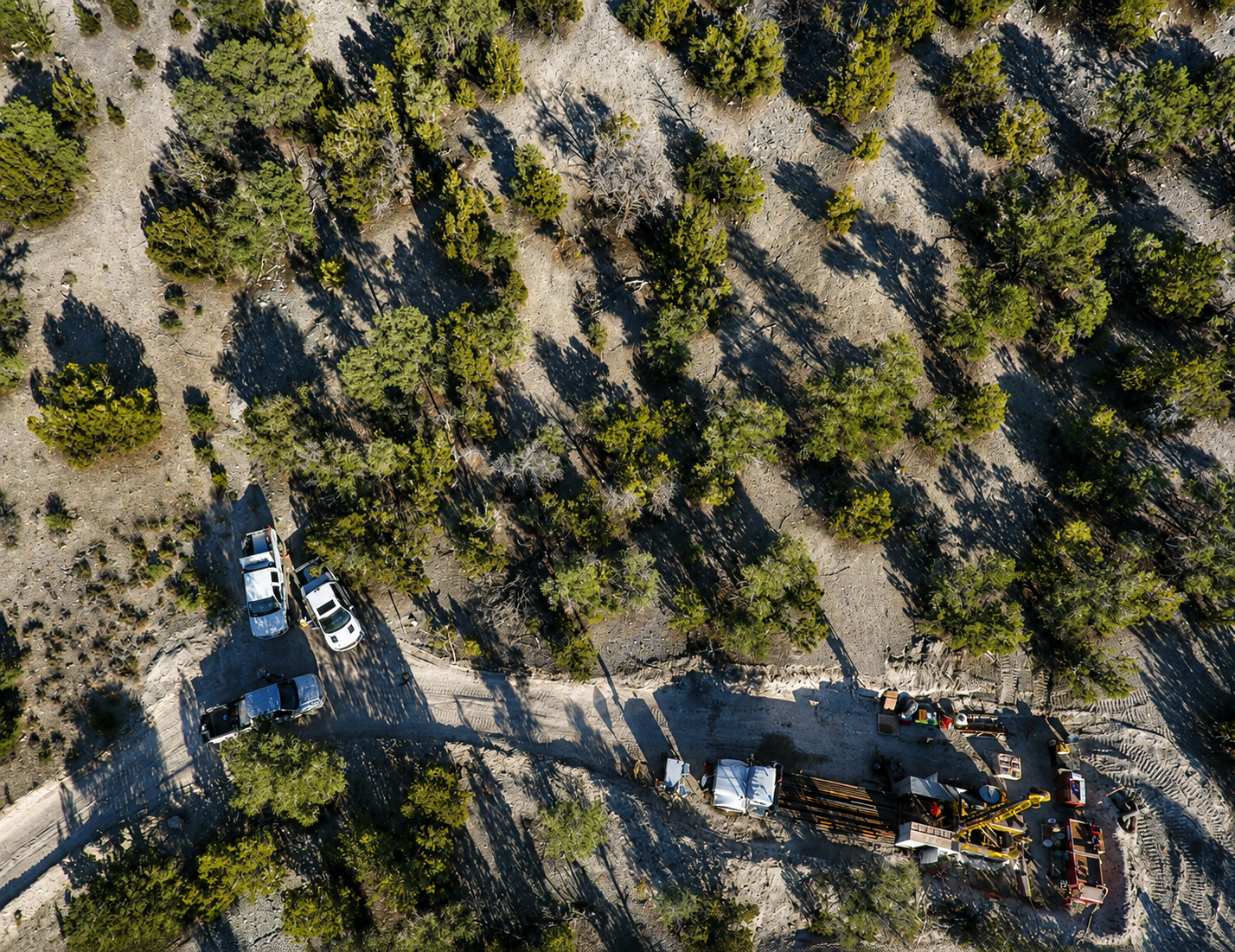
US Gold Corp is advancing the permitted CK Gold Project in Wyoming, with feasibility economics, a tight capital structure, and exploration creating catalysts.
- US Gold Corp is advancing the permitted CK Gold Project in Wyoming, with the March 2026 feasibility study (FS) establishing an after-tax net present value (NPV5%) of $632 million and an after-tax internal rate of return (IRR) of 27%.
- The FS defines an 11-year operation processing 20,000 tonnes per day with proven and probable reserves containing 1.015 million ounces of gold, 260 million pounds of copper, and 3.031 million ounces of silver.
- CK Gold is located approximately 20 miles west of Cheyenne and near the Interstate 80 transportation corridor, with existing regional infrastructure supporting access to labor, contractors, power, and equipment.
- The June 2026 exploration program identified northwest-trending magnetic anomalies and is being used to define drilling targets adjacent to and below the current reserve pit.
- US Gold Corp had 16,526,163 common shares outstanding as of August 7, 2026, alongside 2,828,057 warrants and 548,056 options, making the eventual financing mix relevant to shareholder exposure.
CK Gold Economics Establish a Defined Development Base
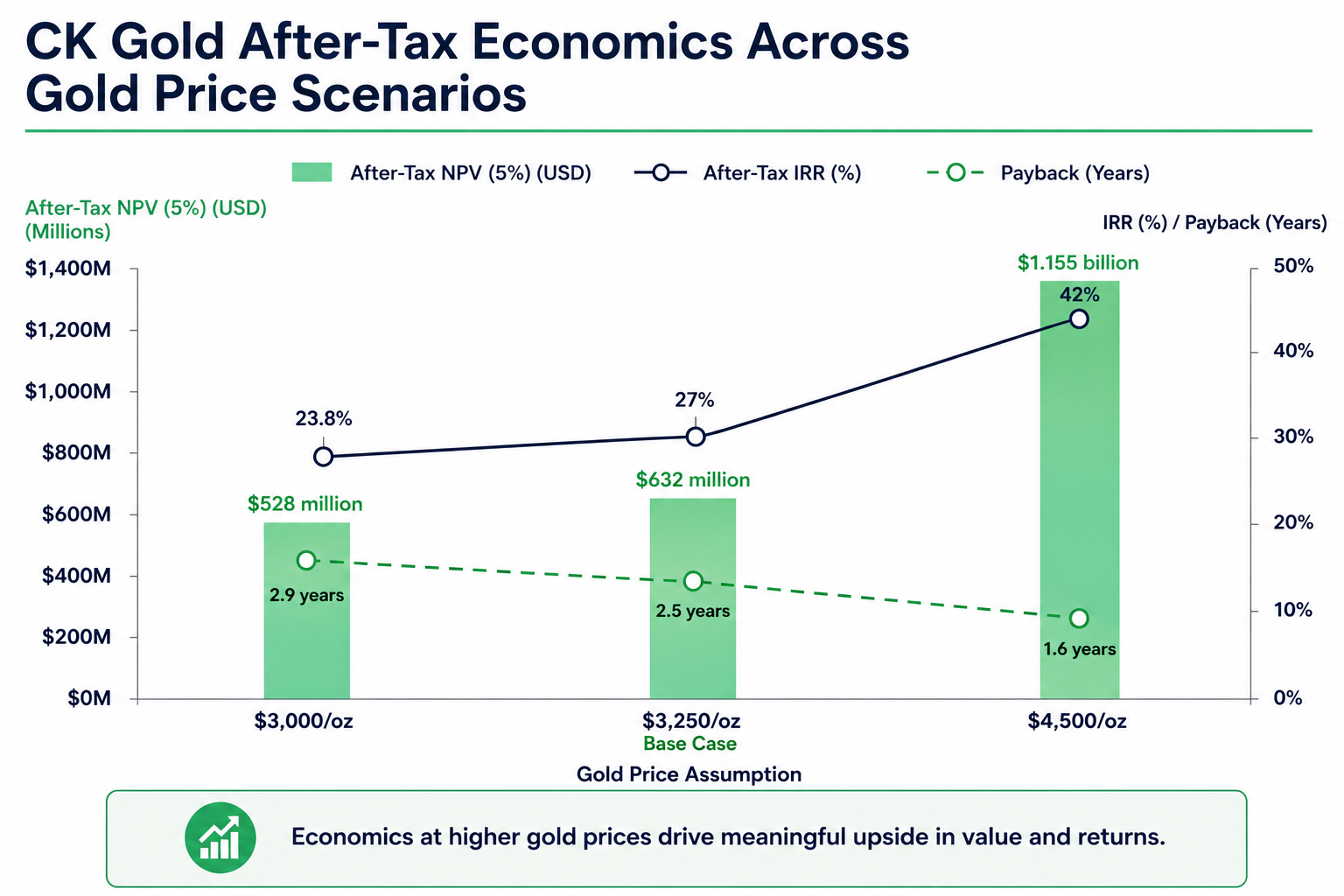
The March 2026 feasibility study (FS) establishes the current economic baseline for US Gold Corp (NASDAQ: USAU). The study uses base case assumptions of $3,250 per ounce of gold, $4.50 per pound of copper, and $40 per ounce of silver and produces an after-tax net present value (NPV5%) of $632 million, an after-tax internal rate of return (IRR) of 27%, and a 2.5-year payback period. Initial capital, including contingency, is $394 million, while sustaining capital is $35 million.
The study also demonstrates the material's sensitivity to the gold price assumption. At $4,500 per ounce of gold, the after-tax NPV5% is $1.155 billion, the after-tax IRR is 42%, and payback is 1.6 years. At $3,000 per ounce of gold, the after-tax NPV5% is $528 million, the after-tax IRR is 23.8%, and payback is 2.9 years. These scenarios establish how the defined project economics change under the metal price assumptions used in the feasibility model.
The reserve case contains 1.015 million ounces of gold, 260 million pounds of copper, and 3.031 million ounces of silver, with an 11-year operating mine life and a 20,000-tonne-per-day process rate. Average annual payable production is 85,000 gold equivalent ounces.
Executive Chairman of US Gold Corp, Luke Norman, described the project's economics:
"At $3,250, you see an after-tax NPV, for example, of $630 million, just under 30% IRR."
Permitting & Infrastructure Reduce Development Complexity
CK Gold's development position is supported by the completion of major permitting milestones. The Mine Operating Permit was approved by the Wyoming Department of Environmental Quality in April 2024 for a 10-year renewable term, while the Industrial Siting Permit received unanimous approval in June 2023 and has been updated through June 2027. Construction was initiated in January 2026.
The project is located on State of Wyoming land with no direct federal involvement. The company also reports an approved water discharge permit in May 2024, acceptance of its reclamation bond in June 2024, and approval of its air quality permit application in November 2024. The permitting process included more than 200 separate meetings involving more than 300 individuals, ranging from the Governor and state agencies to interested parties and individuals.
CK Gold is approximately 20 miles west of Cheyenne, with regional roads, nearby power, and access to existing labor and contractor services. The company identifies proximity to Cheyenne as reducing the requirement for a man-camp, while existing equipment supply hubs are located within a stated 6-hour drive.
Conventional Processing Provides a Defined Operating Base
The CK Gold processing route uses conventional crushing, grinding, flotation, and filtration rather than complex on-site metallurgical infrastructure. The feasibility design incorporates Jameson cell flotation and vacuum filtration of tailings, with concentrate shipped to off-site smelters. The company's presentation describes the operating concept as a simple crush-grind-flotation-and-dry-stack-tailings system.
The FS reports life-of-mine (LOM) average recoveries of 71.5% for gold, 80.6% for copper, and 68.7% for silver. LOM payable production is 707.2 thousand ounces of gold, 186,726 thousand pounds of copper, and 1,874 thousand ounces of silver.
Additional gold remains in the tailings after the planned flotation process, creating a potential future recovery pathway. The company has identified later tailings treatment and grind-size optimization as potential improvements, but those opportunities are not incorporated as additional value in the current feasibility case.
Financing Structure & Construction Execution Remain Key Development Variables
The $394 million initial capital requirement makes the financing structure and construction execution material to the development case. US Gold Corp had 16,526,163 common shares outstanding, 2,828,057 warrants, and 548,056 options as of August 7, 2026. The company reported $30.7 million in cash as of April 30, 2026.
Management has stated that it prefers to minimize equity issuance as it advances project financing. The company's financing objective therefore creates a direct link between the capital required to build CK Gold and future per-share exposure.
Norman described that objective directly:
"With 16.5 million shares outstanding, we don't want to see that balloon through project financing, so clearly, we want to take as much debt as possible."
The FS has been independently reviewed, while management has stated that some final engineering remains before construction. Norman said the FS was completed by Micon and Halyard and subsequently reviewed by additional parties, with final engineering still required before construction. The $394 million initial capital estimate therefore remains the development baseline against which subsequent engineering and construction performance will be assessed.
Exploration Adds Resource Expansion Without Supporting the Base Case
The June 2026 exploration update identified new geophysical targets that are being advanced toward drilling. The expanded drone-mounted magnetic survey covered 325 line kilometers at an average 32-meter drape and identified northwest-trending magnetic anomalies and structures outside the current pit footprint.
The company is using the geophysical results alongside other technical work to define mineral resource drilling targets adjacent to and below the permitted pit. The August presentation identifies 590,000 gold equivalent ounces of measured and indicated resources for potential conversion to reserves and 677,000 gold equivalent ounces of inferred resources for potential conversion to measured and indicated resources.
The existing deposit remains open at depth and along strike, with 2,900 feet of strike length identified as untested. These targets offer potential for resource expansion, but converting them into reserves requires additional drilling and technical definition.
Secondary Optionality Remains Outside the Base Case
Aggregate commercialization, water storage, and additional tailings recovery remain separate opportunities rather than components of the current feasibility economics. The FS does not include potential commercial value from aggregate and rail ballast produced from CK Gold waste rock. The company reports that the local quarry sells crushed stone for approximately $20 to $25 per tonne, while its presentation identifies the commercialization of aggregate as an opportunity for further study.
The potential mechanism is the sale of suitable waste rock generated by the open-pit operation into nearby construction and infrastructure markets. No aggregate revenue is required for the current feasibility economics.
Norman described the potential value of the material:
"Our waste rock is the same grade and quality of granite that is being sold by Martin Marietta next door, so somewhere between $20 and $25 a ton for our waste material, and we've not brought that into the economics of the project."
The exhausted open pit is being evaluated as a potential future water reservoir. The company states that hydrology, water monitoring, and technical studies are being used to assess the viability of future water storage in the exhausted pit. The project's engineering also incorporates water recycling through vacuum filtration, while the company has identified potential post-mining water storage as a separate development opportunity. Tailings treatment is similarly outside the current feasibility case, with additional gold remaining after the planned flotation process and potential recovery requiring further processing.
Portfolio Exploration Provides Additional Optionality
US Gold Corp's portfolio extends beyond Wyoming through exploration assets in Nevada and Idaho. The Keystone Project covers 20 square miles and is 100% controlled by the company on Nevada's Cortez Trend. The presentation identifies geological similarities between Keystone and the Cortez Complex, including the Wenban Formation, Eocene-aged intrusive rocks, high-angle structures, and porphyry and Carlin-type mineralization.
Historical drilling at Keystone provides geological evidence for mineralization across the district. Hole Key19-05rc encountered altered, gold-bearing upper and lower plate rocks from the surface to 414.5 meters, while the company continues to develop targets through geophysical and geological work.
Challis Gold in Idaho provides a separate exploration asset with an approved US Forest Service Plan of Operations. The company's presentation identifies a historical, non-current resource at Johnny's Point of approximately 313,825 ounces of gold at 1.22 grams per tonne. These assets remain separate from the CK Gold development case and do not underpin its feasibility economics.
Investment Thesis For US Gold Corp
- The company has a defined development base at its flagship gold-copper project, with the March 2026 feasibility study establishing an after-tax net present value of $632 million, an after-tax internal rate of return of 27%, and a 2.5-year payback period at the stated base-case metal prices.
- The flagship gold-copper project has secured major permits, is located on State of Wyoming land without direct federal involvement, and construction began in January 2026.
- The project combines 1.015 million ounces of gold reserves with 260 million pounds of copper and 3.031 million ounces of silver over an 11-year operating life.
- The United States Gold Corporation's 16,526,163 common shares outstanding provide an established equity base against the project's 394 million dollar initial capital requirement, making the eventual financing mix material to per-share exposure.
- Exploration below and beyond the reserve pit provides a pathway for resource expansion, but those additional ounces are not required to establish the current feasibility study economics.
- Aggregate commercialization, potential tailings recovery, and water storage represent separate opportunities that remain outside the current feasibility study base case.
The investment case is therefore anchored by a permitted, feasibility-backed development project with defined reserves and economics. Financing structure, final engineering, construction execution, and resource conversion remain the variables that determine how that base case develops from the current stage.
TL;DR
US Gold Corp's CK Gold Project combines a March 2026 FS with approved major permits, established regional infrastructure, and a defined reserve base. The FS establishes an after-tax NPV5% of $632 million, an after-tax IRR of 27%, and a 2.5-year payback period using $3,250 per ounce of gold, $4.50 per pound of copper, and $40.00 per ounce of silver. The reserve contains 1.015 million ounces of gold, 260 million pounds of copper, and 3.031 million ounces of silver over an 11-year operating life. Exploration below and beyond the reserve pit provides a separate resource expansion pathway, while financing structure, final engineering, and construction execution remain the principal development variables.
FAQs (AI-Generated)
Analyst's Notes





Subscribe to Our Channel




Stay Informed






















