




ValOre Metals & the Q4 2026 PEA: 8 Things You Need to Know


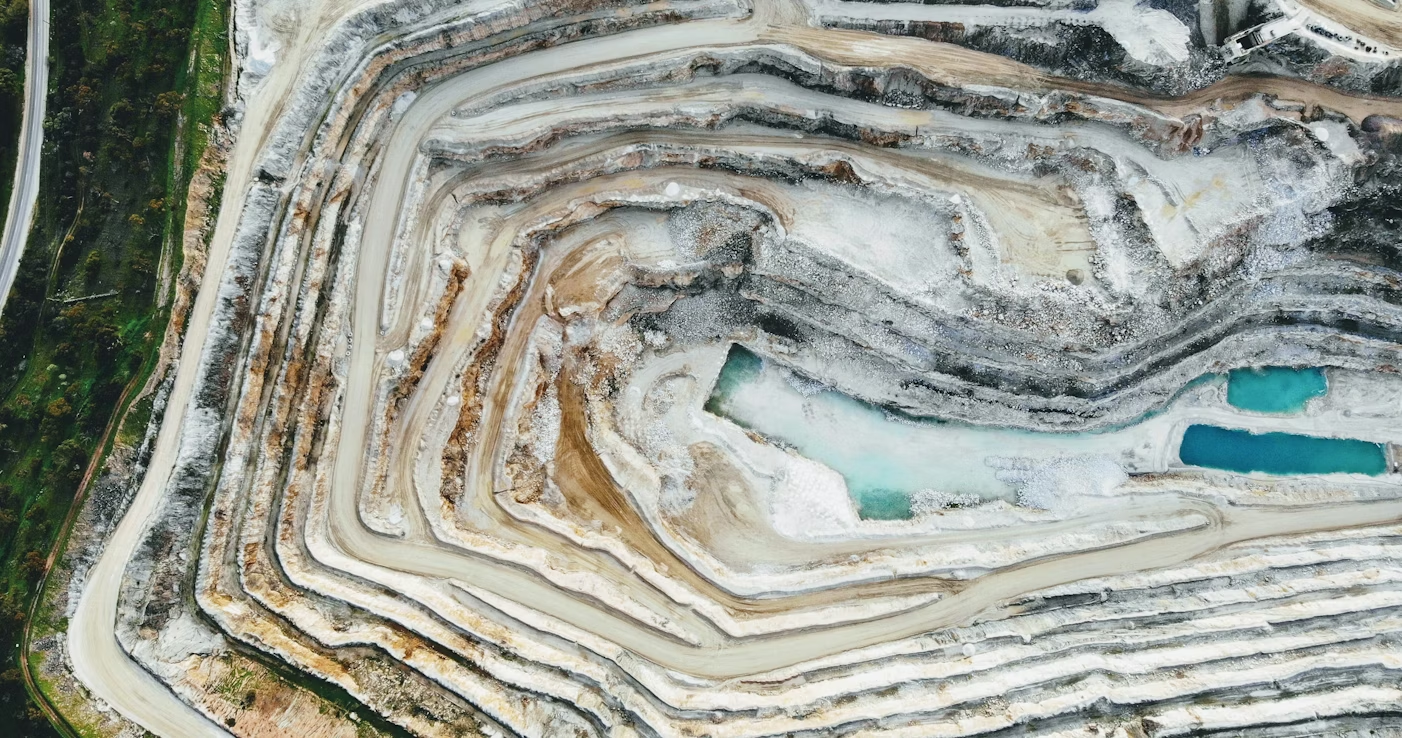
ValOre Metals' $26M market cap trades well below that of its peers in the PGE developer space. The fourth-quarter 2026 PEA is positioned to close the valuation gap.
Project Overview
ValOre Metals (TSX-V: VO) holds a 100%-owned Platinum Group Elements (PGE) and gold project in northeast Brazil at an early but advancing development stage. The Pedra Branca project hosts a 2022 Inferred Resource of 63.6 million tonnes grading 1.08 grams per tonne for 2,198,000 ounces of platinum, palladium, and gold. Seven near-surface resource zones have been defined, with the core deposits of Esbarro, Curiu, Cedro, and Cana Brava together containing more than 1 million ounces, and the southern zones of Trapia and Massape containing a further 1 million ounces. An 8-kilometre mineralised trend at the Pitombeiras target reinforces the district-scale character of the asset.
Exploration drilling completed in 2023, totalling more than 6,000 metres across five new zones, was not incorporated into the existing resource estimate. That programme produced a new discovery at the Salvador Target and identified an emerging north-south exploration trend, adding to the ounce count that the current estimate does not yet reflect. A Preliminary Economic Assessment (PEA) is targeted for the fourth quarter of 2026, with licensing and Environmental Impact Assessment (EIA) activities planned for the first quarter of 2027. ValOre's stated corporate objective is to build an integrated precious metals company anchored by Pedra Branca while pursuing acquisition and partnership opportunities in advanced-stage gold projects in northeast Brazil.
1. A $26M Market Cap Against a 2.2 Million Ounce Resource Base
ValOre's market capitalisation of approximately $26 million to $27 million is anomalously low relative to the ounce count and grade profile the company has established at Pedra Branca. Comparable-stage developers have market capitalisations ranging from $126 million to $440 million, placing ValOre at a significant discount relative to peers with broadly similar resource metrics.
The gap between Pedra Branca's resource position and ValOre's market capitalisation is a central question Smart identifies the company must answer.
Chief Executive Officer and Director of ValOre Metals, Nick Smart, elaborated on the discrepancy:
"We've got an ounce count that is comparable to our peers, we've got good grades, but these are companies that are all $100 to $200 million market cap companies. ValOre today is sitting around $26 million, so the real question then is, why is that? ValOre's got a good project, and we're just not being recognised for it in terms of the pricing."
The company attributes the underpricing to limited market awareness and a historical association with uranium assets that has since been addressed, rather than to any fundamental shortcoming in the project.
2. The Peer Group That Defines the Discount
Four named development-stage companies set the valuation benchmark against which ValOre's discount becomes quantifiable. Stillwater Critical Minerals carries a market capitalisation of $126 million against a resource of 2.0 million ounces of palladium and 1.3 million ounces of platinum at its Stillwater West project. Generation Mining trades at $236 million with 2.6 million ounces of palladium and 0.8 million ounces of platinum at its Marathon project.
At the upper end of the comparator set, Bravo Mining carries a market capitalisation of $440 million against 10.4 million measured and indicated and 5.0 million inferred palladium-equivalent ounces at its Luanga project, and Platinum Group Metals trades at $389 million with a 23.4 million ounce four-element resource at Waterberg. ValOre's $26 million to $27 million market capitalisation places it below every named comparator by a substantial margin, despite Pedra Branca carrying an ounce count and grade profile broadly comparable to the smaller peers in the set.
Few development-stage companies are positioned to bring new platinum and palladium supply online; real supply constraints persist amid continued, growing demand; and economically viable platinum group element deposits are genuinely difficult to find. These sector characteristics intensify rather than dilute the case for examining whether ValOre's discount is supported by project fundamentals.
3. Near-Surface Geometry & Open-Cast Mining Economics
Pedra Branca's mineralisation extends to the surface, and the mining method under evaluation is open-cast extraction. Open-cast methods carry significantly lower capital requirements and shorter timelines to first production than underground development, and the project does not require a substantial capital build-out for basic infrastructure and utilities because much of it is already in place at the site.
The early years of the life-of-mine plan are structured around the collection and processing of high-grade chromitite boulders on the surface, grading from 6.5 to 8.5 grams per tonne. The top layer of the near-surface ore body contains oxidised and weathered material that complicates traditional flotation processes, which has directly motivated the heap leach processing development underway with the University of Cape Town (UCT).
4. Metallurgical Progress: Heap Leach Route & the UCT Partnership
Processing development for Pedra Branca is advancing through a partnership with UCT, focused on a low-cost heap-leach route suited to the project's oxidised and weathered near-surface material. Leaching routes combined with a pre-treatment step on weathered material yield extraction yields of 72.88% for platinum and 74.07% for palladium, while a specific hot caustic pre-treatment enables the subsequent leaching of platinum-group elements tightly bound within the chromitite host.
Scale-up is progressing from shake flask tests through stirred tank reactors to column tests designed to simulate heap conditions. Concurrent relogging of historical drill core across the Curiu, Esbarro, and Cedro deposits is underway to refine geological and mineralisation controls and inform mine planning assumptions for the PEA.
5. Brazil: Infrastructure Position & Jurisdictional Advantages
Pedra Branca's site position reduces the capital exposure typically associated with remote resource development. The site is approximately 4 hours by paved highway from a deep-water port, and electricity access is available nearby. Management identifies no major community or regulatory impediments to advancing the project.
Brazil's operating environment provides structural advantages over the jurisdictions that currently account for the concentrated supply risk in global platinum and palladium production. South Africa, Russia, and Zimbabwe represent that supply concentration; Brazil offers geopolitical diversification alongside favourable logistics costs, favourable electricity costs, and stable regulatory frameworks that support investment and streamline approvals. Brazil graduates more mining engineers annually than the United States and Canada combined, supporting long-term operational labour availability for any build-out.
6. How the Uranium Overhang Shaped Market Perception
ValOre's historical association with uranium assets created a market perception gap separate from Pedra Branca's project quality. Among investors, there was no clear association between ValOre and the serious development of PGE assets, a condition the company has since addressed through its Brazilian project repositioning.
The prior uranium holdings are the primary source Smart cites for the market's failure to recognise ValOre as a developer.
"ValOre, in terms of history, we've previously held uranium assets. I think, amongst investors, there isn't that association with saying, okay, ValOre is a serious player and developer of PGE assets. We've now cleared that up with our recently announced sale of the Hatchet uranium properties through to Future Fuels. We're 100% focused on precious metals and specifically the flagship Pedra Branca PGE project. So I think we've cleared that market perception, but there's still a journey for us in terms of market awareness."
The sale of the Hatchet uranium properties to Future Fuels resolves the structural cause of the perception problem. Management's position is that the perception itself has been addressed, but that awareness of the repositioning among the broader investor base remains incomplete.
7. Why the PEA Is the Re-Rating Event
The PEA is the instrument by which ValOre must answer the open question that separates Pedra Branca from a re-rated valuation: whether the ounces can be extracted and sold at economics that justify a market capitalisation comparable to the peer group. That question is currently unresolved, and the $26 million market capitalisation reflects that.
Proving that Pedra Branca's ounces can be extracted and sold economically is, in Smart's assessment, the primary purpose of the fourth-quarter 2026 PEA:
"Advancing the test work, doing the engineering work, and the preparation work in order to publish a preliminary economic assessment, which is our big target for the year. So that's proving the economics: can we extract these ounces out of the ground economically and sell them? My view is yes, we can, and I think once we demonstrate that, we've got a real pathway to value there as well."
8. The 2026 to 2027 Catalyst Sequence
Three dated milestones define the near-term pathway for Pedra Branca. Pedra Branca resource updates, including recently drilled targets, are targeted for the third quarter of 2026. The PEA publication will follow in the fourth quarter of 2026. Licencing and EIA activities for Pedra Branca are targeted for the first quarter of 2027.
Each positive result from the UCT partnership narrows the residual uncertainty around heap-leach processing economics, and the cumulative weight of that test work forms the technical evidence base the PEA will draw on.
Key Takeaway for Investors
- ValOre Metals' market capitalisation of approximately $26 million to $27 million sits well below comparable-stage developers, which trade at market capitalisations ranging from $126 million to $440 million, despite Pedra Branca carrying a broadly comparable ounce count and grade profile to the smaller peers in the set.
- Named peers, including Bravo Mining Corp and Platinum Group Metals Ltd, have market capitalisations of $440 million and $389 million, respectively, which represent the upper end of the comparator set and the scale of the potential re-rating.
- Near-surface, open-cast geometry and a developing heap-leach processing route combined with a pre-treatment step, with extraction indications of 73% for palladium and 74% for platinum, position Pedra Branca for lower capital intensity relative to underground operations.
- Brazil's site infrastructure, including paved highway access to a deep-water port and proximity to electricity supply, combined with the announced sale of the Hatchet uranium properties to Future Fuels, has removed a structural overhang from the investment thesis.
- The fourth-quarter 2026 Preliminary Economic Assessment publication is the primary re-rating mechanism, with metallurgical test-work scale-up results serving as incremental catalysts ahead of that publication and licensing and Environmental Impact Assessment activities targeted for the first quarter of 2027.
Bottom Line
ValOre Metals’ market capitalisation of $26 million to $27 million sits well below the $126 million to $440 million range occupied by comparable-stage developers, and neither the resource size, the grade profile, nor the project's infrastructure position provides a fundamental basis for that discount. The explanatory factors are limited market awareness and a historical association with uranium assets that has now been resolved through the sale of the Hatchet uranium properties to Future Fuels. The fourth-quarter 2026 PEA is the primary instrument for replacing the current perception-driven discount with demonstrated project economics.
Analyst's Notes





Subscribe to Our Channel





Stay Informed


