




With 40 Rigs Nearby, Dune Oil's M47 Wells Still Need Roads Up the Anticlines


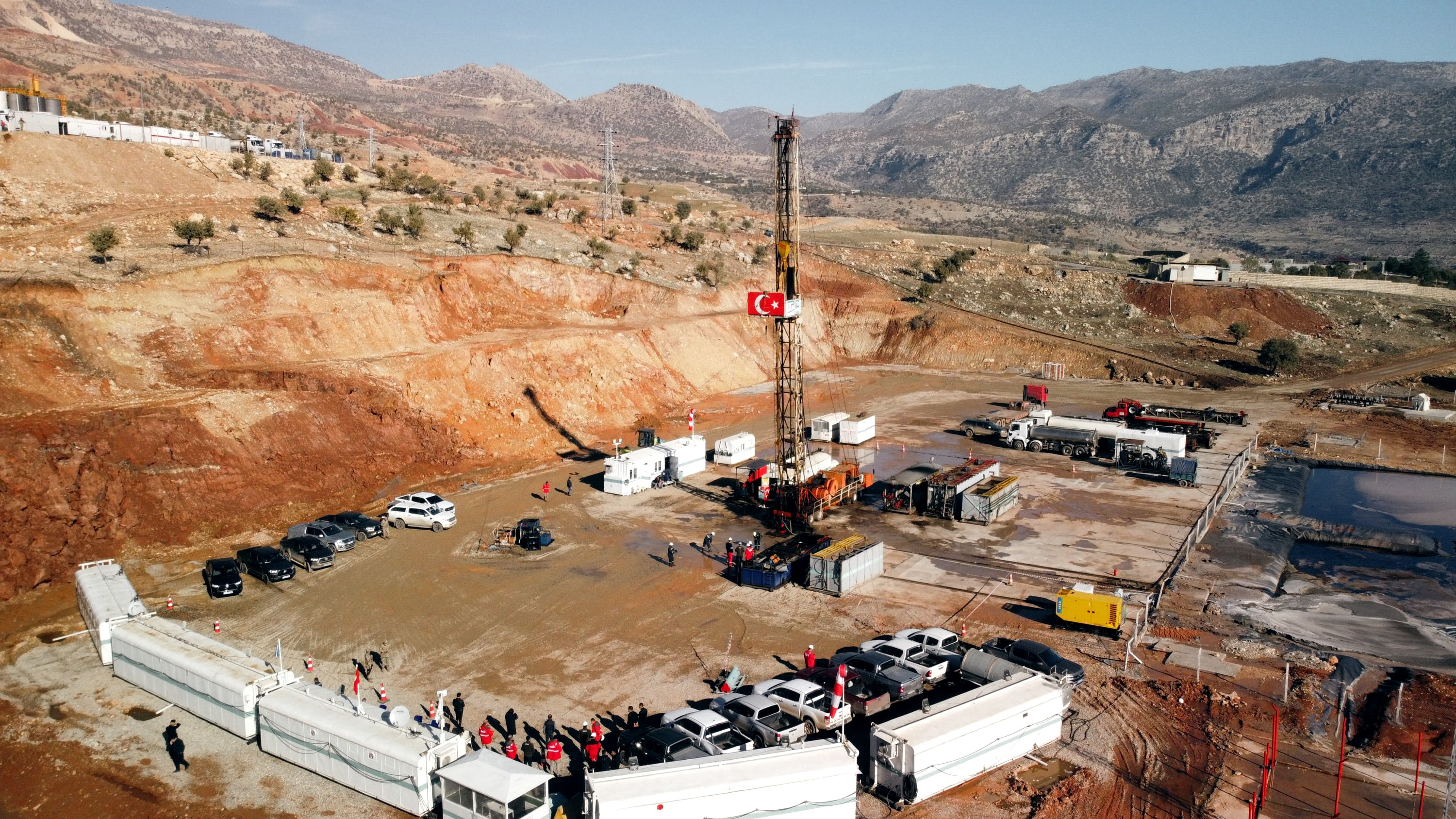
Gabar's rigs and service crews work around Dune Oil's M47 block, and management sees roads and pads on the hilltop anticlines as the harder job.
- Dune Oil began two-dimensional (2D) seismic fieldwork on its M47 block in southeastern Türkiye on November 11, 2026.
- Seismic shot holes are being drilled with portable drilling units suited to the area's steep terrain.
- At any given time, 5,000 oil workers are within 5 or 10 kilometers (km) of the block, and 40 rigs were operating in the region as of November 2026.
- The region's major fields were drilled off the surface anticlines that form the oil traps, and hilltop sites need roads built to reach them.
- Seismic acquisition is scheduled to finish by the end of February 2027, and C-1 and C-2 production and testing are planned for early 2027.
What Has Happened
Dune Oil (CSE: DUNE | OTCQB: DUNXF) began field operations for its two-dimensional (2D) seismic program on the M47 oil block in Şırnak Province, southeastern Türkiye, on November 11, 2026. Shot-hole drilling followed on November 13, using portable drilling units suited to the area's steep terrain, with holes drilled to a planned depth of 9 meters (m).
Dune Oil has an agreement to earn a 29% working interest in M47, the C3 and C4 licenses in the Cudi-Gabar petroleum province. The services needed to drill there are readily available, and the hilltop terrain is the part of the work that calls for roads and site building.
Services & Rigs Near M47
The largest oilfield service companies operate in the area around M47. At any given time, 5,000 oil workers are within 5 or 10 kilometers (km) of the block, and 40 rigs were operating in the region as of November 2026. Management ties their presence to the scale of development there, which it puts at billions of dollars.
President and Chief Executive Officer of Dune Oil, Scott Lower, separates the supply of services from the ground a well pad has to sit on:
"They've got Schlumberger, Halliburton, Weatherford, all the US companies are there selling their services and 40 rigs. So it's not difficult to get the services in the area, but the terrain itself, when you're doing a well pad, you've got these rolling hills."
One planned well job at M47 is the C-1 sidetrack, needed because the original well had 3 failed cement jobs. The work starts with a whipstock, a steel wedge that steers the drill bit sideways, set in the well. Crews then mill a window in the casing above the damaged zones and drill a parallel well alongside it. Once a pump and water management tools are in, the new wellbore should be a completed producing well.
Wells on the Anticline Crests
The oil in this part of Türkiye is trapped in anticlines, upward folds in the rock layers that show at the surface. The fold visible at the surface is still present as a trap 2,000 or 2,500 m down, and the major fields in the region were drilled off those surface anticlines.
Drilling on the anticlines means working on high ground. Valley floors are called ground zero, and hilltops may rise 300 to 400 m above them. Every site needs a road to the top before a rig can be brought up, along with containers that may run anywhere from 60 to 100 loads.
Lower measures the access work already done at C-1 by the length of road it took:
"So to get up to the top where the C-1 well is, there was more than a 1 km road built just to get up to drill there. Now we're on the plateau, and on the plateau you can do a bunch of different well pads there."
The 2025 North Field discovery at the C-1 and C-2 wells contains more than 70 m of gross oil pay, the full thickness of oil-bearing rock, and 38 m of net pay, the thickness of rock judged to be producible. The oil is held in the Mardin and Beloka groups, carbonate rock broken by natural fractures. More than 150 m of the Mardin section was left undrilled, to be reached by a future sidetrack for a production well. Chief Operating Officer of Dune Oil, Jordan Coleman, leads field operations and the execution of the M47 work program. His more than 17 years of oilfield operations experience spans production, drilling, and operational supervision roles.
Seismic on Steep Ground
The seismic crews are working the same terrain. Dune Oil signed the acquisition contract on October 21, 2026, with Ertürk Group, a Türkiye-based seismic and drilling services contractor headquartered in Diyarbakır, after a competitive tender. The program covers about 45 km across 6 lines over the C3 and C4 licenses, an area of approximately 310 square kilometers. The current field plan holds 865 dynamite shot points, set 50 m apart along each line, with receivers every 25 m and a minimum of 600 live recording channels, the receiver signals recorded at the same time.
By November 15, 2026, survey crews had staked all 237 shot points on the first 2 lines, about 27% of the field plan. They had also drilled 57 shot holes on Line 101, about half of that line's 119, and daily drilling rates were rising as more drilling units came into operation. As of November 19, 2026, the field crew numbered approximately 50 people and worked in coordination with local authorities in accordance with the program's health, safety, and environmental procedures.
Risks to the schedule include weather, terrain, access, security, military coordination, and mine-risk conditions in the work area. Final acquisition parameters will be confirmed after field source tests, and the contractor runs field quality control and preliminary processing while acquisition continues. The program's budget is approximately US$600,000 net to Dune Oil. Its data is aimed at fault-controlled structural traps, where breaks in the rock layers seal oil in place, across the license, particularly in the eastern part of the block, and at gaps in existing seismic coverage.
Broader Context
The Cudi-Gabar region went from no oil output to 83,300 barrels per day (bbl/d) in 5 years, and it now supplies over half of Türkiye's onshore production and about 8% of national demand. More than US$2 billion in oil sales came from the basin between 2021 and 2025. Until 4 or 5 years ago, the area had been among the longest-running conflict zones, and the exploration push began in 2020 once that conflict was resolved. Management links the pace since then to rising government investment, with the country's president announcing discoveries in person.
Lower traces the region's late start to the decades before that push:
"And with that sort of conflict, nobody wants to invest and drill for oil or explore for oil. So it sat dormant with almost nothing going on for many years, many decades actually."
The region now has 150 producing wells, and management estimates that at least half a billion dollars has been spent on developing the area. Turkish Petroleum announced the Gaziler and Çardaklı oil discoveries on November 9, 2026, with Gaziler lying directly north of M47. It is also advancing development drilling at its Mehmet İrfan Güler field, 1 to 2 km north of Dune Oil's licenses, and its near-term target for the region is about 100,000 bbl/d.
Gabar's barrels go into an under-supplied domestic market. Türkiye's demand is about 1.0 million bbl/d, while only about 127,000 bbl/d are produced, and only about 1 in 10 barrels the country uses is domestic. Its oil import bill runs to about US$35 billion a year. For oil leaving M47, tanker trucks carrying 250 barrels can haul it 130 km to the Tüpraş Batman refinery, with no early water separation needed. A pipeline completed in 2026 into Esma Çevik adds capacity of more than 150,000 barrels of oil equivalent per day.
What to Watch Next
Seismic field acquisition is scheduled to be completed by the end of February 2027. Final processing and interpretation follow. Dune Oil then expects to finalize and announce new drilling locations for its 2027 program: exploration locations in the South Lead area and development locations in the North Lead. In early 2027, the North Field work is planned to move to C-1 and C-2 production and testing: the C-1 sidetrack, a C-2 re-entry, and new development wells to first production.
Mid or South Lead prospect drilling is planned for 2027, and full North Field production development, with an early production facility and trucking to the oil refinery, follows from 2027 onward. The C-1 sidetrack, part of that well work, starts from the plateau the existing road already reaches.
FAQs (AI-Generated)
Analyst's Notes





Subscribe to Our Channel

Stay Informed


