




3% vs 7%: The Analyst Gap Behind Canada Nickel's Re-Rating Case



Canada Nickel's re-rating case rests on a nickel demand-model gap, Western supply scarcity, faster permitting, and high-grade Reid drilling.
- Global nickel demand has grown close to 7% annually since 2019, well above the roughly 3% forward growth rate still used in many analyst models.
- Fewer than a handful of Western nickel sulfide developers are advanced enough to reach construction before 2030, a scarcity set against hundreds of comparable gold, silver, and copper equities.
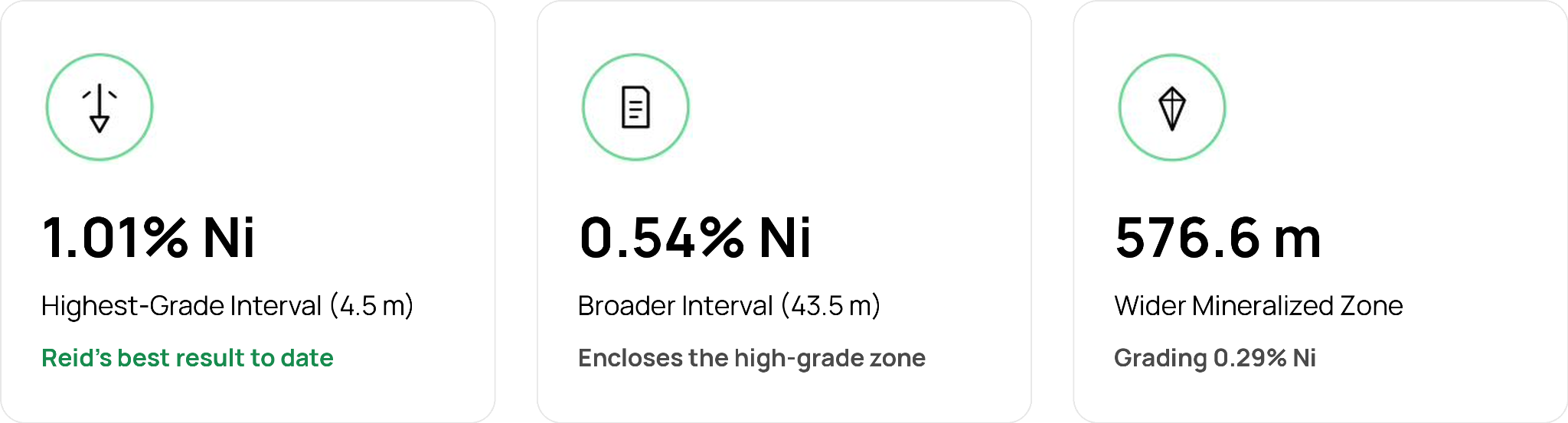
- New drilling at Reid returned 1.01% nickel over 4.5 meters, the project's highest-grade interval to date.
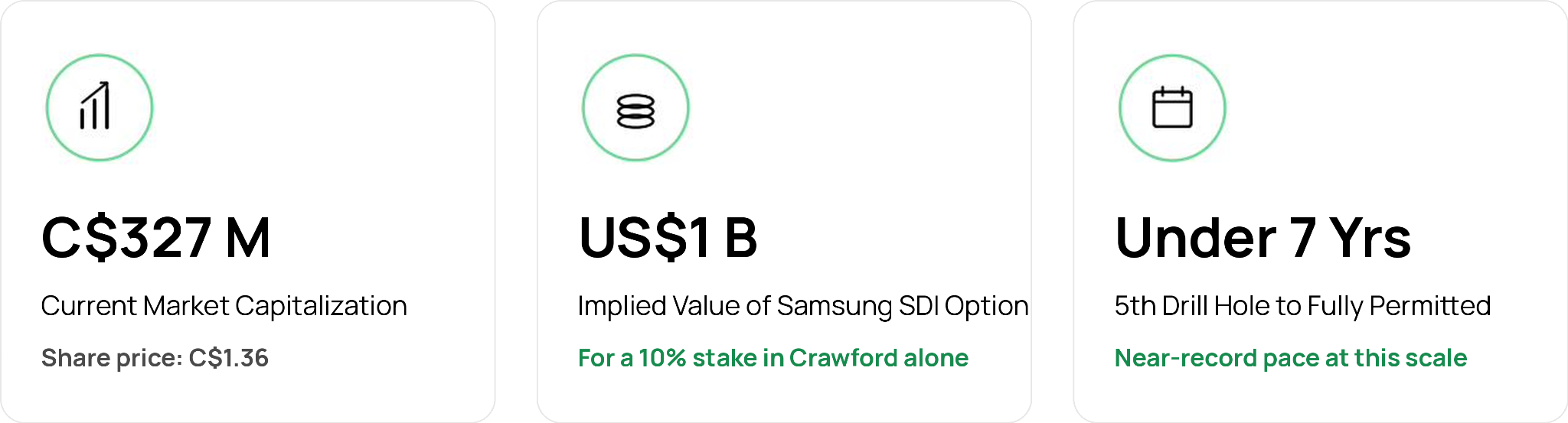
- Canada Nickel ran resource definition, economic studies, and permitting concurrently rather than sequentially, moving from its 5th drill hole to a fully permitted project in under 7 years.
- Canada Nickel shares traded at C$1.36 as of the company's July 2026 corporate presentation, against a 52-week range of C$0.77 to C$2.59 and a market capitalization of approximately C$327 million.
Nickel demand has grown close to 7% annually since 2019, yet many forward models still assume roughly 3% growth going forward. That gap has drawn less attention than Indonesia's tightening supply controls and the price floor those controls have created. Canada Nickel Company Inc. (TSXV: CNC | OTCQX: CNIKF) sits inside that gap as one of a small number of Western nickel sulfide developers advancing its flagship Crawford project toward a construction decision this decade, while new drilling at its Reid Nickel Sulfide Project adds resource optionality to the broader Timmins Nickel District.
Demand Growth Outpacing Forward Models
Global nickel demand has expanded at close to 7% annually since 2019, a pace roughly 3 to 4 times faster than other base metals, driven by electric vehicle battery growth layered on top of decades of steady stainless steel demand. Industry demand projections point to a near doubling of nickel consumption by 2030, to approximately 5 million tonnes annually, with upside toward 6 million tonnes.
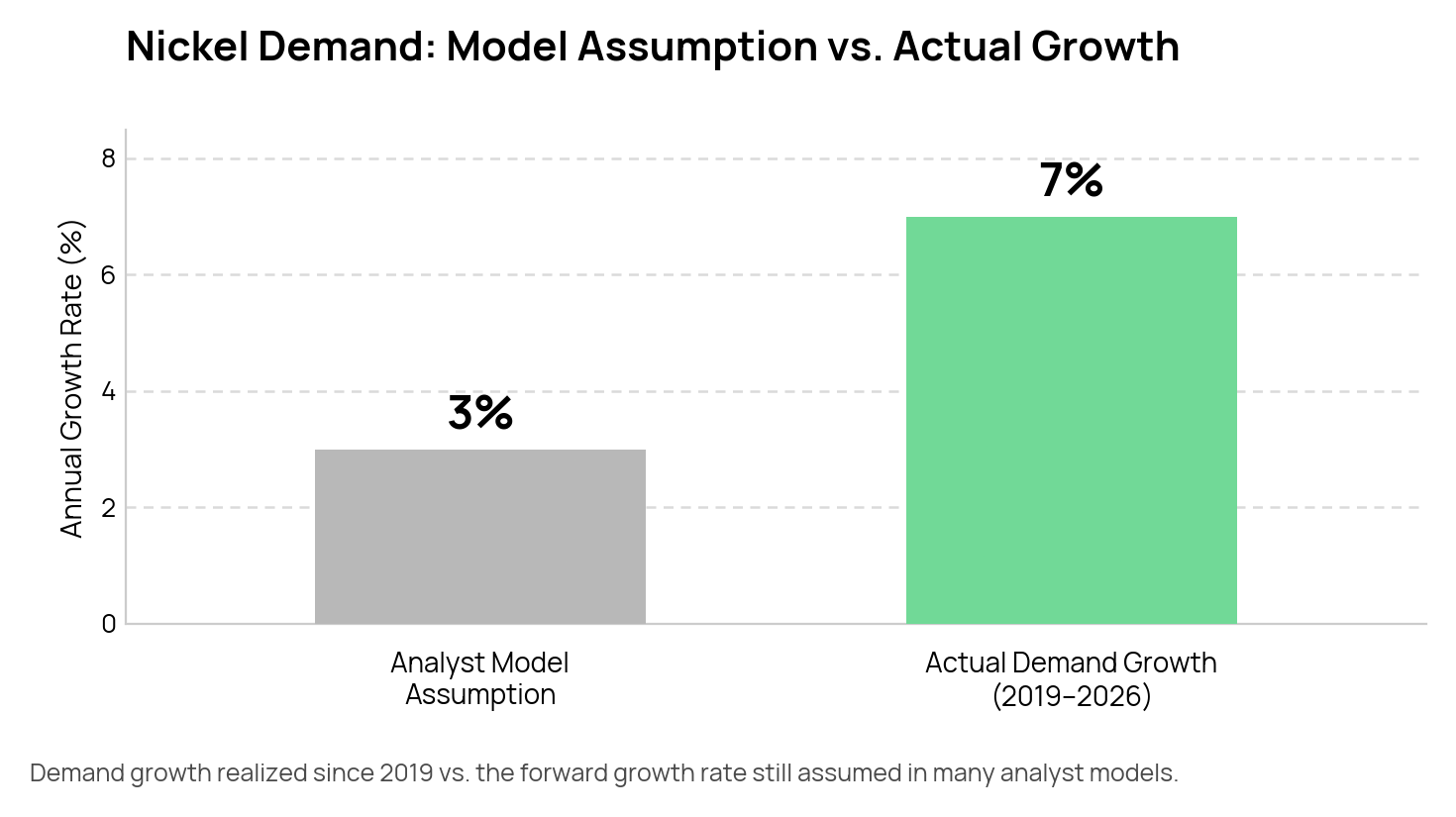
Set against that 7% actual pace, the 3% figure still built into many forward models is the disconnect Chief Executive Officer and Director of Canada Nickel, Mark Selby, calls out directly:
"Nickel demand's grown at nearly 7% a year since 2019, stainless steel is a wonderful material, it's grown at 5% to 6% a year for many, many decades, and yet analysts always end up using 3% demand growth going forward."
A Narrow Field of Developers
That demand gap collides with a supply-side scarcity among the equities themselves. Only a small number of Western nickel sulfide projects, Canada Nickel's Crawford project among them, are positioned to reach construction before 2030, against hundreds of comparable gold, silver, and copper development stories available to generalist investors on the TSX. That imbalance is a structural setup for outsized moves once capital rotates toward the sector: the bulk of money currently raised on the exchange still goes toward precious metals, with meaningful generalist capital into critical minerals still likely 1 or 2 years away. Investor interest in Canada Nickel's own story has increased since January 2026, when nickel prices moved, and Indonesia's quota decisions took effect, though only a modest share of that broader pool of potential investors has acted on it so far.
Reid's Highest Grades to Date
Canada Nickel reported on August 6, 2026, the highest-grade intervals to date at Reid, located approximately 39 kilometers northwest of Timmins, Ontario. The result returned 1.01% nickel over 4.5 meters, the standout result within a 0.54% nickel interval over 43.5 meters, itself part of a wider 576.6-meter mineralized zone grading 0.29% nickel.
The results come from the first 2 of 9 planned infill holes designed to move previously inferred zones into higher-confidence resource categories. Reid already carries an Indicated Resource of 0.87 billion tonnes grading 0.23% nickel and an Inferred Resource of 1.45 billion tonnes grading 0.22% nickel, published January 12, 2026, within a geophysical footprint approximately 2.5 times larger than Crawford's.
Permitting Pace as a Differentiator
That same scarcity puts a premium on speed, and Canada Nickel's approach to advancing Crawford is where that speed shows up. Selby credits the pace to running resource definition, economic studies, and permitting concurrently rather than sequentially:
"We were working on the PEA while we were still building the resource. We started the permitting process as soon as we had enough information to start that process. And so, rather than doing things sequentially, that's allowed us to get to where we've basically gone from 5th drill hole to fully permitted here in the very near future in just under 7 years, which for a project of that scale is pretty close to record time."
Where Shares Sit
Canada Nickel shares traded at C$1.36 as of the company's July 2026 corporate presentation, with a 20-day volume-weighted average price of C$1.48 and a 52-week range of C$0.77 to C$2.59. Market capitalization stood at approximately C$327 million, against cash and equivalents of C$14 million and debt of C$56 million, well below the US$1 billion valuation implied by Samsung SDI's option to acquire a 10% direct interest in Crawford alone.
Whether that gap narrows depends less on any single catalyst than on whether generalist capital actually begins rotating toward critical minerals over the next 1 to 2 years, and whether Reid's improving grades and Crawford's permitting pace continue to hold up as that rotation unfolds.
FAQs (AI-Generated)
Analyst's Notes





Subscribe to Our Channel




Stay Informed


