




Beyond Remnant Mining: How West Red Lake Gold Mines Is Building Madsen's Next Generation Mining Inventory


West Red Lake Gold Mines' latest Madsen definition drill results highlight a shift toward large non-remnant mining panels, expanding long-term growth potential.
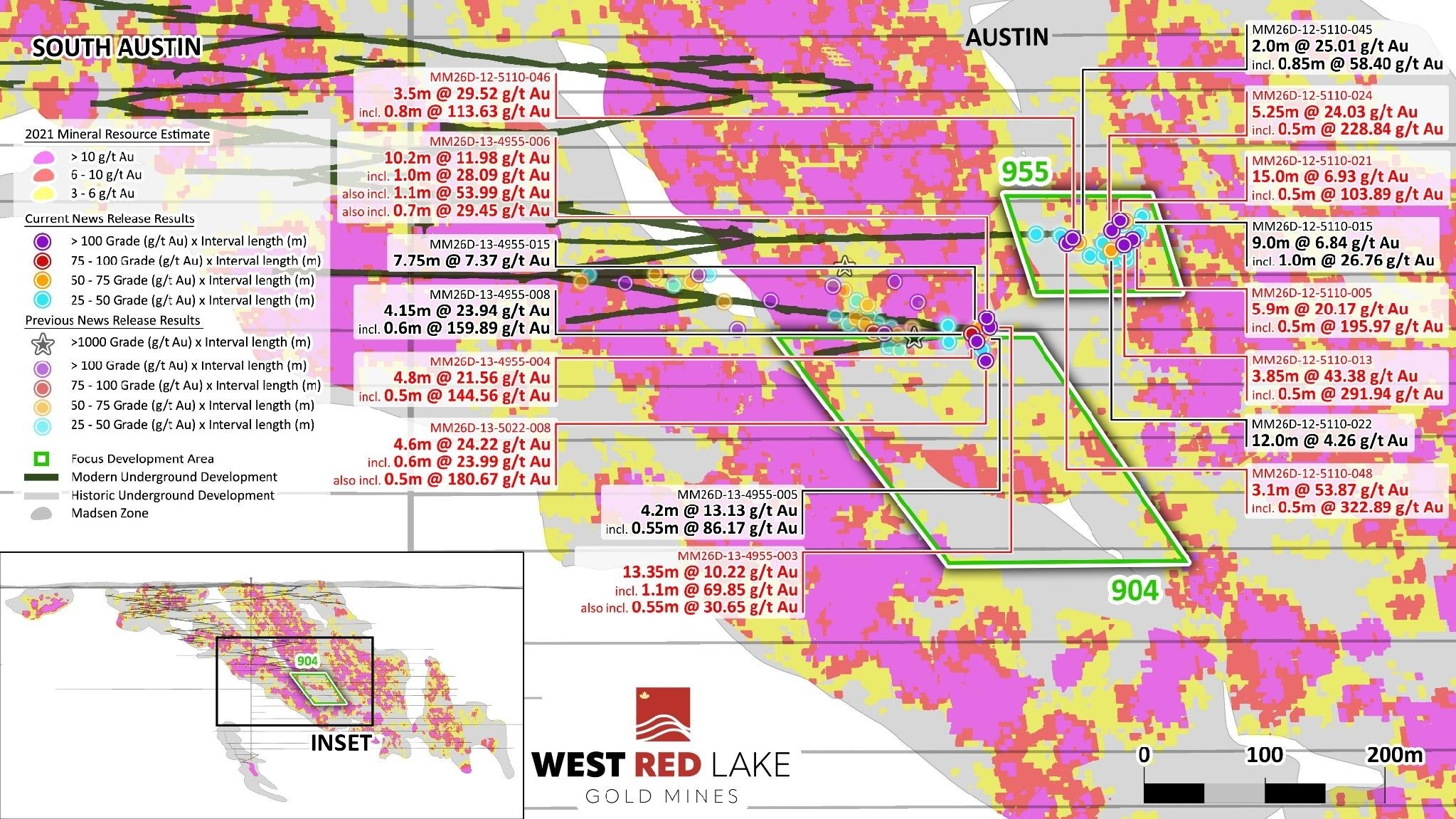
- West Red Lake Gold Mines' latest definition drilling returned high-grade gold intercepts from the Austin 955 and Austin 904 complexes as the company advances mine-ready inventory at Madsen.
- The Austin 904 Complex is emerging as a large non-remnant mining panel, with current drilling focused on defining a substantial intact zone for future mining.
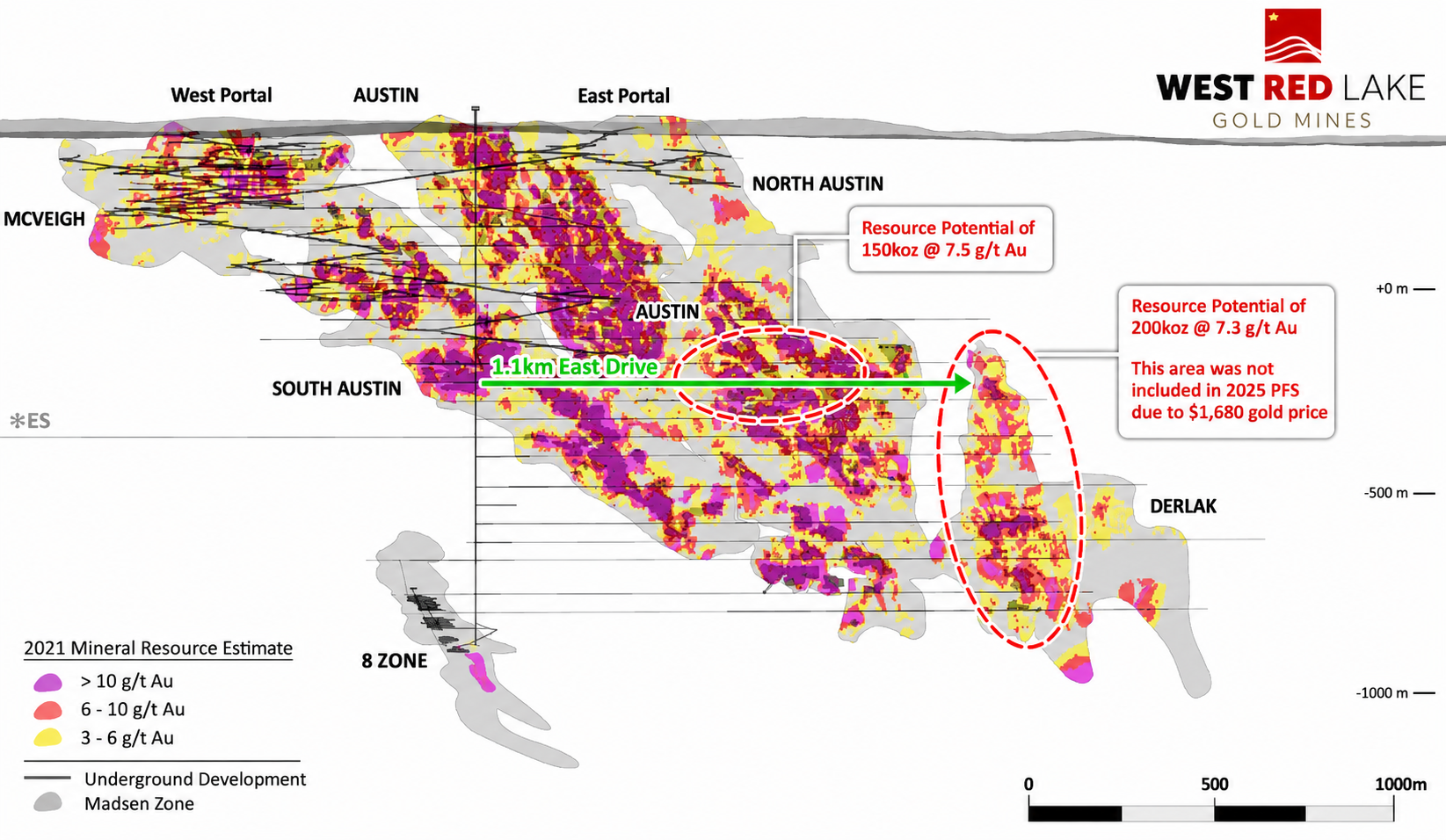
- Development of the 13 Level East Drive is creating new drill access to eastern targets, including the Derlak area, while expanding underground exploration flexibility.
- The company's exploration strategy extends beyond current mining areas, with deeper targets at Madsen and regional opportunities such as Starratt-Olsen under evaluation.
- Upcoming catalysts include continued Austin drilling, Starratt-Olsen assay results, Phase 1 shaft refurbishment and the combined Madsen-Rowan Pre-Feasibility Study (PFS).
What Has Happened
West Red Lake Gold Mines Ltd. (TSXV: WRLG | OTCQX: WRLGF) has reported additional high-grade definition drilling results from the Austin 955 and Austin 904 complexes at its Madsen Mine in Ontario's Red Lake district. Highlights included 43.38 grams per tonne gold over 3.85 metres and 53.87 grams per tonne gold over 3.10 metres from the Austin 955 Complex, alongside 10.22 grams per tonne gold over 13.35 metres and 30.65 grams per tonne gold over 0.55 metres from the Austin 904 Complex.
While the grades continue to show strong underground results, the broader significance lies in how the company is advancing the next generation of mining areas within the deposit. Current drilling is focused on defining larger intact zones that can support future mining plans while underground development simultaneously expands access to new exploration corridors.
The Strategic Shift: Transitioning to Large-Scale Non-Remnant Panels
The Austin 904 Complex has become one of the company's priority drilling areas in 2026 because it differs from many of the deposit's historically mined portions. Rather than representing fragmented remnant mineralisation, management describes the area as a largely intact panel measuring approximately 200 metres by 200 metres.
Importantly, underground development has now progressed to a stage where the company can systematically drill across the upper portion of the panel and begin evaluating its continuity. This allows definition drilling to move beyond isolated intercepts and toward establishing the geological confidence required for future mine planning.
Vice President of Exploration at West Red Lake Gold Mines, Will Robinson, discussed the rationale behind the current drilling campaign:
"So these two areas have been a priority lately with the drilling over the last few months at Madsen. They present us with areas within the deposit that are mostly non-remnant, which is favourable for us to define these areas with the definition drilling because then when we go to mine these areas later, it's a more efficient mining approach."
The Austin 904 Complex is also notable because management views it as following a path similar to the 4447 panel, a high-grade area defined through drilling before being incorporated into the mine plan. The current objective is to apply that same process to a new portion of the deposit as development advances deeper underground.
Opening the Eastern Corridor: The 13 Level East Drive
Beyond the immediate drilling results, West Red Lake Gold continues to expand its underground infrastructure, which could shape future exploration across the property. A key component of this strategy is the 13 Level East Drive. This development is extending underground access eastward from existing mining areas and creating new drill platforms to test targets beyond the current resource footprint.
As underground development advances, additional drill stations are becoming available to test the Austin 904 Complex at depth while also improving access toward targets farther east.
Robinson commented on this process:
"We are currently advancing laterally across the upper portions of this panel, and we look forward to testing this area at depth over the coming months as underground decline development opens new drill access."
The significance of the development is not limited to the Austin zones. As the corridor advances, it improves access to the Derlak area and other eastern targets that have received comparatively less drilling. By opening new underground drill positions, the 13 Level East Drive expands the company's ability to evaluate mineralisation along strike and at depth, creating opportunities to test geological concepts that would be more difficult or more costly to evaluate through surface drilling alone.
The Campbell Analogue: Testing Madsen's Depth Potential
One of the recurring themes in West Red Lake Gold is the potential for Madsen's mineralised system to extend well below currently defined resources. The deposit has been delineated to a depth of approximately 1.2 kilometres below the surface. However, historic deposits elsewhere in the Red Lake district have demonstrated that gold mineralisation can remain productive at substantially greater depths. The company highlights the neighbouring Campbell and Red Lake mines as examples of systems that were ultimately mined to depths exceeding 3 kilometres.
The comparison is not intended to imply that similar continuity has already been established at Madsen. Rather, it illustrates why management continues to emphasise underground access and deeper drilling opportunities. If the geological controls responsible for mineralisation remain active at depth, significant portions of the system may remain underexplored.
The company's discussion of discoveries such as Upper 8 adds another dimension to this thesis. Management views these zones as evidence that multiple mineralised lenses may occur within favourable ultramafic host rocks, creating the possibility for stacked mineralised horizons within the broader system.
District-Scale Pipeline Expansion
While Madsen remains the centrepiece of current operations, West Red Lake Gold's exploration strategy extends across a broader 47-square-kilometre land package. The company's approach increasingly resembles a hub-and-spoke model, with Madsen's permitted processing infrastructure serving as the central asset and nearby targets providing potential future sources of mineralisation.
One of the most active regional opportunities is Starratt-Olsen, located approximately two kilometres southwest of Madsen. Eight holes totalling roughly 2,500 metres have been completed as part of the current surface drilling campaign. All holes have intersected alteration and mineralisation styles similar to those observed at Madsen, although assay results remain pending.
Robinson explained the geological rationale behind the program:
"Our expectation coming into this program at Starratt is that we would be seeing mineralisation and geology very similar to what we see at Madsen. So we can take the lessons learned and some of the themes at Madsen, apply those at Starratt, and that helps us execute a much more efficient drilling program at Starratt."
Rowan: A Second Growth Platform
The district strategy extends beyond exploration targets alone. West Red Lake Gold's Rowan Project has become an increasingly important component of the company's broader growth plans and is expected to feature prominently in future development studies. Rowan hosts an indicated mineral resource of 334,825 ounces grading 13.03 grams per tonne gold, following a substantial increase reported earlier in 2026. The project is located approximately 80 kilometres from Madsen and is being evaluated as a potential future source of high-grade mill feed within the company's broader operating platform.
The strategic connection between the two assets is reflected in the company's plan to deliver a combined Madsen-Rowan Pre-Feasibility Study (PFS) during the second half of 2026. That study is expected to provide the first integrated assessment of how the assets may fit together within West Red Lake Gold's long-term growth strategy.
What to Watch Next
Several milestones could provide further insight into West Red Lake Gold's progress over the coming quarters, including continued definition drilling at the Austin 904 and Austin 955 complexes, where management intends to advance areas currently being drilled in 2026 toward potential integration into the mine plan in the first half of 2027. Additional results from the ongoing Starratt-Olsen surface drill program, which is approximately halfway complete, should help clarify the geological similarities between Starratt-Olsen and Madsen, while progress on Phase 1 shaft refurbishment and delivery of the combined Madsen-Rowan Pre-Feasibility Study (PFS) targeted for the second half of 2026 are expected to further define both the operational and growth pathways being advanced across the property.
FAQs (AI-Generated)
Analyst's Notes





Subscribe to Our Channel





Stay Informed






















