




Cabral Gold's Mine-Building Team Now Faces the Ramp-Up Test After First Pour


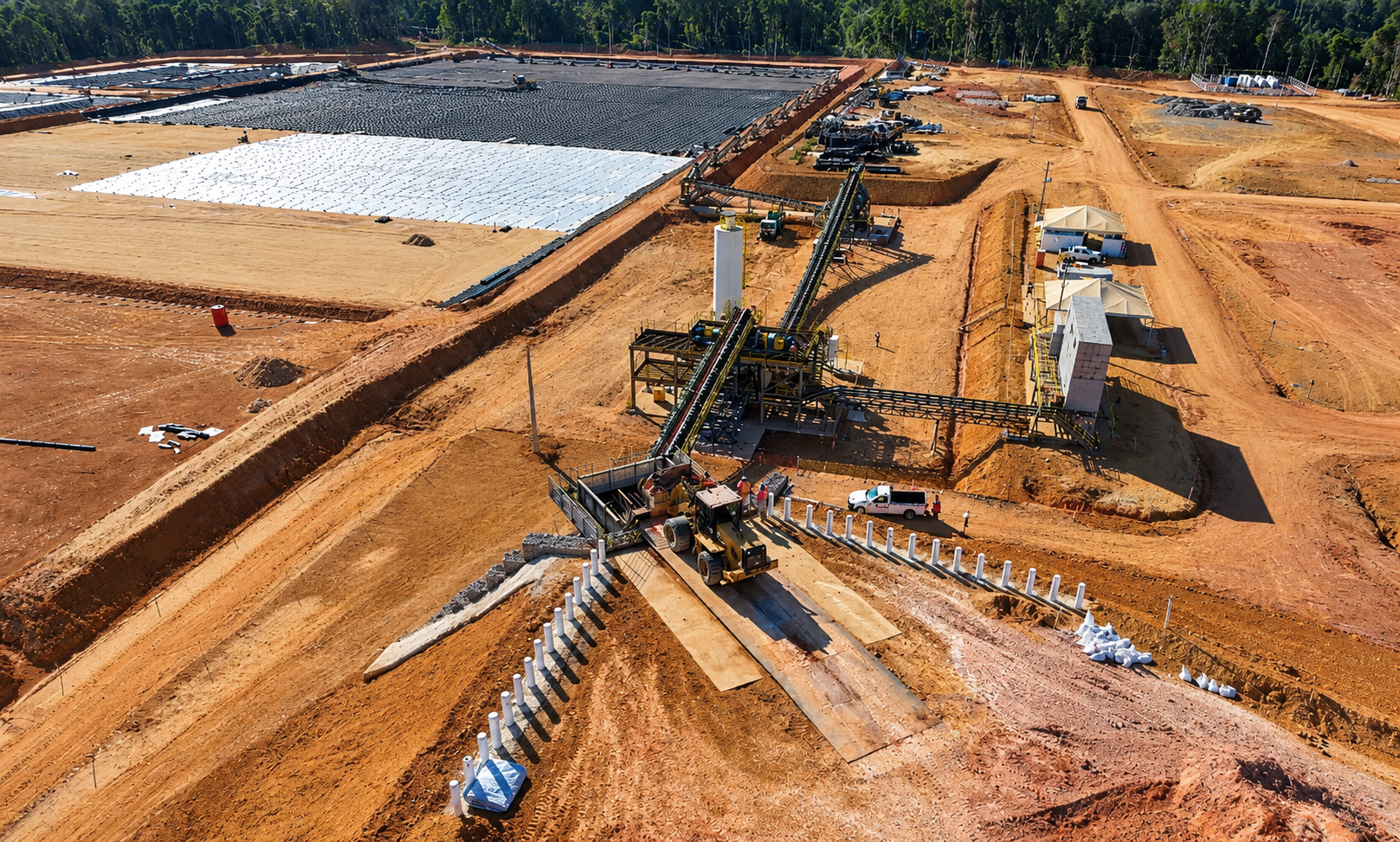
Cabral Gold poured about 1,130 ounces at Cuiú Cuiú, 2 months ahead of schedule. Ramp-up results will test its mine-building team.
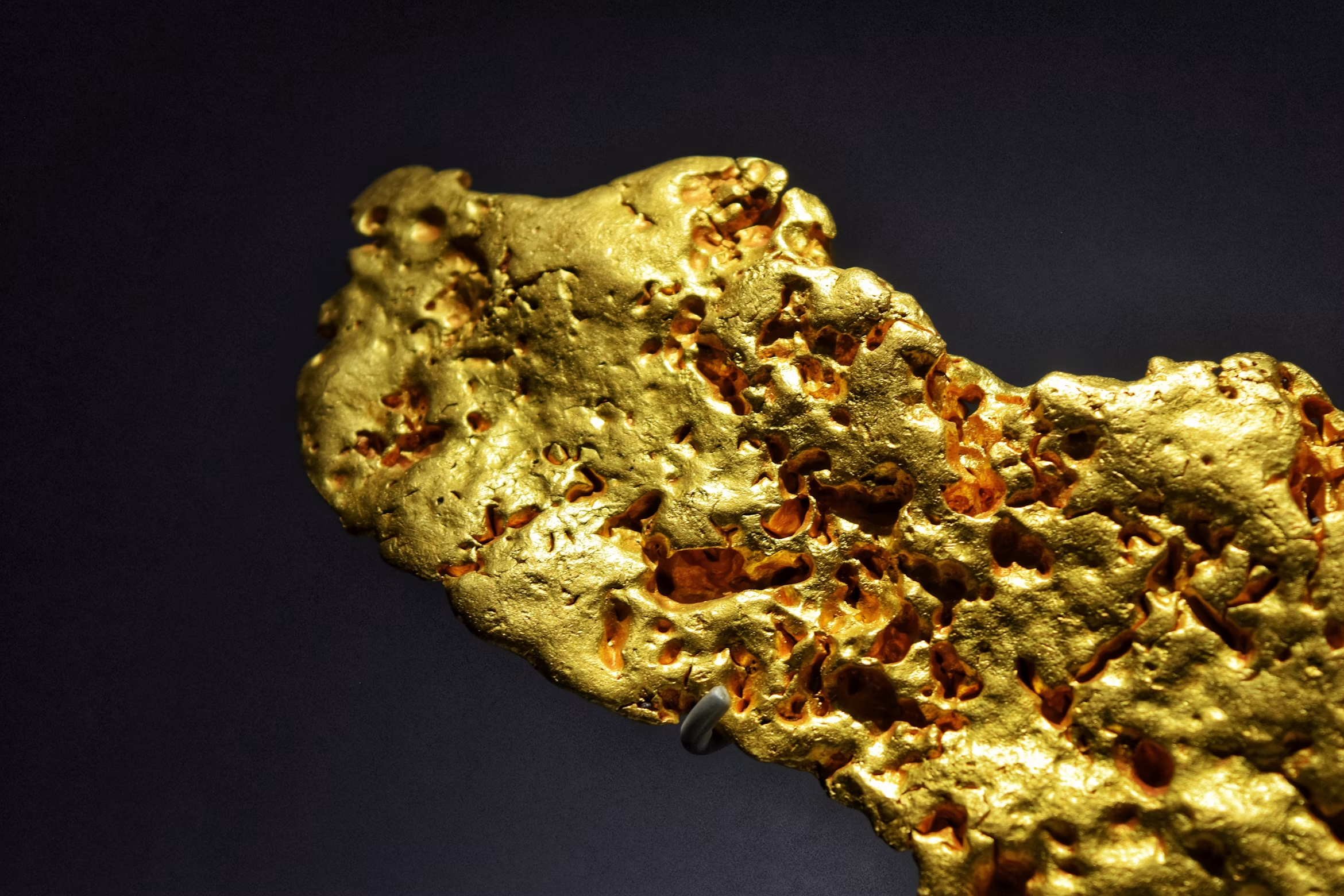
- Cabral Gold announced its first gold pour at the Phase 1 Cuiú Cuiú mine in Brazil on September 10, 2026: approximately 1,130 ounces of gold in doré assaying about 93% to 94% gold.
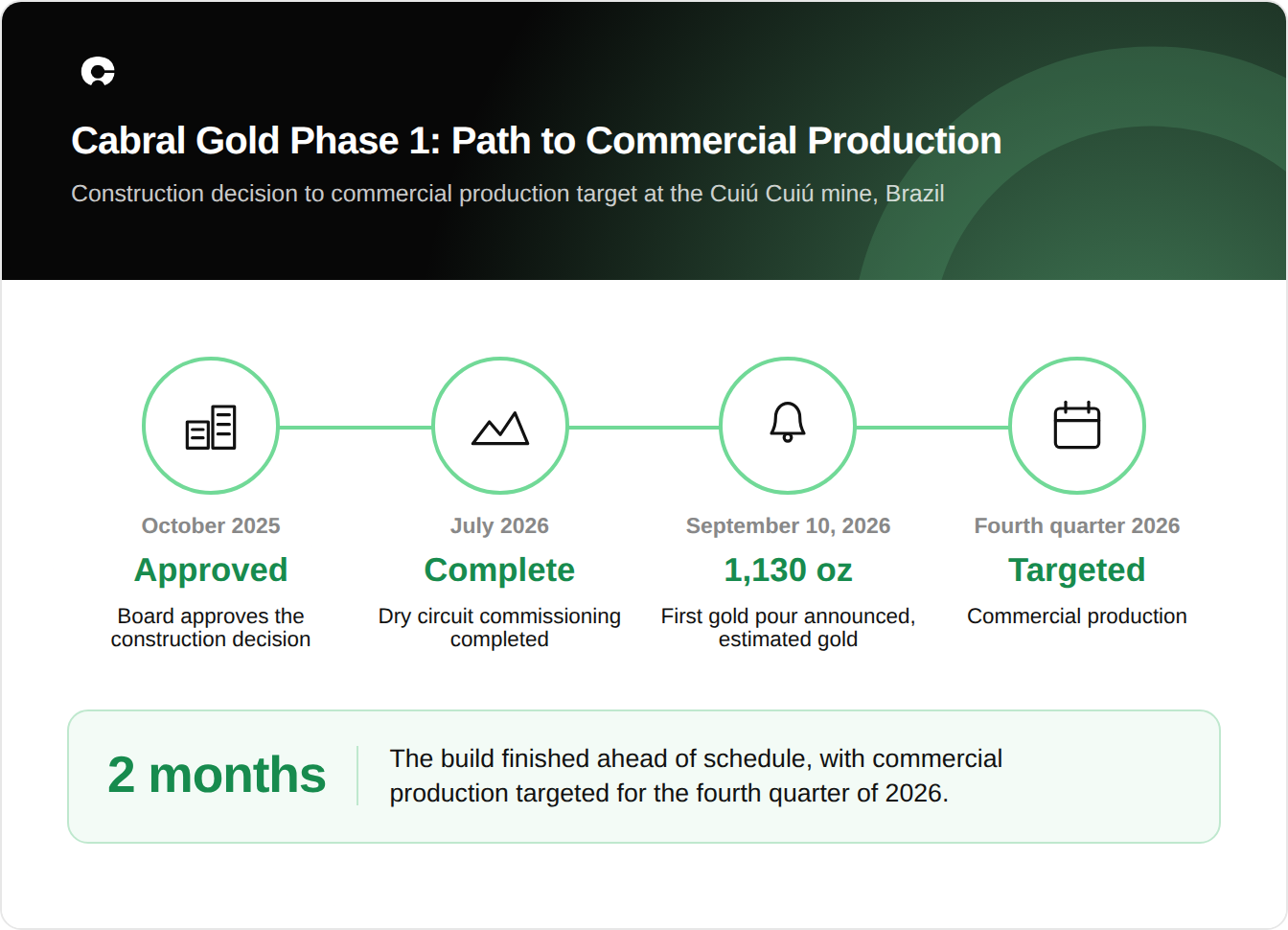
- The mine was built about 2 months ahead of schedule, with the board approving the construction decision in October 2025 and construction completed in August 2026.
- The management team includes the co-discoverer of the neighboring Tocantinzinho deposit, an operations head with 6 mine constructions behind him, and finance and exploration leads with decades of regional experience.
- Stacking is running at about 1,500 tons per day against a 3,000-ton-per-day design rate, and the first heap leach pad is still leaching, so recovered gold has not yet been reconciled with the mine plan grade.
- Cabral Gold is targeting commercial production in the fourth quarter of 2026, will not issue 2026 production guidance, and is targeting formal 2027 guidance after the ramp-up.
What Has Happened
Cabral Gold Inc. (TSXV: CBR | OTCQX: CBGZF) announced the first gold pour at its 100%-owned Phase 1 Cuiú Cuiú mine in Pará state, Brazil, on September 10, 2026. The commissioning pour produced about 1,130 ounces of gold in doré assaying about 93% to 94% gold, with the balance likely mostly silver. The bars went to a refinery, which had not yet reported the final gold content.
Phase 1 mines free-digging oxide material above the district's hard rock deposits and processes it by heap leach, with no drilling, blasting, crushing or grinding. Dry circuit commissioning was completed in July 2026, and commissioning of the wet circuit, the plant that recovers gold from the leach solution, is nearing completion.
The pour is the first operating evidence on a question Cabral Gold faced 12 months ago: whether a company with an exploration background could finance, build and commission a mine. The build has an answer. The ramp-up does not yet.
The Schedule Result & the Team Behind It
The mine was built about 2 months ahead of schedule, and the project went from concept stage in 2023 to first pour in under 3 years. Phase 1 moved from construction decision to first pour and now to the commercial production target.
The executive team that ran the build brings collective experience across construction, operations, finance, and exploration. President and Chief Executive Officer Alan Carter co-founded Peregrine Metals, sold for $487 million, and co-discovered the Tocantinzinho gold deposit, which G Mining Ventures operates next to Cuiú Cuiú and which produced 177,000 ounces in 2025; he has invested C$2 million in cash in Cabral Gold and is its third-largest shareholder. Vice President Operations Luiz Celaro, who managed construction on site, has more than 30 years of experience on gold projects, including 6 mine constructions. Vice President Project Development John Sestan is a mining finance specialist with more than 30 years of experience, including with Rio Tinto and EMR Capital. Vice President Exploration and Technical Services Brian Arkell spent 23 years with Newmont, including as Director of Exploration for South America. President Brazil Ruari McKnight co-founded Serabi Gold, whose Palito mine operates in the same Tapajós region. Chief Financial Officer Samantha Shorter has more than 19 years of experience in the resource industry, including with operations in Brazil and Mexico. Vice President Exploration Elton Pereira has more than 30 years of experience and is credited with multiple gold discoveries in Brazil.
Each background maps to a Phase 1 task: construction, project scheduling and delivery, technical oversight, regional operations, geology, and financing. The schedule and the commissioning pour, which came in above management's expectations, are the Phase 1 outcomes measured against that record so far.
Carter compared the position a year earlier, when financing was not yet in place, with the position now:
"In 12 months, not only have we secured the financing, we made a construction decision, assembled a team, built this thing, and commissioned this thing."
What the First Pour Has Not Yet Measured
Recovery against the mine plan, throughput, and unit cost determine whether Phase 1 performs as designed. The pour informs the first of the 3 only in part.
The July 2025 Prefeasibility Study led by Ausenco Brazil assumes average gold recovery of 87.8% and life-of-mine all-in sustaining costs of US$1,210 per ounce. Oxide material on the first leach pad appears to be leaching faster than projected, and laboratory tests have already shown fast leaching. Management noted that field results usually lag the laboratory, and that here they appear to be keeping pace. The first pad is still leaching, so gold is still coming off it. Reconciling the block model grade in the mine plan with recovered gold requires that leach cycle to finish, which is expected to take a few more weeks.
Stacking has been running at about 1,500 tons per day in recent days against a 3,000-ton-per-day design rate, and reaching that rate is expected to take a further few weeks. The design uses 4 on-off leach pads and a processing capacity of 1 million tons per year. The company's stated focus after the pour is ramping up to commercial production, optimizing recoveries and reducing unit costs.
Ramp-Up Controls & Guidance Timing
Plant performance during the ramp-up is managed from a control room, and Cabral Gold has tied its disclosure to the outcome.
A process manager with about 40 employees manages the various aspects of plant operation. The control room tracks belt speeds and cement addition, so operators can adjust the process at each stage of the ramp-up. Carter cautioned that a heap leach still carries operating variables:
"There's lots of tweaking that needs to be done, even with a heap leach operation. You're not drilling and blasting and crushing and grinding, but there's an awful lot of other factors that go into the process."
Because of that variability, Cabral Gold is not issuing production guidance for 2026. Management said formal 2027 guidance will follow the ramp-up, probably in January and possibly earlier, and the company is targeting commercial production in the fourth quarter of 2026.
Phase 2 Draws on Phase 1 Experience & Cash Flow
The execution record feeds directly into Cabral Gold's larger plan, because Phase 2, a hard rock operation, would follow the Phase 1 build.
Carter said 75% of the gold in the 2022 resource is in hard rock beneath the oxide material now being mined. That resource covers 3 deposits, and the update targeted for the end of 2026 models 6 deposits after approximately 50,000 meters of drilling since September 2022. The district also holds about 50 peripheral targets. Management has tied a Preliminary Economic Assessment (PEA) on the hard rock, targeted for 2027, to how much the resource grows. Sestan linked the completed mine to that next step:
"The completed Phase 1 operation includes several low-cost, readily available expansion opportunities that we are assessing. It also provides an operating base, along with valuable local project development and construction experience, that should simplify and de-risk the planned expansion into the significant hard rock Phase 2 component of our development strategy."
The company is targeting details on Phase 1 expansion options before the end of 2026, alongside the resource update. Phase 1 cash flow is intended to fund Phase 1 expansion, exploration drilling, and the PEA.
Regional Context & What to Watch Next
Cuiú Cuiú lies in the Tapajós Gold Province, next to G Mining Ventures' Tocantinzinho mine, Brazil's third-largest gold mine. The next disclosures fall into 3 groups: plant performance, growth, and guidance.
- The refinery's report on final gold content, completion of the first pad's leach cycle, and the reconciliation of recovered gold with the mine plan grade.
- Stacking progress toward 3,000 tons per day and completion of wet circuit commissioning.
- Commercial production, targeted for the fourth quarter of 2026.
- Phase 1 expansion details and the 6-deposit resource update, both targeted before the end of 2026, and a PEA on the hard rock targeted for 2027.
- Formal 2027 production guidance, which management said is probably coming in January.
The build has produced 2 measured outcomes: the schedule and the commissioning pour. The ramp-up adds recovery, throughput, and cost data ahead of any Phase 2 PEA.
FAQs (AI-Generated)
Analyst's Notes





Subscribe to Our Channel





Stay Informed






















