Westhaven Gold Builds Shovelnose Gold Project Towards PFS as Dundee Funds Development and Discovery


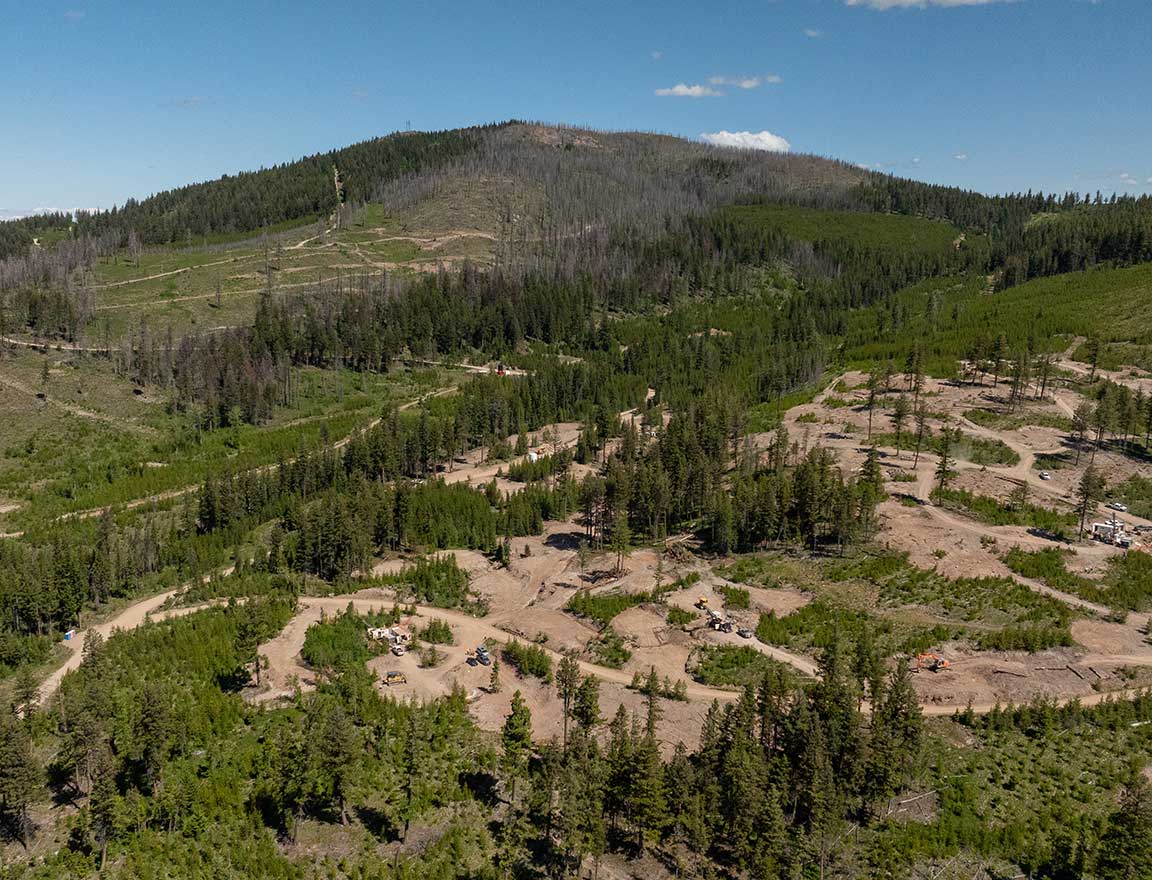
Westhaven Gold (TSXV:WHN) advances its Shovelnose gold project towards a 2027 PFS, with Dundee's C$85M earn-in funding drilling and belt-wide exploration.
- Westhaven Gold secured C$85 million in project-level funding from Dundee Corporation, which can earn up to a 60% interest in the four Spences Bridge Gold Belt properties.
- Westhaven keeps a 40% interest with no right of first refusal, and management describes the corporate share structure as effectively frozen until the pre-production financing.
- Resource infill drilling at the South Zone is nearly complete and continues to return wide, high-grade intervals, including 37.89m grading 5.29 g/T gold.
- An updated MRE is expected very early in 2027, followed by a PFS in the second half of 2027 and a best-case FID towards the end of 2029.
- Four drills are shifting to a 15,000m exploration programme across roughly 93 drill-ready targets, adding discovery potential alongside development.
For years, Westhaven Gold Corp. (TSXV:WHN, OTCQB:WTHVF) told a familiar junior mining story. Its Shovelnose project in southern British Columbia delivered high-grade drill results and a robust economic study, but the balance sheet could not keep pace with the opportunity. That changed in February 2026, when Westhaven closed a strategic earn-in agreement with Dundee Corporation (TSX:DC.A) worth up to C$85 million. Westhaven President and CEO Ken Armstrong and Dundee President and CEO Jonathan Goodman explained how the partnership lets the company advance a mine and explore a district at the same time. The model runs against the traditional Canadian approach of drilling a deposit to its limits before thinking about production. Instead, the partners plan to build a modest, high-margin underground operation first and grow it through exploration. For investors, the question is whether that approach, funded by a partner with a mine-building record, can unlock value that a cash-constrained junior struggled to deliver alone.
From Cash-Constrained Explorer to Funded Developer
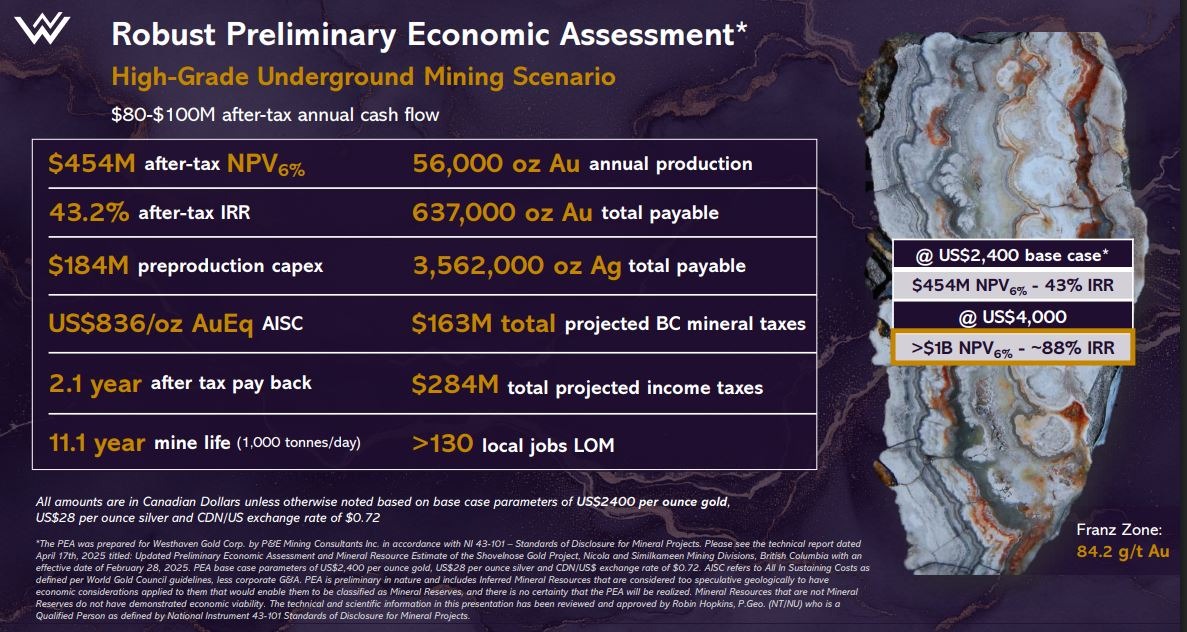
Armstrong, a geologist who has worked alongside Westhaven Chairperson Eira Thomas for more than 30 years, joined the company around 18 months ago with a clear brief. His task was to find a way to fund Shovelnose and move it forward. He inherited a Preliminary Economic Assessment (PEA), released in March 2025, that showed an after-tax net present value (NPV) of C$454 million at a 6% discount rate and an after-tax internal rate of return (IRR) of 43.2%. The study outlined an 11.1-year underground mine producing an average of 56,000 ounces of gold per year. Pre-production capital was estimated at C$184 million, with all-in sustaining costs (AISC) of US$836 per gold-equivalent ounce, all at a base case gold price of US$2,400 per ounce.
Westhaven spent much of 2025 weighing options and had a team ready to proceed alone. A meeting with Dundee's technical team at Beaver Creek a year earlier set the partnership in motion instead. For Goodman, a geological engineer who built Dundee Precious Metals into a producer, the appeal was two-sided. Shovelnose already hosts a defined, profitable orebody, and it sits within a belt he believes is very unlikely to contain only one deposit.
Interview with Ken Armstrong, CEO of Westhaven Gold, & Jonathan Goodman, CEO of Dundee Corporation
Inside the Dundee Earn-In
The agreement operates at the project level rather than the corporate level. Dundee can earn up to a 60% interest in Westhaven's four Spences Bridge Gold Belt properties by funding up to C$85 million of expenditure in four stages, including a firm minimum commitment of C$30 million. Westhaven remains operator for now. Once Dundee reaches a 50% interest, after spending C$65 million, it gains the right to take over operatorship, which Armstrong said could happen towards the end of 2027 at the current pace. Westhaven's board treated two terms as essential. The company keeps a meaningful 40% interest, and that interest carries no right of first refusal, leaving Westhaven free to transact on it.
Armstrong acknowledged that some investors see a joint venture as giving away the project. He countered that the company's market capitalisation was about C$40 million when the deal was announced. A conventional raise might have brought in C$10 million while issuing half the existing share count or more.
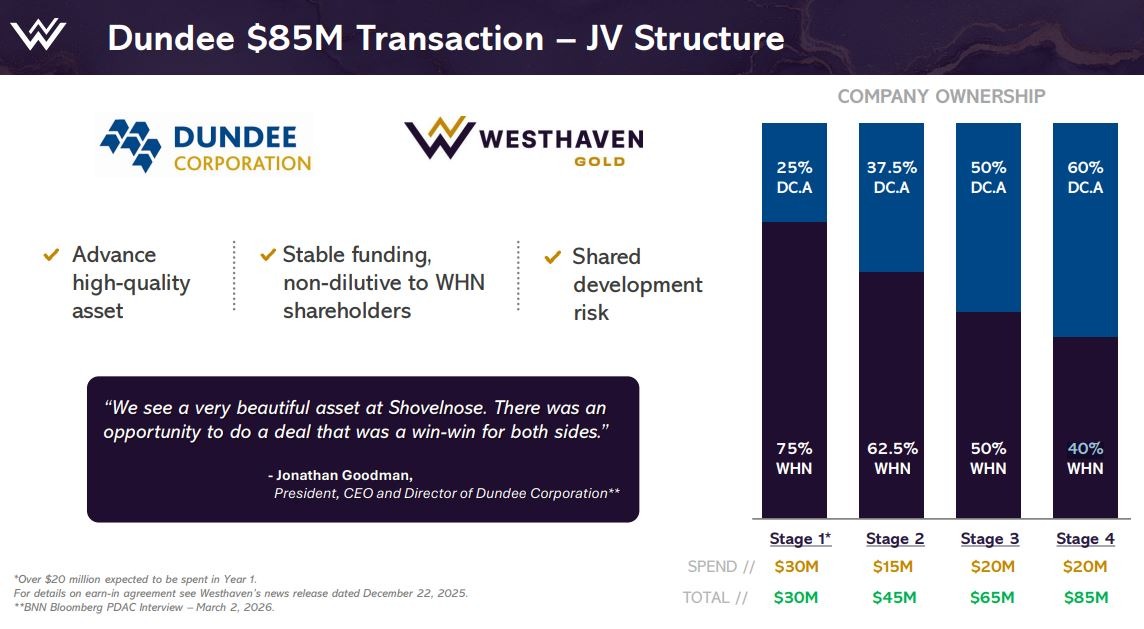
With project spending covered, Westhaven's own cash needs now largely relate to general and administrative costs. Armstrong framed the benefit for shareholders directly:
"There's a reasonable chance for our next major financing so to our shareholders, this is a big piece. Our share capital structure is now frozen. [A] retail investor can build a position in the market and they don't need to worry about a dilutive financing hitting them on a Monday morning."
Armstrong expects the next major financing to be Westhaven's 40% share of pre-production capital.
Infill Drilling & the Road to Pre-Feasibility
The 2026 programme is the largest in Westhaven's history. It comprises 50,000m of drilling, of which 35,000m is resource infill at the South Zone deposit. As of September 2026, 109 infill holes totalling 34,265m had been completed. Recent results include 37.89m grading 5.29 g/t gold and 31.9 g/t silver and 14.00m grading 13.09 g/t gold and 105.8 g/t silver. The company estimates true widths at 70-80% of reported intervals. The infill has been drilled at nominal 25m centres. Armstrong said the intention is for the bulk of the ounces to sit in the measured category in the updated Mineral Resource Estimate (MRE), which he expects very early in 2027. That estimate will feed a Pre-Feasibility Study (PFS) targeted for the second half of 2027.
Drilling has also found high-grade intercepts outside the planned stopes, including one about 40m below the deepest stope in the mine plan. Armstrong said this could extend mine life but will not change the PFS. Metallurgical work has so far supported recoveries above 90% using conventional cyanide leaching, and ore sorting is being tested. A C$4 million sonic drilling programme for geotechnical and hydrogeological work is also under way.
A Buildable Mine in Southern British Columbia
Shovelnose is a low-sulphidation epithermal system hosted in young volcanic rocks, a style that is less familiar in Canada than the orogenic gold of the Abitibi, Red Lake or Yellowknife. Armstrong pointed to Lundin Gold's Fruta del Norte in Ecuador as the closest world-class analogue. Location is a central part of the case. The project lies about two and a half hours' drive from Vancouver, with the Coquihalla Highway crossing the property and grid power already on site. Armstrong said this removes the need to define a very large resource simply to justify major infrastructure, as can be the case in more remote districts. The development plan sends roughly half the tailings back underground as paste backfill, with the rest dry-stacked at surface. Goodman added that early mining would target the highest-grade areas to support a strong payback. On permitting, Armstrong noted that British Columbia continues to approve mine expansions in the region. His best-case realistic timeline for a final investment decision (FID) is towards the end of 2029.
The District-Scale Exploration Case
The Spences Bridge Gold Belt runs roughly 75-80km from the Skoonka properties in the north to Shovelnose in the south, and Westhaven controls about 60,263 hectares across four properties. Goodman argued that epithermal systems rarely occur as single deposits and that the same geology extends along the belt. According to Goodman, Westhaven's exploration team has about 150 targets, of which roughly 93 are drill-ready. In his view, the partnership raises the probability of discovery because the partners can test many targets rather than a handful each year.
"At the end of the day the opportunity here is to really test that whole system, and I think that's what people really need to come and appreciate is that the probability of finding a lot more with this deal is much higher than it would have been on their own."
As the infill programme wraps up, four drills are moving onto 15,000m of exploration drilling, which will continue until mid-December and resume in 2027. Armstrong estimated exploration spending this year at around C$5 million of the roughly C$20 million programme.
The Investment Thesis for Westhaven Gold
- Westhaven has secured non-dilutive project funding of up to C$85 million, which covers resource drilling, exploration and study work through feasibility without new equity at the corporate level.
- The Shovelnose PEA shows an after-tax NPV of C$454 million and a 43.2% after-tax IRR at US$2,400 gold, with pre-production capital of C$184 million.
- Infill drilling continues to return wide, high-grade intercepts, which supports the goal of an MRE with most ounces in the measured category.
- Investors should monitor the updated MRE, expected very early in 2027, as the first test of how the infill programme translates into resource confidence.
- The South Zone PFS, targeted for the second half of 2027, is the next major de-risking milestone.
- Results from the 15,000m exploration programme could add a discovery-driven catalyst on top of the development story.
- Key risks include the eventual 40% share of pre-production capital, a possible change of operator, and permitting timelines ahead of a potential FID in late 2029.
Macro Thematic Analysis
The Westhaven-Dundee structure reflects a wider shift in how junior gold developers are being financed. Equity markets for early-stage miners have been selective, and juniors that rely on repeated share issues face heavy dilution before reaching a production decision. Project-level earn-ins offer an alternative. A well-capitalised partner funds the work, the junior retains a meaningful stake, and the corporate share structure stays intact. Goodman also challenged the industry's tendency to chase scale before building anything:
"We're living in a different era. Everybody wants to retire in 5 years and sell their business for $25 billion and 10 million ounces of gold [but] the mining industry doesn't work like that. Never has."
His argument is that many successful mines started modestly and grew through exploration once cash flow and infrastructure were in place. Shovelnose fits that profile. Its infrastructure allows a smaller operation to stand on its own economics, while the belt offers room for growth. Geology adds another dimension. Low-sulphidation epithermal systems globally tend to occur in clusters, and many deposits in known districts do not outcrop at surface. That makes systematic, well-funded exploration more important than single-target bets. Jurisdiction is also relevant. Southern British Columbia offers established mining communities, services and road and power access, which reduces execution risk relative to remote projects that depend on new infrastructure.
TL;DR
Westhaven Gold has shifted from cash-constrained explorer to funded developer through a project-level earn-in with Dundee Corporation worth up to C$85 million, under which Dundee can reach 60% of the four Spences Bridge Gold Belt properties. Infill drilling at the Shovelnose South Zone is nearly complete and continues to return wide high-grade intervals such as 37.9m at 5.29 g/t gold. An updated resource is expected very early in 2027, with a PFS in the second half of 2027. Four drills are now turning to exploration across roughly 93 drill-ready targets. Westhaven retains 40% with no right of first refusal, and its share structure is effectively frozen until FID.
FAQ (AI-generated)
Analyst's Notes





Subscribe to Our Channel







Stay Informed