




Cobra Resources Reports Boland & Head Rare Earth Results, Flags Actinium in Product Testing


Cobra Resources reports that Boland and Head rare-earth drilling is advancing a maiden resource; product testing flags actinium above targeted limits.
- Cobra Resources completed 74 drill holes for approximately 3,200 metres across its Boland and Head rare earth prospects in South Australia, defining a continuous high-grade flank of approximately 5 kilometres at Head.
- Drilling defined mineralisation across three in-situ recovery (ISR) amenable formations, with around 80% of assay and permeability results received and 12 Head drillholes outstanding.
- The company is targeting a collective maiden Mineral Resource Estimate (MRE) of 200 to 400 million tonnes at greater than 1,000 parts per million Total Rare Earth Oxide (TREO).
- Net Acid Production Potential (NAPP) analysis indicates natural acid generation exceeds consumption in high-grade zones, with maximum potential acidity of 60 kilograms of sulphuric acid per tonne.
- Radionuclide testing of the Mixed Rare Earth Carbonate (MREC) product returned actinium above targeted limits, with testing covering ISR pre-conditioning, pH control, and actinium suppression underway at the Australian Nuclear Science and Technology Organisation (ANSTO).
Cobra Resources has reported further rare earth drilling results from its Boland and Head prospects in South Australia, advancing the project toward a maiden Mineral Resource Estimate (MRE). The company also disclosed that radionuclide testing of its rare earth product found actinium levels above target limits, with actinium suppression testing underway.
Drilling Results at Boland & Head
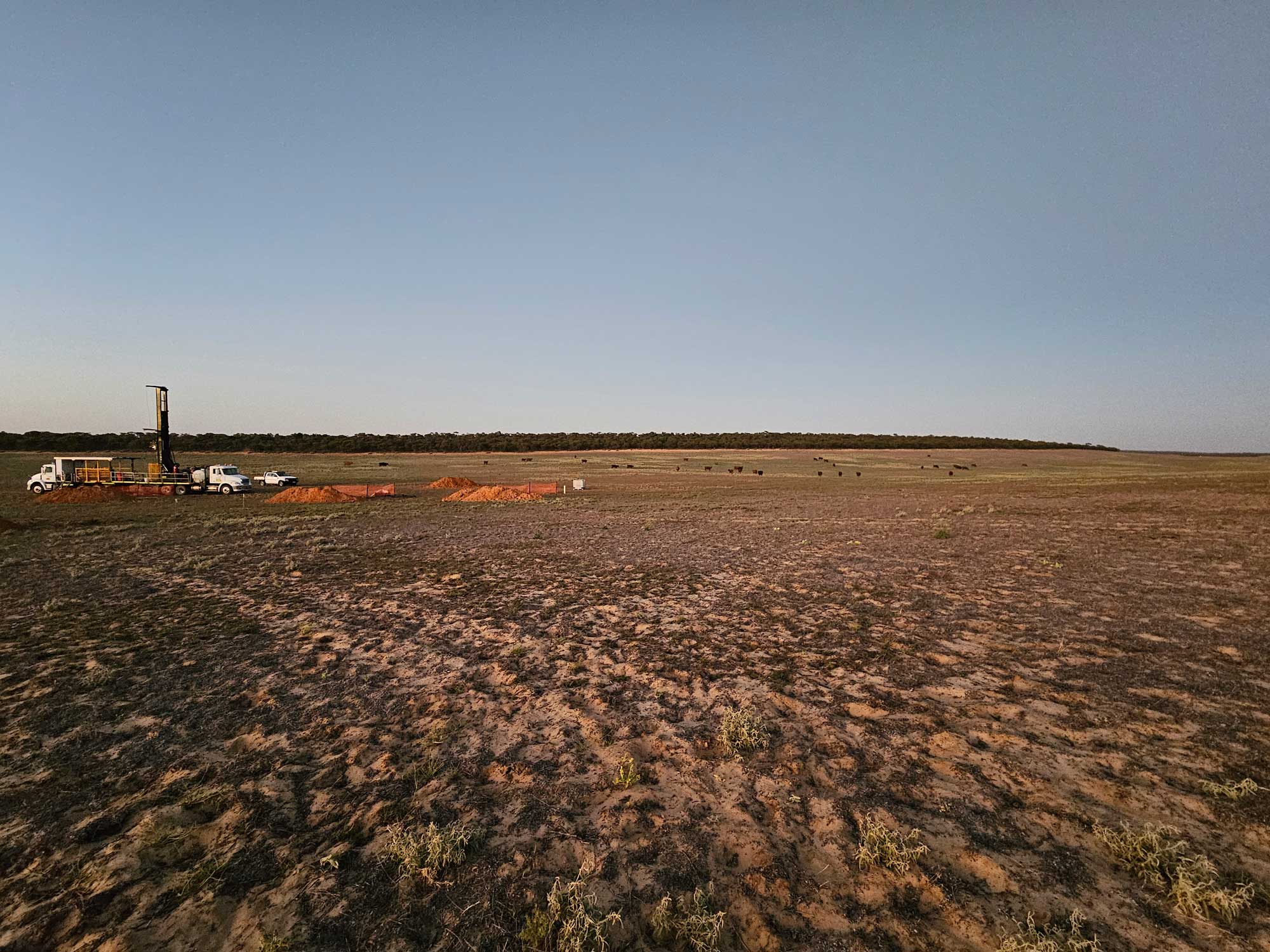
Cobra Resources (LSE: COBR) completed 74 drill holes for approximately 3,200 metres of sonic core drilling across its Boland and Head prospects. The programme defined a continuous high-grade flank of approximately 5 kilometres at Head, where mineralisation remains open to the north and south. Around 80% of assay and permeability results have been received, with a further 12 drillholes at Head outstanding.
Highlight intercepts included 1.06 metres at 3,607 ppm Total Rare Earth Oxide (TREO) from 18.6 metres depth and 3.8 metres at 1,322 ppm TREO from 26.1 metres depth. A further intercept returned 2.7 metres at 1,458 ppm TREO from 33.3 metres depth. Managing Director of Cobra Resources, Rupert Verco, frames the results this way:
"What they're showing us is scale. We are defining mineralisation over extensive areas across two prospects, and this only represents a very small percentage of our significant landholding."
Cobra considers the drilling sufficient to support a maiden resource across both prospects.
Wudinna Geology & the ISR Method
Mineralisation at Boland and Head occurs within three stacked formations amenable to in-situ recovery (ISR): the shallow Narlaby sand, the Garford clay, and the deeper Pidinga aquifer of reduced, permeable sands. The Pidinga is the most advanced, with completed hydrology work, strong head pressure, and strong metallurgy, while permeability work on the Garford and confinement work on the Narlaby remain outstanding.
Cobra is targeting permeability rates of 1 to 2 metres per day, with scaled bench studies indicating rates above 8 metres per day. An emulated tracer test recovered nearly 80% of the injected tracer from an adjacent well over two days. The company is targeting well-field spacings of 15 to 25 metres and leach cycles of 30 to 60 days across a landholding spanning 3,200 square kilometres of palaeochannel systems.
Tenure & Regional Setting
Boland sits on licence EL7074, held 100% by LAM Wudinna, a wholly owned subsidiary of Cobra, while Head sits on licence EL6784. Alcrest Royalties Australia retains a 1.5% net smelter return (NSR) royalty over future production from licences EL7074 to EL7078, and a Native Title Agreement is in place with the Barngarla people, with heritage surveys clearing the drilling areas.
South Australia has hosted 4 ISR pilot studies over the past two years, including a recently completed uranium pilot by Alligator Energy, a few hundred kilometres away, alongside long-running commercial ISR uranium operations in the same formations. Cobra is separately running a diamond-drilling programme 24 hours a day at its Manna Hill copper-gold project.
Cost Factors in ISR Extraction
Net Acid Production Potential (NAPP) analysis indicates that natural acid generation exceeds consumption within continuous high-grade zones, with a maximum potential acidity of 60 kilograms of sulphuric acid per tonne, compared with modelled consumption of 1 to 16 kilograms per tonne. Sourcing sulphuric acid internationally and domestically is currently challenging.
Reagent acid is a primary operating expense in Mixed Rare Earth Carbonate (MREC) production. Verco is precise on the cost mechanism:
"For a standard rare earth project, you might be operating at US$18 to US$20 a kilo MREC operating cost. 30% of that may be your acid requirements, so if we can minimise that 30% significantly, it's a huge cost saving."
In-situ recovery carries lower capital intensity than conventional mining, at 15% to 20% of hard-rock capital costs. Remediation and liability costs for aquifer-confined ISR uranium operations are about 28 times lower per pound of uranium produced than those for open-cut strip mining, such as at the Ranger uranium mine.
Product Specification, Radionuclide Testing & the Path to a Resource
The optimised MREC comprises 58.83% TREO, of which heavy rare earths account for 42.9%. Neodymium represents 27.5% of TREO, praseodymium 6.7%, dysprosium 3.8%, and terbium 0.7%. Cerium is precipitated during impurity removal without solvent extraction, lifting the heavy rare earth proportion to 43%. Radionuclide analysis of the MREC returned low levels for all radionuclides except actinium, which exceeded targeted limits. Testing has commenced with the Australian Nuclear Science and Technology Organisation (ANSTO) to cover ISR pre-conditioning, pH control, and actinium suppression.
Cobra is targeting a collective maiden resource of 200 to 400 million tonnes at greater than 1,000 ppm TREO, expected to comprise an indicated component in the Pidinga and an inferred component across the overlying formations. The maiden MRE will incorporate permeability and acid-generation modelling as the basis for a scoping study, and a field trial to produce larger quantities of MREC is targeted for early 2027. The company is evaluating a capital-light field demonstration using ANSTO's pilot facility. Verco describes the demonstration option this way:
"We're talking about a number that's probably only a couple of million dollars Australian to do that. That would be a very light, capital-light process to demonstrate a very valuable mining method."
Results from the remaining Head drill holes are due in the coming weeks.
FAQs (AI-Generated)
Analyst's Notes





Subscribe to Our Channel






Stay Informed






















