




i-80 Gold Corp. & The Nevada Processing Moat: Institutional Buy-Side Analysis of Second Quarter 2026 Execution & Capital Structure


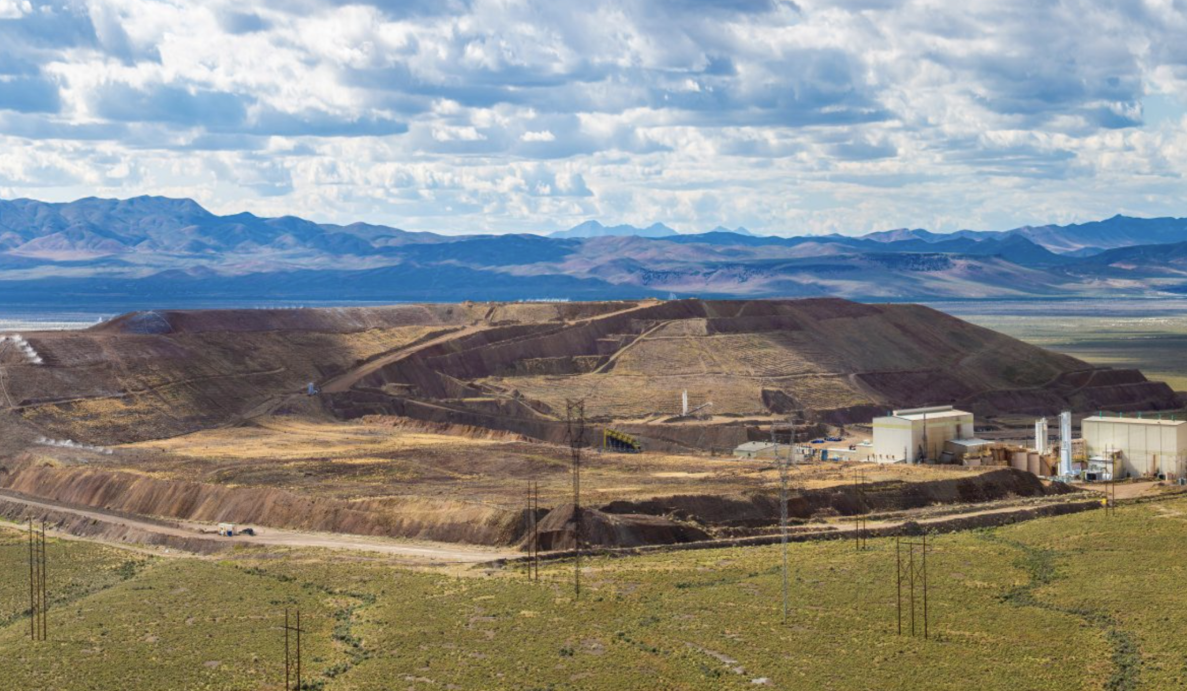
i-80 Gold Corp. reports second-quarter 2026 production of 11,098 ounces of gold and US$464.6 million in treasury as Lone Tree's autoclave refurbishment progresses on schedule.
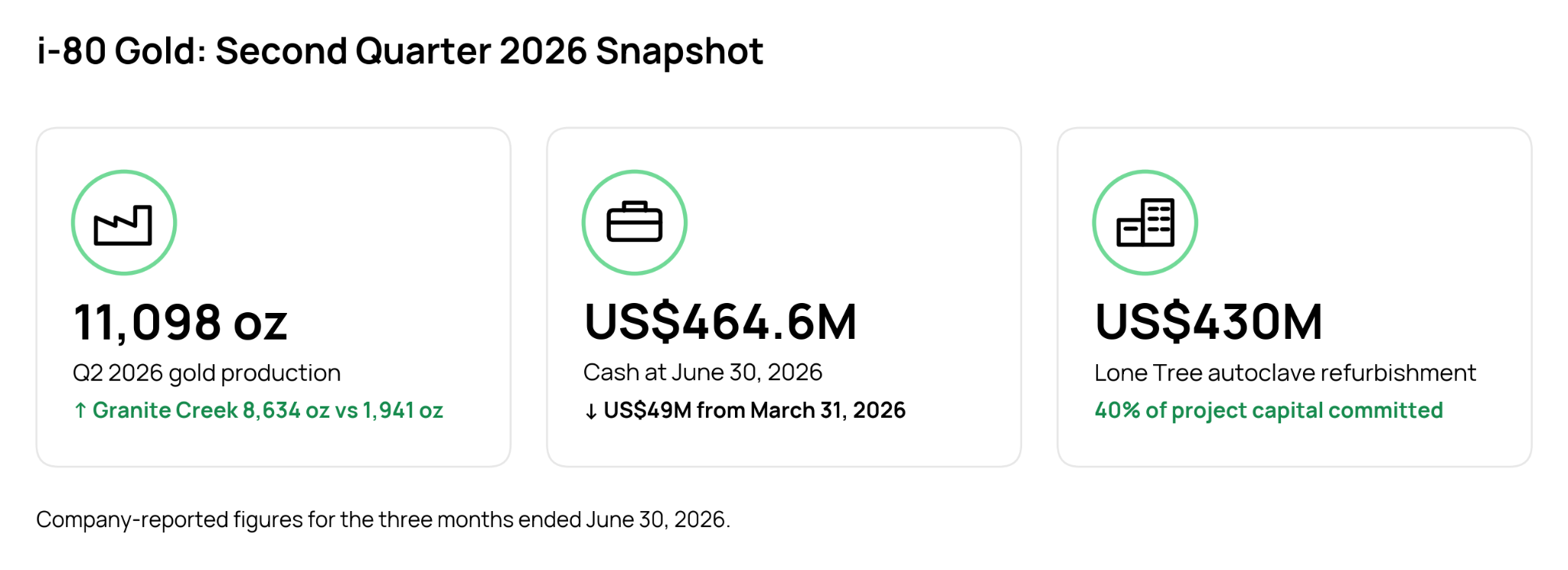
- i-80 Gold produced 11,098 ounces of gold in the second quarter of 2026, including 8,634 ounces from Granite Creek underground.
- More than 5,300 recoverable ounces remained in process at third-party facilities, highlighting the constraint of external toll milling.
- The US$430 million Lone Tree autoclave refurbishment remains on schedule for first gold by year-end 2027, with 40% of project capital committed.
- Mineral Point has been resequenced as Phase 2 ahead of Cove, with its Pre-Feasibility Study (PFS) now targeted for mid-2027.
- i-80 Gold held US$464.6 million in cash as of June 30, 2026, providing a fully funded runway through Phase 1 and Phase 2 development.
Executive Operating & Financial Summary
i-80 Gold Corp. (NYSE: IAUX | TSX: IAU) reported gold production of 11,098 ounces for the second quarter of 2026, driven by the underground mining ramp-up at Granite Creek in Nevada. The company maintains liquid assets of US$464.6 million in cash as of June 30, 2026, providing a fully funded runway through Phase 1 and Phase 2 development. Refurbishment is advancing on the 100% owner-operated Lone Tree pressure oxidation (POX) autoclave, targeting approximately 92% gold recovery to eliminate third-party toll discounts. Granite Creek's groundwater treatment reached mechanical completion in late July 2026, increasing surface capacity to approximately 3,500 gallons per minute to stabilize underground decline development. Contractor staffing and drill-rig shortages have shifted the bankable Feasibility Study (FS) timelines for Archimedes and the Pre-Feasibility Study (PFS) for Mineral Point to mid-2027.
The Nevada Hub-and-Spoke Processing Architecture
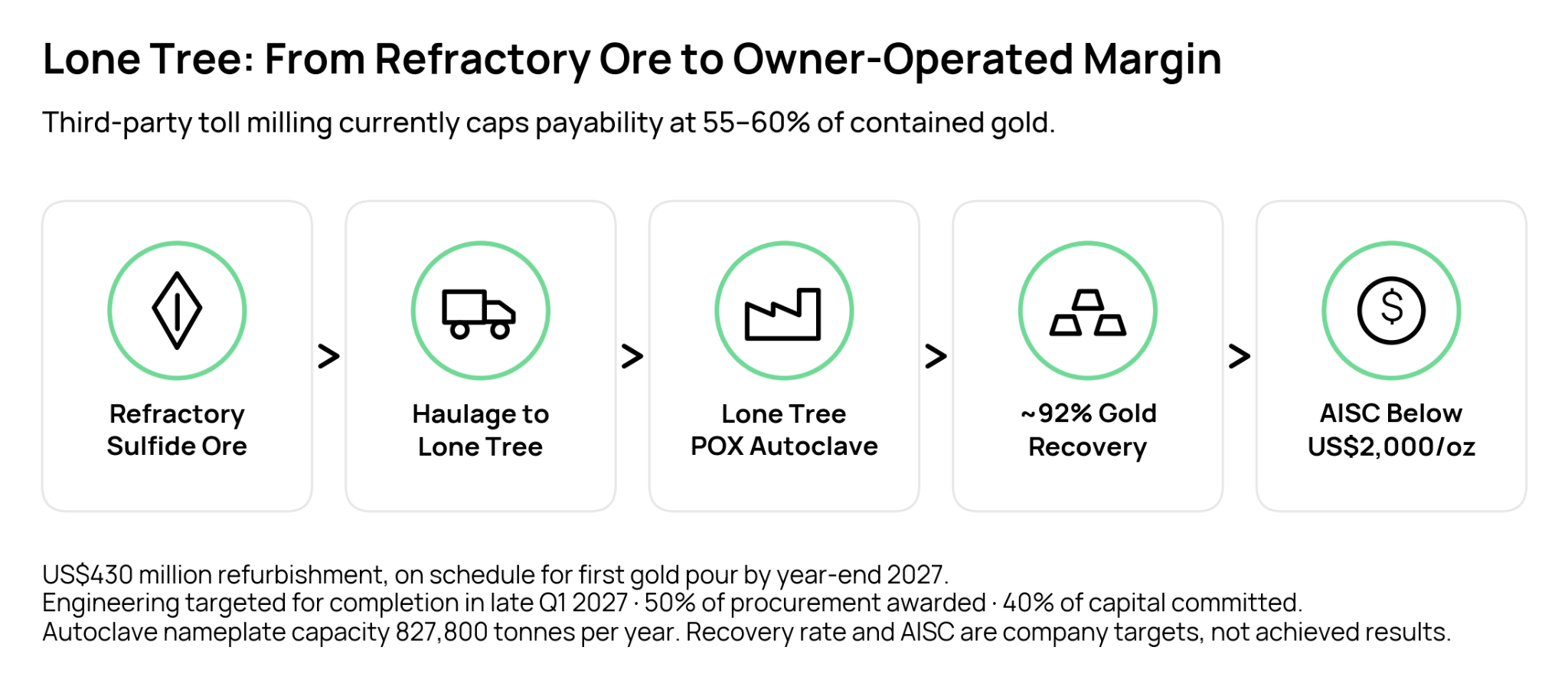
The regional hub-and-spoke model is the core operational mechanism for i-80 Gold Corp. in Nevada. Instead of building capital-intensive mills at each site, the company routes refractory sulfide ore from Granite Creek, Archimedes, and Cove to the central Lone Tree autoclave, thereby reducing site-level capital costs and prioritizing direct underground development.
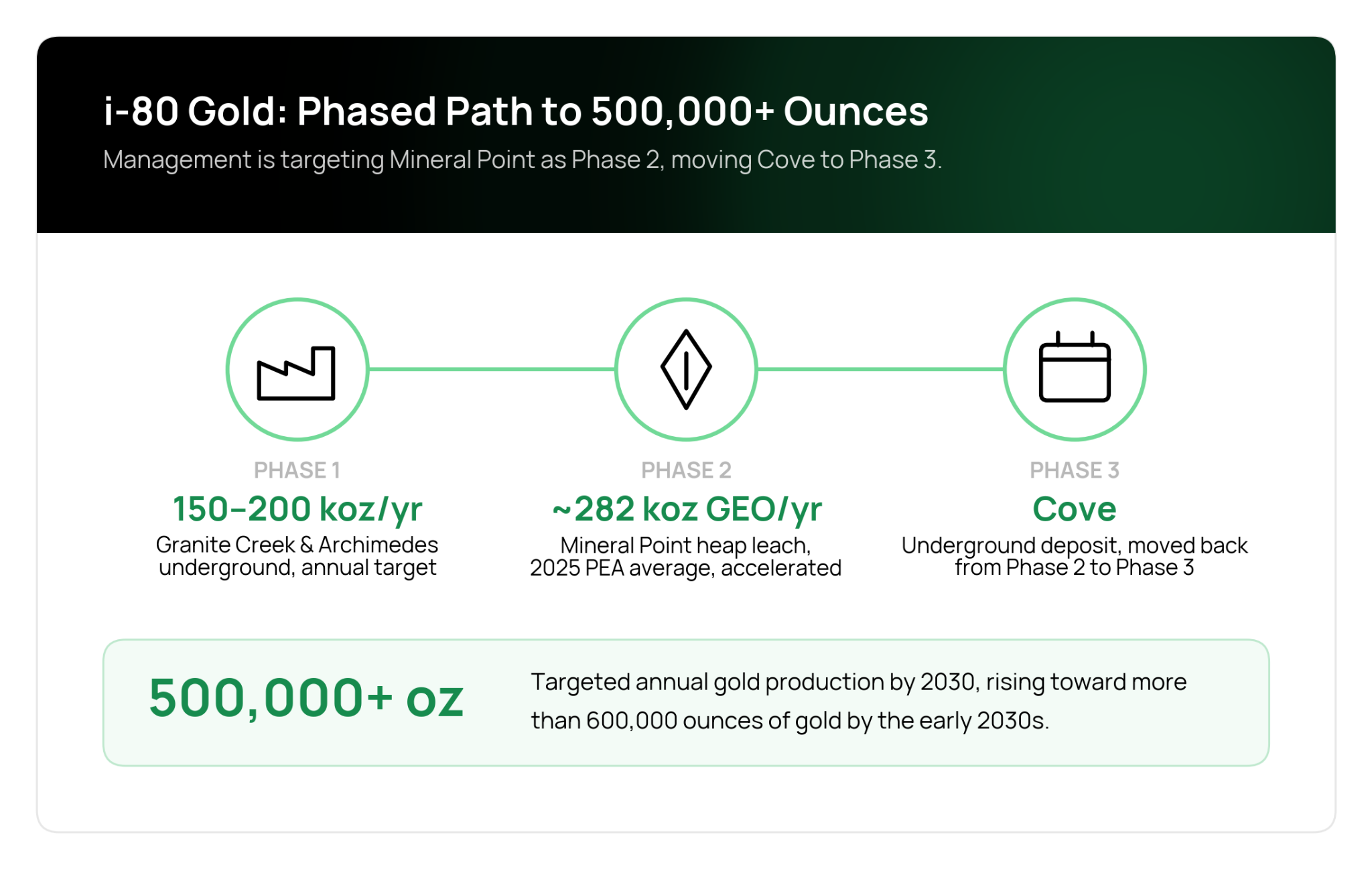
The company outlines a phased production ramp-up. Under Phase 1, the Granite Creek and Archimedes underground deposits target combined production of 150,000 to 200,000 ounces of gold annually. Owner-operated processing secures independent downstream capabilities, creating a technical barrier to entry in the Great Basin.
Lone Tree Refurbishment: Eliminating Third-Party Toll-Milling Constraints
Refurbishing the central Lone Tree autoclave is the operational link to unlock the value of the company's refractory sulfide ore bodies. Currently, i-80 Gold Corp. relies on third-party toll-milling contracts to process Granite Creek ore, capping payability at 55%-60% of contained gold. The June 30, 2026 report highlights this constraint: over 5,300 recoverable ounces of gold remained in process at third-party facilities, limiting quarterly revenue to US$24.3 million. To eliminate this bottleneck, the company is advancing the US$430 million Lone Tree refurbishment, which is on schedule for the first gold pour by year-end 2027. Detailed engineering continues to advance toward targeted completion in the late first quarter of 2027, with 50% of procurement packages by value awarded and 40% of project capital committed as of mid-July 2026.
President and CEO of i-80 Gold Corp., Richard Young, detailed this scarce processing infrastructure:
"I think the easiest way for investors to think about our company is that we're one of two companies with an autoclave technology in Nevada, which means we can process refractory materials that, other than Nevada gold mines, nobody else can"
The cost-benefit of this transition is a projected drop in AISC. Young highlighted this impact:
"With the commissioning of our Lone Tree facility, we would expect our AISC to drop under $2,000 an ounce."
Asset Portfolio Execution: Phase 1 Mining Operations & Timeline Realities
In the second quarter of 2026, operating execution at Granite Creek underground demonstrated mine productivity, with gold production increasing to 8,634 ounces from 1,941 ounces in the second quarter of 2025. Underground development advanced by 360 meters, compared to 211 meters in the prior-year period. Although ground conditions temporarily restricted access to two high-grade headings, remediation was completed and access re-established late in the period, maintaining 2026 production guidance of 30,000 to 40,000 ounces.
At the Archimedes underground project, the company completed 899 meters of development in the second quarter of 2026. Work advanced on the ventilation raise, and the completed exploration drift established a drilling platform for the Lower 426 and Ruby Deeps zones. First gold from the Upper Archimedes deposit remains targeted for the fourth quarter of 2026, as mining activities above the 5,100-foot level are supported by existing permits.
However, contractor staffing availability has shifted the Archimedes Feasibility Study (FS) timeline to mid-2027, slowing progress on the 55,000-meter infill drilling program across 140 holes. In response, management prioritized long-life technical infrastructure, constructing a new worker change facility and office complex to serve both Archimedes and Mineral Point, rather than refurbishing temporary surface structures, thereby increasing second-quarter 2026 capital expenditures above prior guidance.
Ruby Hill Strategy: Resequencing the Phase 2 & Phase 3 Milestones
At Ruby Hill, the company is evaluating strategic resequencing to accelerate cash flow generation. Instead of advancing the Cove underground deposit as Phase 2, management is targeting the acceleration of the large-scale Mineral Point open-pit heap leach project as Phase 2, moving Cove to Phase 3. This pivot leverages the heap leach model's low capital intensity, accelerating the timeline to reach over 500,000 ounces of annual gold production by 2030.
The acceleration is supported by the technical campaign at Mineral Point, which completed 14,836 meters of core and reverse-circulation drilling in the second quarter of 2026 using five rigs. The program is designed to convert inferred resources for a Pre-Feasibility Study (PFS). However, due to drill-rig shortages and slower penetration through the sanded dolomite unit, program completion has shifted to the first quarter of 2027, with the PFS now targeted for mid-2027.
Mineral Point's Preliminary Economic Assessment (PEA), filed on March 31, 2025, outlines average annual production of approximately 282,000 gold-equivalent ounces. At US$2,175 per ounce of gold and US$27.25 per ounce of silver, the study projects an after-tax net present value (NPV5%) of US$614 million. This high-margin cash-flow profile attracted foundational capital from Franco-Nevada, which allocated US$50 million to fund ongoing infill drilling and engineering through a royalty package.
Capital Structure & Liquidity: Balance Sheet Integrity post-Recapitalisation
The cash-drawdown rate in the second quarter of 2026 reflects the intensive capital deployment phase of the Lone Tree autoclave refurbishment. As of June 30, 2026, cash stood at US$464.6 million, down US$49 million from the March 31, 2026 balance of US$513.5 million. The outflow was driven by US$49.6 million in operating activities and US$21.5 million in capital expenditures (CAPEX), partially offset by a US$16.9 million release of restricted cash and proceeds from warrant exercises.
This liquidity position is anchored by the US$1.1 billion recapitalization package completed in the first quarter of 2026, which retired US$165.0 million in legacy debt and secured a cash position of US$513.5 million at the end of the first quarter of 2026. This recapitalization provides a fully funded runway to execute Phase 1 and Phase 2 development plans. Management plans to fund Phase 3 development primarily from operating cash flows generated by the autoclave circuit and active mining operations.
Technical & Execution Risks: Managing Hydrology & Regional Contractor Scarcity
Operational success depends on managing active geological and hydrological execution risks. Hydrological dewatering is a critical variable at the Granite Creek underground mine, where declines encounter high groundwater inflows. To stabilize declining development rates, the company commissioned a second expanded water treatment facility in June 2026, increasing surface water treatment capacity to approximately 3,500 gallons per minute.
Geological grade reconciliation is an additional variable that management is actively addressing. Early underground pre-development in certain zones encountered lower-than-modeled grade reconciliation due to structural complexity and grade mismodeling. The company is executing infill drilling to refine stope shapes and models ahead of active mining.
Furthermore, capital cost inflation and schedule slippage on the US$430 million Lone Tree autoclave represent key construction variables. To prevent commissioning delays, Hatch Ltd.'s EPCM schedule must be strictly adhered to. The company is managing this risk by having already awarded 50% of procurement packages by value and committing 40.0% of project capital as of mid-July 2026.
Autoclave Feeding, Cost Sensitivity & Study Maturity
Beyond near-term development milestones, long-term asset value depends on three critical residual execution risks. Autoclave feeding and thermal continuity present operational risks. Operating the centralized autoclave at its nameplate capacity of 827,800 tonnes per year requires a continuous ore delivery schedule from three geographically separate underground operations. Mining interruptions, haulage bottlenecks along the Interstate 80 corridor, or stockpiling mismatches could starve the autoclave of feed, triggering costly thermal cycling or shutdown periods that increase maintenance costs and disrupt production.
Second, the projected all-in sustaining cost (AISC) is sensitive to cost pressures and head grades. While management targets reducing consolidated AISC to below US$2,000 per ounce of gold once owner-operated processing is online, this depends on maintaining targeted head grades at active mining stopes. Any underperformance in grades or cost inflation in key processing inputs would compress projected margins.
Third, accelerating the Mineral Point heap leach project as Phase 2 ahead of Cove carries higher study and technical execution risks. Current economic projections for Mineral Point are based on a PEA with lower geological confidence and higher margins of error. Transitioning this large-scale oxide project directly to development without a bankable FS exposes the capital structure to design revisions and cost overruns.
Investment Thesis for i-80 Gold Corp.
- i-80 Gold Corp. is executing a transition from a junior explorer to an independent owner-operator gold producer in Nevada, supported by the strategic refurbishment of its central processing complex.
- By establishing the Lone Tree pressure oxidation autoclave as a centralized regional hub, the company is targeting the elimination of third-party toll-milling discounts of 40% to 45%.
- This technical architecture is designed to increase refractory ore payability from 55% to 60% under current contracts and to achieve an owner-operated recovery rate of approximately 92%, representing an estimated cash margin expansion of US$1,000 to US$1,500 per ounce of gold treated.
- The initial phases of this transition are fully funded by the company's treasury of US$464.6 million as of June 30, 2026, avoiding near-term equity dilution.
- The company has secured scarce regional processing infrastructure in Nevada, which is ranked 1st out of 68 jurisdictions globally for mining investment attractiveness in the 2025 Fraser Institute Annual Survey of Mining Companies, supporting a systematic production scale-up toward a target of over 600,000 ounces of gold by the early 2030s.
Consequently, the buy-side investment case for i-80 Gold Corp. pivots on a well-funded transition from underground development to centralized metallurgical execution. By using its cash reserves to establish an independent processing footprint, the company aims to capture significant recovery-driven margin expansion that insulates its operations from external cost and tolling bottlenecks. This technical and financial runway positions the company to emerge as a prominent, high-margin gold producer in a top-tier global jurisdiction before the central autoclave commences commercial operations.
TL;DR
i-80 Gold Corp.'s second-quarter 2026 results mark its transition from capital restructuring to physical execution. Granite Creek gold production increased to 8,634 ounces, although third-party processing constraints delayed sales and left more than 5,300 recoverable ounces in process. The company is advancing the US$430 million Lone Tree autoclave refurbishment toward first gold by year-end 2027, with 40% of capital already committed. Slower penetration through sanded dolomite at Mineral Point and contractor shortages at Archimedes have pushed feasibility studies to mid-2027, while US$464.6 million in cash provides substantial funding capacity. With Nevada ranked as the world's top mining jurisdiction in the 2025 Fraser Institute survey, i-80 Gold's funded regional processing strategy provides a defined pathway toward higher-margin gold production.
FAQs (AI-Generated)
Analyst's Notes





Subscribe to Our Channel





Stay Informed






















