Uranium Selloff Overlooks Producers Despite Record Contract Prices



Uranium stocks fell 42.5% from January while long-term contract prices rose past their 2007-08 peak, favoring producers with reserves to sell over developers.
- The Global X Uranium ETF, a proxy for the uranium sector, fell 42.5% from its January high to October 21, 2026, as reported by BNN Bloomberg.
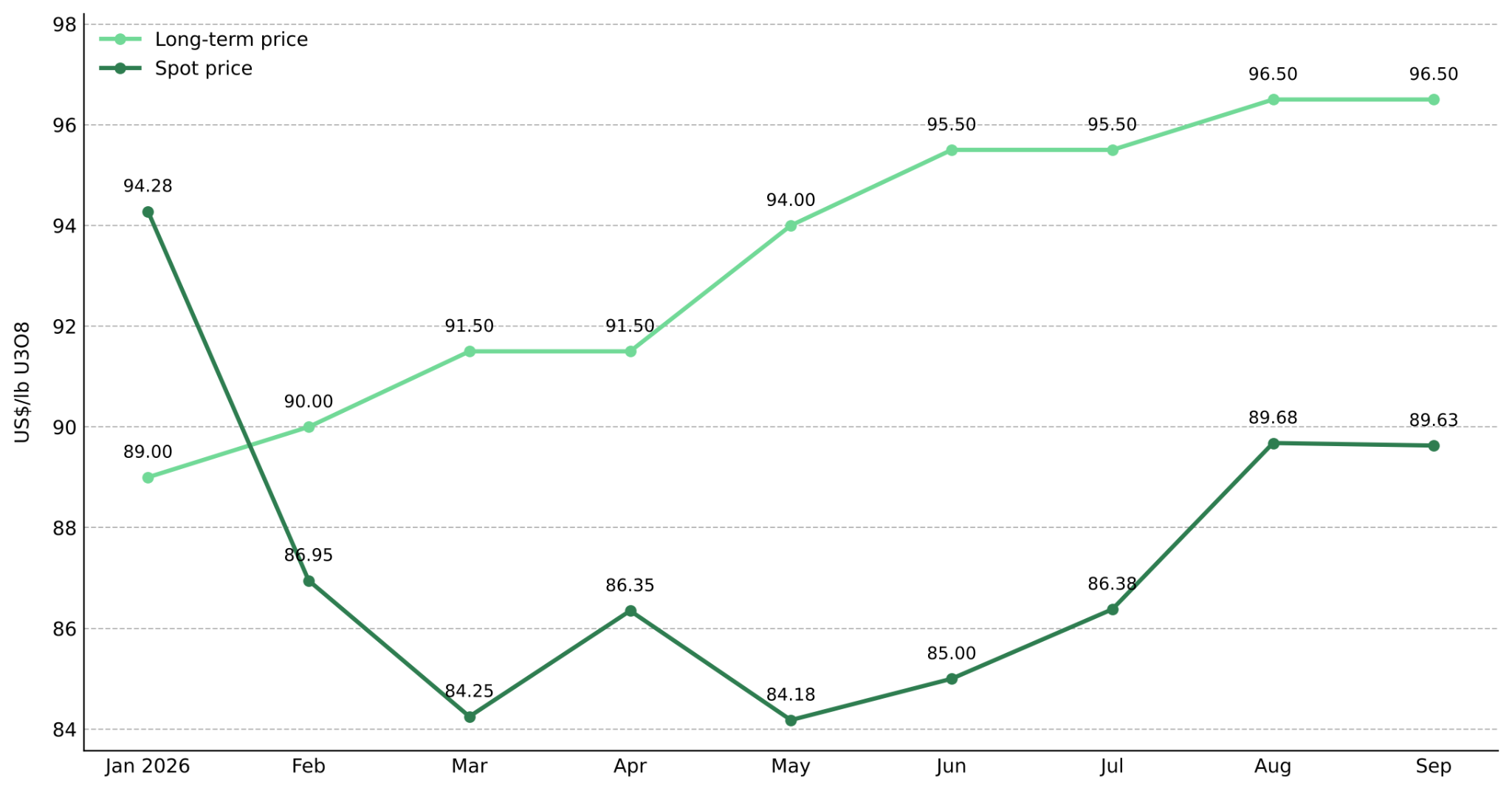
- Between the end of January and the end of September, the long-term uranium contract price rose from US$89.00/lb to US$96.50/lb, above its 2007-08 peak of US$95/lb.
- The spot price ended September at US$89.63/lb, 4.9% below its January close and US$6.87/lb under the long-term price.
- Utilities buy most uranium through 3-to-15-year contracts, which anchors producer revenue to the contract market even where delivery prices reference spot.
- Restarted idle mines have slowed uranium’s price rise, but spare capacity is running down while new uranium mines take 10 to 20 years to move from discovery to production.
Uranium Shares Fall as Utility Contracting Lifts Term Prices Past Their Previous Peak
Uranium equities and the price utilities pay for uranium under contract moved in opposite directions through 2026. The Global X Uranium ETF, a proxy for the uranium sector, fell 42.5% from its January high to October 21, 2026, according to BNN Bloomberg. Meanwhile, the long-term uranium price, the benchmark for multi-year supply contracts, rose from US$89.00/lb U3O8 at the end of January to US$96.50/lb at the end of September.
The term price now sits above its 2007-08 peak of US$95/lb, the World Nuclear Association (WNA) reported on October 21. The spot price, the cash price for near-term delivery, ended September at US$89.63/lb, 4.9% below its January close of US$94.28/lb. Share prices have tracked the weaker spot market, not the contract market where most uranium changes hands.
Restarted Mines Cap Spot Prices While Utilities Lock In Long-Term Supply
The split traces to how uranium is sold. Most volume moves through 3-to-15-year term contracts between producers and utilities, and spot trades account for roughly one-quarter of supply, according to the WNA. Utilities and producers now make up only 30% to 40% of spot activity, and traders and financial players supply the rest. As a result, the spot price, and the equity sentiment keyed to it, carries heavy weight from financial traders alongside reactor fuel buying.
Supply explains why spot has lagged. Muted price response has been attributed to producers reopening dormant mines, an option that is running out as the industry uses up its spare capacity, BNN reported. World mines supplied 60,213 tU in 2024, 90% of utility requirements, with stockpiles and recycled material covering the rest, per the WNA. New uranium mines take 10 to 20 years to move from discovery to production, so new output cannot answer a demand step-up inside the current contracting cycle.
Decade-Long Mine Lead Times Keep Uranium Supply Short of Reactor Demand
Demand runs ahead of mine development. The WNA Reference Scenario lifts reactor uranium requirements from about 68,920 tU in 2025 to just over 150,000 tU in 2040, as nuclear capacity climbs from 398 GWe to 746 GWe.
Two outcomes may follow for uranium producers with uncommitted reserves, the cohort whose earnings depend on signing new contracts. In the first, the term price keeps rising and spot, now US$6.87/lb below it, closes the gap. BNN notes spot has tended to catch up when trading below a rising term price, which would reprice producer equities toward contract economics. In the second, restarts and stockpile sales keep spot pinned below term, and equities stay range-bound while capital chases AI stocks.
Uranium Term Contracts Reward Producers, Raise Developer Funding Costs
Exposure splits by revenue source. Producers carrying uncontracted pounds stand to book term deals near current contract levels. Developers without production depend on equity markets to fund construction, where a 42.5% drawdown raises their cost of capital. ETF holders own both groups at once, so the ETF's fall reflects developer and sentiment weight as much as producer earnings.
The test separating the two groups is whether a company can contract pounds at current term prices. Kazatomprom said in August 2026 that pricing power was returning to producers with large proven reserves, according to the WNA.
Timing remains the unknowable part. Improving fundamentals offered no protection against 2026 losses. Positions sized to withstand a further drawdown, rather than timed to a catalyst, carry a lower risk of a forced exit.
Uranium Selloff Reflects Sentiment, Not Weaker Producer Revenue
The contract market sets what uranium producers earn, and it strengthened through 2026. The sector's equity decline reflects positioning and spot-driven sentiment, not a weaker revenue base for producers with reserves to sell.
Value has moved toward pounds in the ground with a path to delivery, and away from optionality on distant supply. Producers able to sign long-term volume hold the stronger hand, while developers reliant on equity funding carry the cost of the selloff.
Long mine lead times mean today's underfunded developers become tomorrow's missing supply, which keeps pricing power with producers holding reserves. A sector that keeps falling while its contract price keeps rising is a reason to shift toward projects with contracts in hand, not a reason to opt out.
Analyst's Notes





Subscribe to Our Channel







Stay Informed