




Gold Jumps 9% as Fed Hike Odds Fall, With Q2 Central Bank Buying Adding Longer-Term Support


Gold rose 9% as Fed hike odds fell, while record central bank buying and below-spot project assumptions strengthen downside protection.
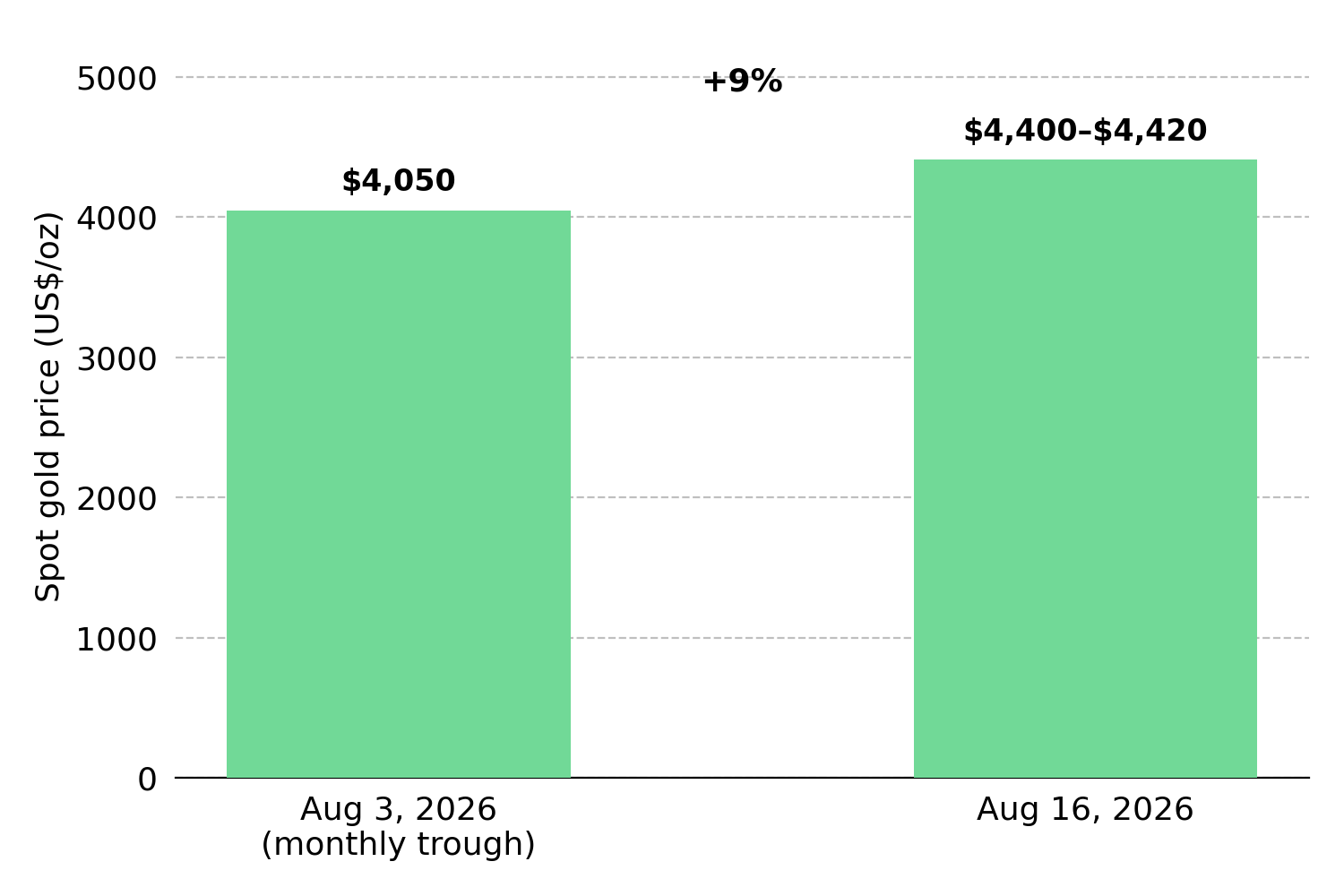
- Spot gold rose from about $4,050 per ounce on August 3 to $4,400-$4,420 per ounce by August 16, 2026, as July inflation data cut priced-in odds of a September Fed rate hike from about 55% to 35%.
- The World Gold Council (WGC) recorded 288.9 tonnes of net central bank gold purchases in the second quarter of 2026, up 62% year over year and a record for any second quarter on file, while 89% of surveyed central banks expect global gold reserves to rise over the next 12 months.
- Major bank gold forecasts span Goldman Sachs' $4,400-per-ounce hawkish scenario to Bank of America's $5,000-$6,000 base case, supporting cautious position sizing as the 2026 outlook remains contested.
- Development-stage gold projects highlighted below use base-case prices of $2,500 to $3,250 per ounce, well below spot near $4,400 per ounce, allowing project economics to absorb a gold-price pullback without relying on current prices.
- The Fed's August 19 meeting minutes and Chair Kevin Warsh's August 28 Jackson Hole address could shift expectations for the September rate decision, with more hawkish signals pressuring gold and lower tightening risk supporting current prices.
Softer Inflation Cuts Rate-Hike Odds & Lifts Gold 9% as Fed Signals Set Near-Term Risk
July consumer price index data and a softer-than-expected core producer price index reading cut the priced-in probability of a 25-basis point September Fed rate hike from about 55% to 35% in the week through August 14, 2026. Over the same period, spot gold rose from about $4,050 per ounce on August 3 to $4,400-$4,420 per ounce by August 16, an increase of roughly 9% from the month's trough.
Higher real interest rates increase gold's opportunity cost because bullion pays no yield while US Treasuries provide an interest return. Lower odds of a near-term Fed hike reduce expected yields on competing assets, decreasing the opportunity cost of holding gold and supporting prices even if physical demand is unchanged. Fed signals can reprice gold within days, while central bank reserve purchases develop over quarters, making policy expectations the faster-moving driver of near-term prices.
Fed Chair Kevin Warsh has said the Fed is not constrained by market pricing, signaling that lower market-implied rate-hike odds do not guarantee a policy hold. The August 19 Fed meeting minutes and Warsh's August 28 Jackson Hole address come before the September 16 rate decision and could reinforce or reverse the drop in rate-hike odds, supporting or pressuring gold accordingly.
289-Tonne Central Bank Buying Record Extends Gold Demand Beyond Near-Term Fed Moves
Central bank gold purchases provide a slower-moving source of demand than Fed-driven repricing, which affects spot prices over days and weeks. The WGC's Gold Demand Trends report for the second quarter of 2026 recorded 288.9 tonnes of net central bank purchases, up 62% from 177.9 tonnes a year earlier and a record for any second quarter on file, after a revised first-quarter total of 57 tonnes. Poland's central bank added 51 tonnes, lifting reserves to 632 tonnes against a stated target near 700 tonnes. China's central bank added 33 tonnes, its largest quarterly addition since the fourth quarter of 2023, taking official holdings to 2,346 tonnes and extending its buying streak to 21 consecutive months. Uzbekistan and Kazakhstan added a further 16 tonnes and 15 tonnes, respectively, reinforcing that second-quarter accumulation extended across multiple central banks.
Russia sold 22 tonnes in the second quarter, while Turkey sold 4 tonnes after larger disposals in the first quarter, showing that official-sector flows were not uniformly positive. Despite those sales, net central bank purchases still reached 288.9 tonnes, indicating that accumulation by other reserve managers more than offset disposals during the quarter. The WGC survey found that 89% of 76 central banks expect global gold reserves to rise over the next 12 months, supporting the view that official-sector demand could remain a source of gold buying beyond the second quarter.
Against that central bank demand backdrop, the development-stage projects examined below use base-case gold prices below current spot, reducing their reliance on today's gold price to support published project economics.
Below-Spot Gold Assumptions & Lower Financing Risk Preserve Resource Upside
Because mining companies cannot control the gold price, project economics built on assumptions below spot are less dependent on current market prices to support projected returns. The projects examined below use base-case gold prices of $2,500 to $3,250 per ounce versus spot near $4,400 per ounce, allowing their published economics to absorb a lower gold price before reaching the assumptions used in their studies. The sections below assess downside protection through three factors: base-case gold assumptions, financing structures that limit equity dilution, and resources or discoveries not yet included in published project economics.
Gold Prices Above Study Assumptions Lift Returns & Expand Project Margins
US Gold Corp's March 2026 feasibility study for the CK Gold gold-copper project in Wyoming uses a base-case gold price of $3,250 per ounce, about 26% below current spot near $4,400 per ounce. At $3,250 per ounce, the study reports a $632 million after-tax net present value at a 5% discount rate (NPV5%) and a 27% after-tax internal rate of return (IRR). At the study's $3,000-per-ounce downside case, after-tax NPV5% remains $528 million and after-tax IRR remains 23.8%, showing that the published economics remain positive at a gold price about 32% below current spot.
Cabral Gold's preliminary feasibility study for the Cuiú Cuiú project in Brazil uses a $2,500-per-ounce base-case gold price and reports a 78% after-tax IRR for the initial oxide heap-leach phase. The study's sensitivity analysis reports after-tax IRRs of 59% at $2,250 per ounce and 151% at $3,500 per ounce, showing how changes in the assumed gold price affect modeled returns from the initial oxide operation.
Alan Carter, President and Chief Executive Officer of Cabral Gold, ties margin to the current all-in sustaining cost of the operation:
"We should be producing gold at an all-in sustaining cost of about $1,200 an ounce, even with the pullback in the gold price. There's an enormous profit margin on that gold that we expect to be producing very quickly."
Cash, Debt & Owned Infrastructure Reduce Financing and Processing Dependence
Base-case gold assumptions address commodity-price risk, while available cash and debt capacity determine how much external financing a project may require before production. Hycroft Mining Holding Corporation ended the second quarter of 2026 with $220.5 million in unrestricted cash and no debt, providing internal funding capacity for its Vortex and Brimstone underground evaluation and its roasting-versus-pressure-oxidation trade-off study while reducing near-term external financing pressure.
US Gold Corp has roughly 16.5 million shares outstanding and has stated a preference for debt over new equity to fund CK Gold's $394 million initial capital requirement, which could reduce equity dilution if the project is financed on those terms. New Found Gold is converting its owned Pine Cove mill in Newfoundland to a gravity carbon-in-leach circuit targeting an increase in gold recovery from 87% to about 92%. Processing material from both Queensway and Hammerdown through the same owned facility could reduce reliance on third-party toll milling and the associated external processing costs.
Large Gold Resources Offer Scale While PEA-Stage Economics Carry More Uncertainty
Tudor Gold's Goldstorm deposit at the Treaty Creek project in British Columbia contains 24.9 million ounces of gold in indicated resources and a further 4 million ounces in inferred resources, forming the resource base for an underground preliminary economic assessment (PEA) now in progress.
P2 Gold's Gabbs gold-copper project in Nevada remains at an earlier stage than the development projects above, with an updated resource estimate and full feasibility study targeted for later in 2026. Its 2025 preliminary economic assessment (PEA) reported a $942.9 million after-tax NPV5% and a 33.8% after-tax IRR. A feasibility study provides greater engineering and cost definition than a PEA, while PEA economics carry greater uncertainty because drilling, design, costs, and schedules can change as a project advances.
$4,400-$6,000 Gold Forecast Range Favors Projects Underwritten Well Below Spot
Goldman Sachs cut its year-end 2026 gold target to $4,900 per ounce from $5,400 per ounce in mid-June 2026, citing weaker exchange-traded fund inflows and later Fed rate cuts. It also identified a hawkish scenario in which gold falls to about $4,400 per ounce if the Fed raises rates. Bank of America's base case places gold near $5,000-$6,000 per ounce, while a separate non-base-case scenario puts gold above $8,000 per ounce.
The roughly $1,600-per-ounce gap between Goldman Sachs' $4,400 hawkish scenario and the top of Bank of America's $5,000-$6,000 base case reflects different assumptions about Fed policy and the strength of central bank gold demand. Against that forecast range, projects underwritten at $2,500-$3,250 per ounce retain a larger price cushion before gold reaches the assumptions used in their published economics.
289-Tonne Central Bank Buying Supports Gold as Fed Signals Drive Near-Term Risk
Gold is currently supported by central bank purchases over longer periods, while Fed policy expectations can move prices over days and weeks. The WGC recorded 288.9 tonnes of net central bank buying in the second quarter of 2026, while 89% of 76 surveyed central banks expect global gold reserves to rise over the next 12 months. Fed policy is the faster-moving risk because changes in rate expectations can alter gold's opportunity cost and reprice spot within days or weeks.
The Fed's August 19 meeting minutes could clarify policymakers' support for holding or raising rates, while Chair Kevin Warsh's August 28 Jackson Hole address could shift expectations ahead of the September 16 rate decision. Signals favoring a policy hold could reinforce the recent decline in September rate-hike odds and support gold, while renewed support for another increase could reverse part of that repricing and pressure prices.
Continued central bank buying supports maintaining gold exposure, but it does not remove the near-term price risk from changing Fed expectations. Position sizing should therefore account for the risk that the recent gold rally reverses if the August 19 Fed minutes or August 28 Jackson Hole address restore expectations for higher rates.
The Investment Thesis for Gold
- Gold exposure should favor producers, developers, and explorers with conservative price assumptions, lower financing risk, and project catalysts that do not require spot gold near current levels.
- Central bank buying provides gold demand beyond near-term Fed repricing, with 288.9 tonnes purchased in the second quarter of 2026 and 89% of surveyed central banks expecting global reserves to rise over the next 12 months.
- Position sizing should account for the August 19 Fed minutes and August 28 Jackson Hole address, as hawkish signals could pressure gold while lower rate-hike expectations could support current prices.
- The development projects examined above use base-case gold prices of $2,500-$3,250 per ounce versus spot near $4,400, reducing their reliance on current prices if more hawkish Fed signals pressure gold.
- Existing cash and debt financing, where available, can reduce reliance on new equity before production and lower dilution risk if gold prices weaken.
- Resources and discoveries excluded from current economic studies can add project-level upside if further drilling or engineering incorporates them into future resource estimates or project economics.
Taken together, these factors favor gold projects with base-case economics that remain positive at prices below current spot, sufficient cash or debt capacity to reduce reliance on new equity, and additional resources or discoveries that can expand future project economics without depending on the current gold rally to continue.
TL;DR
Gold rose about 9% from its August 3 trough as softer July inflation data cut the priced-in probability of a September Fed hike from roughly 55% to 35%. At the same time, central banks bought a record 288.9 tonnes in the second quarter, reinforcing demand beyond short-term policy moves. Development-stage projects using $2,500-$3,250 gold assumptions remain less dependent on spot near $4,400, while cash, debt capacity, and owned infrastructure can reduce financing pressure. Major bank scenarios still span roughly $4,400 to $6,000, making the August 19 Fed minutes and August 28 Jackson Hole address key near-term risk events.
FAQs (AI-Generated)
Analyst's Notes





Subscribe to Our Channel











Stay Informed






















