



Hard-Rock Lithium Studies Average 41% IRR, Ahead of Brine & Clay at 26%


Across 24 lithium studies since 2022, BMO finds hard-rock projects average a 41% post-tax internal rate of return, ahead of 26% for brine and clay projects.
- Across BMO's comparison of 24 lithium project studies completed since 2022, hard-rock projects average a 41% post-tax internal rate of return (IRR).
- Brine and clay projects in the same comparison average a 26% post-tax IRR.
- The September 2025 feasibility study for Lithium Ionic's Bandeira project in Brazil estimates a 61% post-tax IRR at a US$1,392 per tonne price for 6% spodumene concentrate during the payback period, stepping up to an average life-of-mine price of US$2,212 per tonne.
- Bandeira's post-tax net present value at an 8% discount rate is 7.6 times initial capital, against a 3.3 times hard-rock average.
- BMO supplied the comparison, and BMO Capital Markets advised Lithium Ionic on the sale of its Salinas properties.
Introduction
Published lithium project studies can be compared using the post-tax internal rate of return (IRR) and the ratio of post-tax net present value (NPV) to initial capital. The ratio divides a project's estimated value by its construction cost, so a higher figure means each dollar of construction capital supports more estimated value.
BMO compiled both measures across 24 lithium project economic studies completed since 2022, grouped by deposit type. BMO also benchmarked the study against those group averages.
Industry Context
BMO's grouping separates the 24 studies into brine and clay projects, hard-rock projects, and the lithium set overall. Hard-rock projects mine lithium-bearing minerals, such as spodumene, from solid rock and concentrate them before sale, while brine projects recover lithium from salt-rich water, and clay projects recover lithium from sedimentary deposits.
Brine and clay projects average a 26% post-tax IRR and post-tax NPV of 1.9 times initial capital. The full set of lithium projects averages 33% and 2.2 times. Hard-rock projects average 41% and 3.3 times, the highest of the 3 groups on both measures. BMO's comparison does not name the 24 studies or state a common price or discount rate assumption underlying them.
Emerging Practices & Industry Progress
Hard-rock lithium in Brazil's Minas Gerais state is already mined and processed at operating mines, including 2 that use dense media separation (DMS), a process that separates heavier lithium-bearing mineral from lighter waste rock in a dense liquid.
CBL's Cachoeira mine, a private Brazilian operation in production since 1991, pairs underground mining with DMS processing. Sigma Lithium's Grota do Cirilo project achieved first production in April 2023 from an open-pit mine and also uses DMS processing.
Remaining Challenges
Lithium equities have not kept pace with spodumene prices. As of August 2026, the commodity had remained relatively high, while shares of lithium producers and explorers, including Australian producers, had fallen back from their levels at the start of 2026. For developers who still need construction capital, that gap makes equity a more expensive source of funding.
Lenders set a separate test. After 3 to 4 years of erratic lithium prices, lenders want to see a project make money through the low points of the cycle, and a floor price in an offtake agreement is one way a producer can show it.
Selling the concentrate depends on conversion capacity, the refineries that turn spodumene into battery chemicals. Outside China, that base is still thin: in North America, Tesla is one of the few companies to have built its own refining capacity. A producer committing its output needs a buyer with the capacity and the readiness to take it.
Company or Project Examples
Lithium Ionic (TSXV: LTH | OTC: LTHCF | FSE: H3N) is developing the Bandeira lithium project in Minas Gerais, Brazil, which BMO set against the 3-group averages. The September 2025 feasibility study (FS) estimates a 61% post-tax IRR and a post-tax NPV8% of US$1.45 billion, or 7.6 times initial capital. Both figures assume a price of US$1,392 per tonne (t) for 6% spodumene concentrate (6% lithium oxide) during the payback period, stepping up to an average life-of-mine price of US$2,212/t. Its site operating cost is below the 50th percentile on the global cost curve for 6% spodumene concentrate. BMO provided the comparison, and BMO Capital Markets acted as financial advisor to Lithium Ionic in connection with the sale of its Salinas properties.
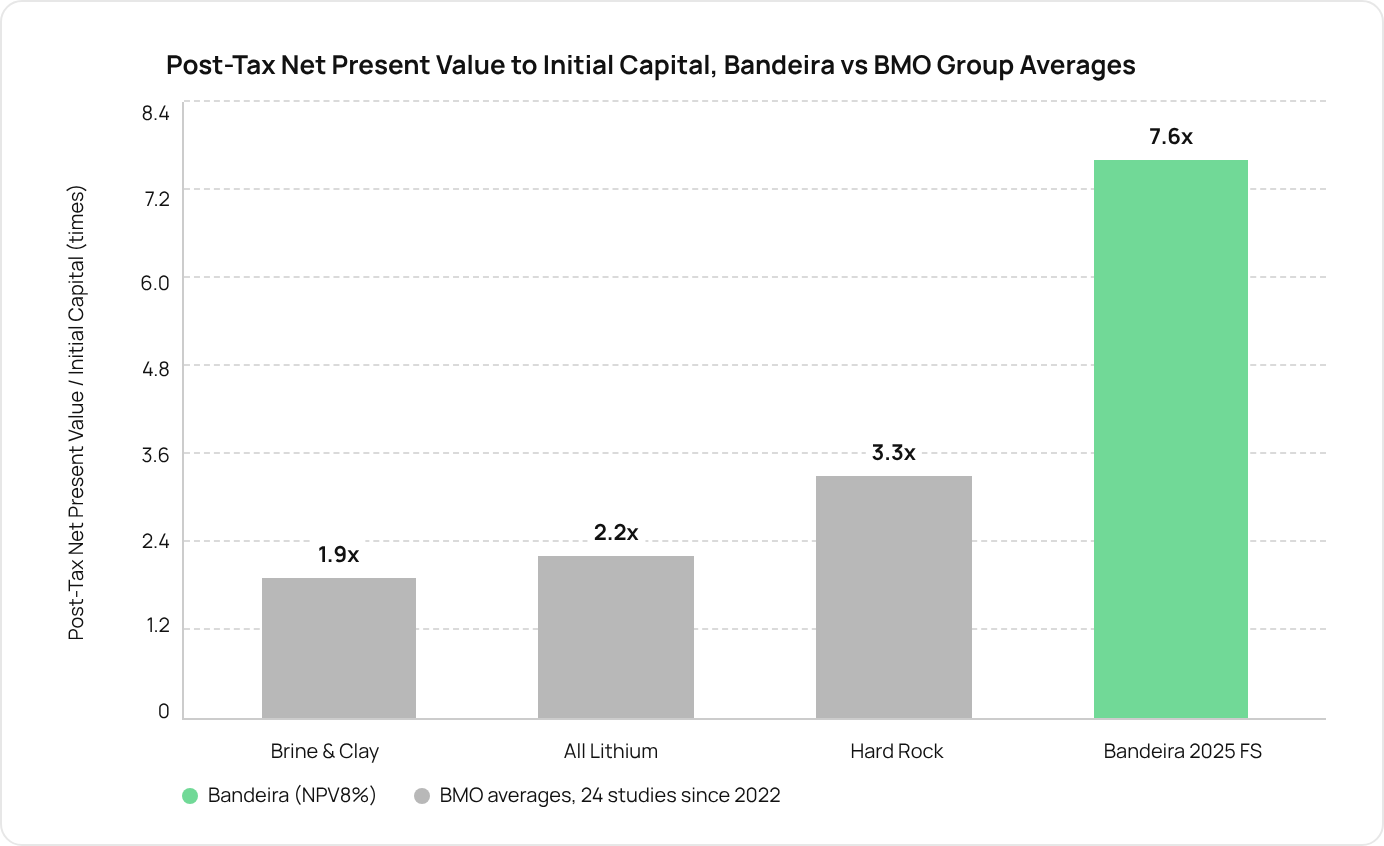
The 7.6-times ratio divides NPV8% by the initial capital of US$191 million, including US$19.6 million in contingency. The FS adopts Fastmarkets' May 2025 spodumene forecast, which averages US$1,392/t for 6% spodumene concentrate from 2026 to 2028 and US$2,300/t from 2031 onward. Payback on capital in the FS is 26 months.
Chief Executive Officer of Lithium Ionic, Blake Hylands, links the offtake floor to what a lender sees in each tonne sold:
"The way we were able to structure our offtakes with a floor of a thousand means any lender can see that we're making money on every ton, that you can service the debts, and we're starting to see, like you said, some stability in that price as well."
The binding offtake agreements, signed in March 2026 with Yahua Group and Grand Chen for about 170,000 tonnes per annum, set a floor price of US$1,000/t with no ceiling and no discount to market pricing, alongside a US$20 million prepayment facility. Lithium Ionic received US$30.0 million in cash at the closing of the Salinas sale to PLS Brasil Mineração, a subsidiary of PLS Group, on August 25, 2026, and the proceeds are expected to support early works, procurement, and construction readiness at Bandeira.
Regional or Jurisdictional Perspective
Bandeira lies less than 500 meters from Cachoeira and less than 4 kilometers (km) from Grota do Cirilo, and is designed as an underground mine with DMS processing.
Minas Gerais has more than 300 mines and is Brazil's third-largest economy. In July 2022, Brazil issued a presidential decree allowing unrestricted trade of any products containing lithium, and in May 2023, the Minas Gerais state government and municipal agencies launched Lithium Valley Brazil to simplify and support lithium development and production. Lithium Ionic has secured access to the hydroelectric grid for Bandeira and submitted its application for a construction permit in November 2023. The project sits near paved roads and is less than 300 km from ports.
Hylands puts a scale on the belt's future concentrate output:
"There's going to be hundreds of thousands, if not a million tons per annum or more of concentrate coming out of this belt."
Lithium Ionic will look for new drill targets in the belt as the market allows, while its focus for now stays on advancing Bandeira.
Industry Outlook
Demand for battery materials is spreading beyond electric vehicles. Electric vehicle sales in North America are still growing at double-digit rates, and Lithium Ionic expects battery storage for AI data centers, and robotics after it, to become the next sources of demand.
Refining capacity is being built ahead of the mine supply that would feed it. Refiners now under construction are sized at 5 to 10 times current consumption, by Lithium Ionic's estimate, and expansions in China can come online quickly. Europe is adding refiners with investment from governments and funds, and has moved faster than North America on building that capacity. For producers, that means more buyers for concentrate at a time when few new mine projects are in the pipeline to supply it.
Hylands ties the slower build outside China to time:
"It just takes time. And so, yeah, to your point, unfortunately, the maturity is in China right now or mostly in China, probably 85% or so."
Until that build-out matures, Chinese converters remain the main buyers of new hard-rock concentrate. A fixed-term offtake, such as Lithium Ionic's 5-year offtake term, leaves a producer free to sell into Europe and the Americas as conversion there matures, and Brazil's open trade rules let its producers supply buyers worldwide.
FAQs (AI-Generated)
Analyst's Notes


Subscribe to Our Channel






Stay Informed


