Kazakhstan Cuts 2026 Uranium Output as $7.50 Term-Spot Gap Tests Deficit Thesis



Kazakhstan cuts 2026 uranium output 9.4% as a $7.50 term-spot gap, Chinese reactor growth, and US fuel policy test the deficit thesis.
- Uranium's long-term contract price reached $94 per pound at the end of June, its highest level since 2008, while spot traded near $86.50 per pound on August 7, leaving a $7.50 spread consistent with producers requiring higher prices for multi-year supply commitments.
- Kazatomprom, responsible for roughly one-fifth of global primary supply, has cut its 2026 nominal production target by close to 10 percent even after its multi-year sulphuric acid bottleneck was resolved.
- China's State Council approved eight reactor units across four nuclear power projects on July 31, bringing approvals since 2022 to 49 units and extending the pipeline of future uranium demand.
- US policy is increasing domestic nuclear fuel requirements while forcing supply-chain substitution, with $17.5 billion in Department of Energy conditional loans supporting up to ten new reactors and a January 2028 ban targeting Russian-origin enriched uranium, which has historically supplied close to one quarter of US enrichment services.
- Kazatomprom's August 21 half-year results are the nearest scheduled test of the supply thesis, as another production guidance cut would support a tighter market and the case for spot uranium moving toward the $94-per-pound long-term contract price.
Fed Holds Rates as Uranium Term Price Leads Spot by $7.50 and Supply Signals Strengthen
Uranium spot and long-term contract prices are sending different signals about near-term sentiment and future supply availability. Spot uranium traded near $86.50 per pound on August 7, while the long-term contract price stood at $94 per pound at the end of June, its highest level since 2008 and $7.50 above spot. Roughly 80% of uranium is sold through multi-year utility contracts, so the long-term price reflects the level producers require to commit future supply. Spot uranium trades in the smaller residual market outside long-term utility contracts, making it more sensitive to near-term trading flows than the contract market that governs most future supply commitments.
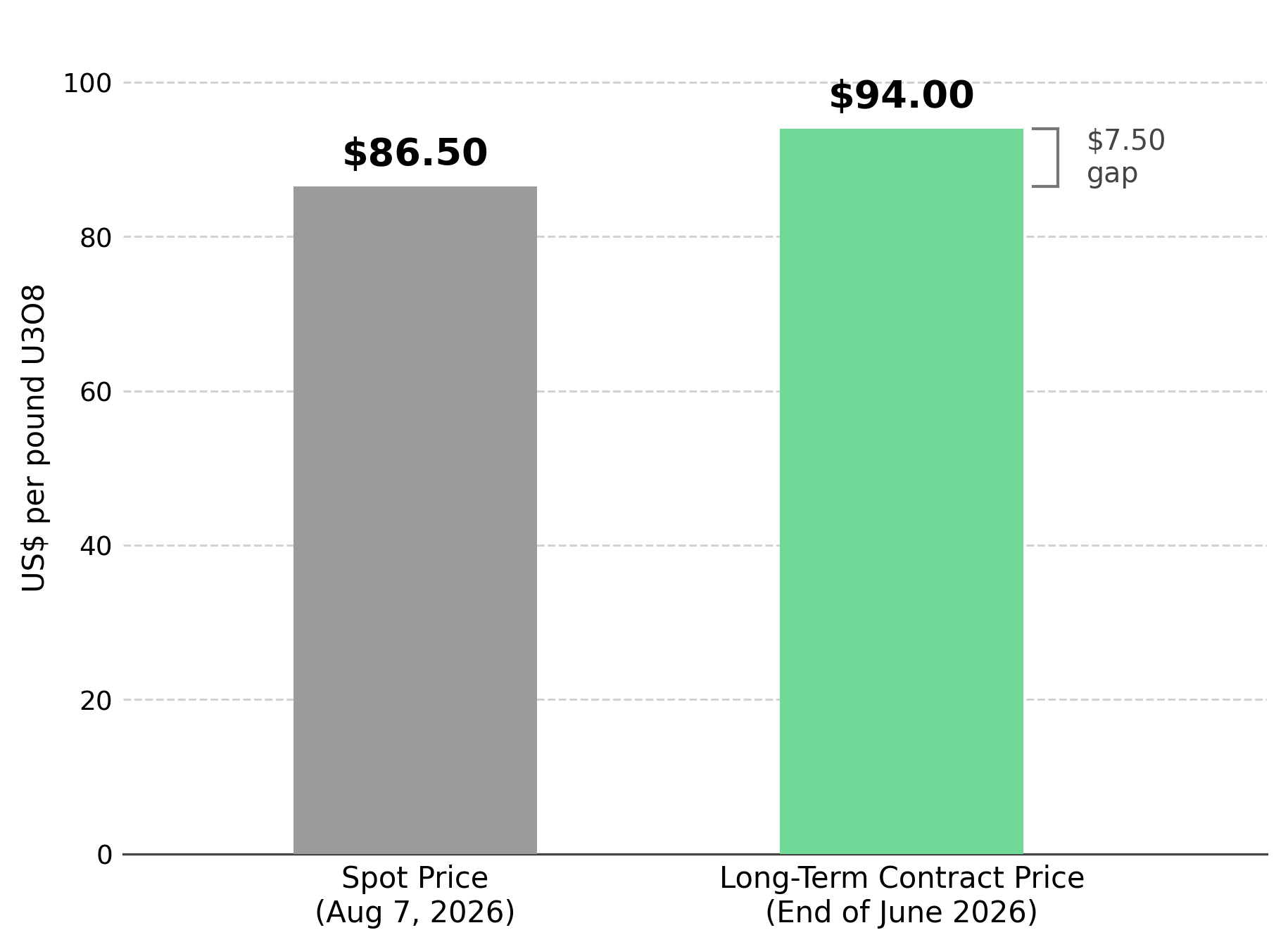
Uranium’s $7.50 spot-to-term price gap has widened while US interest rates remain restrictive. The Fed held its benchmark rate at 3.50% to 3.75% on July 29 in a 9 to 3 vote, with all three dissents favoring a hike, while higher rates can support the dollar and increase financing costs for uranium mine restarts and new enrichment capacity. The long-term uranium price reaching $94 per pound despite those conditions supports the case that utility contracting and producer supply discipline, rather than a broad commodity rally, are driving the higher term benchmark.
Producer Restraint Cuts Uranium Supply as the Global Supply-Demand Gap Widens
Kazatomprom supplies close to one fifth of global primary uranium and cut its 2026 production target from 32,777 tonnes to 29,697 tonnes, an approximately 8-million-pound U3O8 reduction equal to about 5% of global supply. With sulfuric acid supply now assessed as stable for 2026, the lower target points to deliberate production discipline rather than a reagent-driven shortfall. That restraint is paired with longer-term Chinese offtake, after shareholders approved an amended supply agreement with China National Uranium Corporation on August 10 and 11.
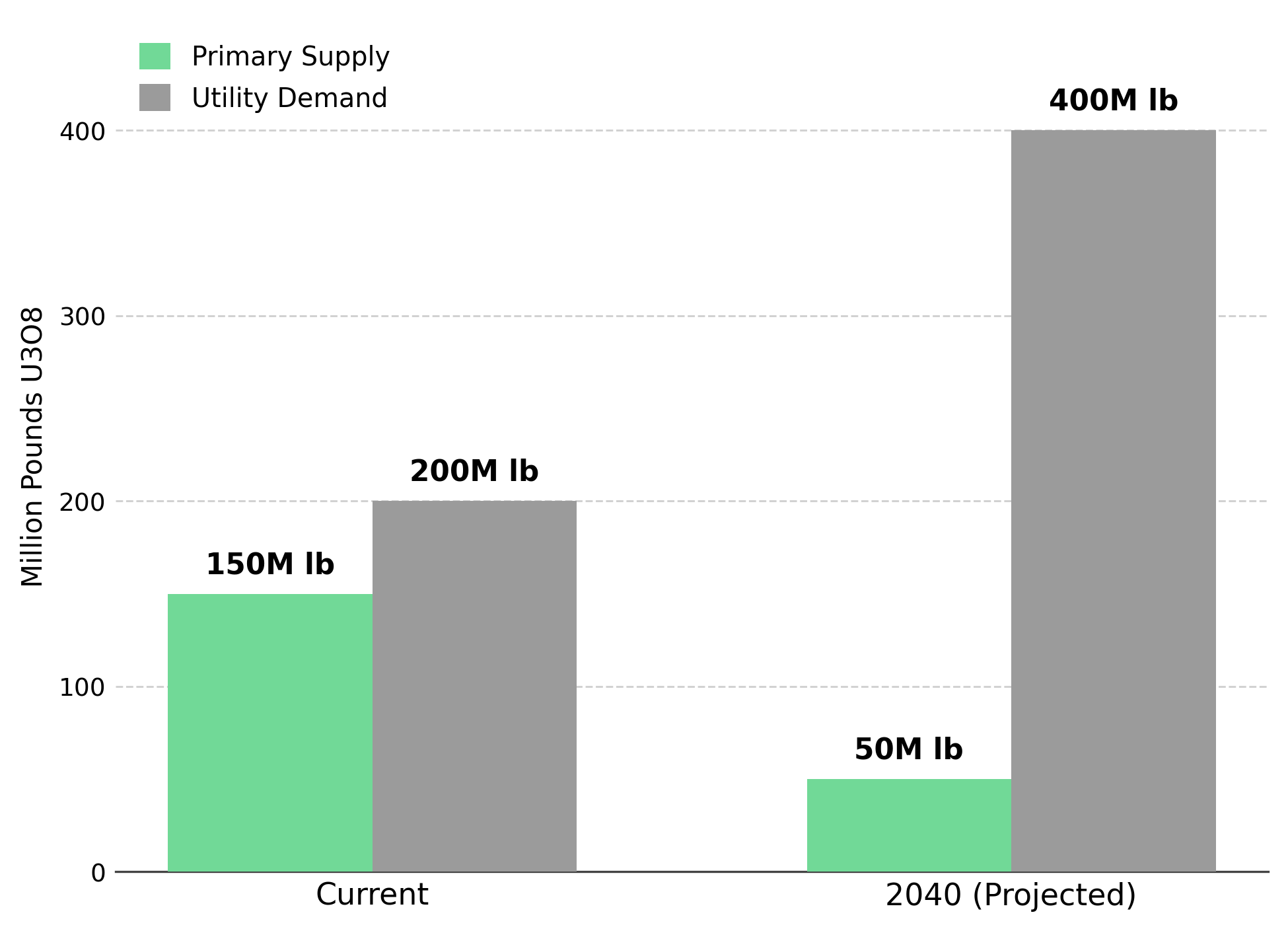
Phil Hoskins, Chief Executive Officer of Atomic Eagle, a uranium developer advancing the Muntanga project in Zambia, frames the scale of the imbalance in global terms:
"Everyone talks about a very obvious supply-demand imbalance that's opening up, and it's an imbalance that's going to continue over time. Roughly 150 million pounds is being produced at the moment on the supply side, and 200 million pounds is being consumed by the nuclear utilities. By 2040, that supply of 150 is going to drop to 50, based on current production, and demand will double to 400 million pounds."
West African Supply Risk Rises as US Permitting Advances and Domestic Uranium Supply Gains Importance
Kazakh production restraint is not the only source of uranium supply risk, as Niger continues to face uncertainty over control and shipments from the SOMAIR mine. Niger and Orano remain in arbitration at the International Centre for Settlement of Investment Disputes over control of the operation, leaving ownership and shipment rights over uranium produced at SOMAIR unresolved. Niger accounts for about 5% of global mined uranium supply, so unresolved SOMAIR offtake and shipment rights add a separate supply risk that would remain even if Kazakh production conditions improve.
US uranium projects are advancing through licensing and federal permitting as policymakers seek additional domestic supply. enCore Energy’s Dewey Burdock project in South Dakota secured a 20-year Nuclear Regulatory Commission source materials license renewal through June 2046 and became the state’s first in-situ recovery uranium project included in the federal FAST-41 program, extending regulatory certainty while improving permitting coordination.
China’s 49 Reactor Approvals Lift Uranium Demand as Russian Import Ban Forces US Fuel Substitution
China's State Council approved four nuclear power projects totaling eight reactor units across four coastal provinces on July 31, expanding the country's pipeline of future uranium demand. The approvals bring China's total to 49 reactor units approved since 2022, extending future uranium requirements while Kazatomprom is reducing its 2026 production target.
US policy is addressing a separate fuel-cycle risk: historical dependence on Russia for close to one quarter of domestic uranium enrichment services. In June, the US Department of Energy's Office of Energy Dominance Financing announced $17.5 billion in conditional loan support for long-lead components for up to ten Westinghouse AP1000 reactors, targeting deployment timelines up to three years shorter and increasing future nuclear fuel requirements if the projects proceed. A full ban on Russian-origin enriched uranium imports takes effect in January 2028, requiring US utilities to replace Russian supply and increasing the strategic value of non-Russian conversion, enrichment, and uranium supply capacity.
US Uranium Production Advances as Scarce Processing Capacity Increases the Value of Domestic Supply
Energy Fuels' White Mesa Mill in Utah is the only fully licensed and operating conventional uranium processing facility in the US, giving conventional mines a scarce domestic processing route. Its Pinyon Plain mine is producing at a reported weighted average cost near $23 per pound, providing Energy Fuels with lower-cost mine supply alongside that processing capacity.
US Uranium Supply Expands as Processing Capacity Falls Short and New Infrastructure Gains Upside
IsoEnergy is combining its Utah uranium portfolio with High-Pressure Slurry Ablation processing technology through DISA Uranium, targeting an 88% recovery rate after metallurgical testing produced a fourfold increase in feed grade. The approach could improve the amount of uranium delivered to downstream processing from the same volume of mined material, addressing part of the domestic processing constraint.
Philip Williams, Chief Executive Officer of IsoEnergy, frames the scale of the processing shortfall the platform addresses:
"There's one processing facility operating today, that's White Mesa. What you have in the United States is a massive disconnect between the domestic requirements and domestic production, and that gap is not going to be filled by just one processing facility. It's got a license for about 8 million pounds a year, and we need 50 million pounds of production in the United States. So a new processing facility is required."
$94 Uranium Term Price Raises Early-Stage Exposure as Project Milestones Drive Valuation
With the long-term uranium price at $94 per pound and Kazatomprom reducing planned supply, earlier-stage developers and explorers provide exposure to future uranium production or discovery but without the near-term cash flow of operating producers. For these companies, drill results, defined resources, permitting milestones, financing capacity, and development timelines provide measurable evidence of project progress before operating cash flow is available.
Underexplored Nunavut Basin Expands Uranium Discovery Potential as Drill Results Test Scale
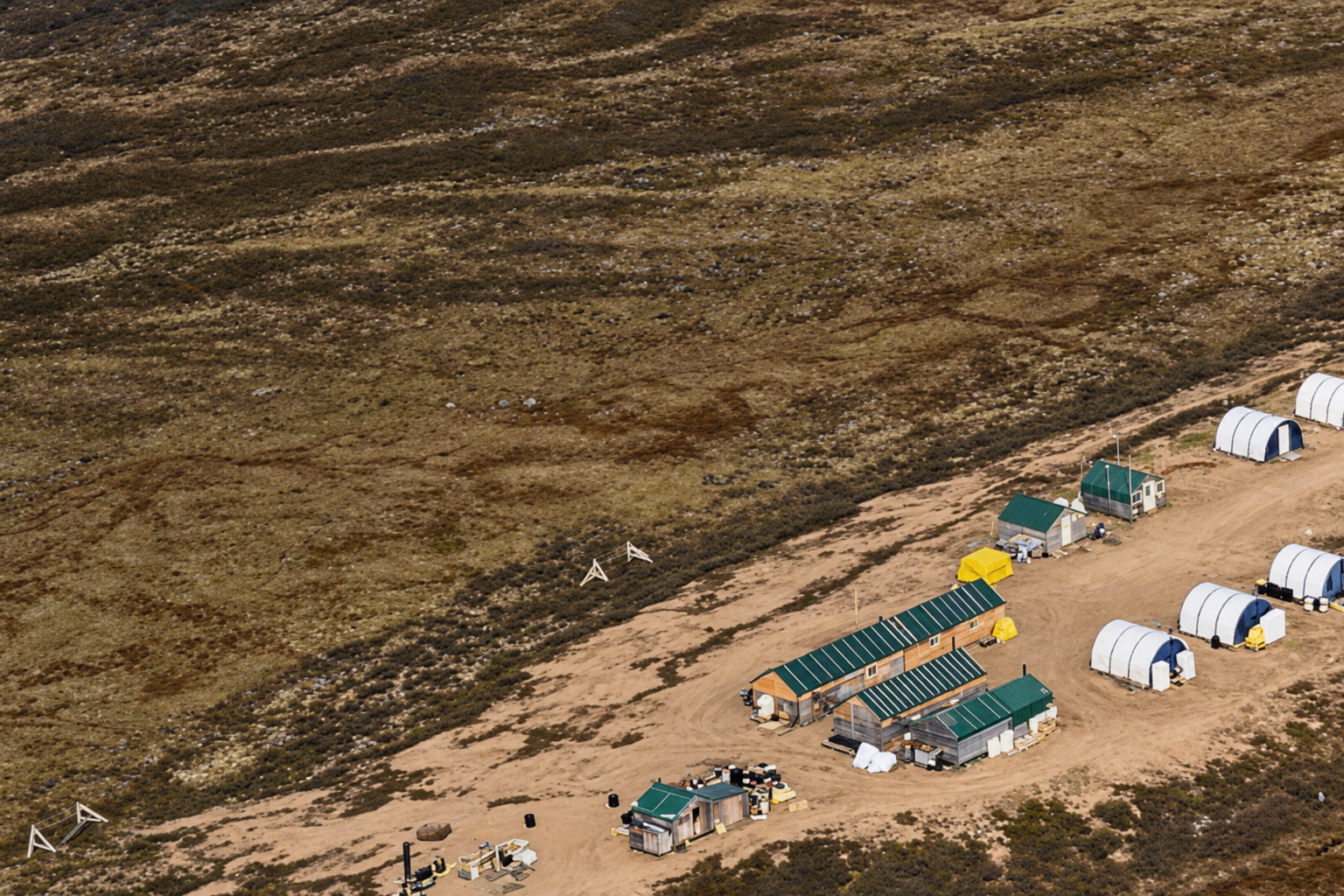
ATHA Energy is exploring the Angilak project in the Angikuni Basin, Nunavut, a basin the company benchmarks against the roughly 50-year maturation arc of the Athabasca Basin, where the Rabbit Lake deposit was found in 1968 and the Hurricane deposit in the 2020s. The project carries no NI 43-101 compliant mineral resource, feasibility study, or net present value at this stage, and the company completed a C$63 million raise in the first quarter of 2026 covering roughly 24 months of exploration.
Troy Boisjoli, Chief Executive Officer of ATHA Energy, situates that positioning within the broader cycle:
"This is an opportunity to build out scale in a basin that is completely under-explored. If you want to draw an analogy, from our team's perspective, we think about it like exploring in the Athabasca Basin circa 1965, it's a massive opportunity across multiple mineralized corridors."
Zambia Development Advances as Higher-Grade Niger Exposure Broadens Optionality
Atomic Eagle is advancing Muntanga in Zambia as its core development-stage project, while an option on the Sitwe license and negotiations concerning Madaouela in Niger provide additional but less certain project exposure. Madaouela carries a disclosed resource of 99.0 million pounds at 1,319 parts per million (ppm), approximately 4.3 times Muntanga’s 309 ppm average grade, although grade alone does not determine project economics.
War Risk Intensifies Nuclear Supply Concerns as Utilities Prioritize Diversified Uranium Sources
Repeated power losses at the Zaporizhzhia Nuclear Power Plant reinforce the value utilities place on secure and geographically diversified nuclear fuel supply chains. International Atomic Energy Agency Director General Rafael Mariano Grossi confirmed on August 6 that Zaporizhzhia lost external power twice in the previous week, bringing complete off-site power losses since the war began to 24, including 12 in the past four months. All six reactors have been shut down since 2022, so the recent power losses do not directly remove operating nuclear generation or create an immediate increase in uranium demand.
Zaporizhzhia adds a security-of-supply consideration to the separate US effort to reduce dependence on Russian nuclear fuel services before the January 2028 import deadline. Repeated security incidents at Zaporizhzhia and restrictions on Russian enriched uranium increase the value of diversified long-term fuel supply for utilities operating reactors over multi-decade lifetimes.
August 21 Output Guidance Tests Uranium’s Supply Thesis & $94 Term-Price Case
The $7.50 gap between spot and long-term uranium prices does not yet prove a sustained supply shortfall, because slower utility contracting could also keep spot prices below the term benchmark. Spot uranium has remained between $85 and $87 per pound since April, while utility contracting has historically remained below the roughly 150-million-pound annual replacement requirement, leaving spot prices range-bound despite the $94-per-pound long-term contract benchmark.
Kazatomprom’s August 21 half-year operating and financial review is the nearest scheduled test of the supply thesis, with production guidance and output performance determining whether planned supply tightens further. A further cut to 2026 production guidance would reduce expected primary supply and strengthen the case for spot uranium moving closer to the $94-per-pound long-term contract price. Stable or higher output, with Kazatomprom assessing sulfuric acid supply as stable for 2026, would weaken the case for a near-term spot move toward that benchmark.
The Investment Thesis for Uranium
- Long-term uranium pricing is being supported by planned supply restraint, with Kazatomprom cutting its 2026 production target even as it assesses sulfuric acid supply as stable.
- Future uranium demand is expanding across multiple markets, with China approving 49 reactor units in 2022 and the US providing $17.5 billion in conditional loan support for up to ten AP1000 reactors.
- Uranium supply remains exposed to concentrated jurisdictional risk, with Kazakh production restraint and unresolved SOMAIR ownership and shipment rights in Niger affecting two significant sources of mined supply.
- The January 2028 ban on Russian-origin enriched uranium creates a defined timetable for US utilities to replace supply from a country that has historically provided close to one quarter of US enrichment services.
- Exploration and development-stage companies provide higher-risk uranium exposure before operating cash flow, with value dependent on drill results, resource definition, permitting, financing, and processing milestones.
- Kazatomprom’s August 21 half-year review is the nearest scheduled test of the supply thesis, with lower production guidance strengthening the case for tighter supply and stable or higher output weakening it.
The $7.50 gap between spot and long-term uranium prices does not, by itself, prove a sustained supply deficit. Kazatomprom’s August 21 half-year review is the next scheduled test, with lower production guidance strengthening the supply-tightening case and stable or higher output weakening it. The producers, developers, explorers, and processors discussed in the article provide different exposures to the same market drivers: lower planned Kazakh supply, continued Chinese reactor approvals, US fuel-cycle policy, unresolved uranium shipment risk in Niger, and nuclear-security concerns in Ukraine.
TL;DR
Uranium’s long-term contract price reached $94 per pound while spot traded near $86.50, leaving a $7.50 gap that points to tighter future supply commitments without yet confirming a sustained deficit. Kazatomprom cut its 2026 production target by 9.4%, China has approved 49 reactor units since 2022, and the US is expanding reactor financing while preparing to restrict Russian enriched uranium imports from January 2028. Niger and Ukraine add separate geopolitical risks, while US processing capacity remains limited. Kazatomprom’s August 21 half-year review is the next key test, with lower output guidance strengthening the supply-tightening case and stable or higher production weakening it.
FAQs (AI-Generated)
Analyst's Notes





Subscribe to Our Channel












Stay Informed