ATHA's RIB North: Where Uranium Width Concentrates Ahead of Delineation


ATHA Energy's RIB North long section shows the widest uranium intercepts near the 2025 discovery, with flank and down-dip drilling testing that pattern.
- Every hole on ATHA Energy's RIB North long section except 1 has intersected uranium mineralization along 1.45 kilometers of strike on the eastern limb of the Mineralized RIB Corridor.
- The 4 widest composite intercepts, ranging from 17.5 to 37.0 meters, occur in a single stretch running from the 2025 discovery hole to a step-out that targeted mineralization approximately 250 meters to the northeast.
- West-southwest of the discovery hole, no intercept has yet exceeded 8.5 meters, although 3 of the new holes on that flank recorded readings above the company's high-grade threshold.
- The widest intercept on the section, 37.0 meters, plots below the discovery hole in basement rocks, and the company marks the section open down-dip beneath the central section and both flanks.
- All widths are core-length gamma-probe measurements pending assays and true-thickness work, with drilling scheduled through the end of September 2026 and 3-dimensional inversion results due in the fourth quarter of 2026.
Reading the Full RIB North Long Section
On the RIB North Long Section, ATHA Energy Corp. (TSX.V: SASK | FRA: X5U | OTCQX: SASKF) released on September 8, 2026, the midpoint of each drill intercept is plotted within a 500-meter-wide window on the eastern limb of the Mineralized RIB Corridor, an 18-kilometer structure at the 100%-owned Angilak Uranium Project in Nunavut. Only 1 hole on the section did not intersect mineralization.
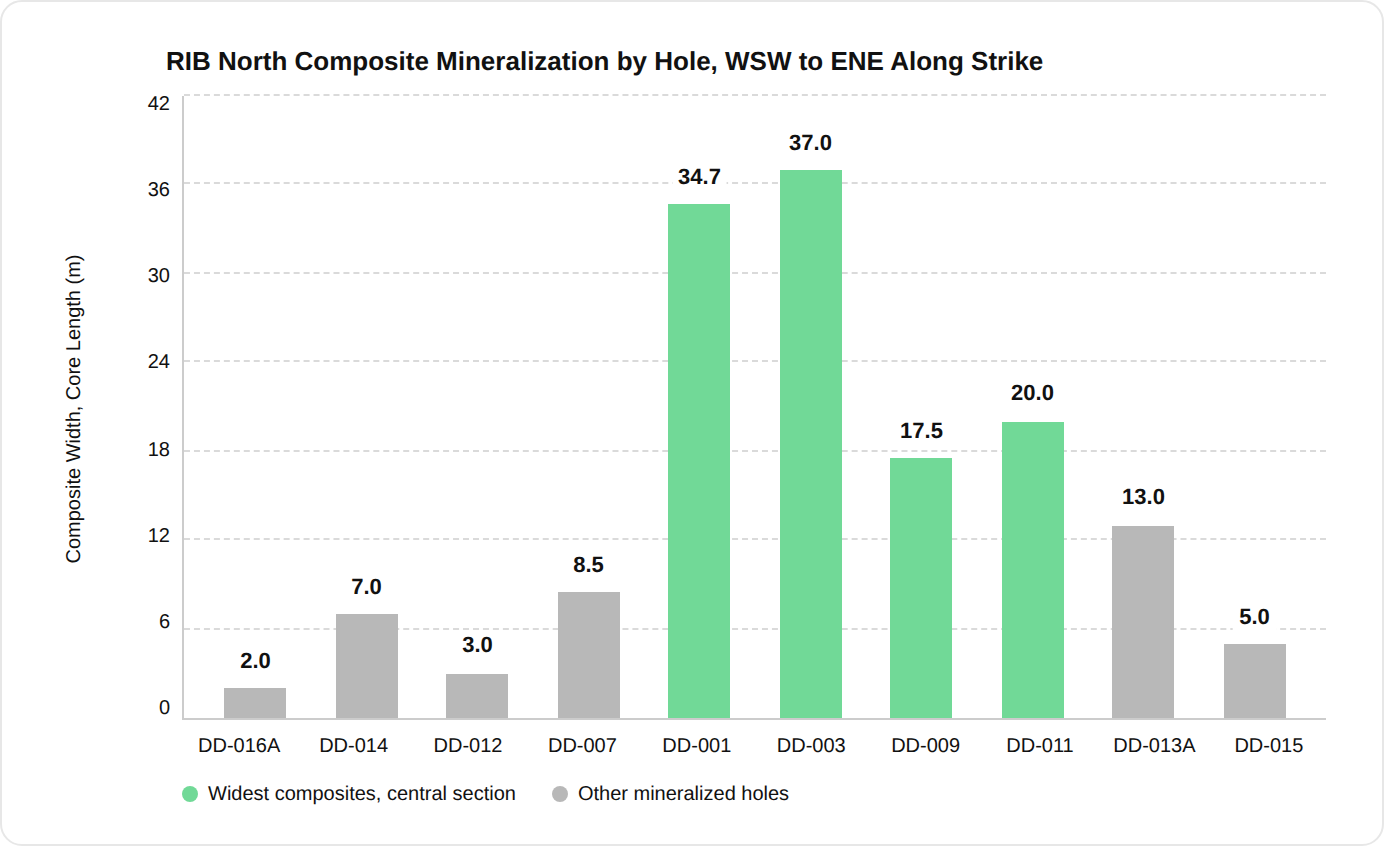
The mineralized holes returned composite uranium grades between 2.0 and 37.0 meters. Each figure is a core-length total of the intervals averaging above 300 counts per second (CPS) on the downhole gamma probe. Ordered from west-southwest to east-northeast, those widths are not evenly distributed along the 1.45 kilometers of strike.
The current data points are spaced 125 to 300 meters apart. At that spacing, each hole is a single observation of a system the company describes as open in all directions, so the pattern below describes the section as drilled to date, not the limits of the mineralization.
The Central Section Holds the Widest Composites
The 4 widest composites on the section fall in one contiguous stretch. It begins at the 2025 discovery hole, which returned 34.7 meters of composite mineralization with grades up to 8.16% uranium oxide over 0.5 meters, and extends east-northeast to a step-out that targeted mineralization about 250 meters along strike from the discovery. Between them, 1 hole returned 37.0 meters, the widest on the section, and another returned 17.5 meters.
The 250-meter step-out shows how a composite figure is assembled. Its 20.0 meters are derived from 15 separate zones between 494.0 and 700.5 meters downhole, with individual intervals of 0.5 to 3.5 meters. The strongest interval, from 661.5 meters to 663.0 meters, averaged 8,453 counts per second (CPS), with a peak of 26,680 CPS. Three intervals in the hole recorded readings above the company's 10,000 CPS high-grade threshold, totaling 1.3 meters.
The discovery hole's 8.16% uranium oxide over 0.5 meters is the only reported assay grade. ATHA lowered its mineralization cutoff from 500 CPS to 300 CPS after 2024 and 2025 assays showed that readings above 300 CPS typically return grades above 0.01% uranium oxide. That threshold confirms the presence of mineralization; it does not convert a CPS reading into a grade.
The Flanks Are Mineralized in Every Hole, but Narrower So Far
West-southwest of the discovery, every hole on the section except 1 is mineralized, but no intercept yet exceeds 8.5 meters. Moving away from the discovery, the 4 mineralized holes returned lengths of 8.5, 3.0, 7.0, and 2.0 meters. The third of these targeted mineralization about 430 meters southwest of the discovery hole, and the fourth plots furthest west-southwest on the section.
Width and intensity do not move together on this flank. The 430-meter step-out peaked at 20,138 CPS within a 1.5-meter interval at 571.5 meters; the hole between it and the discovery area returned a 2.5-meter interval averaging 4,542 CPS, with a peak of 14,592 CPS; and the westernmost hole peaked at 10,986 CPS. All 3 recorded intervals were above 10,000 CPS. On the east-northeast flank, the pattern reverses. A step-out that targeted mineralization about 370 meters along strike from the discovery returned 13.0 meters across 5 zones, and the easternmost hole on the section returned 5.0 meters, yet neither recorded a reading above 10,000 CPS, with peaks of 6,855 CPS and 8,184 CPS.
The flank widths are observations from individual step-out holes, not established trends. They are points on an evolving section and do not show systematic thinning. Dips also vary among the new holes on the section, from -57° to -65°, so core-length widths cannot be compared directly until true thickness is determined.
Depth Is the Section's Other Open Direction
The host geometry changes along strike. The unconformity separating Angikuni Basin sediments from basement lithologies deepens toward the east-northeast, and the intercept midpoints deepen in the same direction, from the west-southwest holes to the 3 easternmost holes. The widest intercept, 37.0 meters, plots well below the discovery hole's intercept, and ATHA marks the section open down-dip beneath the central section and both flanks.
Mineralization at both RIB North horizons is basement-hosted and structurally controlled, associated with strong albite and hematite alteration, graphitic and sulfide-bearing structures, and overprinting silicification. The association is visible at hole level: in 3 of the new holes, graphite is logged at or immediately around the intervals that returned the strongest readings.
Depth also lengthens each test. The 250-meter step-out finished at 717 meters and the easternmost hole at 731 meters, compared with 529 meters for a hole on the shallower west-southwest side, so step-outs to the east-northeast and down-dip require longer holes per data point.
What the Width Pattern Means for ATHA's Next Stage
ATHA's stated objective for 2026 is continuity, with resource delineation to follow. The width distribution maps onto that sequence. The central stretch already contains the broadest composites, while the flank step-outs and the open down-dip area are the parts of the section where additional drilling can test whether the observed width pattern extends beyond the better-defined central area.
Chief Executive Officer of ATHA Energy, Troy Boisjoli, explained why continuity comes before delineation:
"The reason to build out continuity of mineralization is that then you can delineate with a very high degree of confidence. You aren't guessing."
Diamond drilling with 3 rigs is scheduled to continue through the end of September 2026, and 3-dimensional inversion modeling from the Angikuni Basin survey is targeted for the fourth quarter of 2026. ATHA raised $63 million in the first quarter of 2026, and management has stated that 100% of the capital on its balance sheet is focused on advancing Angilak. The next data sets can resolve 3 open points in the section: laboratory assays will assign grades to the gamma intervals; true thickness will show how the core-length widths compare; and further step-outs will show whether flank and down-dip holes return widths comparable to those of the central stretch.
The western-limb horizon is a separate test outside this section. A follow-up hole returned 3.0 meters across 4 zones about 220 meters southwest of the hole that first identified that horizon.
The Investment Thesis for ATHA Energy
- Every hole on the RIB North long section except 1 has intersected uranium mineralization across 1.45 kilometers of strike on the eastern limb of the Mineralized RIB Corridor.
- The widest composite intercepts, from 17.5 to 37.0 meters, occur in a contiguous central stretch between the 2025 discovery hole and a step-out about 250 meters to the northeast.
- The flank holes are mineralized but narrower so far, and 3 of the new west-southwest holes recorded readings above 10,000 counts per second despite their shorter composite widths.
- The section is open along strike and down-dip, and its widest intercept plots below the discovery hole in basement rocks.
- All reported widths are core-length measurements from downhole gamma probes, so laboratory assay grades and true thickness are the next data sets for the system.
- ATHA has stated that continuity will come first in 2026, with resource delineation to follow, with drilling scheduled through the end of September 2026 and 3-dimensional inversion modeling results targeted for the fourth quarter of 2026.
RIB North has moved from a single discovery hole to a mineralized section in which width is concentrated around the discovery and readings above 10,000 counts per second appear on the west-southwest flank. The results from the remaining 2026 holes and the pending assays will show whether that central width profile extends outward and downward as ATHA moves toward delineation.
TL;DR
The RIB North long section is mineralized in every hole but 1 along 1.45 kilometers of strike. The widest composites, up to 37.0 meters, fall between the 2025 discovery hole and a step-out about 250 meters to the northeast, while flank holes return narrower widths, with several readings above 10,000 CPS. The section is open along strike and down-dip. Assays, true thickness, and further step-outs will test whether the central width pattern extends.
FAQs (AI-Generated)
Analyst's Notes





Subscribe to Our Channel




Stay Informed