Kazakhstan’s Proposed China-Russia Uranium Contracts Could Tighten Western Supply Options


Kazakhstan's 28% share of US uranium deliveries raises supply risk as China and Russia contracts compete with Western procurement.
- Kazakhstan supplied 28% of US utility uranium deliveries in 2025, making Kazatomprom's October 7, 2026 shareholder vote on contracts with Chinese and Russia-linked buyers relevant to how much future Kazakh supply remains available to Western utilities.
- The EIA's 2025 Uranium Marketing Annual Report put the weighted average price paid by US utilities at $58.46 per pound, 35% below TradeTech's $89.50 spot price for the week ending August 21, 2026, showing how far current spot pricing has moved above prices embedded in earlier utility deliveries.
- Kazatomprom's first-half 2026 results reported C1 cash costs rising 37% to $24.48 per pound, 13 percentage points faster than the 24% increase in the average weekly uranium spot price over the same period.
- Niger adds a second source of uranium supply uncertainty: the Somaïr permit transfer to state-owned Tsumco SA remains subject to Orano's legal challenge, while the reawarded Madaouela I project requires updated technical work and environmental approvals before development can advance.
- US and Canadian projects could add Western uranium supply over time, but permitting, resource definition, and restart execution leave the timing uncertain as utility procurement planning already extends through 2034.
Kazakh Contract Shift & Uranium Supply: Western Utilities Face Allocation Risk
Kazakhstan accounted for 28% of US utility uranium deliveries in 2025. On October 7, 2026, Kazatomprom shareholders are scheduled to vote on new contracts with a Chinese state buyer and a Rosatom-linked buyer, which could commit additional Kazakh uranium to China and Russia rather than the uncontracted market. If approved, the contracts would reduce the Kazakh uranium remaining available to buyers outside China and Russia, while higher Kazatomprom production costs and delays to additional sulfuric acid capacity constrain how quickly supply can respond. The tighter pool of uncommitted supply increases the strategic value of US and Canadian projects that are already permitted, funded, or newly licensed because they can add Western uranium supply without relying on new Kazakh contracting availability.
In a general meeting notice filed August 21, 2026, Kazatomprom asked shareholders to approve a spot and term uranium contract with China’s State Nuclear Uranium Resource Development Company and a separate supply contract with the Rosatom-linked Uranium One Group. The notice does not disclose volumes or contract duration, so the amount of uranium that could be committed cannot be quantified ahead of the October 7 shareholder vote. If approved, the contracts would commit additional Kazatomprom uranium to Chinese and Russian counterparties, reducing the amount of those volumes potentially available for contracting by other utilities.
Kazakhstan Uranium Costs & Acid-Plant Delay: Input Pressure Outpaces Spot Gains
Kazatomprom's first-half 2026 results reported C1 cash costs, which measure direct mine-site production costs, rising 37% year over year to $24.48 per pound. The average weekly uranium spot price over the same period rose 24% year over year to $85.98 per pound, leaving C1 cash-cost inflation 13 percentage points above the increase in the spot benchmark.
Kazatomprom's August 2026 disclosure moved the targeted commissioning of its TQZ sulfuric acid plant from the first quarter of 2027 to between the third quarter of 2027 and the first quarter of 2028, a six- to 12-month delay. Potential paleontological specimens discovered during earthworks halted construction pending clearance under Kazakhstan's heritage rules. Because sulfuric acid is a key reagent in Kazatomprom's in situ recovery (ISR) operations, the delay prolongs its reliance on externally sourced acid until the TQZ plant is commissioned.
US Uranium Price Gap & Thin Spot Supply: Procurement Costs Face Higher Benchmarks
US utility delivered prices remain well below the current uranium spot benchmark, creating a wide gap between prices paid on earlier deliveries and current spot-market pricing. The EIA's 2025 Uranium Marketing Annual Report shows US utilities paid a weighted average of $58.46 per pound for delivered uranium in 2025, up 11% from 2024 but 35% below TradeTech's $89.50 spot price for the week ending August 21, 2026. The difference does not represent an immediate increase in utility procurement costs because the EIA figure reflects 2025 deliveries rather than uranium purchased at August 2026 spot prices; it instead shows the price exposure utilities could face when future purchases are made closer to current market levels.
Madaouela I: Reawarded Permit Adds a Future Supply Option
Separately, Niger's reaward of the Madaouela I permit creates another potential source of future uranium supply, giving development-stage Atomic Eagle a 60% interest under a new mining convention following an initial $10 million fee. The convention provides two years to update feasibility work and reapply for environmental approvals, establishing a defined pathway toward redevelopment.
The project currently contains a foreign estimate of 116.5 million pounds of uranium oxide at approximately 1,282 parts per million, or 0.13%, which Atomic Eagle plans to convert into a JORC 2012-compliant Mineral Resource estimate in the fourth quarter of 2026. Its historical pit shell used a $70 per pound uranium price, 28% below the current spot benchmark, providing a stronger uranium price backdrop as the company updates costs, recoveries, and mine design assumptions. Completion of the resource update and subsequent technical work would help determine how Madaouela I could contribute additional uranium supply.
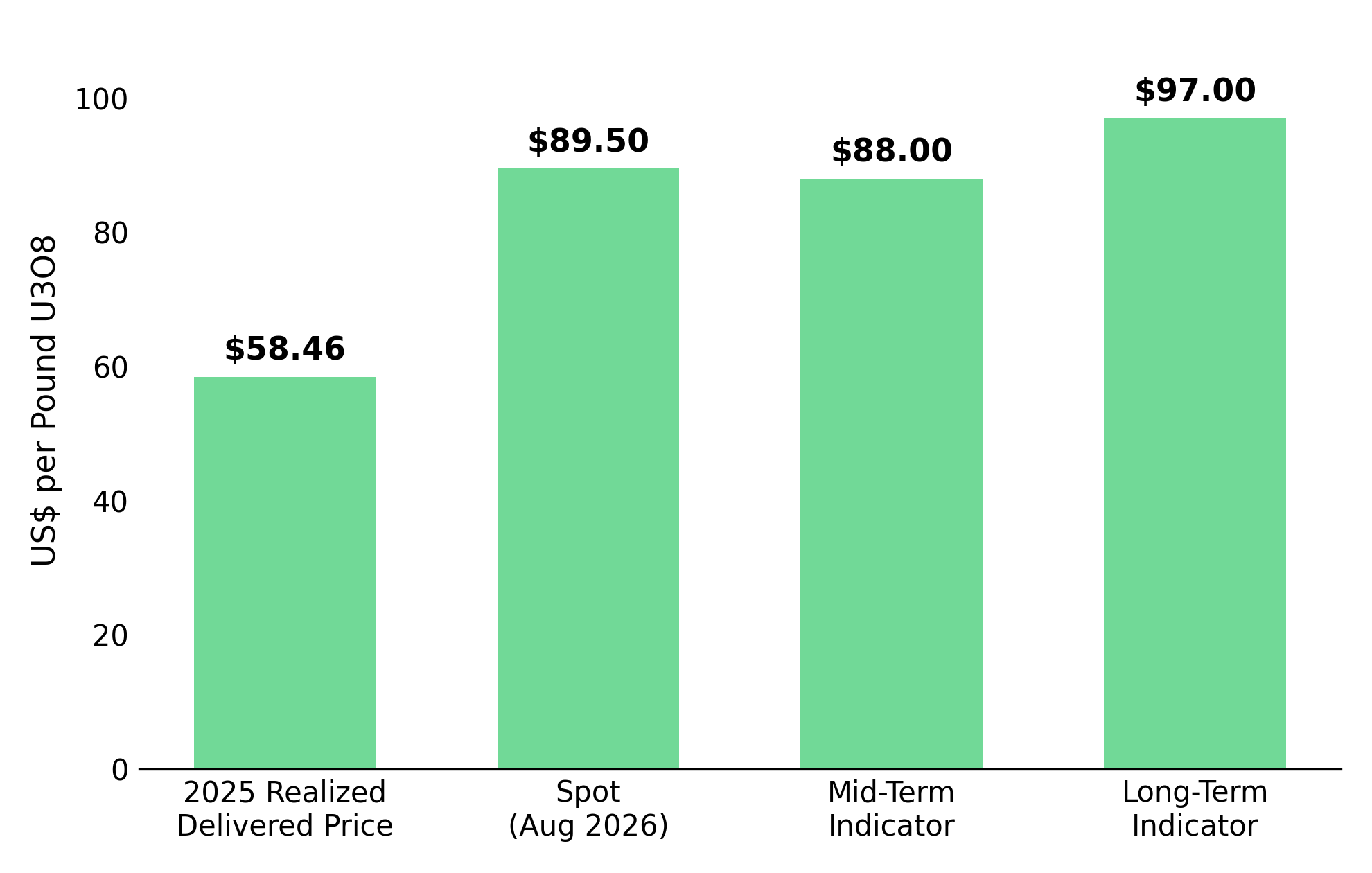
TradeTech's $89.50 spot indicator represented a $1.75 weekly gain and a 4.7% increase since mid-July, reaching a six-month high on reported volume of only 450,000 pounds across five transactions. Limited offers above $90 per pound leave buyers seeking immediate material with fewer alternatives, increasing the potential for relatively small transactions to move the spot benchmark.
Niger Uranium Control Risk: Somaïr Ownership Remains Disputed
Niger adds a separate source of uranium supply uncertainty through the unresolved control of Somaïr. According to Nigerien cabinet minutes published in August 2026, Niger transferred the Somaïr uranium permit to state-owned Tsumco SA, replacing the structure under which Orano held a 63% interest. Orano is contesting the transfer through legal proceedings, leaving control of the operation unresolved and its future production path uncertain.
Phil Hoskins, Chief Executive Officer of Atomic Eagle, frames the kind of buyer now competing for African uranium assets:
"What's really going to drive investments into Africa and into a lot of these different mines is the strategic need for the commodity, for reasons other than just the mining cash flows that our investors are probably looking at. The way the Chinese would look at an investment in an asset like this would be very different to how moms and dads will view the NPVs and cash flows of a mining operation."
Reactor Growth & Long-Term Uranium Pricing: Utilities Secure Supply Through 2034
Longer-dated uranium pricing and utility procurement activity predated the August 2026 developments in Kazakhstan and Niger, showing that buyers were already securing supply beyond the immediate spot market before either event became public.
The International Energy Agency's Electricity 2026 report found that nuclear generation reached a record in 2025 and projected further growth through 2030, with China accounting for approximately 40% of the global increase. TradeTech's $88 per pound mid-term indicator was $1.50 below spot, while its $97 long-term indicator carried a $7.50 premium, showing that longer-dated uranium was priced above the current spot benchmark. Separately, one buyer sought uranium for 2027 delivery, while a US utility requested 400,000 pounds annually from 2030 through 2034. These requests do not represent completed contracts, but they show uranium procurement extending through 2034 rather than remaining concentrated in the current spot market.
US & Canadian Uranium Supply: Projects Could Offset Reduced Kazakh Availability
If additional Kazatomprom volumes are committed to Chinese and Russian counterparties, US and Canadian projects become more relevant as potential sources of uranium for Western utilities. The companies below are at different stages of development, but each controls assets, infrastructure, or permitted capacity that could contribute additional North American supply over time.
Production-stage enCore Energy received a 20-year renewal of its Nuclear Regulatory Commission (NRC) Source Materials License for the Dewey Burdock in situ recovery (ISR) project in South Dakota, extending federal authorization through June 2046. The renewal followed Dewey Burdock's August 2025 addition to the FAST-41 Program and completion of key federal environmental and historic-preservation reviews. The project therefore represents an authorized source of potential US uranium production, although South Dakota state permits remain outstanding and no production timeline has been disclosed.
US Uranium Processing & Mine Restarts: Existing Infrastructure Supports Additional Supply
Energy Fuels operates the White Mesa Mill in Utah, which its latest annual filing identifies as the only fully licensed and operating conventional uranium processing facility in the US. That existing infrastructure gives the company the ability to process uranium-bearing material without requiring construction of a new conventional mill, providing an established processing route as the US seeks additional domestic uranium supply. Mill utilization will depend on sufficient feed being available at economic margins, but the facility reduces one of the infrastructure requirements facing prospective mine restarts.
Development-stage IsoEnergy contributed five permitted, past-producing uranium projects in Utah to DISA Uranium Corporation in exchange for a 33% interest. The transaction closed alongside a $105 million private placement, including $33 million from IsoEnergy, to fund evaluation of mine restarts using High Pressure Slurry Ablation technology. DISA also holds an NRC license covering uranium recovery from abandoned mine waste across multiple sites. Together, the permitted projects, financing, and recovery license provide a pathway toward additional US uranium supply, subject to successful deployment of the recovery technology and restart execution.
Canadian Uranium Exploration: Resource Growth Could Expand Future Western Supply
Exploration-stage ATHA Energy reports approximately 6.8 million acres of uranium-prospective ground, including more than 3 million acres in the Athabasca Basin, giving the company exposure to one of the world's established uranium-producing regions as Western utilities seek additional long-term supply options. At Lac 50, ATHA has disclosed an exploration target of 60.8 million to 98.2 million pounds of uranium oxide.
Troy Boisjoli, Chief Executive Officer of ATHA Energy, describes the competition for prospective Canadian uranium ground:
"The market that we're going into is fantastic, and you see new entrants coming into the basin all the time, or trying to. You have to think about basin prospectivity in the context of what your availability is to secure and enter into exploration strategies in the basin when everything's been staked."
Uranium Supply Catalysts & Contract Allocation: Project Milestones Matter More Than Spot Moves
Over the next two quarters, contract allocation and project-level supply developments provide clearer confirmation of the thesis than short-term movements in the uranium spot price. Kazatomprom's October 7, 2026 shareholder vote will establish whether the proposed Chinese and Russia-linked contracts are approved, while any subsequent disclosure of volumes and delivery periods will show how much Kazakh uranium is committed to those counterparties. Further delay beyond the TQZ sulfuric acid plant's revised third-quarter 2027 to first-quarter 2028 commissioning window would prolong Kazatomprom's reliance on externally sourced acid. In Niger, the outcome of Orano's legal challenge will determine whether control of the Somaïr operation becomes clearer or remains disputed.
The Investment Thesis for Uranium
- Kazakhstan supplied 28% of US utility uranium deliveries in 2025, so additional volumes committed to Chinese and Russia-linked counterparties could reduce the Kazakh uranium available to Western utilities.
- US utilities paid a weighted average $58.46 per pound for uranium delivered in 2025, 35% below TradeTech's $89.50 spot price in the week ending August 21, 2026, showing how far current spot pricing has moved above earlier delivered prices.
- Niger adds a separate supply risk, with control of Somaïr disputed through Orano's legal challenge and Madaouela I requiring updated technical work and environmental approvals before development can advance.
- Federal authorization can advance a US uranium project without establishing a production date, as enCore's Dewey Burdock project still requires South Dakota state-level permits despite its renewed NRC license.
- Utility procurement already extends through 2034, while potential new US and Canadian supply still faces permitting, resource-definition, and restart hurdles that leave production timing uncertain.
Taken together, these shifts make buyer identity an increasingly important pricing factor alongside the size of the uranium supply deficit. As utilities, state-owned entities, and other strategic buyers compete for a shrinking pool of uncommitted Kazakh and Nigerien uranium, the market may become more sensitive not only to how much material is available, but also to who can secure it, under what terms, and with what degree of supply certainty.
TL;DR
Kazakhstan supplied 28% of US utility uranium deliveries in 2025, making proposed contracts with Chinese and Russia-linked buyers important to future Western supply availability. US utilities paid $58.46 per pound for delivered uranium in 2025, 35% below an August 2026 spot price of $89.50. Kazatomprom is also facing higher production costs and a delayed sulfuric acid plant. Niger adds legal and development uncertainty at Somaïr and Madaouela I. Meanwhile, uranium procurement extends through 2034, but potential new US and Canadian supply still faces permitting, resource-definition, processing, and restart hurdles.
FAQs (AI-Generated)
Analyst's Notes





Subscribe to Our Channel




.jpg)


.png)

Stay Informed