




New Found Gold: Emerging Producer in Rising Market



New Found Gold transitions to gold producer with November 2025 Hammerdown pour, positioning to develop high-grade Queensway project as gold holds near $4,200/oz.
- New Found Gold poured first gold at Hammerdown on November 12, 2025, transitioning from developer to producer with targeted full production by early 2026 at 50,000 ounces annually.
- The November 2025 acquisition of Maritime Resources created an emerging Canadian gold producer with near-term cash flow to fund the high-grade Queensway Gold Project development.
- The Q3/25 Preliminary Economic Assessment demonstrates 1.5 million ounce production over 15 years at all-in sustaining costs of US$1,256 per ounce, with phased development requiring C$155 million initial capital.
- New Found Gold holds approximately C$87 million in cash and marketable securities as of September 30, 2025, providing development capital while Hammerdown generates cash flow.
- Operations in Newfoundland, ranked a Top 10 mining jurisdiction globally by the Fraser Institute, coincide with gold prices holding near US$4,200 per ounce amid expectations for interest rate cuts.
Market Context for New Producer Entry
New Found Gold Corp. enters production during a supportive period for gold producers, with spot prices at $4,195 per ounce as of December 9, 2025. The precious metals complex has strengthened on expectations of U.S. interest rate cuts, with with market expectations favoring monetary easing at the upcoming central bank meeting. This macroeconomic backdrop typically benefits gold producers, particularly those with low-cost operations and development projects leveraged to higher gold prices.
The company's November 2025 transition to producer status through the Hammerdown Gold Project represents strategic timing. Production commencement coincides with market conditions that historically support both operating margins for existing mines and financing availability for development projects. Silver's surge to $54 per ounce in October 2025 underscores broad-based strength in precious metals, driven by weak U.S. private payrolls data that reinforced rate-cut expectations.
For New Found Gold, this environment provides dual advantages: immediate revenue generation from Hammerdown production and enhanced project economics for the larger Queensway Gold Project. The company's positioning in Newfoundland, Canada, offers jurisdictional stability that becomes increasingly valuable during periods of economic uncertainty when investors prioritize political risk alongside commodity price exposure.
Company Overview: Dual-Asset Canadian Gold Strategy
New Found Gold Corp. operates two complementary gold assets in central Newfoundland, Canada. The company trades on the TSX Venture Exchange under symbol NFG and on the NYSE American under NFGC, with a market capitalization of approximately C$1.1 billion as of November 27, 2025. The capital structure includes 337.4 million basic shares outstanding, 10.1 million options, 2.4 million restricted share units, and 15.5 million warrants, with major shareholders including Eric Sprott at 19 percent and Dundee Corporation at 11 percent.
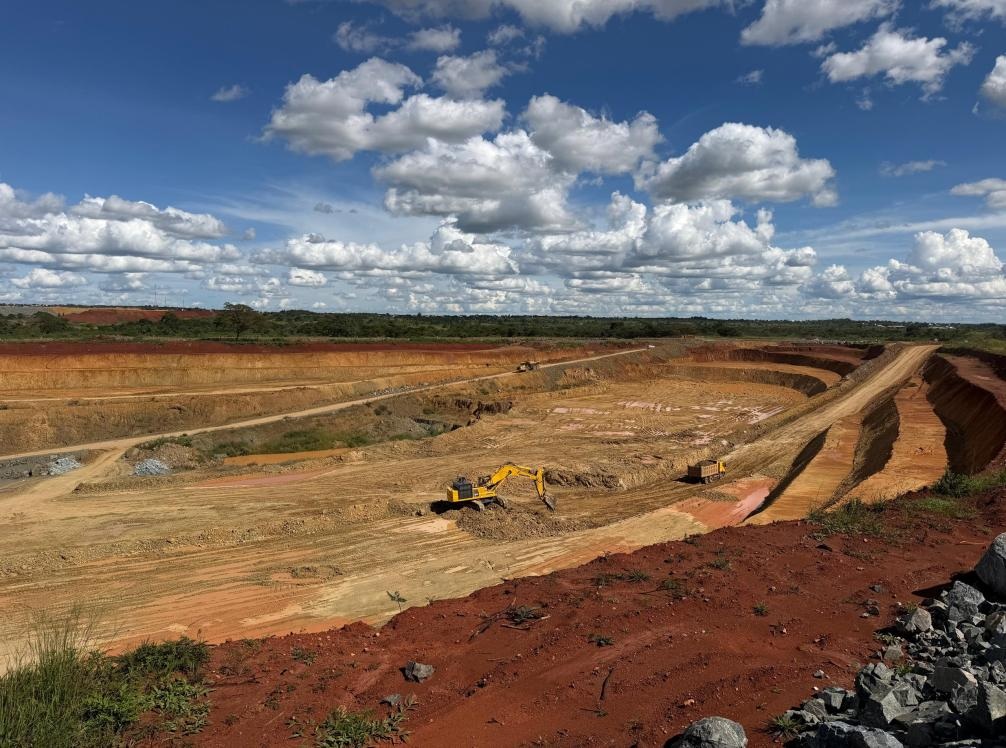
The Hammerdown Gold Project, acquired through the November 13, 2025 completion of the Maritime Resources transaction, provides immediate production. This fully permitted, high-grade open pit operation includes existing mill infrastructure rated at 1,300 tonnes per day nominal throughput. Stockpile processing commenced in the second half of 2025, with the mill transitioning to Hammerdown feed during that period. The project holds Proven and Probable mineral reserves of 1.9 million tonnes at 4.46 grams per tonne gold, containing 272,000 ounces.
The Queensway Gold Project represents the company's primary growth asset, with a Preliminary Economic Assessment completed in Q3/25 outlining 1.5 million ounces of gold production over a 15-year life of mine. Located 15 kilometers west of Gander, Newfoundland, along the Trans-Canada Highway, Queensway benefits from established infrastructure including renewable power, Gander International Airport, and deep shipping ports. The project's Indicated Mineral Resources total 18,038 thousand tonnes at 2.40 grams per tonne gold containing 1,392,000 ounces, as of March 15, 2025 with an additional 10,709 thousand tonnes at 1.77 grams per tonne in the Inferred category containing 608,000 ounces, effective March 15, 2025.
Strategic Significance: Maritime Acquisition Creates Producer
The November 13, 2025 completion of the Maritime Resources acquisition fundamentally repositioned New Found Gold from an exploration and development company to an emerging gold producer.
CEO Keith Boyle stated that:
"Since day one, the objective of the new management team at New Found Gold has been to advance Queensway to cash flow."
This transaction delivers that objective ahead of Queensway's own production timeline. Hammerdown's near-term production provides several strategic benefits beyond immediate cash generation. The operating experience gained from ramping production at a permitted mine with existing infrastructure creates operational capability that transfers to Queensway's future development.
The timing of first gold pour in November 2025 positions cash flow generation to support Queensway's permitting, engineering, and early construction phases. The 2022 Feasibility Study for Hammerdown projected 50,000 ounces of annual production at an all-in sustaining cost of US$912 per ounce. At current gold prices near US$4,200 per ounce, operating margins significantly exceed the feasibility study base case, potentially accelerating the timeline for Queensway Phase 1 construction. The acquisition also consolidated the Newfoundland gold district under single ownership, eliminating potential operational conflicts and enabling integrated planning across both projects.
Queensway Development: Phased Approach to Production
The Queensway Gold Project's Preliminary Economic Assessment, completed in Q3/25, outlines a three-phase development strategy designed to minimize initial capital requirements while rapidly advancing to cash flow. Phase 1 involves a 700-tonne-per-day high-grade open pit mine with custom toll milling at an offsite facility. This approach requires approximately C$155 million in initial capital and targets average annual production of 69,000 ounces during years one through four at an all-in sustaining cost of US$1,282 per ounce.
Phase 2 growth capital of C$442 million expands production to 7,000 tonnes per day through construction of an on-site processing plant, generating average annual production of 172,000 ounces at US$1,090 per ounce all-in sustaining costs during years five through nine. This phase incorporates in-pit tailings deposition, reducing environmental footprint and minimizing surface disturbance. Phase 3 adds underground mining with C$143 million in growth capital to access high-grade zones at depth, extending mine life and maintaining production levels.
The phased approach provides several advantages for investors and the company. Lower initial capital reduces execution risk and financing requirements, with Hammerdown cash flow potentially funding a material portion of Phase 1 development. The PEA base case at US$2,500 per ounce gold generates after-tax net present value at five percent discount rate of C$743 million with 56 percent internal rate of return. Sensitivity analysis shows that each US$100 increase in gold price adds approximately US$89 million to after-tax NPV, creating significant leverage to the current price environment near US$4,200 per ounce.
Exploration Upside: Camp-Scale Potential
Beyond the defined mineral resources included in the Queensway PEA, New Found Gold controls a 110-kilometer strike length along two major structural corridors: the Appleton Fault and JBP Fault. The company emphasizes that initial mineral resource estimate sits within less than five percent of this total strike extent, with numerous additional gold targets identified across the property. This camp-scale potential represents material exploration upside that could extend mine life and production rates beyond current projections.
Recent drilling results demonstrate the system's continuity and grade potential. Channel sampling at the Iceberg excavation returned intercepts including 117.0 grams per tonne gold over 2.16 meters and 64.8 grams per tonne gold over 5.21 meters. Grade control drilling at the Keats excavation intersected 219.01 grams per tonne gold over 9.35 meters and 104.76 grams per tonne gold over 10.20 meters. The Dropkick zone, located 11 kilometers from the AFZ Core area, returned drill results including 42.79 grams per tonne gold over 14.95 meters.
The Queensway Development Schedule shows permitting and engineering activities extending through 2026 and into 2027, with Phase 1 construction commencing in Q1 2027 and production beginning in Q1 2028. Concurrent with this development timeline, ongoing exploration programs target resource expansion and new discovery. For investors, this creates potential for mineral resource growth announcements during the development period, potentially enhancing project economics before production commences.
Jurisdictional Advantages: Newfoundland's Mining Framework
Newfoundland and Labrador consistently ranks among the top global mining jurisdictions in the Fraser Institute's Annual Survey of Mining Companies. The province's 2025 ranking in the top 10 globally reflects several factors relevant to New Found Gold's operations. The provincial government has established a stated goal to build five new mines by 2030, demonstrating political commitment to mining sector development.
Infrastructure access distinguishes Newfoundland from many exploration and development jurisdictions. The Trans-Canada Highway provides year-round road access, eliminating seasonal transportation constraints common in northern Canadian projects. Gander International Airport offers direct connections to major eastern Canadian and U.S. cities, facilitating personnel movement and equipment transport. Deep shipping ports at multiple locations enable concentrate shipment and supply delivery without requiring construction of port facilities.
The jurisdiction's skilled mining workforce, developed through decades of mining activity in the province, provides access to experienced personnel without requiring fly-in/fly-out camps from distant labor markets. This combination of infrastructure, political support, permitting clarity, and workforce availability reduces both development risk and operating costs compared to frontier jurisdictions. For investors evaluating development projects, jurisdictional considerations often carry equal weight to geology and economics.
Financial Position & Capital Requirements
New Found Gold reported cash and marketable securities of approximately C$87 million as of September 30, 2025, providing working capital for ongoing operations and development activities. The company's capital structure as of November 27, 2025 shows 337.4 million basic shares outstanding with 365.4 million fully diluted shares when including options, RSUs, and warrants.
The Queensway Phase 1 initial capital requirement of C$155 million positions the company to pursue development financing through multiple avenues. Hammerdown's production cash flow provides internal funding capacity, while the company's existing treasury covers permitting, engineering, and early-stage construction activities. The project's robust economics with 56 percent internal rate of return at base case US$2,500 per ounce gold position Queensway favorably for potential debt financing.
Investor consideration of New Found Gold's financial position should account for the dual-asset cash flow profile. Hammerdown transitions from capital consumption to cash generation during the H2/25 to early 2026 period, reducing consolidated cash requirements as Queensway advances through permitting and engineering. The 2022 Hammerdown Feasibility Study projected average annual free cash flow of C$41.4 million at the base case gold price.
The Investment Thesis for New Found Gold
- Immediate production revenue from Hammerdown's November 2025 first gold provides cash flow to fund Queensway development, reducing reliance on equity financing during the construction period.
- Phased development strategy at Queensway minimizes initial capital to C$155 million while targeting 69,000 ounces annual production in years 1-4, de-risking execution compared to single-phase large-scale developments.
- Significant gold price leverage through low base-case costs of US$1,256/oz AISC creates outsized margin expansion at current prices near US$4,200/oz, with each US$100 price increase adding approximately US$89M to after-tax NPV.
- Top-tier jurisdiction in Newfoundland provides infrastructure access, political stability, and streamlined permitting, reducing non-technical development risks common in frontier mining regions.
- Exploration upside potential across 110km strike length with initial resource representing less than 5% of total property provides organic growth opportunity beyond current PEA mine plan.
- Consider accumulation in mid-cap gold producers if sustained gold prices above US$3,500/oz drive re-rating of development projects with near-term production timelines and jurisdictional advantages.
New Found Gold presents an investment profile combining immediate production with leveraged exposure to development success and gold price appreciation. The November 2025 achievement of first gold pour at Hammerdown transitions the company to cash-flowing producer status, while the larger Queensway project advances through permitting toward 2027 construction.
The company's positioning targets investors seeking exposure to Newfoundland's emerging gold district through a vehicle with near-term cash flow, development upside, and exploration potential. Hammerdown's rapid production ramp targeting full production by early 2026 provides proof of the management team's operational capability while generating revenue to support Queensway development.
For investors evaluating New Found Gold, the investment decision centers on assessment of development execution risk, confidence in Queensway's permitting timeline, and outlook for sustained gold prices. The company's established infrastructure, favorable jurisdiction, experienced management team, and near-term production reduce typical development-stage risks. The current gold price environment near US$4,200 per ounce provides substantial margin above Queensway's projected costs.
TL;DR
New Found Gold transitioned to gold producer status with November 2025 first gold pour at Hammerdown, ramping to 50,000 ounces annually by early 2026. The Maritime Resources acquisition creates cash flow to fund development of the larger Queensway Gold Project, which targets 2027 construction following completion of Q3/25 PEA showing 1.5 million ounce production over 15 years at US$1,256/oz costs. With C$87 million treasury and gold prices near US$4,200/oz, the company offers combined production, development, and exploration exposure. Initial Queensway capital requirement of C$155 million for Phase 1 construction enables 69,000 ounce annual production.
FAQs (AI-Generated)
The company targets full production at Hammerdown by early 2026, ramping from November 2025 first gold pour to the feasibility study rate of 50,000 ounces annually.
Permitting and engineering activities continue through 2026-2027, with Phase 1 construction commencing Q1 2027 and first production targeted for Q1 2028.
Phase 1 initial capital is estimated at C$155 million to construct a 700-tonne-per-day operation producing approximately 69,000 ounces annually in years 1-4.
Indicated resources total 18.0 million tonnes at 2.40 g/t gold containing 1.4 million ounces with Inferred resources of 10.7 million tonnes at 1.77 g/t containing 608,000 ounces.
The PEA base case used US$2,500/oz gold; current prices near US$4,200/oz add approximately US$152 million to after-tax NPV based on project sensitivity.
Analyst's Notes





Subscribe to Our Channel







Stay Informed






















