




New Found Gold & Newfoundland: The Permitting & Power Advantage Canada's Miners Are Searching For


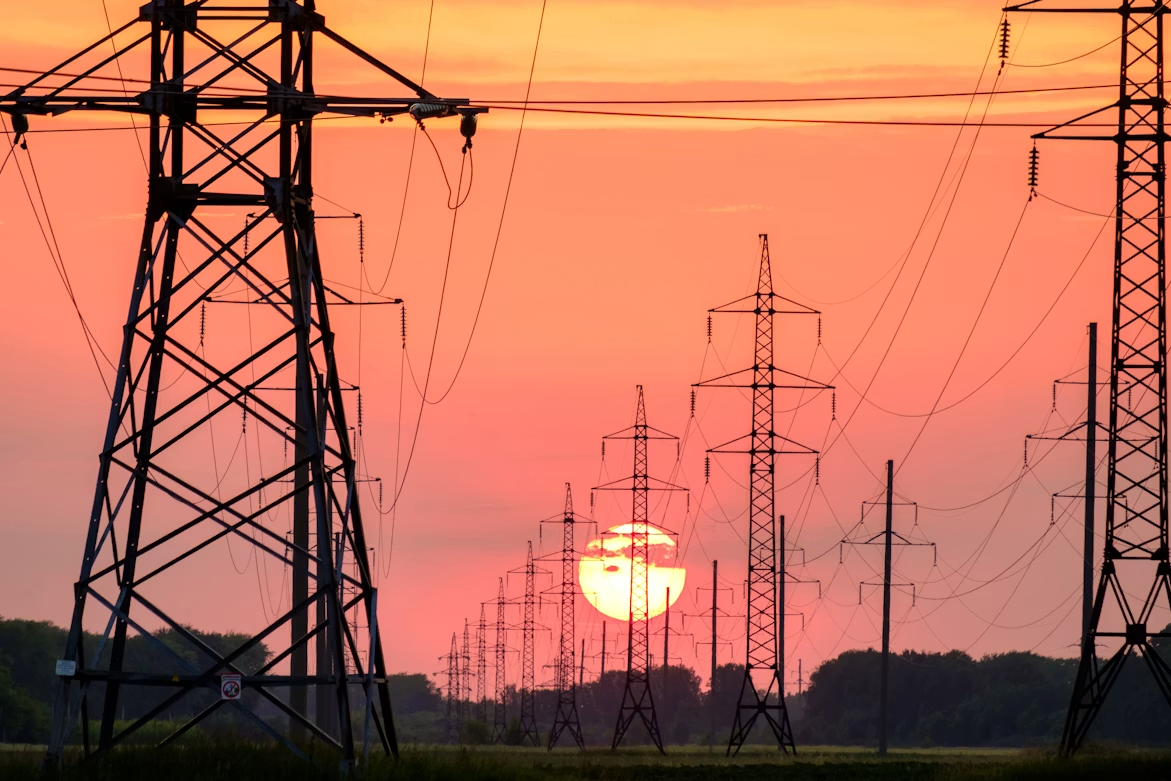
New Found Gold leverages Newfoundland’s fast permitting, existing power lines, and infrastructure to target lower-cost 2029 gold production.
- New Found Gold's Queensway Gold Project targets 2029 production by leveraging Newfoundland's collaborative permitting process and the fully permitted Pine Cove Mill, compressing development timelines by approximately three years.
- Newfoundland ranks among the top 10 jurisdictions globally in the Fraser Institute's 2025 policy perception index, with environmental assessment approvals achieved in as few as 45 days, compared to multi-year timelines in other Canadian provinces.
- Queensway sits directly on the Trans-Canada Highway with existing transmission lines crossing the property, eliminating road construction and power line extension costs that typically burden greenfield projects.
- Skilled workers currently on rotational schedules in other provinces are returning to Newfoundland, with companies receiving hundreds of resumes for advertised positions as construction at Valentine Lake Mine builds transferable capacity on the island.
- The province's 2026 budget forecasts C$283.3 million in mineral exploration spending, up 13% from 2025, supporting the government's target to build five new mines by 2030.
New Found Gold Corp.’s (TSX-V: NFG | NYSE American: NFGC) Queensway Gold Project demonstrates how Newfoundland and Labrador's regulatory efficiency and existing infrastructure can compress development timelines and capital requirements, while most Canadian mining projects face the opposite. The province's environmental assessment process, existing transmission lines running through the Queensway site, and the fully permitted Pine Cove Mill position the company to target 2029 production at a capital intensity significantly below greenfield equivalents in jurisdictions where permitting alone can consume half a decade.
The contrast matters because industry leaders identify permitting certainty as the single biggest lever to unlock mining investment in Canada. Mining has shifted from a cyclical commodity story to a strategic national-interest issue linked to electrification and supply chain security, with global electricity demand rising by approximately 4% annually and requiring roughly 60 million kilometres of new transmission lines by 2035.
Newfoundland and Labrador ranks among the top 10 jurisdictions globally in the Fraser Institute's 2025 Annual Survey of Mining Companies' policy perception index. The province's 2026 budget, tabled April 29, 2026, forecasts mineral exploration spending of C$283.3 million, a 13% increase from 2025's C$248.8 million, with targeted investments including C$1.3 million for critical mineral exploration and C$900,000 for iron ore development in Labrador. The budget anticipates that the first full year production from Valentine Gold Mine and Hammerdown Gold Mine will boost provincial mineral shipments in 2026, following 2025's estimated C$4.6 billion, up 9% from 2024.
Regulatory Efficiency as Economic Infrastructure
New Found Gold Chief Executive Officer Keith Boyle described Newfoundland's permitting approach as fundamentally different from other jurisdictions. Boyle has permitted projects globally and across three other Canadian provinces, giving him direct comparative experience with regulatory systems.
"The thing about Newfoundland that I've noticed, and I've permitted in many jurisdictions, I mean globally, but in Canada in particular, three other jurisdictions: this one here, the government works with you prior to you submitting your application. They help you get all the kinks out. And we're living that now with our Queensway project prior to us submitting our environmental assessment."
The company completed environmental baseline work for Queensway in early 2026 and is targeting submission of its environmental assessment application in the second quarter of 2026, following a blueprint established by Firefly Metals' Green Bay copper gold project, which received environmental assessment release in 45 days for a significantly expanded operation covering a new mill, new tailings dam, and mine expansion.
The distinction between Newfoundland and other Canadian provinces extends beyond speed to structural differences in Indigenous consultation requirements. Boyle noted that properties in other Canadian provinces might involve three different First Nations with overlapping land claims, slowing government willingness to advance projects, while Newfoundland has two First Nations groups, one with a defined southwestern territory and another with province-wide engagement but no associated land claims. The structural difference changes how companies approach consultation and project advancement.
Boyle emphasised that the difference does not diminish consultation obligations but changes the complexity of stakeholder coordination:
"You do the right things. We engage them. We consult with them. But it's much different in Newfoundland. And so you can advance projects in a very different way.”
Power Lines, Highways, & the Infrastructure Discount
The Queensway Gold Project sits directly on the Trans-Canada Highway 15 kilometres west of Gander, with existing transmission lines running through the planned site infrastructure. The infrastructure positioning eliminates two capital line items that typically appear in greenfield project feasibility studies: road construction and transmission line extension. Boyle quantified the access advantage by noting the project is less than 20 kilometres from Gander International Airport and less than 60 kilometres from a port capable of receiving materials shipments.
Newfoundland's existing infrastructure network provides operational advantages that other Canadian jurisdictions lack. The Trans-Canada Highway connects New Found Gold's Pine Cove and Hammerdown operations via approximately 95 kilometres of paved road, enabling what the company describes as a hub-and-spoke mine strategy, in which Queensway ore can be transported to the fully permitted Pine Cove Mill for processing during Phase 1 development.
Boyle described the infrastructure positioning as exceptional for a greenfield development:
"It doesn't get much better than that in terms of infrastructure. We've got a hydroelectric line that goes right through the property that we have to move."
Industry analysis identifies shared infrastructure as a constraint holding back Canadian critical minerals projects, citing northwestern British Columbia as a region rich in mineral potential but hamstrung by power shortages, where multi-user projects such as the proposed North Coast Transmission Line will determine whether copper potential translates into production.
The Pine Cove Advantage & Capital Compression
New Found Gold's acquisition of Maritime Resources in 2024 delivered a fully licensed and permitted mill and tailings facility, compressing the Queensway development timeline by approximately 3 years. The elimination of mill construction from the initial capital program shifts the project's risk profile from construction execution to operational ramp-up.
Boyle explained how the permitted infrastructure changed the development path:
"For us, it was the acquisition of Maritime Resources, where we acquired the Pine Cove Mill, so we got a permitted mill and tailings facility that for us shortcutted the development of Queensway by about 3 years because we now don't have to build a mill on site.”
The strategy targets production at Hammerdown by the end of 2027, generating cash flow to fund Queensway development, with Queensway Phase 1 ore-to-mill targeted for late 2029. High-grade Queensway ore averaging 12 grams per tonne gold in the first years of production will feed the Pine Cove Mill before transitioning to an expanded on-site processing facility.
Workforce Availability & the Repatriation Factor
The infrastructure advantage extends to human capital. Boyle described inbound contact from skilled workers currently employed on rotational schedules in other provinces who want to return to Newfoundland.
"When you fly into any one of the major airports in Newfoundland, half the seats on the plane are people who are flying in and out to go work somewhere else in Canada on a rotation basis. We're getting inbound calls now of people who want to come home, skilled labour that want to come home."
New Found Gold and Firefly Metals reported receiving hundreds of resumes for advertised positions, in contrast to jurisdictions where workforce scarcity inflates operating costs and construction timelines. The repatriation dynamic creates a self-reinforcing cycle as new mines enter production, with Valentine Lake Mine's construction phase having built experience and capacity on the island, workers then available for subsequent projects, including New Found Gold's Hammerdown ramp-up and Queensway development.
Comparative Positioning & Policy Commitment
Newfoundland and Labrador ranks among the top 10 jurisdictions globally in the Fraser Institute's 2025 Annual Survey of Mining Companies' policy perception index, positioning the province ahead of most Canadian jurisdictions.
The provincial government's stated target of building 5 new mines by 2030 signals a policy commitment beyond rhetoric. The 2026 budget's C$1.3 million allocation for critical mineral exploration through the Junior Exploration Assistance Program and C$400,000 to identify new critical mineral targets demonstrates targeted support for early-stage work that feeds the development pipeline, while C$900,000 for Labrador iron ore development, including transmission studies, shows willingness to address infrastructure gaps that constrain larger projects.
What This Signals for Canadian Mining Capital Allocation
Newfoundland and Labrador's regulatory approach, existing infrastructure, and demonstrated track record compressing development timelines from environmental assessment to production offer a template other Canadian provinces could replicate if permitting certainty became a policy priority rather than a project-by-project outcome.
New Found Gold's progression from exploration story to near-term producer exemplifies how jurisdictional efficiency, combined with strategic asset acquisition, compresses capital requirements and timeline risk. The company recently announced a C$205 million financing, which Boyle described as completing the funding package required to achieve cash flow.
"We just announced a C$205 million financing, which is the financing to build Queensway. We're fully funded now to get to cash flow. That cash flow is going to come towards the end of next year.”
Jurisdictions that can permit, build, and operate faster than competitors will capture investment as global electricity buildout accelerates. Newfoundland and Labrador's combination of regulatory efficiency, existing infrastructure, a skilled workforce, and a willingness to support mining development positions the province to benefit as capital seeks jurisdictions where project timelines compress rather than extend.
What to Watch Next
New Found Gold's environmental assessment submission for Queensway, targeted for the second quarter of 2026, will test whether the company can achieve compressed approval timelines. The Hammerdown operation's progression to commercial production in the second half of 2026 will provide the first validation of cash flow for the development strategy.
Queensway drilling results through 2026 and early 2027 will determine whether the resource base expands sufficiently to support Phase 2 mill construction and extended mine life beyond the preliminary economic assessment (PEA) scope.
At the provincial level, the 2026 mineral exploration spending outcome, forecast at C$283.3 million, will demonstrate whether Newfoundland's permitting efficiency and infrastructure advantages translate to sustained capital deployment by junior and intermediate companies beyond the near-term production pipeline.
FAQs (AI-Generated)
Analyst's Notes





Subscribe to Our Channel





Stay Informed






















