Rising Uranium Inventories Buy Time, but New Mines Typically Need 15-20 Years



US utilities report up to 186.3 million pounds of unfilled uranium needs through 2035; contracting and mine readiness will shape future supply.
- The US Energy Information Administration’s (EIA) 2025 Uranium Marketing Annual Report, released July 29, 2026 and reissued August 13, 2026, put commercial inventories at 170 million pounds of triuranium octoxide equivalent at year-end 2025, up 9% from 2024.
- At year-end 2025, EIA reported maximum unfilled US utility requirements of 186.3 million pounds for 2026-2035. Because the figure covers ten delivery years and reflects planned needs, it does not represent an immediate shortage or signed orders.
- Unfilled requirements rise from 2.4 million pounds in 2027 to 37.2 million pounds in 2034. Contracts for those later years could give prospective mines the revenue visibility needed to seek financing.
- Long-term agreements accounted for 87% of uranium delivered to US reactor operators in 2025. Prices paid under existing agreements do not establish the terms available for new contracts that could finance future mines.
- A prospective mine can meet a utility’s delivery window only if its resource, permits, financing and construction schedule support production in time. Inventories may defer procurement, but they cannot shorten development steps.
Higher Uranium Stocks Give Utilities Time, but Access Depends on Ownership
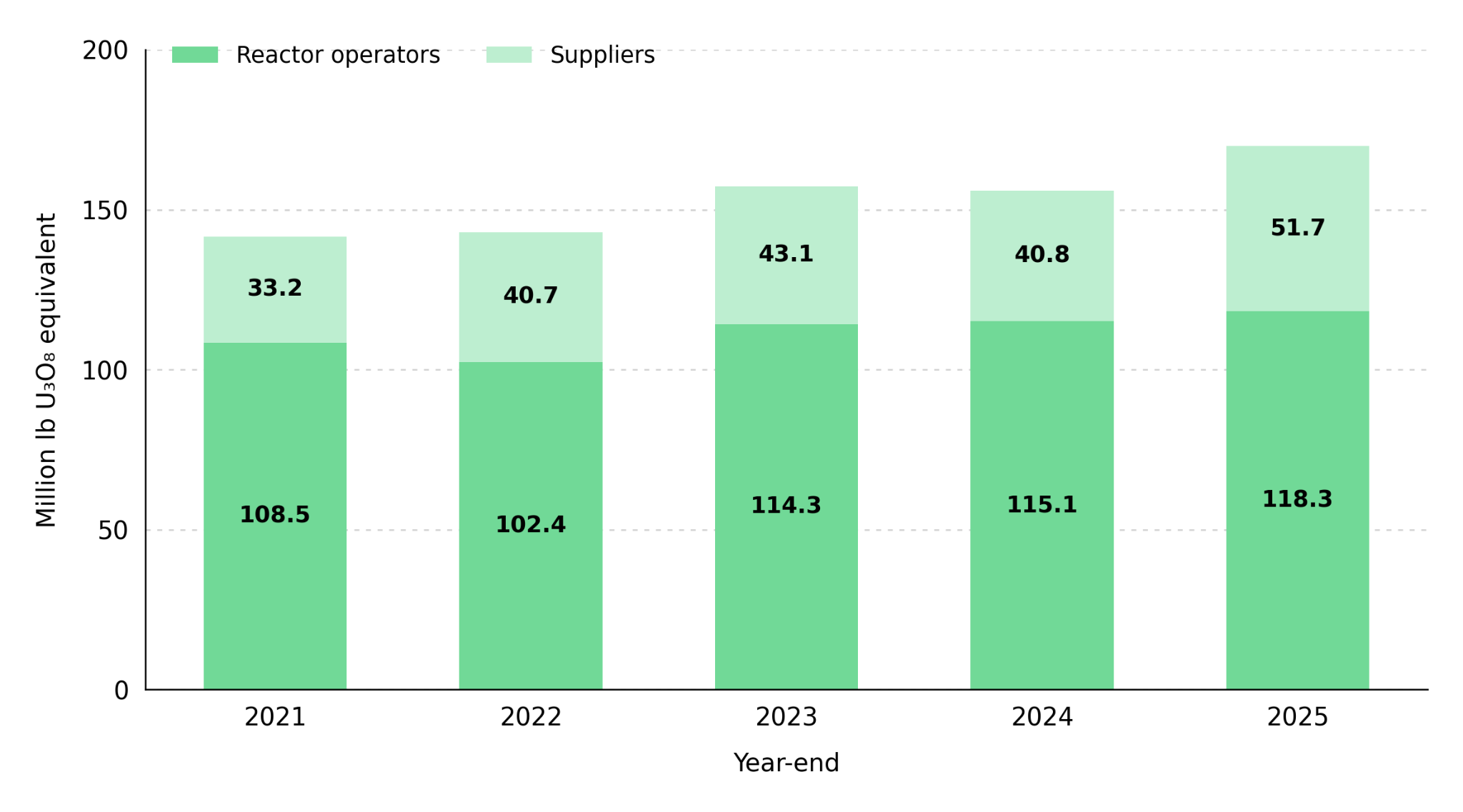
EIA reported 170 million pounds of US commercial uranium inventory at year-end 2025, up from 156 million pounds in 2024. Reactor operators and suppliers owned material at different stages of conversion, enrichment and fabrication, including at foreign facilities. Ownership and processing status mean the full 170 million pounds cannot be treated as uncommitted uranium concentrate available for near-term use.
US reactor operators purchased 46.9 million pounds for 2025 delivery, down 16% from 2024, while the weighted-average price paid rose 11% to $58.46 per pound, according to EIA. Utilities can schedule purchases around inventories and existing contracts, so one year of lower buying does not establish weaker demand for deliveries later in the decade.
At year-end 2025, US reactor operators owned 118 million pounds of uranium inventory, up 3% from 2024, while US suppliers owned 51 million pounds, up 27%, EIA reported. Most of the annual inventory increase was held by suppliers, whose material may be committed to other buyers or still undergoing processing; the higher total therefore does not establish how much is available for a utility’s required delivery date.
Long Mine Timelines Make Uranium Contract Timing Critical to Future Supply
EIA’s year-end 2025 survey recorded 174.1 million pounds of maximum deliveries under existing US utility uranium contracts for 2026–2035. Utilities reported another 186.3 million pounds of unfilled requirements, bringing maximum anticipated requirements to 360.4 million pounds. The total combines maximum deliveries under existing contracts, which can include volume options, with unfilled planning needs; it does not represent guaranteed purchases or an immediate supply deficit.
EIA data show unfilled US utility requirements rising from 2.4 million pounds in 2027 to 12.0 million in 2030, 23.1 million in 2031 and 37.2 million in 2034. Utilities have more time to contract for later deliveries, so these open requirements indicate potential future procurement rather than a present physical shortage. Contracts specifying volumes, prices and delivery dates for those years could give uranium developers a firmer basis for seeking financing.
Projected Reactor Growth Requires Mine Investment to Secure Uranium Supply
The Nuclear Energy Agency (NEA) and the International Atomic Energy Agency (IAEA) identified global uranium resources recoverable below US$100 per pound of triuranium octoxide exceeding 8.1 million metric tons of uranium. The agencies estimated typical mine-development lead times of 15 to 20 years, so the resource total does not establish how much new supply can reach utilities in a particular delivery year.
Reactors operating as of January 1, 2025 required about 64,500 metric tons of uranium annually; NEA and IAEA scenarios put annual requirements at roughly 84,800 to 143,900 metric tons by 2050. Those scenarios are not purchase commitments, but long-term supply contracts can support mine investment decisions years before the additional uranium would be needed.
Older Uranium Contracts Obscure Prices for Financing New Mines
EIA found that long-term contracts accounted for 87% of uranium delivered to US reactor operators in 2025 at a weighted-average price of US$55.91 per pound. The remaining 13% was delivered under spot contracts at a weighted-average US$76.01 per pound. Both figures measure prices paid for 2025 deliveries, which can reflect agreements signed at different times; neither is a current spot quote or the price available under a newly signed long-term contract.
2025 Uranium Deliveries Under New Contracts Do Not Reveal Future Prices
Long-term uranium contracts can support mine financing when their prices and delivery volumes provide enough projected revenue to cover operating costs and repay construction capital.
US reactor operators signed 22 new uranium purchase contracts in 2025 and took delivery of 4 million pounds under those agreements that year at a weighted-average price of US$70.46 per pound. That average applies to the 2025 deliveries; it does not disclose the prices for future deliveries under those contracts or provide a current quote for a new long-term agreement.
Drilling & Funding Advance Uranium Supply Options Before New Mines Open
A mineralized drill hole can guide follow-up work, but a resource estimate and production schedule require additional evidence and development work. The NEA and IAEA reported in their September 14, 2026 release on *Uranium 2026: Resources, Production and Demand* that global exploration and development spending exceeded US$1.78 billion in 2023–2024, about 46% above the combined 2021–2022 total. The agencies also reported that no new uranium mining project began production during the assessment period, so the higher spending has yet to add supply from a new mine.
Pending Uranium Assays Test Whether Drilling Supports Resource Growth
Radioactivity readings can identify targets for further drilling, but laboratory assays are needed to measure uranium grade and geological work is needed before new results can support a resource estimate.
IsoEnergy completed 10,159 meters of summer drilling at Larocque East, where 18 of 26 holes showed elevated radioactivity across a 600-meter trend. The results give the company a focused area to test for growth around Hurricane’s existing indicated resource of 48.6 million pounds of uranium oxide at a reported 34.5% grade. Pending laboratory assays will guide the next drilling program, while the project’s location about 40 kilometers from the McClean Lake mill places it near established infrastructure.
Paying Interest in Shares Preserves Cash for Uranium Exploration
Earlier exploration addresses an even longer horizon. Its relevance to the contracting gap rests on whether funding and governance allow sustained work that can turn targets into defensible resource estimates. Land position offers exposure to discovery; it does not establish a mineable inventory, recoveries, development cost or a date when a utility could receive material.
ATHA Energy updated its board committee assignments and settled approximately US$250,000 of interest on its US$25 million convertible debenture by issuing 340,136 shares. Paying the interest in shares limits near-term cash outflow as it advances exploration at Angilak in Nunavut, where it controls the Angikuni Basin.
Output, Permits & Funding Determine When Uranium Can Reach Utilities
US facilities produced about 2.1 million pounds of uranium concentrate in 2025, up from 657,000 pounds in 2024. At year-end, five operating in situ recovery (ISR) facilities had a combined annual capacity of 13.3 million pounds. The output figure covers all US facilities, while the capacity figure covers operating ISR plants; neither figure establishes how much uranium those plants can supply under new contracts.
Operating ISR Sites Need Available Output to Serve Uranium Contracts
Operating ISR sites can serve nearer utility contracts when sustained output or additional production areas provide uranium beyond existing commitments.
enCore Energy plans to distribute 35 million Verdera shares as a special dividend on September 30, subject to exchange approvals, giving shareholders a separate stake in Verdera. Its South Texas in situ recovery (ISR) operations remain its uranium production base, with Alta Mesa East, Dewey Burdock and Gas Hills identified as planned projects.
New Mining Convention Opens Financing Path for Uranium Development
Defined uranium resources can support later utility contracts when studies establish a workable production plan, permits cover the proposed mine and financing allows construction before the delivery date. An earlier feasibility study can guide that work, but its cost assumptions and the project’s approval status must still fit the mine being planned.
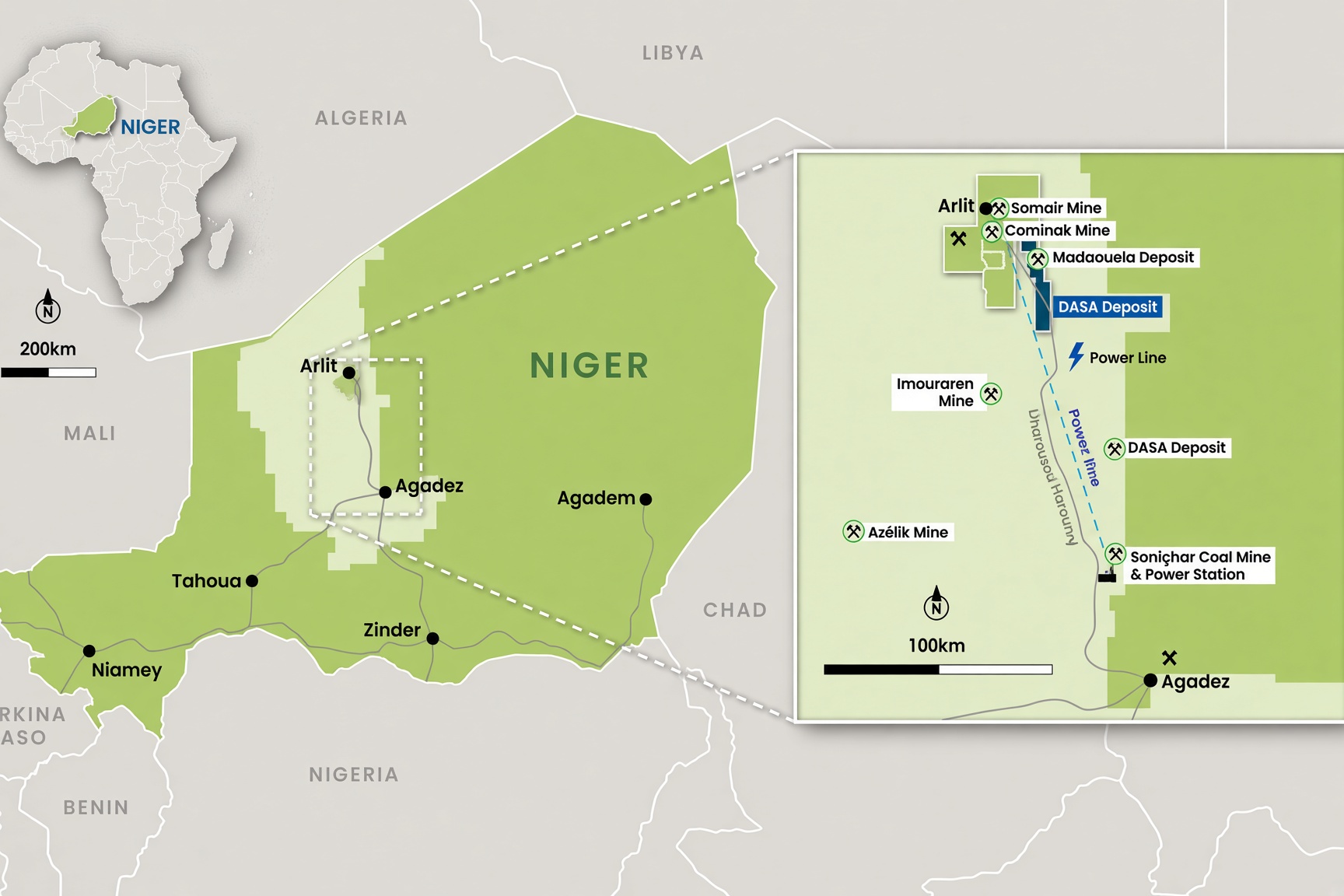
Atomic Eagle regained a 60% interest in Madaouela in Niger under a new mining convention, adding a second uranium development project alongside Muntanga in Zambia. Muntanga has a 58.8-million-pound resource; Madaouela’s 116.5-million-pound foreign estimate covers the entire project. The convention provides a framework for advancing Madaouela and seeking financing, while ongoing drilling at Muntanga targets resource growth.
Utility Contracts for 2031-2034 Would Reduce Unfilled Uranium Needs
EIA reported 170 million pounds of commercial uranium inventory at year-end 2025 and 186.3 million pounds of unfilled US utility requirements for 2026–2035; the latter spans ten delivery years and does not represent an immediate deficit against that inventory. Because NEA and IAEA estimate that developing a uranium mine typically takes 15 to 20 years, delayed contracts that could support new projects may narrow the supply options available for later deliveries.
EIA’s next survey can test whether utilities are covering the 23.1 million pounds unfilled for 2031 and 37.2 million pounds unfilled for 2034 at year-end 2025. A decline in those open volumes, alongside higher contracted deliveries and stable anticipated requirements, would show utilities replacing planned needs with scheduled supply.
The Investment Thesis for Uranium
- EIA’s 170 million pounds of US commercial uranium inventory at year-end 2025 may defer some utility purchases, while 186.3 million pounds of unfilled requirements for 2026-2035 identify potential future contracting needs.
- Reported production and existing commitments determine how much uranium an operating producer can offer for nearer delivery years; rated plant capacity alone does not establish available supply.
- A developer can meet a utility’s delivery date only if current studies, permits and financing support a mine plan that reaches production in time.
- Exploration drilling can add defined resource pounds only after assays establish uranium grade and geological work supports a resource estimate.
- More contracted pounds for 2031–2034 than EIA reported at year-end 2025, alongside stable anticipated requirements, would show utilities converting open needs into scheduled deliveries.
- A new mine needs projected contract revenue sufficient to cover operating costs and repay construction capital; historic delivered-price averages cannot establish whether an individual project meets that test.
Existing uranium inventories may defer utility purchases, while developing a new mine typically takes 15 to 20 years. More contracted pounds for 2031-2034 than EIA recorded at year-end 2025 would show utilities covering later requirements. Updated studies, permits and financing plans tied to those delivery years would show which projects have a feasible path to supplying them.
TL;DR
US commercial uranium inventories rose to 170 million pounds at the end of 2025, giving utilities some flexibility over when they buy. Yet US utilities reported up to 186.3 million pounds of unfilled requirements for 2026–2035, with larger gaps in later years. That figure is a planning measure, not an immediate shortage. New mines typically take 15 to 20 years to develop, so contracts may be needed well before delivery to support financing. Existing delivery prices and plant capacity alone cannot show what new supply will cost or when it can arrive. Watch contracting for 2031-2034 alongside project permits, funding and actual output.
FAQs (AI-Generated)
Analyst's Notes





Subscribe to Our Channel







Stay Informed